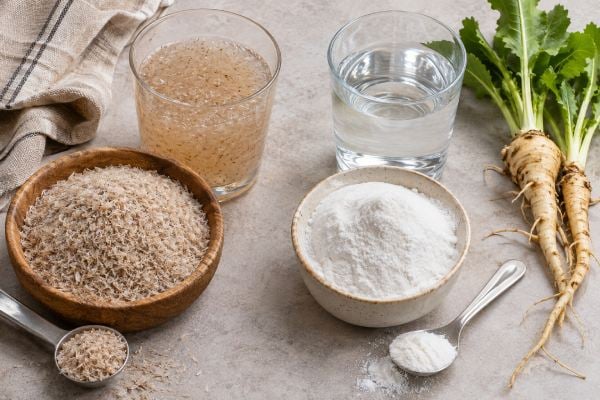
Soluble fiber supplements are often grouped together, but psyllium and inulin behave very differently in the digestive tract. Psyllium is a viscous, gel-forming fiber; when mixed with water, it thickens significantly and can slow the movement and absorption of carbohydrate from a meal. Inulin takes a different route. It is a fermentable prebiotic fiber used mainly by gut bacteria, does not form the same thick gel, and is more likely to cause gas or bloating if increased too quickly.
Both may support metabolic health, but the evidence for their effects on blood sugar differs in degree and mechanism. Psyllium has the more direct data supporting lower post-meal glucose and improved A1C in people with type 2 diabetes. Inulin may help some people over time through changes in the gut environment and overall fiber intake, but it is not a reliable “glucose blocker.” The best choice depends on your goal, digestive tolerance, medication schedule, and diet. Dose matters too: starting low and increasing gradually is usually more comfortable than jumping straight to a full serving.
Table of Contents
- How Soluble Fiber Can Affect Blood Sugar
- Psyllium: The Stronger Evidence for Glucose Control
- Inulin: Prebiotic Benefits With Different Effects
- Psyllium vs Inulin: Which One Fits Your Goal?
- Dose, Timing, and How to Start
- Side Effects, Hydration, and Medication Spacing
- Supplements vs Food: What Matters Long Term
How Soluble Fiber Can Affect Blood Sugar
“Soluble fiber” describes fiber that interacts with water, but that category includes fibers with very different physical properties. Two characteristics are especially important for blood sugar: viscosity and fermentability.
Viscous fiber becomes thick or gel-like in the gut. This can slow gastric emptying and reduce the speed at which digestive enzymes and absorbed nutrients move through the small intestine. When carbohydrate reaches the bloodstream more gradually, the post-meal glucose rise is often smaller. Psyllium is a well-known example of this type.
Fermentable fiber reaches the large intestine, where gut bacteria break it down and produce compounds such as short-chain fatty acids. These may influence gut health, appetite signaling, inflammation, and glucose metabolism over time. Inulin is highly fermentable but not very viscous.
A fiber can have both properties to some degree, but the balance matters. That is why two products that each list “5 grams of soluble fiber” do not necessarily have the same effect on glucose or digestion. Viscosity also explains why supplement form matters. Whole psyllium husk, psyllium powder, and a flavored fiber drink may all behave somewhat differently because particle size, dose, and added ingredients affect how quickly the mixture thickens. Inulin powder, meanwhile, may disappear almost completely into a drink while still being rapidly fermented later in the colon.
Texture gives a rough clue to mechanism: a fiber that visibly thickens water is more likely to slow nutrient movement through the upper digestive tract than one that dissolves without becoming viscous. The response also depends on the meal. Adding viscous fiber to a large serving of refined starch may reduce the glucose rise without making that meal nutritionally equivalent to beans, vegetables, or intact grains. Conversely, a small effect from a supplement can be overwhelmed by a very large carbohydrate portion. This is why fiber works best as part of meal design rather than as a rescue strategy after an unusually high-carbohydrate meal.
Fiber also changes a meal in simple ways. It adds bulk, can increase fullness, and may displace refined carbohydrate when people use fiber-rich foods instead of lower-fiber choices. Those effects can improve glucose control without any single supplement having a dramatic drug-like action.
Meta-analyses of randomized trials in type 2 diabetes generally find that viscous soluble fibers can improve fasting glucose and A1C. The size of the effect varies widely because studies use different fibers, doses, durations, diets, and populations. Supplements should therefore be viewed as an adjunct to meals, activity, sleep, and medical care—not a substitute for them.
For a broader overview of food and supplement sources, see which types of fiber are most useful for blood sugar.
Psyllium: The Stronger Evidence for Glucose Control
Psyllium comes from the husk of Plantago ovata seeds. It absorbs water and forms a thick gel, which is the feature most relevant to post-meal glucose. It is also commonly used to support bowel regularity and can lower LDL cholesterol.
A 2024 systematic review and meta-analysis of 19 randomized trials involving 962 adults found that psyllium supplementation improved several glycemic markers compared with control. On average, fasting blood glucose fell by about 6.9 mg/dL, A1C by about 0.75 percentage point, and HOMA-IR, a research estimate of insulin resistance, also improved. The studies were heterogeneous, so the pooled numbers should not be treated as a guaranteed personal result. Still, the direction of evidence supports a real glucose-lowering effect, particularly in people who already have impaired glycemic control.
A separate 2023 meta-analysis of viscous soluble fibers in type 2 diabetes also found improvements in A1C and fasting glucose. That broader evidence fits the mechanism of psyllium: the thicker the intestinal contents, the slower carbohydrate can reach the absorptive surface.
Timing can matter. Psyllium tends to have the most direct effect on a meal when it is consumed shortly before or with that meal. Taking it hours later may still contribute to daily fiber intake and bowel regularity, but it is less likely to alter the glucose curve from a meal that has already been digested.
This does not mean more is always better. Very large doses can cause fullness, cramping, constipation, or difficulty swallowing if taken with too little liquid. A practical approach is to start with a small amount and increase gradually rather than immediately copying the highest dose used in a study.
If your main goal is specifically post-meal glucose, a detailed discussion of psyllium timing, dosage, and side effects before meals may be useful.
Inulin: Prebiotic Benefits With Different Effects
Inulin is a group of fructan fibers naturally found in foods such as chicory root, onions, garlic, leeks, asparagus, and Jerusalem artichokes. Commercial inulin is often extracted from chicory root and added to powders, bars, yogurts, and “high-fiber” foods.
Unlike psyllium, inulin does not create a strongly viscous gel. Its main feature is fermentability. Gut bacteria rapidly use it, which is why inulin is often described as a prebiotic.
Research suggests that inulin-type fructans may improve some markers of glucose control in people with diabetes, but results are less consistent across populations. A meta-analysis of 33 randomized controlled trials found reductions in blood glucose among participants with diabetes, while clear benefits were not seen in every health group. The studies differed substantially in dose and duration.
An acute 2024 crossover trial in people with type 2 diabetes tested a black tea beverage containing inulin and dextrin before a mixed meal. The fiber-containing drink reduced post-meal glucose fluctuations compared with placebo. Because the intervention combined inulin with dextrin, the result does not prove that inulin alone produced the entire effect. It does, however, support the idea that certain fiber mixtures can alter meal responses.
Inulin’s biggest practical limitation is digestive tolerance. Because bacteria ferment it readily, a sudden high dose can cause gas, bloating, abdominal discomfort, or loose stools. People with irritable bowel syndrome or sensitivity to fructans may react to relatively small amounts. Inulin is a FODMAP-type carbohydrate, so someone following a medically supervised low-FODMAP plan may need to avoid or limit it during certain phases.
For that reason, inulin is usually better thought of as a prebiotic fiber supplement than as a rapid glucose-management tool. If your goal is to add fermentable fiber and your gut tolerates it, it can be useful. If your primary goal is to blunt a meal-related glucose rise, psyllium is generally the more predictable choice.
Psyllium vs Inulin: Which One Fits Your Goal?
Choosing between them becomes easier when you match the fiber to the purpose.
| Goal | Psyllium | Inulin |
|---|---|---|
| Reduce post-meal glucose | Better supported because it is viscous and gel-forming | Possible benefit, but less direct and less predictable |
| Improve A1C over time | Evidence supports modest improvement in type 2 diabetes | Some evidence of benefit, especially in diabetes, but results vary |
| Support constipation | Often useful because it holds water and increases stool bulk | May help some people but can also increase gas or loosen stools |
| Feed beneficial gut bacteria | Fermentable to a degree, but less rapidly | Strong prebiotic effect and highly fermentable |
| Minimize gas and bloating | Often better tolerated when introduced gradually | More likely to cause gas and bloating, especially at higher doses |
| Mix into foods without thickening | Thickens liquids quickly | Easier to add without creating a gel |
Psyllium may be the better first choice for someone with type 2 diabetes who wants a fiber supplement specifically to improve post-meal glucose and bowel regularity. Inulin may suit someone whose main goal is to increase prebiotic fiber and who tolerates fermentable carbohydrates well.
Neither is automatically superior to food. Someone who already eats beans, vegetables, berries, oats, nuts, seeds, and whole grains may not need a supplement at all. A supplement is most useful when it solves a specific problem—such as difficulty reaching fiber targets, constipation, or a desire to add viscous fiber around higher-carbohydrate meals.
Be cautious with products marketed as “prebiotic fiber blends.” They may contain inulin, fructooligosaccharides, resistant dextrin, acacia fiber, partially hydrolyzed guar gum, or several ingredients together. The total grams of fiber do not tell you how viscous or fermentable the blend is. Check the ingredient list and introduce blends gradually.
Dose, Timing, and How to Start
There is no single ideal dose for everyone. Clinical trials often use more fiber than a first-time user should take on day one. Tolerance, diet, medications, fluid intake, and treatment goals all matter.
For psyllium, a conservative starting approach is roughly 3 to 5 grams once daily with a full glass of water. If that is comfortable for several days, some people increase to about 5 grams once or twice daily, often before or with meals. Product labels vary, so measure the actual grams of psyllium rather than assuming every tablespoon is equivalent.
For inulin, starting lower is especially important. About 2 to 3 grams per day can be enough to test tolerance. If there is little bloating or discomfort, intake can be increased gradually toward 5 to 10 grams per day depending on the product and goal. Some people tolerate much less, and there is no reason to force a dose that causes persistent symptoms.
When increasing any fiber supplement:
- Add one product at a time.
- Keep the starting dose low for several days.
- Drink adequate fluid throughout the day.
- Increase only if bowel function and comfort are acceptable.
- Track glucose over repeated meals rather than judging one reading.
- Reduce the dose if bloating, pain, diarrhea, or constipation appears.
If you are already trying to increase fiber from food, do not raise food fiber and supplement fiber aggressively at the same time. A rapid jump from 15 grams per day to 35 or 40 grams can be uncomfortable even if the eventual target is reasonable. The same gradual approach described in how to increase fiber without excessive bloating or constipation applies to supplements.
For post-meal glucose, timing psyllium near the meal is logical because its physical gel is part of the mechanism. Inulin does not need the same precise timing because its primary effects are not based on forming a meal-time gel.
Side Effects, Hydration, and Medication Spacing
Fiber supplements are generally well tolerated, but “natural” does not mean risk free. The main problems are gastrointestinal symptoms and interference with how other substances move through the digestive tract.
Psyllium must be taken with enough fluid. It expands as it absorbs water. Mixing a serving into water and letting it sit for a long time can create a very thick gel that is difficult to drink. Mix it according to the label and drink it promptly, followed by additional fluid if directed.
People with difficulty swallowing, known intestinal narrowing, severe abdominal pain, or a history of bowel obstruction should not casually start a bulking fiber supplement without medical advice. Stop and seek care for inability to swallow, severe pain, vomiting, or signs of obstruction.
Inulin commonly causes gas. This is partly a consequence of fermentation. Mild temporary gas may improve as the dose is adjusted, but ongoing pain or major bloating is a reason to reduce or stop it. People with IBS may need a different fiber source.
Fiber can affect medication absorption. Psyllium in particular can slow or reduce absorption of some oral medications and supplements. A common precaution is to separate fiber supplements from medicines by at least a couple of hours, but the correct interval depends on the drug. Thyroid medication, certain psychiatric medicines, diabetes medicines, and other drugs may have specific instructions. Ask a pharmacist about your exact medication list rather than relying on one universal spacing rule.
Glucose-lowering medications also deserve attention. If adding psyllium meaningfully reduces post-meal glucose, someone using insulin or a medication that can cause hypoglycemia may need closer monitoring. Do not reduce prescription medication on your own simply because a supplement was added.
Finally, check the supplement label. Flavored fiber powders can contain sugar, maltodextrin, or other carbohydrate. Gummies may provide much less fiber per serving and more added ingredients than a plain powder. The simplest formulation is often easiest to evaluate.
Supplements vs Food: What Matters Long Term
Psyllium and inulin can be useful tools, but the goal is not to build a diet around powders. Whole foods provide fiber along with protein, vitamins, minerals, unsaturated fats, and plant compounds that isolated supplements do not fully replace.
A higher-fiber eating pattern can include beans and lentils, vegetables, berries, pears, apples, oats, barley, nuts, seeds, and intact whole grains. These foods expose the digestive system to several fiber types rather than one isolated ingredient. They also tend to replace lower-fiber refined foods, which can improve meal quality in ways a scoop of fiber added to a sugary breakfast cannot.
Think of supplements as targeted tools:
- Use psyllium if you want a viscous fiber with the strongest evidence for post-meal glucose, LDL cholesterol, and bowel regularity.
- Use inulin if you want a fermentable prebiotic fiber and tolerate fructans well.
- Use neither if your food-based fiber intake is already adequate and you have no specific reason to supplement.
If you monitor glucose, compare repeated patterns over several days. A useful result is not only a smaller peak after one meal. Look for better overall control, comfortable digestion, and a routine you can maintain. If the supplement makes you bloated enough to stop eating vegetables or causes medication-timing problems, it is not helping the bigger picture.
The evidence supports soluble fiber as part of diabetes management, but effect sizes vary and supplements do not erase the impact of a high-carbohydrate meal. Start low, use enough water, choose the fiber that matches your goal, and treat the supplement as one piece of a broader metabolic-health plan.
References
- The effect of psyllium on fasting blood sugar, HbA1c, HOMA IR, and insulin control: a GRADE-assessed systematic review and meta-analysis of randomized controlled trials 2024 (Systematic Review)
- Effect of viscous soluble dietary fiber on glucose and lipid metabolism in patients with type 2 diabetes mellitus: a systematic review and meta-analysis on randomized clinical trials 2023 (Systematic Review)
- Galactomannans are the most effective soluble dietary fibers in type 2 diabetes: a systematic review and network meta-analysis. 2023 (Systematic Review)
- Black Tea drinks with inulin and dextrin reduced postprandial plasma glucose fluctuations in patients with type 2 diabetes: an acute, randomized, placebo-controlled, single-blind crossover study 2024 (RCT)
- Assessing the effects of inulin-type fructan intake on body weight, blood glucose, and lipid profile: A systematic review and meta-analysis of randomized controlled trials. 2021 (Systematic Review)
Disclaimer
This article is for general education and does not replace individualized medical advice. Fiber supplements can affect digestion, swallowing, glucose levels, and absorption of some medicines, so people taking prescription drugs should confirm appropriate timing with a pharmacist or clinician. Seek medical guidance before using bulking fiber if you have swallowing difficulty, suspected intestinal narrowing, severe gastrointestinal symptoms, or a history of bowel obstruction.