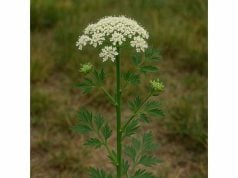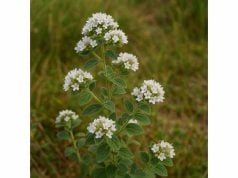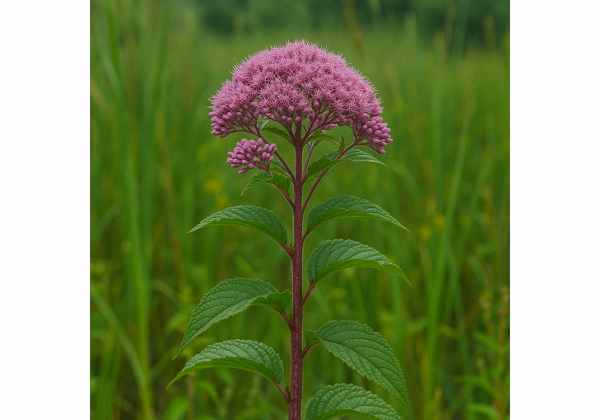
Spotted Joe-Pye weed, Eutrochium maculatum, is a tall North American wetland herb with a long, if now somewhat cautious, place in traditional herbal medicine. Older sources often list it under the names Eupatorium maculatum or Eupatoriadelphus maculatus, and many of the historical uses attached to “Joe-Pye weed” overlap across several related species. Traditionally, the whole herb or root was prepared as a tea for urinary complaints, feverish illness, fluid retention, rheumatic discomfort, and certain women’s health concerns. More recent phytochemical work shows that E. maculatum contains pyrrolizidine alkaloids and sesquiterpene lactones, including lycopsamine and cumambrin B, which help explain why the plant is biologically active but also why modern safety discussions are more guarded than older herbal folklore suggests.
That tension defines the herb. Spotted Joe-Pye weed has real historical medicinal use and real chemical interest, but it is not a carefree modern wellness herb. The most helpful way to understand it is as a traditional urinary and fever herb whose benefits are mostly historical and whose internal use today is limited by pyrrolizidine alkaloid safety concerns.
Key Facts
- Spotted Joe-Pye weed was traditionally used as a diuretic and for feverish or rheumatic complaints.
- Its known constituents include pyrrolizidine alkaloids and sesquiterpene lactones, which make it active but also more safety-sensitive.
- No modern standardized dose is established, and traditional root or herb teas were generally used only in small amounts and for short periods.
- Avoid internal use during pregnancy, breastfeeding, liver disease, or when regular use would increase exposure to pyrrolizidine alkaloids.
Table of Contents
- What Spotted Joe-Pye Weed Is and Why Identification Matters
- Key Ingredients and Medicinal Properties
- Health Benefits and What the Evidence Actually Supports
- Traditional and Modern Uses of Spotted Joe-Pye Weed
- Dosage, Forms, Timing, and Why Modern Use Is Limited
- Safety, Side Effects, and Who Should Avoid It
- How to Choose, Handle, and Think About This Herb Today
What Spotted Joe-Pye Weed Is and Why Identification Matters
Spotted Joe-Pye weed is a native perennial in the aster family, now recognized as Eutrochium maculatum. Older botanical and herbal references often place it in Eupatorium, which is why historical sources may use Eupatorium maculatum for the same plant. It usually grows in moist meadows, marsh edges, wet thickets, ditches, and other damp habitats. The plant is known for its tall stature, purple-spotted stems, whorled lance-shaped leaves, and broad clusters of mauve to purple flowers that appear in late summer.
Identification matters here more than it does with many gentler kitchen herbs. “Joe-Pye weed” is a common name shared across several closely related species, and historical medicinal claims often blur them together. That can create confusion for readers who are trying to match a traditional use to one exact plant. Spotted Joe-Pye weed is related to other Joe-Pye weeds used in older American herbalism, especially species once discussed under the broader gravel-root tradition. But a claim attached to “Joe-Pye weed” in an old herbal is not always a species-specific claim about Eutrochium maculatum.
The plant’s older reputation is strongly tied to Indigenous and settler use. Traditional records note that Native Americans used a tea of the whole herb as a diuretic and used root tea for fevers, colds, chills, diarrhea, liver and kidney complaints, postpartum soreness, and rheumatism washes. Those are substantial traditional uses, but they come from ethnobotanical history rather than from modern clinical trials.
That distinction shapes how the herb should be read today. Spotted Joe-Pye weed is not best understood as a contemporary first-line herbal remedy. It is better understood as a historically important North American medicinal plant whose traditional uses were broad, especially for urinary and fever-related complaints. The stronger question in modern practice is not whether people once used it. They clearly did. The real question is whether its current risk-benefit balance still supports routine internal use. For this species, that answer is more cautious than many readers expect.
One helpful comparison is with herbs that are still widely used as gentler urinary supports, such as goldenrod for urinary tract support. That comparison is useful because it shows how herbal practice changes when a traditional plant turns out to contain compounds that raise more significant toxicology concerns. Spotted Joe-Pye weed remains fascinating, but identification and context are essential before anyone tries to turn old folklore into present-day self-care.
Key Ingredients and Medicinal Properties
The chemistry of spotted Joe-Pye weed helps explain both its historical popularity and its modern caution label. The best documented species-specific constituents include pyrrolizidine alkaloids and at least one guaianolide sesquiterpene lactone. Species-specific phytochemical work has isolated the pyrrolizidine alkaloid lycopsamine and the sesquiterpene lactone cumambrin B from Eupatorium maculatum, while broader reviews of Cherokee aromatic medicinal plants record echinatine and trachelanthamidine in the roots and again note lycopsamine and cumambrin B in the aerial parts or leaves.
From a medicinal perspective, these compounds point in two directions at once. On one side, sesquiterpene lactones are often associated with antimicrobial, anti-inflammatory, bitter, or immunologically active properties in Asteraceae plants. That makes it plausible that Joe-Pye weed had noticeable physiologic effects in traditional fever, urinary, and rheumatic formulas. On the other side, pyrrolizidine alkaloids are a major safety concern. They are not benign background compounds. Modern reviews describe pyrrolizidine alkaloids as naturally occurring toxins linked to hepatotoxicity, genotoxicity, and chronic safety concerns when exposure is repeated or cumulative.
That means the phrase “medicinal properties” has to be handled honestly. Spotted Joe-Pye weed may have:
- Diuretic or urinary-stimulating traditional action
- Diaphoretic or sweat-promoting traditional use
- Possible anti-inflammatory relevance based on related chemistry
- Possible antimicrobial relevance based on sesquiterpene-type compounds
- Historically recognized febrifuge and rheumatism-related use
But it also has a real toxicologic dimension because of its pyrrolizidine alkaloids. That is not a trivial footnote. It is part of the plant’s medicinal identity.
This is one reason older herbal categories can be misleading when read too literally today. A nineteenth-century herbalist might have described Joe-Pye weed as a kidney herb, gravel-root herb, sweating herb, or anti-rheumatic wash. A modern reader also has to ask what else is in the plant, how much of it is present, how long it was traditionally taken, and whether a safer herb now exists for the same purpose. Those are modern questions, but they are the right questions.
If you step back from the folklore, the clearest summary is this: spotted Joe-Pye weed contains compounds that make traditional urinary and inflammatory use plausible, but the same chemistry also limits its modern appeal. It is not a chemically mild plant. It is a biologically active plant whose medicinal promise is inseparable from its toxicology.
Health Benefits and What the Evidence Actually Supports
When people search for the health benefits of spotted Joe-Pye weed, they usually encounter a familiar list: kidney support, diuretic action, fever reduction, rheumatism relief, urinary tract support, and sometimes even broader detox language. The most helpful thing to say is that these uses are mostly traditional and ethnobotanical, not confirmed by modern human trials.
The strongest traditional benefit claim is urinary support. Joe-Pye weed was used historically as a diuretic and for “gravel,” meaning urinary sediment, painful urination, and kidney or bladder complaints. That old reputation is why related Joe-Pye species were often grouped with the name gravel root. This is a meaningful part of the plant’s history. But meaningful history is not the same as modern proof. There is very little species-specific clinical evidence showing that Eutrochium maculatum is an effective or safe modern diuretic herb in the way a clinician would define that today.
A second traditional benefit area is feverish illness. Root tea was used for fevers, chills, and colds, and some of the folklore surrounding Joe Pye himself is tied to fever treatment. Again, this belongs to the herb’s history and cultural importance. What is missing is contemporary clinical evidence showing that spotted Joe-Pye weed should still be relied upon internally for these uses. In a modern context, a fever herb must now be judged not only by tradition but also by safety margin. For this plant, that safety margin is less comfortable than its folklore suggests.
A third area is rheumatism and musculoskeletal discomfort. Traditional records describe root tea washes for rheumatism, which makes topical or wash use part of the plant’s traditional story. That is important because external use sometimes carries a different risk profile than internal use, especially with alkaloid-containing plants. Even so, it would be inaccurate to present spotted Joe-Pye weed as a proven modern anti-inflammatory remedy. Most of the evidence closest to the species is still chemical or ethnobotanical rather than clinical.
So what can reasonably be called a benefit? The most defensible answer is that spotted Joe-Pye weed has a long traditional reputation for urinary, fever-related, and rheumatic support, and its chemistry suggests the plant is active enough that these uses were not arbitrary. But modern benefit claims are sharply limited by the presence of pyrrolizidine alkaloids. In practice, that means the historical benefits are real as history, plausible as pharmacology, and restricted as modern self-treatment options.
For readers interested in gentler urinary herb traditions, corn silk for urinary comfort offers a useful contrast. It shows how a plant can occupy a similar traditional space without carrying the same degree of alkaloid-related concern. That contrast is one of the most useful ways to understand spotted Joe-Pye weed today.
Traditional and Modern Uses of Spotted Joe-Pye Weed
Spotted Joe-Pye weed had a wide practical range in older American herbal use. Traditional records describe tea of the whole herb as a diuretic and tea of the root for fevers, chills, colds, postpartum soreness, diarrhea, and liver and kidney complaints. A root wash was also used for rheumatism, and the plant had a reputation as a diaphoretic, meaning it was thought to encourage sweating. This sort of mixed urinary-fever-rheumatism pattern is common in older North American herbals, where one plant could be used for several “draining” or “moving” functions at once.
That older use pattern makes sense historically. Before modern pharmaceuticals, herbs with any noticeable diuretic, sweat-promoting, or bitter activity naturally found their way into formulas for fever, edema, gravel, and aches. Spotted Joe-Pye weed fit that role well enough to remain in herbal memory. It also helps explain why different Joe-Pye species were sometimes used interchangeably or at least discussed together in older texts.
Modern use is different. Today, the plant is grown far more often as an ornamental pollinator species than as a household medicine. Herbalists who know the plant well tend to talk about it with more caution than enthusiasm, especially for internal use. That caution is driven by the same pyrrolizidine alkaloid issue that reshapes the whole herb’s risk profile. In practical terms, many of the plant’s historical indications now have safer competitors.
For example:
- Mild urinary support can often be approached with gentler herbs.
- Fever and cold support now has many lower-risk options.
- Rheumatic discomfort is usually handled with better-studied internal or external botanicals.
- Postpartum and gynecologic uses are not appropriate for casual self-care.
This does not erase the plant’s traditional importance. It simply changes how it should be used now.
The most defensible modern uses are limited. If it is used at all, some practitioners may reserve it for historically informed, short-term, carefully sourced applications, often leaning toward external or cautiously prepared traditional forms rather than aggressive internal dosing. But for the average reader, the real value of spotted Joe-Pye weed today may be educational rather than practical. It shows how a respected traditional herb can remain historically important while becoming less attractive for modern routine use once its chemistry is better understood.
That makes it different from herbs that stayed both traditional and comfortably mainstream. A comparison with willow bark for pain relief is useful here. Willow bark also has strong traditional roots, but it transitioned into modern evidence-based discussion more comfortably because its benefit-risk balance is easier to work with. Spotted Joe-Pye weed is the opposite case: a historically interesting herb whose safest modern role is narrower than its older reputation suggests.
Dosage, Forms, Timing, and Why Modern Use Is Limited
This is one of the rare herb articles where the most honest dosage guidance begins with a limit: there is no well-established modern evidence-based oral dose for spotted Joe-Pye weed that can be recommended with confidence. Traditional use centered on teas and decoctions of the whole herb or root, but the historical literature describes them more as preparations than as standardized protocols. Ethnobotanical records support the form of use clearly, yet not a validated modern dose. Traditional root infusion use is similarly recorded without the kind of clinical dose standard readers often expect.
That matters because dosage cannot be separated from safety. With a plant that contains documented pyrrolizidine alkaloids, the question is not only “How much works?” but also “How much exposure is wise?” Modern pyrrolizidine alkaloid reviews emphasize that repeated oral exposure is exactly what raises concern, particularly because this class is tied to hepatotoxicity and genotoxicity. In other words, the usual herbal instinct to “try a little more for longer” is the wrong instinct here.
Historically, internal forms included:
- Whole-herb tea
- Root tea
- Root decoction
- Washes or external applications from root tea
In a modern safety-conscious setting, the practical hierarchy is different:
- Learn the plant and its history.
- Avoid assuming that traditional internal use equals modern routine safety.
- Prefer safer herbs when the goal is urinary, fever, or rheumatic support.
- If a trained practitioner uses the herb, keep the course short and the preparation conservative.
- Avoid tincture-style experimentation or long-term self-dosing.
Because the literature does not provide a solid modern clinical dose, any article that gives a firm everyday oral regimen would be overstating certainty. The most defensible wording is that traditional preparations used small amounts of the herb or root, typically as tea or decoction, and that repeated routine internal use is not well supported today.
Timing also becomes less relevant once this safety issue is understood. There is little value in debating whether the herb should be taken before meals, after meals, morning, or evening when the bigger issue is that it is no longer an ideal candidate for casual internal use at all.
This is a good place to compare it with dandelion as a gentler traditional diuretic herb. Dandelion still has traditional urinary and digestive relevance, but it is much easier to discuss in practical dosage terms because its routine internal use is far less constrained by pyrrolizidine alkaloid toxicology. Spotted Joe-Pye weed is not impossible to discuss as a medicine, but any responsible dosage discussion has to begin with restraint rather than enthusiasm.
Safety, Side Effects, and Who Should Avoid It
Safety is the defining modern issue for spotted Joe-Pye weed. The plant contains pyrrolizidine alkaloids, and this class of compounds is widely recognized as potentially hepatotoxic and genotoxic, especially when exposure is repeated or long term. Species-specific work identified lycopsamine in Eupatorium maculatum, and broader modern reviews on pyrrolizidine alkaloids explain why that matters: chronic exposure can damage the liver and create a risk profile that is out of step with casual herbal self-care.
The key groups who should avoid internal use are:
- Pregnant people
- Breastfeeding people
- Children
- Anyone with liver disease
- Anyone already using other potentially hepatotoxic herbs or drugs
- Anyone considering long-term or repeated dosing
- Anyone wanting to self-treat persistent urinary, kidney, fever, or gynecologic symptoms without medical guidance
A second safety issue is historical indication drift. Older sources include use for postpartum soreness and women’s complaints. That does not make spotted Joe-Pye weed appropriate in modern pregnancy or postpartum self-care. In fact, those are exactly the settings where herbs with incomplete toxicology and alkaloid concerns should be approached more cautiously, not less.
Potential side effects are not defined by robust clinical trials, but based on the plant’s chemistry and traditional preparation style, reasonable concerns include nausea, gastrointestinal upset, unwanted diuresis, and liver-related risk with repeated oral use. The more important danger, however, is not an immediate dramatic reaction. It is the false sense of safety that can come from reading only traditional benefit claims and ignoring the toxicology literature.
Topical use may present a lower systemic risk than oral use, but lower is not the same as risk-free. Alkaloid absorption through broken or irritated skin can still be relevant, and homemade preparations are hard to standardize. That means external use should also be cautious and limited.
One useful comparison is comfrey and its pyrrolizidine alkaloid safety profile. The plants are not the same, but they teach a similar lesson: some traditionally valued herbs became much more restricted once their alkaloid chemistry was understood. Spotted Joe-Pye weed belongs in that conversation. Its safety story is not an afterthought. It is the central reason the herb’s modern use is narrower than its historic reputation.
How to Choose, Handle, and Think About This Herb Today
For most readers, the most responsible way to “use” spotted Joe-Pye weed today is to understand it well before considering any medicinal preparation. This is a plant where knowledge is more important than enthusiasm. It is a beautiful native wildflower, an ecologically valuable pollinator plant, and a historically important medicine. But those facts do not automatically make it a wise modern household herb.
If you encounter the herb in commerce or in wild settings, the first question should be identity. Make sure the plant is clearly identified as Eutrochium maculatum and not simply sold under a broad Joe-Pye or gravel-root name. The second question should be purpose. Why this herb, specifically? If the answer is urinary comfort, fever support, or rheumatic pain, there are usually other botanicals with a friendlier safety profile and better modern guidance. If the answer is historical interest or ethnobotanical study, then the plant remains deeply worthwhile.
A thoughtful modern approach looks like this:
- Grow or appreciate the plant as a native ornamental and pollinator resource.
- Read its traditional uses in context rather than as direct modern instructions.
- Treat internal use as restricted rather than routine.
- Prefer safer alternatives for everyday urinary or fever support.
- Avoid wild-harvesting for medicine unless identification and habitat quality are certain.
Storage, product quality, and preparation all matter less than this one strategic decision: whether the herb should be used internally at all. With many herbs, product quality can solve a lot of problems. With spotted Joe-Pye weed, product quality does not erase the alkaloid issue. A well-identified, well-dried plant can still contain compounds that make repeated oral use undesirable.
The best modern mindset is balance. It is possible to respect Indigenous and historical uses without assuming that every historic use should be copied today. It is possible to acknowledge plausible urinary and anti-inflammatory traditions without pretending that species-specific clinical proof exists. And it is possible to admire the plant without turning it into a casual tea herb.
That balance is what makes the herb genuinely interesting. Spotted Joe-Pye weed is not useless, and it is not a miracle. It is a traditional North American medicinal plant whose story becomes more instructive the more carefully you look at it. In that sense, it may be more valuable as a lesson in evidence-aware herbalism than as an herb most people should be drinking regularly.
References
- The Phytochemistry of Cherokee Aromatic Medicinal Plants 2018 (Review)
- Lycopsamine and cumambrin B from Eupatorium maculatum 2009 (Phytochemistry Study)
- Pyrrolizidine Alkaloids—Pros and Cons for Pharmaceutical and Medical Applications 2023 (Review)
- Pyrrolizidine Alkaloids as Hazardous Toxins in Natural Products: Current Analytical Methods and Latest Legal Regulations 2024 (Review)
- Levels, Toxic Effects, and Risk Assessment of Pyrrolizidine Alkaloids in Foods: A Review 2024 (Review)
Disclaimer
This article is for educational purposes only and is not medical advice. Spotted Joe-Pye weed has a real history of traditional medicinal use, but it also contains pyrrolizidine alkaloids, which change its modern safety profile and make routine internal use a poor fit for unsupervised self-care. Do not use this herb to self-treat urinary pain, kidney problems, fever, postpartum symptoms, liver concerns, or chronic inflammation without guidance from a qualified healthcare professional. If you are pregnant, breastfeeding, have liver disease, take prescription medicines, or are considering repeated internal use, speak with a clinician first.
If you found this article useful, please share it on Facebook, X, or another platform you prefer.