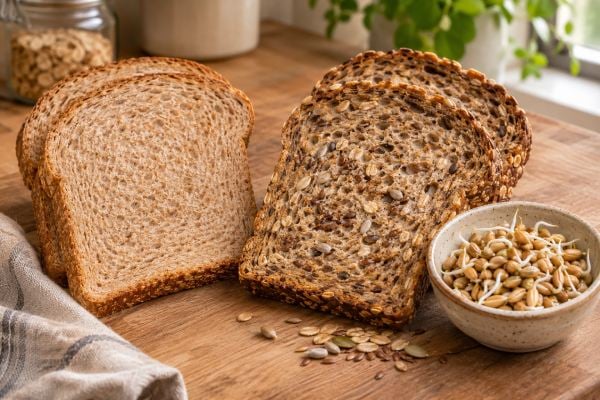
Sprouted grain bread carries a health halo, but “sprouted” does not automatically mean low-carb or low-glycemic. Sprouting activates enzymes in the seed and uses some stored starch for growth, which can shift the nutrient profile and influence digestion. In one small crossover study, a commercial sprouted-grain loaf produced a lower glucose response than several other breads. Yet that single finding does not prove every sprouted loaf will behave the same way.
The finished product depends on how finely the grains are milled, how much intact grain remains, fiber content, added sugar, slice size, and total portion. A dense loaf made from sprouted whole grains is often a better choice than soft, refined white bread. But a finely milled sprouted flour can still deliver starch quickly to the bloodstream. For blood sugar management, the label, portion size, food structure, and accompanying foods matter far more than the word “sprouted” alone.
Table of Contents
- What Sprouting Does to Grains
- Does Sprouted Bread Lower the Glucose Response?
- Why Milling, Texture, and Food Structure Matter
- How to Read a Sprouted Bread Label
- Portion Size and What You Eat With Bread
- Who May Benefit Most From Sprouted Grain Bread?
- How to Test Your Own Bread Response
What Sprouting Does to Grains
A grain is a seed. When moisture and temperature reach the right levels, germination begins. Enzymes activate so the young plant can access stored nutrients; complex carbohydrates break into smaller molecules, proteins are modified, and the levels or availability of certain vitamins, minerals, and plant compounds shift.
Manufacturers may sprout wheat, barley, millet, rye, oats, or other grains before drying them for use in bread. Some loaves include legumes or seeds as well, resulting in a dense, chewy texture with a flavor distinct from standard sandwich bread.
However, the word “sprouted” tells you almost nothing about the final carbohydrate dose. Sprouting does not remove all starch. Once the grains are dried, milled, mixed, baked, and sliced, the bread can contain a similar amount of total carbohydrate per serving as other whole-grain loaves.
This is why metabolic effects cannot be predicted from the sprouting step alone. A bread made from mostly intact sprouted kernels may retain more physical structure than one made from very finely milled sprouted flour. These products often share similar marketing language but behave differently during digestion.
Sprouting is frequently combined with fermentation, seeds, added fiber, or sourdough methods. Each variable affects texture, acidity, starch accessibility, and digestion rate. Comparing “sprouted bread” with “regular bread” as if each were a single standardized food oversimplifies the reality.
For everyday use, treat sprouting as one potentially useful feature, not a guarantee. The same principles used to choose bread for steadier blood sugar still apply: whole-grain content, fiber, structure, slice size, and the rest of the meal all play significant roles.
Does Sprouted Bread Lower the Glucose Response?
Direct evidence suggests a sprouted-grain bread can produce a smaller acute glucose response, but the evidence base is limited.
A 2012 randomized crossover study tested several commercial breads in overweight or obese men. Participants ate 11-grain, sprouted-grain, 12-grain, sourdough, and white breads on separate occasions. In one phase, servings were matched for available carbohydrate; in another, they were matched by weight. The sprouted-grain bread produced a lower glucose response than several comparison breads in that small trial.
The finding is encouraging, but limitations matter. The trial involved only about a dozen men, tested specific commercial products, and measured short-term responses. It cannot confirm that every modern sprouted loaf has a lower glycemic impact than every whole-wheat or sourdough loaf.
The broader evidence base is stronger for whole grains in general than for sprouting specifically. Recent systematic reviews of randomized trials indicate that whole-grain foods tend to improve post-meal glucose and insulin responses compared with refined grains, though the size of the benefit varies. A 2024 review also found modest improvements in fasting glucose across whole-grain interventions.
A 2026 controlled-feeding crossover trial in adults with prediabetes found that whole-wheat bread improved glucose tolerance compared with refined white bread. That trial was not about sprouting, but it reinforces a key point: keeping more of the grain and its structure matters even when the bread is not marketed as sprouted.
So what can reasonably be concluded? Sprouted whole-grain bread can be a good option and may produce a smaller glucose rise than some refined or multigrain breads. But “sprouted” by itself is not enough to predict the response. The specific formulation and portion still determine much of what happens after you eat it.
Why Milling, Texture, and Food Structure Matter
Two breads can contain similar grams of carbohydrate yet produce different glucose curves because the starch is packaged differently.
When grain kernels remain relatively intact, digestive enzymes must work through physical barriers before reaching the starch. When grain is milled into very fine flour, much more surface area is exposed. The starch becomes easier to digest quickly, even if the flour started as a whole grain.
Bread structure adds another layer. Kneading, fermentation, baking, moisture, density, and particle size all affect the food matrix. Research on white bread has shown that changes in processing and structure can alter glycemic response even when the ingredient list is similar. This is one reason a dense, chewy slice behaves differently from a soft, airy slice.
Sprouted bread falls on a spectrum. At one end are loaves with visible or coarsely ground sprouted grains and seeds. At the other are breads made mostly from smooth sprouted-grain flour. Both may legally and accurately be called sprouted grain bread, but the first likely preserves more structure.
Moisture and density matter as well. A compact slice may weigh much more than a fluffy slice even when both look similar on the plate. Comparing “one slice” can therefore be misleading. Looking at carbohydrate per gram of bread, or checking the listed slice weight, makes brand comparisons fairer. A smaller slice with fewer carbohydrates produces a lower rise because the dose is smaller, not necessarily because the grain was sprouted. Distinguishing a processing effect from a portion effect prevents giving one ingredient more credit than it deserves.
This is also why “multigrain” is not a useful metabolic guarantee. A multigrain bread can be made mostly from refined wheat flour with small amounts of other grains added. The number of grains listed on the package matters less than whether those grains are whole and how the bread is processed.
The same principle applies to carbohydrate quality more broadly. Beans, intact barley, steel-cut oats, and other less-refined foods often produce different responses from finely milled starches even when total carbohydrate is similar. A useful overview is how whole grains, beans, and portions fit into better carbohydrate choices.
No label can tell you the exact glycemic response. But a dense texture, visible intact grains, meaningful fiber, and whole grains high on the ingredient list are more informative than a front-of-package claim alone.
How to Read a Sprouted Bread Label
Ignore the front of the package for a moment and turn to the ingredient list and Nutrition Facts panel. You are looking for evidence that the product is truly built around whole grains rather than simply using “sprouted” as a marketing signal.
Start with the first ingredient. “Sprouted whole wheat,” “sprouted whole grain wheat,” or a blend of clearly named sprouted whole grains is more informative than “wheat flour” with a small amount of sprouted grain later in the list.
Then compare the following:
Total carbohydrate per slice. This tells you the carbohydrate dose more directly than claims such as “keto friendly” or “low glycemic.” Many breads land around 12 to 25 grams per slice, but servings vary considerably. Compare equal serving weights when possible.
Fiber. Around 3 grams or more per slice is a useful sign that the bread retains meaningful fiber, although there is no magic cutoff. Check whether the fiber comes mainly from the grain or from large amounts of isolated added fibers.
Added sugar. Bread does not need to taste like dessert. Small amounts of sugar may be used for yeast or flavor, but several grams of added sugar per slice can increase the carbohydrate load without improving fullness.
Serving size. Some brands define one slice as a serving; others use two. Slices may also range widely in weight. A “lower-carb” slice can simply be much smaller.
Protein and seeds. A bread containing intact seeds or legumes may provide more protein and fat, which can improve fullness. Do not assume a high protein number automatically means a lower glucose response, but it can make the meal more balanced.
A quick comparison might look like this:
| Label feature | More useful sign | Less useful sign |
|---|---|---|
| First ingredient | Sprouted whole grain or whole wheat | Refined wheat flour |
| Fiber | Meaningful amount per actual slice | Very low fiber despite whole-grain claims |
| Added sugar | Little or none | Multiple sweeteners high in the list |
| Texture | Dense, coarse, visible grains/seeds | Very soft, finely milled texture |
| Serving | Realistic slice weight | Tiny serving used to create a low-carb claim |
If you count “net carbs,” remember that individual responses to added fibers can vary. Total carbohydrate, ingredient type, and your own glucose response provide a fuller picture than subtracting every gram labeled as fiber.
Portion Size and What You Eat With Bread
Even an excellent sprouted loaf can raise glucose if the portion is large enough. Two thick slices may contain twice the carbohydrate of one slice, and a sandwich with bread plus chips plus a sweet drink creates a very different response from an open-faced sandwich with vegetables and protein.
A simple way to reduce the glucose load is to start with one slice and build the meal around it. Examples include:
- one slice topped with eggs and tomatoes
- open-faced turkey or tofu sandwich with a large salad
- sprouted toast with cottage cheese and berries
- avocado toast with an egg rather than two or three slices of toast alone
- one slice beside a vegetable soup with beans or chicken
Protein, fiber, and fat can slow digestion and increase satiety. They do not erase the carbohydrate in bread, but they can change the overall meal response. The same idea is discussed in how to eat carbohydrate without making every meal a large glucose challenge.
Sequence may matter too. Eating vegetables and protein before a starch can reduce the early post-meal rise in some studies. You do not need to follow a rigid food-order ritual, but building the plate around nonstarchy vegetables and protein before adding bread is often an easy way to keep the bread portion reasonable.
Activity after the meal can be just as practical. A 10- to 20-minute walk gives working muscle another route to take up glucose. If you enjoy bread and tolerate it well, adding movement may be more sustainable than trying to find a loaf that produces no glucose rise at all.
The goal is not a perfectly flat glucose line. Carbohydrate normally raises glucose. What matters is whether the portion fits your metabolic health, medication plan, hunger, and overall diet.
Who May Benefit Most From Sprouted Grain Bread?
Sprouted whole-grain bread may be especially useful for someone who wants a more nutrient-dense alternative to refined sandwich bread but still values convenience. It can provide whole grains, fiber, seeds, and a dense texture in a familiar format.
People with prediabetes or type 2 diabetes may find that a higher-fiber sprouted loaf produces a smaller rise than their usual white bread. That is worth testing, but there is no guarantee. Insulin resistance, medications, portion size, recent activity, sleep, and the rest of the meal all influence the result.
Someone who is very sensitive to carbohydrate may still need a smaller portion even if the bread is sprouted. One slice may work well while two or three do not. In that case, the problem is not that the bread is unhealthy; it is that the carbohydrate dose exceeds what works well for that person at that time.
People who do not tolerate wheat or gluten should be careful with marketing. Sprouting does not make wheat gluten-free. Most sprouted wheat breads still contain gluten and are not appropriate for celiac disease unless the product is specifically made from gluten-free grains and certified appropriately.
Digestive tolerance can differ too. Dense whole-grain breads and added fibers can cause bloating in some people. Introduce them gradually if your current diet is low in fiber.
For people without diabetes, there is usually no reason to choose bread solely by the smallest possible glucose response. Whole-grain quality, enjoyment, nutritional adequacy, and the overall eating pattern matter. Replacing refined bread with a bread you actually like and can eat consistently is more useful than buying a “perfect” loaf that sits untouched in the freezer.
How to Test Your Own Bread Response
If you monitor glucose, a simple personal comparison can be more informative than relying on a generic glycemic-index number. The key is to make the comparison fair.
Choose your current bread and a sprouted whole-grain bread. Compare similar amounts of available carbohydrate, or at least compare the same number and weight of slices while noting the carbohydrate difference. Keep the toppings, time of day, and meal composition similar. Repeat each bread more than once because glucose varies from day to day.
If you use a CGM, focus on the starting glucose, size and duration of the rise, and whether the pattern repeats. Do not assume one 20-minute difference between two traces proves one bread is superior. Sleep, stress, prior exercise, and sensor variation can all shift the curve.
People often discover that portion size matters more than brand. If two slices of sprouted bread still cause a larger rise than desired, try one slice in a more balanced meal before abandoning bread completely. If one slice of ordinary whole-wheat bread works just as well, there is no metabolic reason to pay extra for sprouting.
Personal variation is normal. Research increasingly shows that people can respond differently to the same carbohydrate food. If your response does not match a friend’s or an online chart, that does not mean your device or body is necessarily wrong. See why glucose responses to the same food can differ between people for context.
The best conclusion is measured: sprouting may improve some aspects of grain nutrition and, in certain breads, may reduce the glucose response. But the most reliable strategy is still to choose a genuinely whole-grain, fiber-rich loaf, pay attention to portion size, pair it with protein and produce, and judge the specific bread rather than the marketing word on the package.
References
- The acute impact of ingestion of sourdough and whole-grain breads on blood glucose, insulin, and incretins in overweight and obese men 2012 (RCT)
- Effects of whole grains on glycemic control: a systematic review and dose-response meta-analysis of prospective cohort studies and randomized controlled trials 2024 (Systematic Review)
- Whole wheat bread improves postprandial glucose tolerance in adults with prediabetes: a controlled-feeding randomized crossover trial with microbiome-associated variation in response. 2026 (RCT)
- The influence of dough kneading time and flour particle size distribution on white bread structure, glycemic response and aspects of appetite. 2022 (RCT)
- Whole grain intake, compared to refined grain, improves postprandial glycemia and insulinemia: a systematic review and meta-analysis of randomized controlled trials. 2022 (Systematic Review)
Disclaimer
This article is for general nutrition education and does not replace personalized medical advice. People with diabetes who use insulin or other glucose-lowering medication may need individualized carbohydrate targets, and changes in bread portions can affect medication matching. Sprouted wheat bread still contains gluten and is not suitable for celiac disease unless a specific product is certified gluten-free.