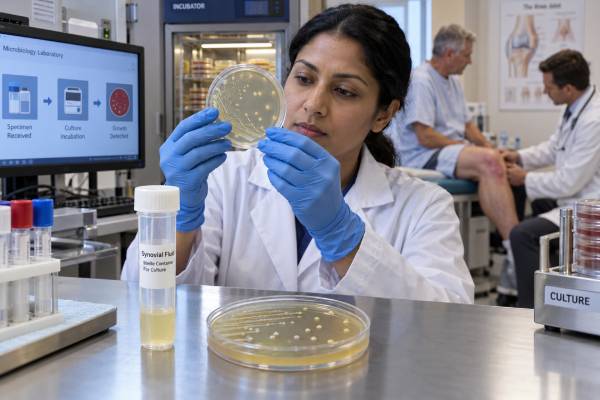
A synovial fluid culture tests joint fluid for microorganisms that may be causing septic arthritis. The sample is collected by joint aspiration or during surgery, then placed in laboratory media that support bacterial growth. If an organism grows, the laboratory identifies it and may perform susceptibility testing to help clinicians choose an effective antibiotic. Culture is one of the most important tests for a hot, swollen joint because untreated infection can rapidly damage cartilage, spread to the bloodstream, and become life-threatening. However, a negative result does not always exclude infection. Antibiotics given before aspiration, a small sample, slow-growing or unusual organisms, delayed transport, and infection confined partly to tissue can all reduce culture yield. Gram stain, white blood cell count, crystal analysis, blood cultures, imaging, and clinical findings are therefore interpreted together. When septic arthritis is strongly suspected, treatment and drainage decisions may need to begin before final culture results are available. The urgency comes from the disease, not from waiting for a laboratory report to become definitive.
- Synovial fluid culture attempts to grow and identify bacteria or other microorganisms from an affected joint.
- Whenever safely feasible, joint fluid should be collected before antibiotics are started.
- A positive culture usually provides strong evidence of infection, but contamination must sometimes be considered.
- A negative culture cannot reliably rule out septic arthritis when clinical suspicion remains high.
- Culture results guide targeted antibiotics, while joint drainage is often required for source control.
Table of Contents
- What the Culture Test Detects
- Who Needs Urgent Joint Culture
- Collection, Transport, and Laboratory Growth
- Reading a Positive Culture Result
- Why a Culture Can Be Negative
- How Culture Fits With Other Joint Tests
- Treatment Decisions After Culture
What the Culture Test Detects
Synovial fluid culture is a microbiology test. Its primary goal is to determine whether viable microorganisms are present in fluid from a joint and, if so, which organism is responsible. Standard orders commonly include aerobic bacterial culture and may also include anaerobic culture. Additional testing for fungi, mycobacteria, gonorrhea, or other pathogens is requested when the history, immune status, exposure, or chronicity makes them plausible.
The test differs from a Gram stain. Gram staining places a treated sample under a microscope and may reveal bacteria within hours, but it frequently misses infections because the number of organisms can be low. Culture gives microorganisms time to multiply in controlled laboratory conditions. It is slower, but it can detect organisms that were not visible on the initial stain and may generate antibiotic susceptibility results.
Culture also differs from the joint-fluid white blood cell count. A high cell count indicates an inflammatory response, not the organism causing it. Crystal arthritis can produce a very high count, and infection can occasionally occur with a lower count. Similarly, C-reactive protein and erythrocyte sedimentation rate measure systemic inflammation but do not identify the pathogen.
In native-joint septic arthritis, common bacterial causes include Staphylococcus aureus, streptococci, and, in selected patients, Gram-negative bacteria. The likely organism changes with age, immune status, healthcare exposure, injection drug use, sexual exposure, recent surgery, skin disease, bacteremia, and the presence of other infections. Prosthetic joint infection has a different microbiologic spectrum and diagnostic framework, often involving organisms that adhere to implanted material and form biofilm. A standard native-joint culture interpretation should not be transferred uncritically to a joint replacement.
A culture report can contain several layers of information:
- Whether growth occurred
- The organism’s name
- The amount or timing of growth in some laboratory systems
- Whether growth occurred in aerobic, anaerobic, or enrichment media
- Antibiotic susceptibility or resistance results
- A comment about possible contamination or need for additional identification
The result must still be interpreted clinically. Culture confirms microbiology, but the diagnosis of septic arthritis depends on whether the organism and sample fit the patient’s illness.
Who Needs Urgent Joint Culture
A suddenly painful, warm, swollen joint should trigger consideration of septic arthritis, particularly when movement is severely restricted. The knee is commonly affected, but infection can involve the hip, shoulder, ankle, wrist, elbow, small joints, or more than one joint. Fever may be present, yet its absence is not reassuring enough to dismiss infection.
Urgent aspiration and culture are particularly important when any of the following is present:
- Rapid onset of severe monoarthritis
- Fever, chills, or systemic illness with a swollen joint
- A new effusion in an immunosuppressed person
- Recent joint surgery, injection, arthroscopy, or penetrating injury
- A prosthetic joint with new pain, swelling, drainage, or reduced function
- Skin or soft-tissue infection near the joint
- Known or suspected bloodstream infection
- Injection drug use
- Diabetes, advanced kidney disease, or other major infection risks
- An unusual flare in rheumatoid arthritis, gout, or another established joint disease
People with pre-existing inflammatory arthritis deserve special caution. Rheumatoid arthritis and its treatments can increase infection risk, while an infected joint may initially be mistaken for an autoimmune flare. Likewise, finding gout or calcium pyrophosphate crystals does not exclude bacterial infection. If the presentation is atypical or severe, culture remains appropriate.
A clinician may also culture fluid from a more indolent joint problem. Tuberculous, fungal, or low-virulence infections can develop over weeks or months and may produce less dramatic symptoms. These cases require special culture methods and longer incubation, so the laboratory must know what is suspected.
Timing matters. For a clinically stable patient, joint aspiration and blood cultures are ideally obtained before the first antibiotic dose. This improves the chance of recovering the causative organism. If a patient is septic, hypotensive, or otherwise unstable, life-saving antibiotics should not be dangerously delayed while arranging a difficult aspiration. Diagnostic collection and treatment are coordinated according to urgency.
Collection, Transport, and Laboratory Growth
Synovial fluid is obtained by arthrocentesis. The skin is disinfected, local anesthesia may be used, and a sterile needle is advanced into the joint. Ultrasound or other imaging guidance may be helpful for a small effusion, a deep joint such as the hip, or difficult anatomy. During surgery, fluid and tissue specimens may be collected directly.
Strict aseptic technique is essential for two reasons: it reduces the risk of introducing infection and reduces contamination of the sample by skin organisms. Fluid should be placed in a sterile container. Depending on local protocol and available volume, some may also be inoculated into aerobic and anaerobic blood culture bottles. Blood culture bottles can improve recovery in certain settings because they provide enriched media and continuous monitoring, although the laboratory still needs a direct specimen for other analyses.
The sample may be divided for:
- Gram stain
- Aerobic and anaerobic culture
- White blood cell count and differential
- Crystal examination
- Additional fungal, mycobacterial, molecular, or biochemical tests
If only a small amount is obtained, priorities should reflect the most dangerous diagnosis. When septic arthritis is a serious concern, microbiology and cell count generally take precedence. Clear communication between the clinician and laboratory helps prevent the entire specimen from being used for a lower-priority test.
In the laboratory, the sample is plated or inoculated into media and incubated under conditions suited to likely organisms. Some bacteria may grow within a day, while others require several days. Anaerobes, fungi, and mycobacteria can require specialized methods and substantially longer observation. A “no growth to date” status is not always the final result.
If growth occurs, identification may use biochemical methods, mass spectrometry, or molecular techniques. Susceptibility testing exposes the organism to antibiotics and reports whether it is categorized as susceptible, intermediate or susceptible with increased exposure, or resistant under the laboratory’s standard. These results allow broad empiric treatment to be narrowed when clinically appropriate.
Blood cultures are often collected because septic arthritis can arise from bacteremia, and the blood may grow the organism even when joint culture does not. Conversely, a positive joint culture with negative blood cultures can still represent true localized infection.
Reading a Positive Culture Result
A positive synovial fluid culture usually has high clinical significance because normal joint fluid is sterile. Growth of a recognized pathogen from a properly collected sample in a patient with compatible symptoms strongly supports septic arthritis. The result can identify the organism, reveal resistance, and influence the duration and route of antibiotic therapy.
Certain findings strengthen the interpretation:
- The same organism grows from joint fluid and blood
- Multiple samples grow the same organism
- Gram stain and culture agree
- The organism grows promptly rather than only after prolonged enrichment
- The synovial fluid is highly inflammatory or purulent
- Imaging, surgery, or tissue pathology supports infection
- The clinical response matches treatment directed at that organism
Not every positive culture is automatically a true infection. Skin organisms can enter the sample during collection or processing. The possibility of contamination is greater when a low-virulence organism grows in only one of several samples, appears late, and conflicts with the clinical picture. Yet organisms sometimes dismissed as contaminants can cause genuine infection, especially in prosthetic joints, immunocompromised patients, or after procedures. The decision should not be based solely on the organism’s reputation.
A culture result may be reported before susceptibility testing is complete. Clinicians initially choose empiric antibiotics based on illness severity, likely source, local resistance patterns, allergies, kidney function, and risk for organisms such as methicillin-resistant S. aureus or Gram-negative bacilli. Once the laboratory identifies the organism and susceptibilities, therapy can often be narrowed to reduce toxicity and unnecessary antimicrobial exposure.
If an unusual organism is found, the clinician may reassess the source. For example, certain bacteria raise questions about endocarditis, gastrointestinal or urinary infection, animal exposure, sexual transmission, or an infected device. Additional blood cultures, echocardiography, or imaging may be needed depending on the organism and presentation.
A positive culture also does not indicate that antibiotics alone will be sufficient. An infected joint is a closed space containing inflammatory material and organisms. Aspiration, arthroscopic washout, open drainage, or repeated procedures may be necessary for source control.
Why a Culture Can Be Negative
Culture-negative septic arthritis is possible. “No growth” means the laboratory did not recover an organism under the conditions used; it does not prove that no infection existed. The pretest probability remains crucial.
Common reasons for a negative result include:
Antibiotics before aspiration: Even one or more doses can lower the bacterial burden and reduce culture yield. Antibiotics may also lower the synovial white blood cell count and neutrophil percentage, making the overall picture less typical.
Low organism concentration: Bacteria may be unevenly distributed, present in small numbers, or partly attached to synovial tissue rather than suspended freely in fluid.
Insufficient specimen volume: A tiny sample may limit the number of media inoculated and prevent simultaneous standard, anaerobic, and specialized testing.
Fastidious or unusual organisms: Gonococci, mycobacteria, fungi, and some anaerobes require specific collection methods, media, incubation conditions, or testing from other sites.
Delayed or improper transport: Organisms can lose viability if the sample is not handled promptly and correctly.
Biofilm-associated infection: In prosthetic joints, organisms may adhere to implant surfaces and be difficult to recover from a single fluid sample.
A noninfectious condition: Crystal arthritis, autoimmune inflammation, trauma, and other causes can produce a septic-looking joint without microbial growth.
When culture is negative but concern remains high, clinicians may repeat aspiration, obtain synovial tissue during drainage, extend incubation, request fungal or mycobacterial studies, or use targeted molecular testing. Broad-range bacterial polymerase chain reaction is not a perfect universal solution; contamination, inability to provide full susceptibility data, local availability, and variable sensitivity affect its usefulness.
The clinical course also matters. Persistent fever, rising inflammatory markers, ongoing purulent drainage, bacteremia, worsening joint function, or failure to improve with noninfectious treatment can justify continued management as infection despite an initial negative culture. In contrast, rapid improvement with crystal-directed therapy and repeatedly negative microbiology may support a noninfectious diagnosis, provided the patient remains stable.
How Culture Fits With Other Joint Tests
Culture should be interpreted as one part of the synovial fluid analysis. The complete pattern often includes appearance, cell count, neutrophil percentage, crystals, Gram stain, and culture.
A synovial fluid white blood cell count above approximately 50,000 cells per microliter with a high neutrophil percentage increases suspicion for bacterial infection, but the threshold is not definitive. Gout and calcium pyrophosphate arthritis may exceed it, while early or partially treated infection may fall below it. Lower counts are also possible in immunosuppressed patients.
Gram stain can provide a same-day clue and may show Gram-positive cocci, Gram-negative rods, or another morphology. Its specificity is generally high when bacteria are clearly seen, but sensitivity is poor enough that a negative stain cannot exclude infection. Culture remains necessary after a negative Gram stain.
Crystal microscopy is essential when gout or CPPD is possible. Monosodium urate or calcium pyrophosphate crystals can explain intense inflammation, but coexistence with infection is well documented. Culture should not be canceled merely because crystals are found when infection remains clinically plausible.
Blood CRP, ESR, procalcitonin, and peripheral white blood cell count can support assessment of systemic inflammation. None identifies bacteria in the joint. Normal or mildly abnormal blood tests do not safely rule out localized septic arthritis, especially early in disease.
Imaging may show an effusion, guide aspiration, identify adjacent osteomyelitis or abscess, and evaluate structural damage. Ultrasound is useful for detecting fluid; MRI can assess deeper infection and surrounding tissue. Imaging generally cannot replace fluid sampling when a native joint infection is suspected and aspiration is feasible.
The final diagnosis is therefore probabilistic until evidence converges. A strong positive culture can resolve uncertainty, but a negative result requires the rest of the case to carry more weight.
Treatment Decisions After Culture
Suspected septic arthritis is treated as an urgent condition. Initial management typically includes aspiration, blood cultures, empiric antibiotics, and orthopedic or other specialist evaluation for drainage. The exact order depends on stability. In a stable patient, diagnostic samples should usually be obtained before antibiotics. In sepsis or shock, antimicrobial treatment and resuscitation take priority while source control is arranged promptly.
Empiric antibiotics are chosen to cover the most likely organisms. Age, recent healthcare exposure, local resistance, immune status, injection drug use, sexual exposure, trauma, and Gram stain findings all influence the regimen. Kidney function, allergies, pregnancy, and drug interactions affect dosing and selection.
When culture and susceptibility results return, clinicians may:
- Narrow the antibiotic spectrum
- Change therapy for resistance or poor penetration
- Adjust the dose for kidney or liver function
- Determine whether intravenous treatment can transition to oral therapy
- Search for a bloodstream or distant source
- Reassess drainage if the patient is not improving
Duration is individualized according to the organism, joint, adequacy of drainage, presence of osteomyelitis or endocarditis, immune status, and clinical response. A prosthetic joint, spinal infection, or infection involving adjacent bone follows a different pathway from uncomplicated native-joint septic arthritis.
Treatment response is followed through pain, swelling, range of motion, fever, inflammatory markers, wound findings, and overall function. Repeat culture is not required for every improving patient, but repeat aspiration or surgery may be needed when fluid reaccumulates or symptoms persist.
Urgent medical assessment is appropriate for a hot, swollen joint with fever, rapid loss of movement, inability to bear weight, confusion, severe weakness, or recent joint surgery or injection. A history of gout or rheumatoid arthritis should not delay evaluation. The central principle is simple: obtain the best microbiologic sample possible, but do not allow the pursuit of certainty to postpone necessary treatment in a critically ill patient.
References
- Guideline for management of septic arthritis in native joints (SANJO). 2023. Clinical guideline.
- Native Joint Septic Arthritis. 2024. Review article.
- Effect of Antibiotic Administration Before Joint Aspiration on Synovial Fluid White Blood Cell Count in Native Joint Septic Arthritis. 2024. Research article.
- Guidelines for the diagnosis and treatment of septic arthritis in children and adults. 2024. Clinical guideline.
- Multi-centre evaluation of Gram stain in the diagnosis of septic arthritis. 2025. Multicenter study.
Disclaimer
This article is for general education and does not replace urgent medical evaluation or individualized treatment. Septic arthritis can permanently damage a joint and cause sepsis, so a hot, swollen, or rapidly worsening joint requires prompt professional assessment. Culture results must be interpreted with the full clinical picture, including prior antibiotics, cell counts, crystals, blood cultures, imaging, and response to treatment.