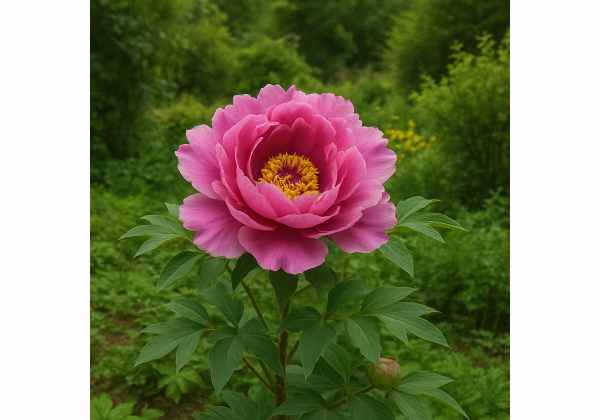
Tree peony, Paeonia suffruticosa, is best known as a spectacular ornamental shrub, but in traditional East Asian medicine its dried root bark has a much older and more practical identity. This medicinal material is commonly called moutan cortex or moutan bark, and it is the part of the plant most closely associated with therapeutic use. Unlike nutritive herbs that work mainly through fiber or minerals, tree peony root bark is valued for distinctive compounds such as paeonol, paeoniflorin, galloyl glucose derivatives, and related polyphenols that have drawn scientific interest for anti-inflammatory, antioxidant, vascular, and skin-related effects.
Even so, this is not a simple herb to summarize. Tree peony has a strong traditional reputation for “heat,” blood stasis, menstrual discomfort, and inflammatory conditions, but many modern claims go far beyond what human evidence can firmly support. The best way to understand it is as a pharmacologically active traditional root bark with meaningful laboratory and animal data, selected professional use, and a smaller human evidence base than many commercial wellness articles suggest.
That balance matters, because tree peony is promising, but it is not a casual “take it for everything” botanical.
Key Takeaways
- Tree peony root bark may help support inflammatory balance and microcirculatory health, especially in traditional formulas rather than as a stand-alone cure.
- Its best-known active compounds are paeonol and paeoniflorin, which help explain interest in skin, vascular, and menstrual support.
- A common traditional decoction range for the dried root bark is about 6 to 12 g per day, though extracts are not directly interchangeable with raw herb.
- People who are pregnant, trying to conceive, or taking anticoagulant or antiplatelet medicines should avoid self-prescribing it.
- Long-term use should be guided by a qualified clinician because this is a stronger medicinal bark, not a mild daily tonic.
Table of Contents
- What tree peony is and which part is medicinal
- Key ingredients and medicinal properties of tree peony
- Tree peony health benefits with realistic expectations
- Traditional uses and how modern evidence compares
- How to use tree peony in decoctions, extracts, and formulas
- Dosage, timing, and how long to use it
- Safety, side effects, and who should avoid it
What tree peony is and which part is medicinal
Tree peony, Paeonia suffruticosa, is a woody peony native to China and long cultivated across East Asia for both ornamental and medicinal purposes. When people discuss its health effects, they usually do not mean the decorative petals. The main medicinal material is the dried root bark, known in traditional medicine as moutan cortex. That distinction is essential, because the flowers, pollen, seeds, callus extracts, and root bark do not have the same history, chemistry, or clinical relevance.
In traditional Chinese medicine, moutan bark has been used in formulas aimed at clearing heat, cooling blood, moving stagnant blood, and easing certain pain or inflammatory patterns. That language does not translate perfectly into modern biomedical categories, but it often overlaps with areas such as menstrual discomfort, inflammatory skin conditions, vascular tension, and localized heat or swelling. The bark is also recognized in modern pharmacognosy and has been included in formal pharmacopoeial standards.
A second important clarification is botanical naming. You may also see the plant referred to as Paeonia × suffruticosa in some modern sources, reflecting its cultivated hybrid background. In practice, the medicinal literature still commonly links moutan bark to tree peony under the familiar name Paeonia suffruticosa. For a reader trying to understand the herb, the main takeaway is simple: the medicinal identity centers on the woody peony root bark, not on generic “peony” wellness claims.
Tree peony is best approached as a more pharmacologically active herb than a nutritive plant. It is not like a leafy tonic or soothing mucilage herb. Its use has historically been more targeted and often formula-based. This is one reason it is better compared with traditional anti-inflammatory and circulatory herbs than with kitchen botanicals. Readers familiar with curcumin and other inflammation-focused botanicals may notice a similar pattern: strong mechanistic interest, broad traditional use, but a need for careful interpretation when moving from bench science to human outcomes.
The root bark also occupies an interesting place between medicine and cosmetics. Modern reviews discuss its increasing use in dermatological and cosmetic research, especially for brightening, inflammation, and oxidative stress. Still, that growing cosmetic profile should not distract from its primary traditional identity as a medicinal root bark.
The most useful framing is this:
- the root bark is the main medicinal part
- the ornamental flower is not the main therapeutic material
- many claims online blend together different peony species and plant parts
- tree peony is best used as a targeted medicinal herb, usually not as a casual daily tonic
Once that foundation is clear, the rest of the evidence becomes much easier to evaluate honestly.
Key ingredients and medicinal properties of tree peony
Tree peony root bark has attracted sustained scientific attention because its chemistry is richer and more pharmacologically interesting than its elegant appearance might suggest. The two compounds most often mentioned are paeonol and paeoniflorin, though the bark also contains gallotannins, monoterpene glycosides, phenolic compounds, flavonoids, and related polyphenols. Together, these constituents help explain why the herb is studied for inflammatory signaling, oxidative stress, vascular protection, skin biology, and pain-related pathways.
Paeonol is one of the bark’s signature molecules. It is a phenolic compound frequently associated with anti-inflammatory, antioxidant, antimicrobial, and skin-related effects in experimental studies. It is often one of the main markers used in quality control for moutan bark, and it plays a major role in the bark’s modern pharmacological identity.
Paeoniflorin is another important constituent, though many readers associate it more strongly with herbaceous peony. It still matters here because peony medicines often overlap chemically, and paeoniflorin contributes to the broader interest in pain modulation, inflammatory balance, and neurovascular effects. Tree peony root bark is therefore not a one-compound herb. It is a multi-constituent medicinal bark whose effects likely arise from combined action rather than from a single isolated molecule.
Other notable constituents include:
- galloyl glucose derivatives and related tannin-like polyphenols
- flavonoids with antioxidant activity
- monoterpene glycosides
- phenolic acids and aromatic compounds
- additional minor compounds studied for skin and inflammatory pathways
A practical way to understand the medicinal properties of tree peony is to group them into broad actions:
- Anti-inflammatory potential: one of the most consistent themes in modern research
- Antioxidant activity: relevant to tissue stress, skin research, and cellular protection
- Microcirculatory and vascular support: aligns with some traditional “blood-moving” concepts
- Pain-related and spasm-related interest: especially in formula contexts
- Skin-modulating activity: a growing area in cosmetic and dermatologic research
This profile helps explain why tree peony sits at the crossroads of traditional medicine and modern pharmacology. It is not merely a symbolic or folkloric herb. It clearly contains compounds with real biological activity. At the same time, chemistry alone does not guarantee proven clinical benefit. Many peony compounds look excellent in cell and animal work, but not all of those results translate cleanly to routine human use.
That is why it helps to think of tree peony as similar in research status to some other phytochemically rich medicinal plants: strong lab evidence, plausible traditional use, and selective professional value, but not blanket proof for every popular claim. A useful comparison point is boswellia in inflammation research, where mechanistic enthusiasm is real but still needs to be matched carefully to human outcomes and product quality.
Tree peony’s chemistry is genuinely impressive. The mistake is not underestimating it, but assuming that every interesting compound automatically means every traditional use is fully proven.
Tree peony health benefits with realistic expectations
Tree peony has several credible health directions, but the strength of evidence differs sharply depending on the claim. The most useful way to assess it is to separate areas with strong mechanistic and preclinical support from those with clearer human relevance.
One of the most plausible benefit areas is inflammatory balance. Tree peony root bark and its compounds have repeatedly been studied for effects on inflammatory mediators, oxidative stress, and tissue injury pathways. This does not mean the herb is a general anti-inflammatory cure, but it does support its traditional use in patterns involving heat, swelling, and inflammatory discomfort. It is especially credible as part of a professional formula rather than as a self-prescribed single-herb strategy.
A second major area is skin support. Modern reviews increasingly discuss tree peony in cosmetic and dermatologic settings, especially for brightening, inflammatory skin stress, and photoaging-related interest. This is one of the more commercially visible applications today, largely because paeonol and related compounds fit well with contemporary skin research. Still, readers should distinguish early laboratory and cosmetic ingredient research from proven treatment of skin disease.
A third area is menstrual and pelvic discomfort, particularly within traditional formula use. Tree peony has long been used in blood-stasis and menstrual patterns, including dysmenorrhea-like complaints in traditional systems. This is plausible, but modern evidence often involves multi-herb prescriptions rather than tree peony alone. It is better described as a traditional gynecologic support herb than as a stand-alone evidence-based menstrual remedy.
A fourth area is vascular and microcirculatory support. Traditional “move blood” language does not map neatly onto modern medicine, but it often overlaps with concepts of circulation, localized stagnation, and inflammatory vascular tension. Tree peony’s pharmacology gives this traditional role some credibility. It should still not be sold as a direct therapy for cardiovascular disease.
Some broader claims deserve more caution. These include anticancer, neuroprotective, liver-protective, and strong antimicrobial claims. Tree peony compounds are being studied in all of these areas, but most evidence remains preclinical. The existence of interesting studies does not make the herb a proven therapy for serious disease.
A balanced benefit summary would look like this:
- strongest overall support: inflammatory and oxidative stress pathways
- promising modern direction: skin and cosmetic applications
- traditionally important: menstrual discomfort and stagnation-type pain
- plausible but less proven clinically: vascular and microcirculatory support
- still preliminary: anticancer, neuroprotective, and major internal disease claims
For readers comparing it with better-known pain and inflammation botanicals, tree peony is more formula-oriented and less self-evident than ginger for digestive and inflammatory support. It is also less suited to casual daily use.
The best expectation is not that tree peony will dramatically fix one symptom on its own. It is that it may contribute meaningful support in the right context, especially when matched carefully to the traditional pattern and preparation.
Traditional uses and how modern evidence compares
In traditional Chinese medicine, tree peony root bark is classically used to cool blood, clear heat, move blood stasis, and reduce certain forms of swelling or pain. Those phrases are not direct biomedical diagnoses, but they do provide a coherent therapeutic picture. The herb was traditionally chosen where there was a sense of heat, irritation, stagnation, or painful obstruction rather than weakness or cold deficiency alone.
Common traditional contexts include:
- menstrual pain and irregular flow associated with stasis patterns
- abdominal discomfort linked to blood stagnation
- warm or inflamed skin conditions
- nosebleed or blood-heat patterns in older frameworks
- irritability, swelling, or lesion-based patterns involving heat
Modern readers sometimes dismiss this language as vague, but it actually lines up reasonably well with what the chemistry suggests. A bark rich in paeonol, phenolics, and related compounds might indeed be relevant to inflammatory tension, vascular reactivity, and tissue irritation. That does not validate every classical indication, but it does make the old uses more intelligible.
Where modern evidence aligns best with tradition is around:
- inflammatory signaling
- pain associated with inflammatory or stasis-like patterns
- skin-related heat and redness
- vascular and microcirculatory interest
Where the alignment is weaker is when traditional use gets translated too aggressively into modern disease-level promises. For example, using traditional “move blood” language to imply treatment of serious cardiovascular disease goes too far. Likewise, a classical use in menstrual formulas does not automatically prove that tree peony alone treats primary dysmenorrhea in modern clinical settings.
Another important point is that tree peony has often been used in formulas, not in isolation. In East Asian medicine, combination prescribing matters. Tree peony may be paired with roots, barks, or blood-regulating herbs chosen to complement or balance its action. That means modern readers looking for single-herb certainty may misunderstand how the plant has historically been used. This pattern is similar to other traditional herbs that gain much of their practical value inside compound prescriptions rather than as isolated extracts.
For comparison, readers who know dong quai’s formula-based role in women’s health traditions will recognize the same issue: traditional importance does not always equal single-herb clinical proof.
The most responsible conclusion is that traditional use gives tree peony a strong therapeutic identity, especially in inflammation, menstrual discomfort, and stagnation-type complaints. Modern evidence supports parts of that identity, especially pharmacologically, but still leaves important gaps at the clinical level. Tradition here is a guide, not a blank check.
How to use tree peony in decoctions, extracts, and formulas
Tree peony is not usually used as a casual tea herb in the way chamomile or peppermint might be. The traditional medicinal form is the dried root bark, usually decocted or incorporated into professional formulas. That already tells you something about the herb’s character: it is a medicinal bark with targeted actions, not a mild wellness beverage.
Decoctions
The classical way to use tree peony is as a decoction. The bark is simmered rather than simply steeped, because tougher plant materials usually require longer extraction. Decoction remains the most traditional and coherent way to use the crude herb when the goal is staying close to historical practice.
Granules and prepared extracts
In modern traditional medicine practice, concentrated granules and standardized extracts are often used for convenience. These can be useful, but they introduce a problem for self-guided use: the product may emphasize one compound, one extraction method, or one modern application while losing the broader character of the crude bark. A product standardized for paeonol is not exactly the same as a whole-bark decoction.
Formula use
This may be the most important category. Tree peony is often more appropriate in formulas than alone, especially when the issue involves menstrual discomfort, inflammatory skin patterns, or blood-stasis-type symptoms in traditional practice. Its effects are frequently balanced with other herbs that either direct the action, soften it, or broaden the therapeutic target.
Topical and cosmetic uses
Modern cosmetic applications often rely on extracts rather than crude herb. These are mostly aimed at brightening, soothing, and anti-aging markets. While interesting, they should not be confused with medicinal internal use.
A practical matching guide looks like this:
- Use crude root bark or formula granules when working within traditional herbal practice.
- Use standardized extracts only when the product clearly identifies the plant part and composition.
- Treat cosmetic applications as a separate use category from internal medicine.
- Avoid assuming that flower, pollen, and root bark preparations are interchangeable.
Tree peony is therefore very different from softer food-herbs or household demulcents. It behaves more like a professional traditional medicine. Readers used to broad self-care herbs may find it more similar in complexity to formula-oriented East Asian botanicals such as schisandra, where preparation and context matter as much as the plant itself.
The safest practical lesson is this: choose the form that fits the tradition and the goal. Tree peony is not improved by casual improvisation. It works best when the preparation respects the bark’s medicinal identity.
Dosage, timing, and how long to use it
There is no single universal dose for tree peony, because traditional crude bark, decoctions, granules, and standardized extracts differ substantially. The most grounded dosing frame comes from traditional bark use.
For the dried root bark, a common traditional decoction range is about 6 to 12 g per day. This is the range most often cited for professional herbal use and is a sensible benchmark for understanding the herb’s intensity. It should not be converted casually into equivalent extract capsules unless the preparation clearly states how the extract corresponds to raw herb.
For granules or concentrated powders, the effective amount depends on the concentration ratio. That is why label instructions matter more than copying crude-herb numbers. For standardized extracts, follow the manufacturer’s stated dosage only when the product comes from a credible source and clearly identifies the medicinal part as root bark.
Timing depends on the goal and the formula:
- with formulas for menstrual or circulatory patterns, use according to the prescribed schedule
- with digestive sensitivity, taking after food may be gentler
- for ongoing formula use, divide across the day rather than taking one large amount
Duration also matters. Tree peony is not usually thought of as a perpetual tonic. Short- to medium-term use is more typical, often for weeks rather than indefinitely. If a person feels they need the herb continuously for months, that is usually a sign to reassess the diagnosis, formula, or broader treatment plan.
A few common dosing mistakes are worth avoiding:
- using a raw-bark range to dose an unrelated extract
- taking multiple peony products at once without realizing they overlap
- assuming stronger is better because the herb is “natural”
- using it long term without a clear reason
Because tree peony may influence inflammatory, vascular, and blood-related pathways, dose discipline matters more than with many mild herbs. This makes it more comparable to willow bark in careful traditional pain use than to a simple soothing tea.
The most useful dosing principle is to stay close to traditional ranges, respect the form, and avoid improvising upward. Tree peony is a medicinal bark, and it should be dosed like one.
Safety, side effects, and who should avoid it
Tree peony is not generally considered one of the most dangerous traditional herbs, but it is not a no-risk plant either. Its safety profile depends on the part used, the dose, the extraction method, and the person taking it. Because the root bark is pharmacologically active and historically tied to blood-moving applications, caution is warranted.
The most likely side effects are gastrointestinal or constitutional, including:
- stomach upset
- nausea
- loose stool in sensitive users
- headache or discomfort from poorly tolerated formulas
- irritation when extracts are too concentrated
The herb also deserves extra caution in people with bleeding concerns. Traditional “move blood” actions and modern vascular interest suggest that tree peony may not be appropriate for people taking anticoagulants, antiplatelet drugs, or other medicines where bleeding risk is relevant. This does not prove a severe interaction in every case, but it is enough reason not to self-prescribe casually.
Pregnancy is another important caution. Because the herb has traditionally been used in blood-moving and menstrual-related contexts, it is generally not considered a good candidate for unsupervised pregnancy use. People trying to conceive should also be cautious for the same reason.
Other groups who should use extra care include:
- people on anticoagulant or antiplatelet therapy
- those with unexplained heavy bleeding
- pregnant people
- individuals with chronic liver or kidney illness using concentrated extracts
- those taking multiple traditional formulas at once
A second major safety issue is identity and substitution. “Peony” is a broad word, and products may mix together root bark, flower extracts, pollen, or even different peony species. That makes it harder to know exactly what is being taken. A root-bark medicine should not be confused with a cosmetic flower extract or general “peony supplement.”
Topical cosmetic use appears more straightforward than internal medicinal use, but even there, skin tolerance and formulation quality matter. A promising ingredient does not guarantee that every cosmetic product is well made or suitable for sensitive skin.
The best overall safety summary is this:
- moderate traditional use can be appropriate in the right context
- concentrated extracts require more caution than crude bark decoctions
- pregnancy and blood-thinning contexts deserve special care
- tree peony is better used intentionally than casually
In other words, this is a plant to respect. It may be very useful, but it is not the kind of herb that benefits from guesswork.
References
- Paeonia × suffruticosa (Moutan Peony)-A Review of the Chemical Composition, Traditional and Professional Use in Medicine, Position in Cosmetics Industries, and Biotechnological Studies 2022 (Review)
- Traditional uses, phytochemistry, pharmacology, and pharmacokinetics of the root bark of Paeonia x suffruticosa andrews: A comprehensive review 2023 (Review)
- Root Bark of Paeonia suffruticosa Extract and Its Component Gallic Acid Inhibit the Peroxynitrite-Mediated Oxidative Stress and Inflammatory Response 2019
- Safety and Efficacy of Tyrosinase Inhibition of Paeonia suffruticosa Andrews Extracts by a Human Cell Line 2019
- Safety Assessment of Paeonia suffruticosa-Derived Ingredients as Used in Cosmetics 2024 (Safety Assessment)
Disclaimer
This article is for educational purposes only and is not a substitute for medical advice, diagnosis, or treatment. Tree peony root bark is a traditional medicinal material with meaningful pharmacological activity, but human clinical evidence remains limited and product quality varies. Speak with a qualified healthcare professional before using it medicinally if you are pregnant, trying to conceive, take blood-thinning medicine, or have a chronic medical condition.
If you found this article useful, please share it on Facebook, X, or another platform where it may help someone else.