The Volumetrics diet is built around a simple idea: you can often eat a larger amount of food while taking in fewer calories if you choose foods with lower energy density. In plain terms, that means meals with more water-rich, fiber-rich, and minimally processed foods such as vegetables, fruit, broth-based soups, potatoes, beans, and lean proteins. For people who feel hungry on smaller portions, that can make weight loss feel more realistic.
This guide explains how the Volumetrics diet works, which foods fit best, how to build satisfying meals, what a day of eating can look like, and where the approach helps most in real life.
Table of Contents
- What the Volumetrics Diet Actually Is
- How Energy Density Affects Fullness
- Foods to Eat More and Less Often
- How to Build Volumetrics Meals
- A Sample Day of Volumetrics Eating
- Benefits, Limits, and Common Mistakes
- How to Start the Volumetrics Diet
What the Volumetrics Diet Actually Is
The Volumetrics diet is a weight-loss approach that focuses on energy density, which means the number of calories in a given weight or volume of food. Foods with low energy density give you more physical food for fewer calories. Foods with high energy density give you more calories in a smaller amount of food.
That is why a large bowl of vegetable soup, a baked potato, or a big plate of roasted vegetables can feel more filling than a much smaller handful of chips or a dense pastry, even when the calories are similar.
Volumetrics is not a strict low-carb diet, low-fat diet, or macro-counting system. It does not require you to ban entire food groups. Instead, it encourages you to:
- eat more foods with high water content and fiber
- choose foods that create bigger, more satisfying portions
- keep calorie-dense foods in smaller amounts
- build meals that control hunger without making portions feel tiny
The approach is often attractive to people who dislike traditional dieting because it feels less restrictive on the plate. Instead of trying to win weight loss through miniature meals, you shift the composition of the meal so that more of it comes from lower-calorie foods.
In practice, Volumetrics usually leads people toward patterns that already tend to support fat loss:
- more vegetables and fruit
- more broth-based soups and salads
- more beans, potatoes, and whole grains in sensible portions
- less reliance on fried foods, sweets, buttery add-ons, and snack foods
- fewer meals where most of the calories come from oil, cheese, pastry, or ultra-processed convenience foods
That does not mean calorie-dense foods are “bad” or forbidden. Olive oil, nuts, cheese, chocolate, and desserts can still fit. Volumetrics just treats them as smaller supporting players rather than the bulk of the meal.
This matters because many people struggle not with knowing that calories count, but with feeling hungry when they try to reduce them. Volumetrics is essentially a practical strategy for creating a more manageable calorie deficit without relying only on restraint.
It also fits well with the broader idea of what to eat in a calorie deficit: high-volume foods, enough protein, and meals that are easier to stick with over time. The strength of the approach is not that it is magical. It is that it makes calorie control feel less like constant deprivation.
How Energy Density Affects Fullness
Energy density is the core concept behind the Volumetrics diet, so it helps to understand why it matters. Your stomach and appetite do not respond only to calories. They also respond to the amount of food, the speed of eating, the fiber content, the water content, and how long a meal keeps you satisfied afterward.
Foods with low energy density usually help on several of those fronts at once.
A food tends to have lower energy density when it contains more:
- water
- fiber
- air
- intact structure
A food tends to have higher energy density when it contains more:
- fat
- sugar in concentrated form
- refined flour
- very little water
- very little fiber
That is why grapes and raisins feel so different. They start from the same basic food, but once the water is removed, the calories become far more concentrated. The same pattern shows up with potatoes versus chips, apples versus apple pastries, or broth-based soups versus creamy casseroles.
This is where Volumetrics becomes practical rather than theoretical. If you fill more of your plate with foods that are naturally lower in energy density, you can often eat a bigger portion without pushing calories too high. That helps reduce the sense that weight loss means “barely eating.”
It also explains why certain meals feel easier to control than others:
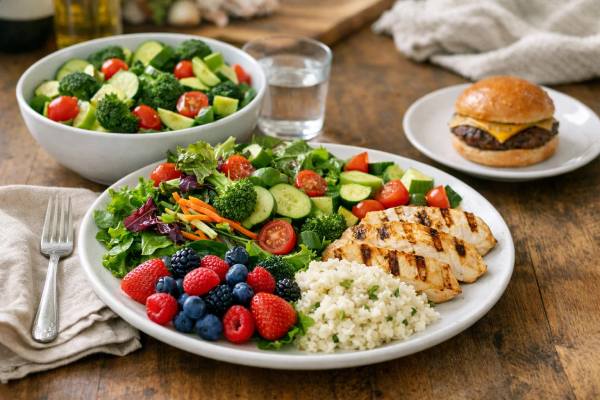
- A large salad with chicken, beans, vegetables, and a measured dressing often feels more substantial than a small fast-food sandwich.
- A bowl of lentil soup and fruit often keeps people fuller than a granola bar with similar calories.
- A baked potato with Greek yogurt and salsa may be more satisfying than a small serving of fries.
There is another important point: low energy density is helpful, but it is not enough by itself. A giant plate of lettuce and cucumbers is low in calories, but it may not keep you full for long if it is missing enough protein, starch, or fat. That is why Volumetrics works best when it is combined with meal balance, not when it becomes a contest to eat the fewest-calorie foods possible.
This is also where many people drift naturally toward high-volume, low-calorie foods without needing a rigid rulebook. The goal is not to eat endless piles of watery foods. The goal is to use food volume strategically so meals feel generous and appetite stays under better control.
A good Volumetrics meal usually combines:
- low-energy-density foods for size and fullness
- protein for satiety and muscle support
- enough carbohydrate or fat to make the meal feel complete
- flavor and texture so the meal is actually enjoyable
That combination matters more than any single food ever will.
Foods to Eat More and Less Often
One of the easiest ways to understand Volumetrics is to group foods by how calorie-dense they are. The exact categories can vary a little in different explanations of the diet, but the practical pattern stays the same: foods with more water and fiber usually sit on the lower end, while foods with more fat and less water sit on the higher end.
| Category | Typical foods | How often they fit | Main role |
|---|---|---|---|
| Very low energy density | Nonstarchy vegetables, broth-based soups, most fruit, leafy salads | Very often | Add volume with relatively few calories |
| Low energy density | Beans, lentils, potatoes, whole grains, lean proteins, low-fat dairy | Often | Build satisfying, balanced meals |
| Medium energy density | Bread, cheese, eggs, hummus, avocado, higher-fat meats, mixed dishes | Moderately | Add staying power and flavor in sensible portions |
| High energy density | Chips, cookies, candy, butter, oils, pastries, fried foods, nuts in large amounts | More selectively | Enjoy in smaller servings rather than building meals around them |
This does not mean you should only eat foods from the first category. A meal made entirely of fruit and vegetables can be too light for many people. The better strategy is to let the lowest-energy-density foods take up more physical space on the plate, while the richer foods stay present but more measured.
Foods that often make Volumetrics easier include:
- broth-based soups
- salads with protein added
- berries, apples, oranges, and melon
- potatoes and sweet potatoes
- beans and lentils
- oats
- Greek yogurt
- lean chicken, turkey, white fish, shrimp, tofu, and cottage cheese
- frozen vegetables
- tomatoes, cucumbers, cabbage, mushrooms, zucchini, broccoli, and cauliflower
Foods that are easy to overdo within a Volumetrics approach include:
- oils and butter
- dressings and creamy sauces
- nut butters
- pastries and baked sweets
- chips and crackers
- granola
- trail mix
- cheese-heavy dishes
- fried foods
That does not mean they are off-limits. It means they are easy to underestimate because they pack many calories into a small amount of food. This is why the best Volumetrics plans usually borrow from broader lists of foods that work well in a calorie deficit and then emphasize the lower-energy-density end of those choices.
Vegetables deserve special attention because they do a lot of the heavy lifting here. They add weight, chewing time, color, and plate size without driving calories up very fast. Building meals around vegetables that support weight loss is one of the simplest ways to make Volumetrics work in real life.
How to Build Volumetrics Meals
The easiest way to follow Volumetrics is not to memorize food categories. It is to learn a meal-building pattern you can use over and over.
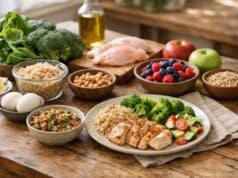
A practical Volumetrics plate usually looks like this:
- about half the plate from vegetables, fruit, soup, or salad
- about one quarter from protein
- about one quarter from starches or legumes
- small but deliberate amounts of calorie-dense extras
That structure keeps meals large enough to feel satisfying while still leaving room for protein and real staying power. It is very similar to the logic behind building a high-protein plate for weight loss, except Volumetrics puts even more emphasis on lower-energy-density foods taking up visible space.
Here are some easy examples.
Breakfast
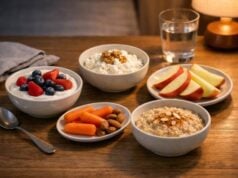
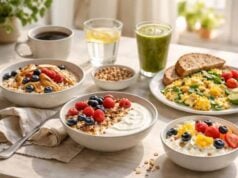
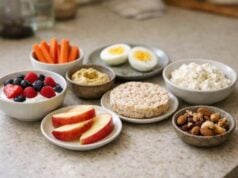
- Oatmeal made with berries and Greek yogurt
- Veggie omelet with fruit
- Cottage cheese bowl with chopped apple and cinnamon
- Yogurt parfait with fruit and a small portion of oats
Lunch
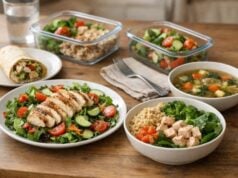
- Big salad with chicken, beans, and measured dressing
- Soup and sandwich with extra vegetables
- Grain bowl with roasted vegetables, lentils, and lean protein
- Potato topped with chili and a side salad
Dinner
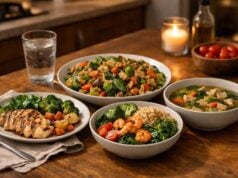
- Stir-fry with lots of vegetables, shrimp, and rice
- Turkey taco bowl with lettuce, salsa, beans, and cauliflower rice mixed with regular rice
- Sheet-pan chicken, broccoli, and potatoes
- Lentil soup with roasted vegetables and fruit afterward
Snacks
- Fruit and yogurt
- Raw vegetables with hummus
- Air-popped popcorn
- Cottage cheese and berries
- Soup cup and fruit on a hunger-heavy afternoon
The most useful Volumetrics habit is to add low-energy-density foods before removing everything else. For example:
- Add a soup or salad starter before dinner.
- Mix roasted vegetables into pasta instead of simply cutting pasta in half.
- Add berries to yogurt instead of replacing the whole snack with something tiny.
- Bulk up rice bowls with cabbage, mushrooms, zucchini, or cauliflower rice.
This mindset matters. People often approach weight loss by shrinking meals until they become unsatisfying. Volumetrics works better when you re-engineer the meal instead.
That said, meal balance still matters. If you focus only on volume, you can end up eating a lot of food that is physically filling but not very satisfying. Protein helps prevent that. Many people do better when each main meal includes a meaningful amount of protein, which is why guidance on protein per meal for weight loss often pairs well with Volumetrics thinking.
A good Volumetrics meal should leave you feeling fed, not just stuffed with low-calorie foods. That difference is what makes the approach sustainable.
A Sample Day of Volumetrics Eating
A sample day can make the Volumetrics diet easier to picture. The exact calories and portions vary by person, but the pattern stays the same: bigger-looking meals built from lower-energy-density foods, with protein and enough structure to keep hunger manageable.
Here is one realistic example.
Breakfast
A bowl of oatmeal cooked with extra liquid, topped with blueberries and a scoop of Greek yogurt, plus a side of orange slices.
Why it works: the oats and yogurt give more staying power than fruit alone, while the fruit adds volume and sweetness.
Lunch
A large salad with chopped romaine, cucumber, tomatoes, carrots, chickpeas, grilled chicken, and a measured vinaigrette, plus an apple.
Why it works: this is a big meal physically, but a large share of the plate comes from foods that are not very calorie-dense.
Snack
Air-popped popcorn and a cottage cheese cup with berries.
Why it works: popcorn provides volume, while cottage cheese adds protein.
Dinner
A bowl of lentil and vegetable soup, followed by baked salmon, roasted broccoli, and potatoes.
Why it works: soup can reduce the urge to attack dinner too quickly, and the meal still includes enough protein and starch to feel complete.
Dessert
Sliced strawberries with a spoonful of whipped topping or a small square of dark chocolate.
Why it works: Volumetrics is easier to follow when richer foods are included intentionally rather than treated like a failure.
This kind of day does not look extreme. That is the point. The best version of Volumetrics is not dramatic. It is quietly effective.
A few patterns show up repeatedly in successful days of eating:
- fruit appears often because it gives volume and sweetness
- vegetables show up at more than one meal
- soup, salad, or both are used strategically
- protein is included consistently
- starches are present, but they are not the entire meal
- calorie-dense extras are measured instead of automatic
It is also easy to adapt by meal type. If you need quick ideas, Volumetrics principles work well with low-calorie breakfasts and low-calorie dinners that still feel substantial. The trick is not hunting for “Volumetrics recipes.” It is using the energy-density principle inside the foods you already like.
For example, you can turn many favorite meals into more Volumetrics-friendly versions:
- tacos become taco bowls with extra lettuce, salsa, and beans
- pasta becomes pasta with mushrooms, spinach, and a larger tomato base
- burgers become burger bowls with a large salad and roasted potatoes
- sandwiches become soup-and-sandwich combinations with fruit on the side
Once you start seeing those swaps, the diet stops feeling like a special program and starts feeling like a smarter way to assemble normal meals.
Benefits, Limits, and Common Mistakes
The biggest benefit of the Volumetrics diet is psychological as much as nutritional. It helps people feel like they are still eating real meals. That matters because hunger, not just willpower, is one of the main reasons weight-loss plans break down.
Key benefits include:
- larger portions for fewer calories
- better appetite control for many people
- more emphasis on fruit, vegetables, legumes, and minimally processed foods
- flexibility across many cuisines and eating styles
- no requirement to eliminate carbs or ban favorite foods
- easier alignment with long-term healthy eating patterns
It also tends to improve meal quality almost by accident. If you follow Volumetrics well, you usually end up eating more produce, more fiber, and fewer ultra-dense snack foods. For many people, that is a better route to consistency than trying to micromanage every number.
Still, the approach has limitations.
It can be misunderstood as “just eat salad.”
That is one of the biggest mistakes. If meals become too low in protein or too low in satisfaction, hunger often comes back later.
It can be tricky in restaurants or highly processed food environments.
Restaurant foods often look normal in size but are loaded with oil, cheese, butter, or sugary sauces. Volumetrics works best when you can see and control the structure of the meal.
Not all low-calorie foods are equally satisfying.
A giant bowl of raw vegetables may be low in energy density, but it may not feel as satisfying as a mixed meal with soup, potatoes, lean protein, and roasted vegetables. Warmth, texture, and meal composition matter.
Some calorie-dense foods are still healthy.
Avocado, nuts, olive oil, seeds, and fatty fish can support health and satiety. Volumetrics should not turn into fear of all higher-calorie foods. It works best when those foods are included intentionally, not removed automatically.
People with very high energy needs may need larger portions of denser foods.
Athletes, taller individuals, and very active adults may find that very low-energy-density eating alone is not enough.
A few common mistakes show up again and again:
- eating lots of low-calorie foods without enough protein
- using huge salads but drowning them in dressing and toppings
- assuming all soups are low-calorie, even creamy ones
- relying on fruit and vegetables alone for meals
- avoiding all fats, then feeling unsatisfied and snacking later
- treating the approach as a trick instead of a pattern
The smartest version of Volumetrics is balanced. It leans heavily on volume, but it still respects protein, flavor, meal enjoyment, and the fact that some richer foods help meals feel complete. That is also why many people combine it naturally with filling low-calorie meal ideas rather than using it as a standalone identity.
How to Start the Volumetrics Diet
The easiest way to start Volumetrics is not to overhaul everything at once. It is to change the structure of meals you already eat.
A practical starting plan looks like this:
- Add one high-volume food to each main meal.
Fruit at breakfast, salad or soup at lunch, and extra vegetables at dinner is enough to begin. - Keep protein visible.
Do not let the diet become only about low-calorie foods. Include yogurt, eggs, beans, lentils, chicken, fish, tofu, or cottage cheese regularly. - Change side dishes before changing everything else.
Replace some fries with potatoes and salad. Add soup before a sandwich. Mix vegetables into pasta. Use fruit as a dessert base more often. - Measure calorie-dense extras for a while.
Oils, dressing, cheese, nut butter, granola, and sweets can fit, but many people underestimate them. - Repeat meals that work.
A few reliable breakfasts, lunches, and dinners are more useful than endless novelty. - Use hunger as feedback.
If you are hungry all the time, your meals may be too light, too low in protein, or too low in satisfaction.
A good beginner grocery list for Volumetrics often includes:
- frozen vegetables
- leafy greens
- fruit
- potatoes
- beans and lentils
- oats
- broth-based soups
- Greek yogurt
- eggs
- lean proteins
- salsa, mustard, herbs, and spices
You do not need to become perfect at this overnight. A few easy changes can shift the energy density of your diet meaningfully:
- start dinner with broth-based soup or a salad
- swap some snack foods for fruit, yogurt, or popcorn
- add vegetables to sandwiches, wraps, pasta, bowls, and eggs
- choose meals that look large because of produce and legumes, not because of refined extras
Volumetrics is especially useful for people who say, “I can handle dieting for a few days, but I get too hungry.” In many cases, the problem is not a lack of discipline. It is that their meals are too small, too dense, or too easy to overeat.
That is why the best starting point is simple: make the plate look fuller with foods that do not drive calories up too quickly, keep protein steady, and let richer foods stay in the plan in smaller amounts. Done that way, Volumetrics becomes less of a diet and more of a repeatable eating style.
References
- Impact of energy density on energy intake in children and adults: a systematic review and meta-analysis of randomized controlled trials 2023 (Systematic Review and Meta-Analysis)
- Calorie reformulation: a systematic review and meta-analysis examining the effect of manipulating food energy density on daily energy intake 2022 (Systematic Review and Meta-Analysis)
- Obesity in Adults: A 2022 Adapted Clinical Practice Guideline for Ireland 2022 (Guideline)
- Enhanced protein intake on maintaining muscle mass, strength, and physical function in adults with overweight/obesity: A systematic review and meta-analysis 2024 (Systematic Review and Meta-Analysis)
- Dietary Guidelines for Americans, 2020-2025 2020 (Guideline)
Disclaimer
This article is for general educational purposes only. The Volumetrics diet can be a useful weight-loss strategy, but calorie needs, medical conditions, digestive tolerance, medications, and nutrition requirements vary, so this information is not a substitute for professional medical advice, diagnosis, or treatment.
If this article helped you, please share it on Facebook, X, or any other platform where it could help someone build a healthier, more satisfying way to eat.