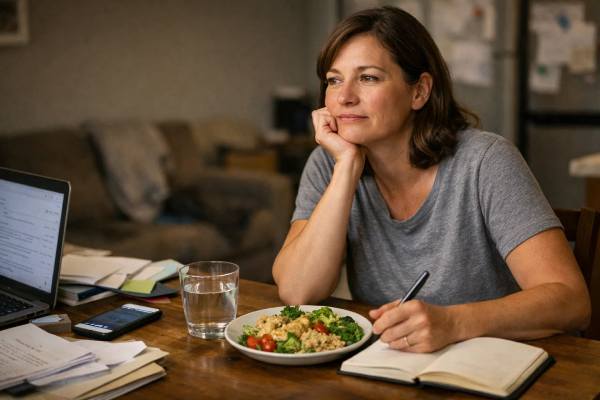
Stressful life events can make weight loss feel like it is slipping through your hands. Grief, caregiving, layoffs, breakups, illness in the family, moving, financial strain, exam seasons, and burnout can disrupt sleep, routines, appetite, energy, and decision-making all at once. When life gets hard, the usual advice to meal prep perfectly, train hard, and stay highly motivated often stops being realistic.
The goal during these seasons is not to run your best plan. It is to protect your most important habits well enough that things do not unravel. This article explains how stress changes eating and behavior, how to adjust your expectations without giving up, and which habits matter most when you are trying to stay steady instead of perfect.
Table of Contents
- Why stressful life events disrupt weight loss habits
- Redefine success for hard seasons
- Build a minimum viable routine
- Make food decisions easier under stress
- Protect sleep, movement, and decompression
- Handle emotional eating without all-or-nothing thinking
- Know when to maintain, pause, or get help
Why stressful life events disrupt weight loss habits
Stressful life events rarely affect only one part of your routine. They tend to hit multiple systems at once. Your sleep gets worse. Your schedule becomes unpredictable. Grocery shopping gets sloppier. Meals become delayed or skipped. Exercise feels harder to start. Small tasks take more effort. By evening, your brain wants comfort, convenience, or relief.
That is one reason stressful periods can quietly change body weight even when you are still “trying.” The problem is often not a lack of knowledge. It is that stress makes your usual habits harder to execute and high-reward choices easier to reach for.
Stress can affect eating in several different ways:
- Some people lose their appetite at first, then rebound into overeating later.
- Some become more snack-driven, especially at night.
- Some eat more takeout, convenience food, sweets, or salty foods because decision fatigue is high.
- Some stop eating structured meals and end up grazing all day.
- Some become less active, not because they do not care, but because their mental bandwidth is depleted.
Stress can also make self-regulation feel more fragile. When life is calm, packing lunch, taking a walk, or stopping after one serving may feel manageable. During a hard season, the same actions can feel surprisingly difficult. That does not mean you are weak. It means the context changed.
Poor sleep adds another layer. Stressful life events often shorten sleep, fragment it, or shift it later, and that can make appetite feel louder and cravings more intense. It can also make harder foods feel less worth resisting. That is why resources on stress management habits and how poor sleep affects hunger often overlap so much in real life.
Another overlooked issue is that stress narrows attention. During a crisis or demanding season, your brain often focuses on what is urgent, not what is important in the long run. Weight loss habits are easy to treat like optional extras when you are just trying to get through the day.
This is the part many people misunderstand: stressful seasons do not only test motivation. They change the environment your habits depend on. That is why the answer is rarely “try harder.” The better answer is to simplify, protect the basics, and stop judging yourself by what you could do in an easier season.
Redefine success for hard seasons
One of the most useful weight loss habits during stressful life events is changing the target before you fall apart trying to hit the old one.
Many people make the mistake of using the same standard in every season of life. They expect themselves to cook from scratch, hit every workout, sleep perfectly, and lose weight on schedule while also dealing with grief, caregiving, job uncertainty, relationship strain, or a packed family calendar. When that fails, they assume they have no discipline and quit altogether.
A better approach is to redefine success based on current capacity.
| Life season | Main goal | Best mindset | Common mistake |
|---|---|---|---|
| Stable and predictable | Active fat loss or steady progress | Use structure and momentum | Doing too much too fast |
| Busy but manageable | Protect core habits and keep progress moving | Be efficient, not perfect | Adding complexity you cannot sustain |
| Highly stressful or disruptive | Minimize backsliding and keep routines from collapsing | Think damage control and stability | Expecting full-performance behavior during overload |
Sometimes the right goal is not aggressive weight loss. It may be weight maintenance, fewer binge-like evenings, consistent meals, less takeout, or getting through the week without abandoning yourself. That is still progress. In some seasons, staying steady is the win.
This is where consistency matters more than motivation. Motivation is often weakest when life is hardest, so your plan has to rely less on feeling inspired and more on what you can repeat even while stressed.
It also helps to reset your expectations in concrete terms. Instead of saying:
- “I need to get back on track completely”
try:
- “I need three habits that keep the week from drifting”
Instead of saying:
- “I should still lose one pound per week no matter what”
try:
- “I want to keep my routines stable enough that I do not create a bigger setback”
That shift sounds small, but it reduces shame and makes follow-through more likely.
A realistic target during a hard season might be:
- Eat three structured meals most days
- Keep evening overeating from becoming nightly
- Walk or move briefly each day
- Keep bedtime from drifting too far
- Weigh or check in once a week without spiraling
That is not giving up. It is strategic scaling. It also aligns with the broader skill of setting realistic weight loss goals instead of forcing an ideal plan into a non-ideal season.
The people who stay steadier through hard times are not usually the ones with the strongest willpower. They are the ones who know how to lower the bar without losing the routine entirely.
Build a minimum viable routine
When life gets chaotic, your best defense is a minimum viable routine. This is the smallest version of your plan that still keeps you anchored.
Think of it as your “hard season default.” Not the perfect routine. Not your best routine. The version you can keep doing when your time, focus, and emotional energy are limited.
A minimum viable routine usually works best when it includes one habit from each major area:
- Eating structure
- Movement
- Sleep
- Self-monitoring or reflection
For example, your minimum routine might be:
- Eat breakfast or lunch instead of skipping both.
- Keep one reliable meal on hand for rough days.
- Walk for 10 minutes or get a short burst of steps daily.
- Stop screens and start winding down at roughly the same time each night.
- Check in with yourself once a week.
This kind of setup works because it reduces complexity. Under stress, overly ambitious plans fall apart fast. A small routine survives longer.
For food, consistency matters more than variety during hard periods. A predictable meal rhythm can help lower the chance that stress turns into chaotic hunger later. That is why meal routine consistency can be so protective when life feels unstable.
For movement, the goal is not to set personal records. It is to avoid going completely still. A short walk, a few laps during calls, or a basic step target can help preserve energy, mood, and structure. On demanding weeks, guidance around step habits for busy days is often more useful than trying to force long workouts you keep skipping.
Your minimum routine should also be pre-decided. Do not wait until a stressful week begins to figure out what “good enough” looks like. Write it down now. Keep it visible. Make it boringly clear.
A practical template looks like this:
- If the week is normal: I follow my standard plan.
- If the week is stressful: I switch to my minimum routine.
- If the week becomes overwhelming: I protect meals, sleep, and a small amount of movement before I worry about anything else.
That kind of rule reduces decision fatigue. It also keeps stressful periods from becoming full routine collapses.
The most important point is that minimum does not mean meaningless. During hard seasons, a slim routine often does more for long-term progress than a perfect plan you cannot repeat. You are not trying to win the hardest week of your year. You are trying to come out of it with your habits still recognizable.
Make food decisions easier under stress
Food choices usually worsen during stressful life events for one simple reason: stress increases the value of convenience. When your brain is overloaded, the easiest option often wins.
That does not mean you need a perfect meal plan. It means you need fewer decisions and better defaults.
The biggest mistake is relying on daily motivation to decide what to eat. A more useful approach is to create a short list of repeatable meals and snacks that cover your roughest days. The foods do not have to be exciting. They need to be easy, filling, and realistic.
Good hard-season foods usually have at least one of these qualities:
- Ready in under 10 minutes
- Minimal cleanup
- Easy to portion
- Contain protein or fiber
- Easy to keep at home or at work
- Easy to eat even when you feel mentally drained
Examples include Greek yogurt, eggs, rotisserie chicken, frozen vegetables, canned soup with added protein, protein oatmeal, wraps, prewashed salad kits, microwave rice, fruit, cottage cheese, tuna packets, and simple sandwiches. It can also help to keep a few fallback items from a protein and fiber craving toolkit so that stress does not automatically turn into random snacking.
A useful rule is to build a “low-effort menu” for crisis weeks. Choose:
- 3 breakfast options
- 3 lunches
- 3 dinners
- 3 snacks
That is enough structure to reduce food chaos without making you feel boxed in.
Another key habit is eating earlier and more consistently when stress is high. Many people under-eat during the day, either because they are too busy or too wound up to notice hunger, then overeat at night when exhaustion and cravings collide. Keeping simple, steady meals on the front half of the day reduces the chance that evenings become a food free-for-all.
If stress pushes you toward grazing, it helps to create visible meal boundaries:
- Sit for meals when possible
- Use plates and bowls instead of picking from packages
- Keep snacks portioned
- Decide whether you are having a meal or a snack before you start eating
That sounds basic, but stressful periods often erode these boundaries first.
This is also not the season to make food unnecessarily strict. Heavy restriction tends to backfire under pressure. If you label foods as “bad,” skip meals, or try to compensate for stressful eating by going too low the next day, you often create even stronger cravings later. A steadier approach is more protective than a harsher one.
Under stress, food habits improve when the plan gets simpler, not more impressive. Your goal is not perfect nutrition. It is reducing the number of times stress gets to make the decision for you.
Protect sleep, movement, and decompression
When life gets hard, these three habits often look optional. In practice, they are some of the most stabilizing habits you have.
Sleep matters because it affects hunger, cravings, patience, energy, and emotional regulation. Stressful periods often shorten sleep or make it lighter and more broken. That makes it much harder to make deliberate choices around food and much easier to lean on comfort eating, caffeine, and late-night snacking. You may not be able to create ideal sleep during a crisis, but you can protect the basics:
- Keep wake time reasonably consistent
- Avoid stretching the night too late just to reclaim personal time
- Start winding down before you feel completely exhausted
- Keep the bedroom darker, cooler, and calmer
- Reduce stimulating scrolling close to bed
A practical sleep hygiene checklist is especially useful when stress is high because you need fewer decisions, not more.
Movement matters for a different reason. During hard seasons, exercise often becomes a pass-fail event. If you cannot do the full session, you do nothing. That is where short walks, brief stretching, easy strength work, or light movement breaks become valuable. Movement can improve mood, reduce the feeling of being trapped in your head, and help prevent the total inactivity that often shows up when stress piles up.
You do not need a heroic training block. You need a pattern. A short walk after a tense call or after dinner can do more for consistency than a big workout you keep postponing. That is why walking for stress relief and appetite control often works so well in real life.
Decompression is the third piece people skip. If you go from stress straight into food, the food starts doing too many jobs. It becomes relief, reward, comfort, distraction, and transition all at once. That is a heavy burden to place on eating.
You need another way to come down from the day, even if it is brief. Good decompression habits include:
- A short walk
- Showering right after work
- Journaling for five minutes
- Deep breathing
- Tea and a quiet room
- Light stretching
- Music without screens
- A quick reset of the kitchen or living room
The habit itself matters less than what it does: it creates a pause between stress and your next choice.
When stressful life events hit, protect these three habits as stabilizers, not luxuries. They support everything else. If they disappear, eating habits usually become much harder to manage.
Handle emotional eating without all-or-nothing thinking
Stressful seasons often bring more emotional eating. That does not always mean dramatic bingeing. It can look quieter than that: extra handfuls while cooking, dessert every night because you “need something,” drive-through food after a hard appointment, mindless snacking while answering emails, or eating past fullness because the food feels like the only comforting thing in the day.
The mistake many people make is responding with shame. Shame sounds like:
- “I blew it again.”
- “I have no self-control.”
- “I may as well restart next week.”
- “If I cannot do this properly, why bother?”
That reaction often causes more damage than the original eating episode. One hard evening becomes a lost weekend. One off-plan meal turns into a week of emotional drift. This is where all-or-nothing thinking can quietly sabotage progress.
A better approach is to get curious instead of punitive. After an emotional eating moment, ask:
- What happened right before I ate?
- Was I hungry, tired, lonely, angry, anxious, or mentally overloaded?
- What was I hoping the food would do for me?
- What would have made the next choice easier?
Sometimes the answer is that you needed food. Sometimes it is that you needed a break, comfort, a boundary, or sleep. The more specific you get, the more useful your fix becomes.
It also helps to have a short response plan for urge-heavy moments:
- Pause for two minutes.
- Name the feeling or situation.
- Decide whether you need food, relief, or both.
- If you eat, portion it and sit down.
- If you do not eat, use one calming action first.
This keeps you from sliding straight from distress into autopilot. It does not require perfect mindfulness. It just creates enough space for choice.
You should also plan for slips. During major life stress, some overeating is more likely. That is not permission to stop caring. It is a reason to make your rebound faster. The skill that matters most is often not avoiding every lapse. It is returning to your routine without drama. That is why the difference between lapses and relapses matters so much in difficult seasons.
Progress during stress usually depends less on clean streaks and more on short recovery times. A rough night does not have to become a rough month. If you can shorten the gap between a slip and your next normal meal, walk, bedtime, or check-in, you are doing an important weight loss habit very well.
Know when to maintain, pause, or get help
There are times when pushing for active weight loss is reasonable during stress, and times when it is smarter to shift into maintenance or basic damage control. Knowing the difference is a habit in itself.
A fat loss phase may still be workable if your stress is meaningful but contained. Maybe work is busy, a project is intense, or family logistics are heavy, but you are still sleeping fairly well, eating somewhat regularly, and keeping your main routines intact. In that case, slower progress may still be realistic.
A maintenance phase may make more sense if:
- You are sleeping badly most nights
- Meals are chaotic
- Emotional eating is frequent
- Exercise has become inconsistent or punishing
- You feel mentally maxed out
- Your life event is acute and highly disruptive, such as bereavement, separation, caregiving crisis, or job loss
Maintenance is not failure. It can be a smart holding pattern that prevents rebound weight gain, burnout, and a more severe setback later.
Here are signs your plan may be too aggressive for the season:
- You keep restarting every Monday
- You swing between restriction and overeating
- You are using guilt as your main motivator
- Small disruptions knock out the whole routine
- You are obsessing over the scale while ignoring sleep, stress, and sustainability
- You feel worse psychologically every week you stay on the plan
At that point, it can help to shift from “How do I lose faster?” to “What would keep me steady for the next month?” That is a much better question during unstable periods.
A weekly review can help you catch trouble early. A short weekly check-in routine might include:
- How stressful was this week?
- Which habit helped most?
- Where did I drift?
- What is one thing I will make easier next week?
- Am I still in a realistic phase for fat loss, or do I need to aim for maintenance?
It is also important to know when to get more support. Consider professional help if stressful life events are causing repeated binge eating, severe restriction, rapid weight changes, depressed mood, panic, insomnia, or the feeling that food has become your main coping tool. Support from a doctor, therapist, or registered dietitian can be especially useful when the issue is no longer just “habit consistency,” but a deeper stress response or mental health strain.
The steady path through hard seasons is rarely the most aggressive one. It is the one that keeps you grounded enough to protect your health while life is heavy. Sometimes the bravest version of consistency is not pushing harder. It is adjusting wisely, staying kind to yourself, and keeping the basics alive until the season changes.
References
- Stress and eating behaviours in healthy adults: a systematic review and meta-analysis 2022 (Systematic Review and Meta-analysis)
- The effects of sleep disruption on metabolism, hunger, and satiety, and the influence of psychosocial stress and exercise: A narrative review 2024 (Review)
- Self-compassion in weight management: A systematic review 2021 (Systematic Review)
- Emotional Eating Interventions for Adults Living With Overweight and Obesity: A Systematic Review and Meta-Analysis of Behaviour Change Techniques 2025 (Systematic Review and Meta-analysis)
- Weight-loss interventions for improving emotional eating in adults living with overweight or obesity: A systematic review and meta-analysis 2022 (Systematic Review and Meta-analysis)
Disclaimer
This article is for general educational purposes only and is not a substitute for medical advice, diagnosis, or treatment. If stressful life events are causing severe sleep disruption, depression, panic, binge eating, rapid weight change, or major trouble functioning, seek help from a qualified healthcare professional.
If this article helped you, please share it on Facebook, X, or your preferred platform so more people can stay steadier with their habits when life gets hard.