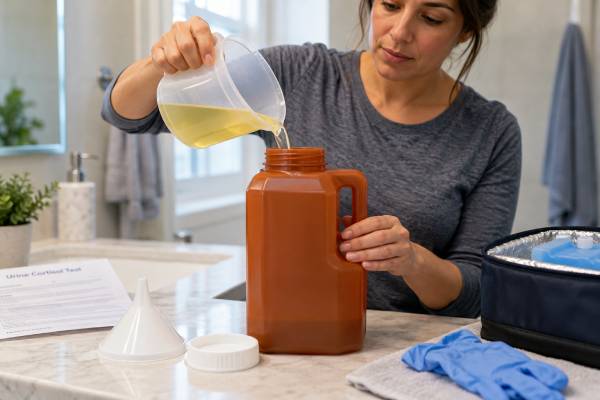
A 24-hour urine cortisol test measures the amount of free cortisol excreted in urine over a full day. It is mainly used to look for cortisol excess, especially when a clinician suspects Cushing syndrome. Because cortisol production changes from hour to hour, collecting urine for 24 hours gives an integrated view of free cortisol exposure rather than a single moment in time. A high result can support hypercortisolism, but it does not by itself prove Cushing syndrome or show where excess cortisol is coming from. Stress, pregnancy, alcohol use, depression, some medicines, and collection errors can also affect results. A normal result can be reassuring in the right setting, yet mild or cyclic Cushing syndrome may require repeat testing. The test is much less useful for diagnosing low cortisol or adrenal insufficiency. Accurate collection, the laboratory’s own reference interval, kidney function, and the clinical reason for testing all matter when interpreting the number.
- What it measures: 24-hour urinary free cortisol (UFC), the unbound cortisol filtered by the kidneys and excreted during one complete collection period.
- A high result: Repeated values above the laboratory range can support endogenous cortisol excess, but stress-related states, pregnancy, medicines, and collection problems may also raise UFC.
- A normal result: One normal collection does not always exclude mild or cyclic Cushing syndrome when clinical suspicion remains high.
- Typical adult range: One current LC-MS/MS laboratory interval is 3.5–45 mcg/24 hours, but ranges vary by method and laboratory.
- Collection accuracy matters: Missing urine can produce a falsely low result, while collecting longer than 24 hours can make the result falsely high.
Table of Contents
- What a 24-Hour Urine Cortisol Test Measures
- Why the Test Is Ordered
- How to Collect Urine Correctly
- Normal Range and Result Meaning
- Causes of High Urine Cortisol
- False Results and Test Limitations
- What Happens After an Abnormal Result
What a 24-Hour Urine Cortisol Test Measures
The test measures urinary free cortisol, often abbreviated UFC. Cortisol is a glucocorticoid hormone made by the adrenal cortex. The hypothalamus and pituitary gland regulate adrenal cortisol production through a feedback system involving corticotropin-releasing hormone and adrenocorticotropic hormone, or ACTH.
Most cortisol circulating in blood is attached to proteins, mainly cortisol-binding globulin and albumin. Only a small fraction is free. Free cortisol can pass through the kidney’s glomerular filter and enter urine. When blood cortisol rises enough, urinary free cortisol generally rises as well. Measuring all urine passed over 24 hours therefore gives an estimate of the day’s free cortisol exposure.
This is different from a single blood cortisol level. Blood cortisol normally peaks around the early morning and falls toward night, so a one-time result depends heavily on collection time and context. A 24-hour UFC smooths out those hourly swings. However, it also loses information about when cortisol was high. A person can have abnormal late-night cortisol regulation even when total daily urine cortisol is only mildly increased.
The test also should not be treated as a complete measure of “adrenal function.” Its main strength is detecting too much cortisol. It is not dependable as a stand-alone test for adrenal insufficiency because healthy people and people with low cortisol disorders can have overlapping low UFC values.
Many laboratories now use liquid chromatography–tandem mass spectrometry, or LC-MS/MS, to measure cortisol. This method is more specific than older immunoassays and reduces some analytical interference from other steroid compounds. The method still does not eliminate biological causes of misleading results, such as kidney disease, acute illness, pregnancy, or an incomplete collection.
Why the Test Is Ordered
Clinicians order 24-hour UFC mainly when there is a reasonable concern for endogenous Cushing syndrome, meaning the body itself is producing too much cortisol. Cushing syndrome can also result from taking glucocorticoid medicines, which is a more common cause overall. Before testing for endogenous disease, clinicians usually review all possible steroid exposure.
That medication review needs to be broad. Glucocorticoids may be taken as pills or injections, but they can also be inhaled for asthma, sprayed into the nose, applied to skin, injected into joints, or included in certain compounded or nonprescription products. Exogenous steroids can change the body’s own cortisol production and can make testing difficult to interpret.
Features that raise suspicion for Cushing syndrome include progressive or unusual combinations such as:
- Easy bruising or thin skin
- Wide reddish-purple stretch marks, especially on the abdomen
- Weakness in the upper legs or shoulders from proximal muscle loss
- Facial redness or fullness and increased fat around the trunk or upper back
- New or difficult-to-control high blood pressure or diabetes
- Osteoporosis or fractures that occur earlier than expected
- Menstrual changes, reduced fertility, or excess facial or body hair in some women
- Growth slowing with weight gain in children
Common problems such as obesity, fatigue, depression, or hypertension can occur without Cushing syndrome, so testing everyone with one nonspecific symptom creates many false alarms. The clinical pattern and progression matter.
Urinary free cortisol is one of several accepted first-line ways to screen for hypercortisolism. Other common approaches include late-night salivary cortisol and the overnight 1-mg dexamethasone suppression test. These tests examine different abnormalities: UFC estimates excess daily free cortisol production, late-night testing checks loss of the normal nighttime low point, and dexamethasone testing checks whether cortisol suppresses normally after feedback from a synthetic glucocorticoid.
A clinician may choose one method over another based on sleep schedule, kidney function, medicines, pregnancy, the likelihood of completing a 24-hour collection, and the suspected form of cortisol excess. More than one type of test may be needed when results and symptoms do not agree.
How to Collect Urine Correctly
A 24-hour urine test is only as accurate as the collection. The laboratory calculates cortisol excretion from the measured urine concentration and the total volume collected, so missing part of the day can lower the reported amount. Extending the collection beyond 24 hours can raise it.
A typical collection works like this:
- Choose a start time. In the morning, urinate into the toilet and do not save that first sample. Record the exact time; it marks the start of the 24-hour period.
- Collect every urine sample after that. Save all urine passed during the day, overnight, and during bowel movements if urination occurs at the same time.
- Finish exactly 24 hours later. At the recorded stop time the next morning, urinate once more and add that final sample to the container.
- Store the urine as instructed. Many laboratories require refrigeration or a preservative. Follow the collection kit instructions rather than adding anything yourself.
- Return the full collection. The laboratory may need the total volume, collection duration, and a well-mixed aliquot depending on its procedure.
A general 24-hour urine collection guide can help with timing and storage details. If a sample was missed, spilled, collected into the toilet, or added after the stop time, tell the laboratory or ordering clinician. In many situations, restarting is more reliable than trying to estimate what was lost. Common 24-hour urine collection errors can materially change the final result.
Do not deliberately change fluid intake, exercise, sleep, caffeine, alcohol use, or medicines unless the ordering clinician gives specific instructions. Some laboratories have test-specific restrictions. Medication changes are especially important to discuss because suddenly stopping prescribed steroids can be dangerous.
Some laboratories use urine creatinine to judge whether a 24-hour collection appears plausible for the person’s body size and muscle mass. Creatinine does not prove that every sample was collected correctly, but an unexpectedly low or high daily amount can flag a collection problem.
Normal Range and Result Meaning
There is no single universal normal range for 24-hour urinary free cortisol. Results depend on the assay, laboratory calibration, age, units, and sometimes other patient factors. The correct comparison is always the reference interval printed on the laboratory report.
For example, Mayo Clinic Laboratories currently lists an adult reference interval of 3.5–45 mcg/24 hours for its LC-MS/MS assay. Using its conversion factor, that corresponds to about 9.7–124 nmol/24 hours. A different laboratory can use a different upper limit, so a value should not be judged against a range copied from another report or website.
| Result pattern | What it may mean | Common next step |
|---|---|---|
| Within the lab range | Often argues against sustained marked cortisol excess, but mild or cyclic disease may still be possible | Stop testing if clinical suspicion is low; repeat or use another first-line test if suspicion remains high |
| Slightly above the upper limit | May reflect early Cushing syndrome, non-neoplastic hypercortisolism, pregnancy, illness, a drug effect, or collection error | Check collection quality and context, then repeat or confirm with another screening method |
| Repeatedly and clearly elevated | Raises concern for endogenous hypercortisolism, especially with compatible clinical features | Confirm cortisol excess and then determine whether it is ACTH-dependent or ACTH-independent |
| Low | Can occur with low cortisol production, exogenous steroid suppression, kidney disease, or normal variation | Do not diagnose adrenal insufficiency from UFC alone; use appropriate blood-based or stimulation testing |
The degree of elevation matters, but there is no universal cutoff that diagnoses Cushing syndrome in every patient. A small elevation deserves more caution than several consistently high collections. Clinicians often obtain at least two urine collections because cortisol secretion varies from day to day and because a single collection can be incomplete.
A low urine cortisol result has a different meaning. It may appear when endogenous cortisol production is suppressed by synthetic glucocorticoids, but some healthy people also have low daily excretion. Kidney impairment can reduce the amount of free cortisol reaching urine and create a falsely reassuring value. For suspected adrenal insufficiency, morning serum cortisol and, when appropriate, an ACTH stimulation test are much more useful than 24-hour UFC.
Causes of High Urine Cortisol
A high 24-hour UFC means the urine contained more free cortisol than expected for that laboratory. The result becomes clinically important only after separating true endogenous Cushing syndrome from physiologic or non-neoplastic causes of increased cortisol.
Endogenous Cushing syndrome occurs when the body produces cortisol inappropriately. The major pathways are:
- Pituitary ACTH excess: A corticotroph pituitary adenoma makes excess ACTH, which stimulates both adrenal glands. This specific cause is called Cushing disease. Cushing disease is not the same term as Cushing syndrome; it is one cause of the syndrome.
- Ectopic ACTH production: A tumor outside the pituitary, such as some neuroendocrine tumors, produces ACTH and drives adrenal cortisol production.
- Adrenal cortisol production: An adrenal adenoma, adrenal carcinoma, or less common bilateral adrenal disorder produces cortisol without normal ACTH control.
Cortisol testing does not identify which pathway is present. That distinction comes later, usually after hypercortisolism has been established.
Other states can increase cortisol without a cortisol-secreting tumor. These are sometimes called non-neoplastic hypercortisolism or, historically, pseudo-Cushing states. Examples include severe depression, alcohol use disorder, poorly controlled diabetes, severe obesity in some patients, major physical stress, hospitalization, and recent surgery. These conditions can reproduce parts of the biochemical pattern seen in Cushing syndrome and can make borderline results difficult to interpret.
Pregnancy is another important exception. Normal hormonal changes can increase urinary free cortisol, and values may reach roughly twice the usual upper limit. A mildly elevated result in pregnancy therefore cannot be interpreted using the same assumptions as a result from a nonpregnant adult.
Medicines can also affect cortisol physiology, assay performance, or dexamethasone testing. This is one reason the ordering clinician should know about prescriptions, over-the-counter products, inhalers, creams, injections, supplements, and hormonal medicines before deciding what a high result means.
When an adrenal mass is found incidentally, cortisol evaluation may be part of a broader hormone workup. Other tests depend on the imaging features and symptoms; for example, suspected catecholamine-producing tumors are evaluated with plasma or 24-hour urine metanephrines, not urinary cortisol alone.
False Results and Test Limitations
The biggest limitation of UFC is that both biology and collection quality can move the result. A laboratory number may be technically accurate for the urine it received while still giving the wrong impression about the patient’s usual cortisol production.
False-high or misleadingly high results can occur with an overlong collection, severe acute stress, hospitalization, surgery, alcohol-related hypercortisolism, depression, pregnancy, and some medicines. Very high fluid intake can also change urinary cortisol excretion in some settings. These influences matter most when the elevation is mild.
False-low or misleadingly normal results can occur when urine is missed, when collection ends early, or when kidney function is reduced. Because free cortisol must be filtered by the kidneys before it appears in urine, lower glomerular filtration can reduce UFC even when blood cortisol production is abnormal. A normal UFC therefore has less power to exclude Cushing syndrome in significant renal impairment.
Mild and cyclic Cushing syndrome create another challenge. A person with cyclic disease has periods of cortisol excess separated by intervals of normal or near-normal production. A 24-hour collection obtained during a quiet phase can be normal. Repeating UFC or using late-night salivary cortisol on multiple days may capture the abnormal period more effectively.
The test also does not show cortisol’s daily rhythm. Healthy cortisol is normally low late at night. Some people with early Cushing syndrome lose this nighttime low before their total 24-hour production becomes strikingly high. Late-night salivary cortisol is designed to assess that feature, while dexamethasone suppression testing evaluates whether the normal feedback brake on cortisol secretion is intact.
Finally, no screening test should be interpreted without pretest probability. In someone with very little clinical reason to suspect Cushing syndrome, a borderline abnormality is more likely to be a false positive or a temporary stress effect. In someone with progressive, highly suggestive features, one normal test may deserve confirmation rather than immediate dismissal.
What Happens After an Abnormal Result
An abnormal UFC usually starts a stepwise evaluation rather than ending it. The first goal is to confirm that cortisol excess is real; the second is to identify its source.
When UFC is mildly elevated, the clinician may review whether the collection lasted exactly 24 hours, whether all urine was captured, whether kidney function is adequate for the test, and whether illness, pregnancy, alcohol, psychiatric disease, or medicines could explain the finding. Repeating UFC on another day is common. A different first-line test, such as late-night salivary cortisol or the 1-mg overnight dexamethasone suppression test, may provide complementary evidence.
If repeated testing supports endogenous Cushing syndrome, the next important blood test is usually plasma ACTH. ACTH helps divide the causes into two broad groups:
- Low or suppressed ACTH suggests ACTH-independent cortisol production, most often from the adrenal glands. Adrenal imaging and endocrine evaluation then help locate and characterize the source.
- Normal or high ACTH suggests ACTH-dependent disease. The source may be a pituitary corticotroph tumor or, less commonly, ectopic ACTH production. Pituitary MRI, additional biochemical testing, and sometimes inferior petrosal sinus sampling may be needed to distinguish them.
This order matters. Finding a small pituitary or adrenal nodule on imaging does not automatically prove it is causing cortisol excess because incidental nodules are common. Biochemical evidence should usually establish the hormonal disorder before an imaging finding is treated as the cause, except when imaging was already obtained for another reason and is guiding the initial evaluation.
Seek prompt medical assessment if symptoms are severe or rapidly worsening, particularly when high cortisol is accompanied by serious infection, very high blood pressure, severe high blood sugar, new blood clots, marked muscle weakness, major psychiatric changes, or low potassium. Severe hypercortisolism can cause urgent metabolic and cardiovascular complications.
For most people, however, the next step after one abnormal urine cortisol result is careful confirmation, not panic. The most useful interpretation combines the actual value, the laboratory range, collection quality, kidney function, medications, pregnancy status, current illness, and the clinical features that led to testing.
References
- Biochemical diagnosis of hypercortisolism: When and how? 2026 (Review)
- Measuring cortisol in Cushing syndrome: diagnosis, monitoring, and cortisol circadian rhythm improvement 2026 (Review)
- Cushing Syndrome: A Review 2023 (Review)
- Approach to the Patient: Diagnosis of Cushing Syndrome 2022 (Review)
- CORTU – Overview: Cortisol, Free, 24 Hour, Urine 2026
Disclaimer
A 24-hour urine cortisol result cannot diagnose or exclude Cushing syndrome by itself. Reference ranges, kidney function, collection accuracy, pregnancy, illnesses, and medicines can change interpretation, so discuss abnormal or discordant results with a clinician or endocrinologist. Do not stop prescribed glucocorticoids or other medicines for testing unless the prescribing clinician gives you a safe plan.