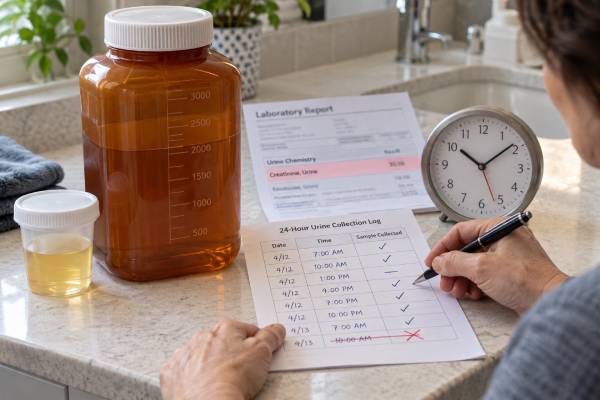
A 24-hour urine test can produce a precise-looking number even when the collection itself was incomplete. The most common errors are missed urine, wrong start or stop times, collecting for more or less than 24 hours, spills, incorrect storage, and using the wrong container or preservative. Low 24-hour urine creatinine can be a clue to undercollection, but it is not proof: creatinine excretion also depends on muscle mass, age, body size, diet, and other factors. Likewise, a high creatinine total can reflect overcollection, greater muscle mass, meat intake, or creatine use. Because many 24-hour results are reported as a total amount per day, missing urine usually makes analyte excretion look falsely low, while collecting too long can make it look falsely high. When the numbers do not fit the clinical picture, reviewing the collection process is often the most important first step.
- Missed urine usually lowers 24-hour totals: A lost void can make protein, calcium, sodium, citrate, creatinine, and other analytes appear lower than they truly are.
- Overcollection usually raises daily totals: Collecting beyond the exact 24-hour period adds extra analyte and can create a false high result.
- Low creatinine is a clue, not a verdict: Low muscle mass, older age, small body size, low meat intake, and illness can all reduce creatinine excretion.
- Total urine volume cannot prove completeness: A large or small volume may reflect hydration rather than whether every void was collected.
- If a meaningful sample was missed, restarting is often best: The laboratory or ordering clinician should decide whether a known incomplete collection can still be used.
Table of Contents
- Why 24-hour urine collection errors matter
- Missed samples and undercollection
- Overcollection and timing errors
- Low and high urine creatinine as quality clues
- Storage, container, and preservative errors
- How to check whether a result is usable
- How to avoid errors on the next collection
Why 24-hour urine collection errors matter
A 24-hour urine test usually reports how much of a substance was excreted during one full day. That makes the result highly dependent on time and completeness. Unlike a spot test, which analyzes one sample as collected, a timed test assumes that every drop produced during the stated interval is represented.
If that assumption is wrong, the final number can be misleading. Missing part of the urine usually lowers the measured daily total. Adding urine from before the start time or after the stop time usually raises it. The effect can be clinically important when a treatment decision depends on whether a result is above or below a threshold.
For example, undercollection can make a 24-hour protein result look less severe, make urinary calcium seem normal when it is actually high, or make sodium intake appear lower than it is. Overcollection can do the opposite. The same principle applies to citrate, oxalate, uric acid, hormones, and many other analytes.
The challenge is that there is no perfect laboratory test for collection completeness. Clinicians use several clues: start and stop times, patient report, total volume, 24-hour creatinine excretion, body size, expected physiology, and whether related analytes make sense together. None of these can prove completeness on its own.
The effect of an error also depends on the clinical question. A small timing mistake may have little impact when a result is far from any treatment threshold, yet the same mistake may matter when the value is borderline. Hormones and metabolites that vary across the day can be especially sensitive to which hours were missed. For that reason, the decision to accept or repeat a collection should be based on both the error and how the result will be used.
A common misunderstanding is that the laboratory can always correct an incomplete collection by using the total volume or creatinine. Usually it cannot. If an unknown portion of urine is missing, the lost analyte amount is also unknown. Ratios may sometimes remain interpretable for particular tests, but a reported daily excretion total cannot be reliably reconstructed from a guessed missing fraction. Honest documentation of the error is therefore more useful than trying to compensate at home.
A 24-hour urine creatinine test is commonly used as one quality check because creatinine production is relatively steady over a day. But “relatively steady” is not the same as identical in every person. Rigid expected-creatinine cutoffs can wrongly label valid collections as incomplete, especially in older adults or people with unusual muscle mass.
Missed samples and undercollection
Undercollection means some urine produced during the 24-hour interval did not reach the collection container. Common causes include forgetting a daytime void, missing an overnight sample, spilling urine, leaving home without a collection cup, or forgetting the final void.
A standard collection starts by emptying the bladder into the toilet at the chosen start time. That first void is intentionally discarded. Every void after that is collected, including the final urine at exactly the same clock time the next day. Confusing the deliberately discarded first sample with a missed sample is a common source of uncertainty.
If a later void is missed, the total amount of every analyte in that urine is lost. The size of the error depends on how much urine was missed and what was being excreted at that time. A small accidental loss may have less effect than missing a full morning void, but there is no reliable way to reconstruct the missing chemistry after the fact.
Undercollection often produces low 24-hour creatinine, but not always. A person could miss urine and still have a creatinine total within a broad expected range. Conversely, a complete collection from someone with low muscle mass may have a low creatinine value. This is why collection history matters.
Total urine volume can provide context but is also imperfect. A volume of 700 mL could mean undercollection, but it could also reflect low fluid intake or substantial sweating. A volume of 4 liters could be complete in someone who drinks heavily or has polyuria. Volume alone should never be used as a pass-fail test.
If a meaningful sample was missed, many laboratories recommend restarting the collection. This is especially important when the test is being used to make a diagnosis, adjust medication, or assess kidney stone risk. The timed urine collection method works only when the entire intended interval is represented.
Overcollection and timing errors
Overcollection occurs when urine outside the intended 24-hour interval is included. The classic example is collecting the first morning void instead of discarding it, then also collecting the final void the next morning. That adds urine produced before the official start time.
Another common error is ending late. If the collection began at 7:00 a.m. Monday but the final void was collected at 9:30 a.m. Tuesday, the container represents 26.5 hours rather than 24. Unless the laboratory corrects for the actual duration—which many standard tests do not—the reported “per 24 hours” total may be falsely high.
Ending early has the opposite effect. A collection stopped at 22 hours misses two hours of production and tends to lower the daily total. Even when the laboratory knows the exact duration, some analytes and reporting systems are not validated for simple arithmetic correction.
Adding an extra sample “just in case” is therefore not harmless. The goal is not to collect as much urine as possible; it is to collect the urine produced during one defined interval.
Timing errors can be especially important when the result is close to a decision threshold. A modest amount of overcollection might shift urinary calcium from just below to just above a hypercalciuria cutoff, or move protein excretion into a different clinical category. A large timing error can create much larger distortions.
The most reliable prevention is to write the start time on the container or instruction sheet and set reminders for the final collection. The start and stop times should be exactly 24 hours apart unless the clinician ordered a different timed interval.
Low and high urine creatinine as quality clues
Creatinine is produced from normal muscle metabolism and is excreted largely through the kidneys. Because daily production is fairly stable within one person, 24-hour creatinine excretion can help identify collections that are biologically implausible.
Historically, clinicians often used simple sex-based expected ranges, such as roughly 15–20 mg/kg/day in women and 20–25 mg/kg/day in men. Those rules can be useful as rough context, but newer population work shows that creatinine excretion varies with age, body size, race or ancestry proxies, diet, muscle mass, and health. A single fixed cutoff can misclassify many valid samples.
Low creatinine excretion can suggest undercollection, especially if it is much lower than the person’s previous results or inconsistent with body size. But true low excretion can occur with low muscle mass, older age, frailty, amputation, neuromuscular disease, small body size, low meat intake, or prolonged illness.
High creatinine excretion can suggest overcollection, particularly if timing exceeded 24 hours. It can also occur in people with greater muscle mass, after a large meat intake, or with creatine supplementation. Exercise may affect creatinine handling as well.
The best use of creatinine is often within-person comparison. If someone’s prior complete 24-hour collections consistently show 1,400–1,500 mg of creatinine and a new collection contains 700 mg, undercollection becomes more plausible. If the result is stable across repeated collections, an apparently “low” value may simply be normal for that individual.
Urine creatinine also appears in ratios such as uACR and UPCR, where it helps adjust a spot sample for concentration. That role is different from using total 24-hour creatinine as a completeness clue. A urine creatinine test should always be interpreted according to how the result was generated.
Kidney function itself can complicate interpretation. Advanced kidney disease changes creatinine handling, and muscle wasting is common in chronic illness. A clinician should therefore avoid rejecting a collection solely because it falls outside an old expected range.
Storage, container, and preservative errors
A collection can be complete in timing and still be unsuitable because of handling. Different analytes have different stability requirements. Some collections must stay refrigerated; others use acid, alkaline, or other chemical preservatives. Some require protection from light.
Using the wrong container can contaminate the sample or change the analyte. Trace-element tests, for example, may require specially prepared containers to avoid metal contamination. Hormone or metabolite tests may depend on a preservative that keeps the compound stable during the 24 hours.
If the laboratory provides a container with acid, do not discard the preservative. Also do not urinate directly onto concentrated acid unless the instructions explicitly say it is safe. Many laboratories recommend collecting into a clean cup and carefully transferring the urine to reduce splash risk.
Leaving a specimen warm when refrigeration is required can allow bacterial growth or analyte degradation. Bacteria can change urine pH and metabolize certain compounds. For some tests, this may alter the result enough to make the collection unusable.
Contamination with stool, toilet water, tissue, menstrual blood, or cleaning products can also interfere. If contamination occurs, the laboratory should be contacted before the collection is submitted. Starting again is often preferable to receiving a number that cannot be trusted.
Combining multiple ordered tests in one container is safe only if the laboratory says their collection requirements are compatible. Two 24-hour tests may use different preservatives. A single container should not be assumed to work for every analyte.
How to check whether a result is usable
When a 24-hour result looks surprising, the first step is to review the collection rather than immediately assuming the biology changed. A simple checklist can prevent unnecessary testing.
Ask whether every void after the start time was collected, whether the final void was included, and whether the start and stop times were exactly 24 hours apart. Note any spill, missed sample, container transfer, or period when the urine was not stored correctly.
Then look at internal clues. Does the total volume make sense for the person’s fluid intake? Is creatinine excretion similar to previous collections? Do sodium, potassium, urea, and other diet-related measures fit the reported intake? In kidney stone testing, are several analytes unexpectedly low at the same time? A cluster of implausibly low values may be more suspicious for undercollection than one low analyte.
Repeated collections can also reveal quality problems. Stone-prevention guidelines often recommend two 24-hour urine collections because day-to-day biology and collection variation are both real. If one collection is very different from the other, clinicians examine whether diet, fluid intake, medication timing, or completeness changed.
Some laboratories can calculate excretion per kilogram or use demographic prediction equations for creatinine. These methods can improve quality assessment but are still estimates. There is no universal mathematical correction that can recover the true analyte total from a partially missed collection.
If the result will change an important decision and completeness is uncertain, repeating the test is usually safer than trying to “fix” the number. A repeat collection is particularly reasonable for borderline results, large unexpected changes from baseline, or values that conflict with blood tests and symptoms.
How to avoid errors on the next collection
Good preparation makes a 24-hour collection much easier. Choose a day when you can stay near a bathroom and avoid major schedule disruptions. Read the laboratory instructions before the start time, not halfway through the day.
Use a smaller clean collection cup if the main container is awkward. Keep the main container in the required storage location and transfer each void promptly. For work or travel, ask the laboratory whether a secondary container or cooler is acceptable.
Set two reminders: one at the start time and one shortly before the final void the next day. Write the exact start time on the label. Remember the key rule: discard the first urine at the start, then collect everything, including the final urine exactly 24 hours later.
Keep diet, fluids, and activity typical unless the test has special preparation instructions. A kidney stone profile collected on an unusually low-salt, high-water day may not show the exposures the clinician is trying to change. In contrast, some hormone or metabolite tests require specific food or medication restrictions.
Tell the laboratory immediately if something goes wrong. Do not hide a missed sample or guess at the volume. A known incomplete collection can often be rescheduled; an unrecognized bad collection can lead to wrong conclusions.
If repeated 24-hour collections remain difficult, ask whether a validated spot test can answer the same question. For example, a spot urine albumin-creatinine ratio is preferred over a 24-hour albumin collection for many CKD screening and follow-up situations.
The central idea is simple: a 24-hour urine result is a measurement of both biology and collection quality. Low creatinine, odd volume, or a surprising analyte value should prompt review, not automatic rejection. Accurate timing, complete collection, correct storage, and honest reporting of mistakes are what make the final number clinically useful.
References
- Population-Based Limits of Urine Creatinine Excretion 2022 (Research Article)
- Specialist Care, Metabolic Testing, and Testing Completeness Among U.S. Veterans with Urinary Stone Disease 2022 (Research Article)
- From collection to correction: Can serial 24-hour urine collections demonstrate improved urinary stone parameters? 2025 (Research Article)
- 24-h urine test application in patients with kidney stone disease: a population-based study in a primary care setting 2025 (Research Article)
- Metabolic Evaluation and Recurrence Prevention 2026 (Guideline)
- Metabolic evaluation for prevention of kidney stones 2026 (Guideline)
Disclaimer
This article is for general education and does not determine whether a specific 24-hour urine collection is valid. Collection completeness should be assessed by the ordering clinician or laboratory using timing, patient report, creatinine, volume, body size, and the clinical question. If you know a sample was missed or the timing was wrong, contact the laboratory before relying on the result.