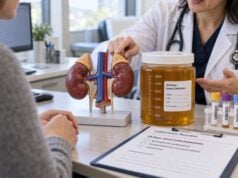
A 24-hour urine calcium test measures the total amount of calcium excreted in urine during one complete day. It is commonly used in people with recurrent kidney stones, unexplained high blood calcium, suspected primary hyperparathyroidism, or questions about how the kidneys handle calcium. A high result, called hypercalciuria, can increase calcium-stone risk, but it does not automatically mean a parathyroid disorder. Sodium intake, calcium intake, vitamin D, medicines, kidney function, and inherited factors can all change urinary calcium. A low result can also have several explanations, including low calcium intake, thiazide use, kidney impairment, or an incomplete urine collection. Traditional cutoffs such as more than 250 mg/day in women or 300 mg/day in men are still used in some settings, but stone risk rises gradually rather than at one sharp threshold. The result is most useful when interpreted with blood calcium, parathyroid hormone, urine volume, sodium, citrate, oxalate, and creatinine.
- High urine calcium is a major calcium-stone risk factor: Traditional hypercalciuria cutoffs are above about 250 mg/24 hours in women and 300 mg/24 hours in men, but risk is continuous.
- A high urine result does not prove hyperparathyroidism: Primary hyperparathyroidism is evaluated with blood calcium and PTH, while urine calcium adds renal and stone-risk information.
- Low urine calcium can be important too: Low intake, thiazide medicines, chronic kidney disease, incomplete collection, and familial hypocalciuric hypercalcemia can lower excretion.
- Sodium intake strongly affects urinary calcium: Higher sodium intake often increases calcium excretion, so urine sodium helps explain an elevated calcium result.
- Collection quality can change the diagnosis: Missing urine falsely lowers the daily total, while collecting longer than 24 hours can falsely raise it.
Table of Contents
- What a 24-hour urine calcium test measures
- Why the test is ordered
- How to collect the sample correctly
- What high urine calcium can mean
- What low urine calcium can mean
- Parathyroid and blood calcium evaluation
- Kidney stone follow-up and next steps
What a 24-hour urine calcium test measures
The test measures how much calcium the kidneys excrete over 24 hours. Calcium enters the bloodstream from food, bone turnover, and normal body metabolism. The kidneys filter calcium and then reabsorb most of it. The final urine amount reflects the balance among intestinal absorption, bone release and storage, hormones, sodium handling, kidney function, and tubular reabsorption.
A timed collection is different from a spot urine calcium test. A spot sample can provide useful clues, but a 24-hour specimen directly measures total daily excretion. That is particularly helpful in kidney stone evaluation because stone risk depends partly on the amount of calcium delivered to urine across the whole day.
The result is usually reported in milligrams per 24 hours or millimoles per 24 hours. Laboratories may give sex-specific or method-specific reference ranges. Traditional definitions often call values above about 250 mg/day in women or 300 mg/day in men hypercalciuria. Some stone experts also consider calcium relative to body weight, with values above about 4 mg/kg/day clearly elevated in many contexts.
These thresholds are practical guides, not biological cliffs. Calcium-stone risk begins to rise at lower levels and increases as urinary calcium increases. A result of 245 mg/day is not fundamentally different from 255 mg/day. The full stone-risk pattern matters more than whether one value barely crosses a cutoff.
Body size and diet also affect what a given number means. A daily calcium excretion that looks moderate in a large adult may represent a relatively high amount per kilogram in a smaller person. Likewise, a result obtained during an unusually salty weekend or after major supplement changes may not represent the person’s usual exposure. When a result is unexpected, repeating the collection under typical conditions can be more useful than making a long-term decision from one borderline value.
Urinary calcium should also be interpreted with the amount of urine produced. A person can have a moderate daily calcium excretion but still form concentrated urine if total volume is low. Conversely, a high fluid intake can dilute calcium concentration without changing the total amount excreted. That is why a comprehensive 24-hour kidney stone risk test measures several factors together.
Stone composition adds another useful layer. Hypercalciuria is especially relevant when prior stones contain calcium oxalate or calcium phosphate, but a high urine calcium value does not explain every stone. Uric acid, cystine, infection-related, and medication stones follow different pathways. Whenever a stone is available, formal analysis can keep the urine result tied to the material that actually formed.
Why the test is ordered
The most common reason for a 24-hour urine calcium test is recurrent or high-risk kidney stones. Calcium oxalate and calcium phosphate are the most common stone types, and excessive urinary calcium can increase supersaturation, the chemical tendency for crystals to form.
A clinician may order the test after a first stone if the person is young, has a strong family history, has multiple or bilateral stones, has only one functioning kidney, has unusual stone composition, or has a medical condition that raises recurrence risk. People with repeated stones often complete one or two full 24-hour urine collections to measure calcium, oxalate, citrate, uric acid, sodium, volume, pH, and other factors.
The test is also used during evaluation of high blood calcium. Primary hyperparathyroidism is a common cause of persistent hypercalcemia. Measuring urinary calcium helps characterize calcium handling and can provide useful information about stone risk. It can also help distinguish primary hyperparathyroidism from familial hypocalciuric hypercalcemia, or FHH, when combined with blood and urine creatinine values.
Another use is evaluating suspected calcium balance disorders. High urinary calcium can occur with excess sodium intake, some forms of idiopathic hypercalciuria, excess vitamin D exposure, granulomatous disease, certain medications, high bone turnover, or other endocrine conditions. Low excretion may occur with low calcium intake, malabsorption, reduced kidney filtration, or thiazide therapy.
The test is not a direct measure of how much calcium is in the bones. A person can have normal urine calcium and still have osteoporosis. Bone density, fracture history, vitamin D status, hormone disorders, and other factors require separate assessment.
How to collect the sample correctly
A 24-hour result is only as accurate as the collection. The laboratory will provide a container and storage instructions. Most stone evaluations are intended to reflect the person’s usual diet and fluid intake rather than an artificially “perfect” day, unless the clinician gives different directions.
A standard collection usually works as follows:
- On the first morning, empty the bladder into the toilet and record the start time.
- Collect every urine sample after that, including overnight urine, for the next 24 hours.
- Keep the container refrigerated or stored exactly as the laboratory instructs.
- At the same clock time the next morning, collect one final urine sample and add it to the container.
- Return the sample with the start and stop times and any requested diet or medication information.
Missing even one substantial void lowers the measured calcium total. Extending the collection beyond 24 hours can raise it. If urine is missed or spilled, contact the laboratory; restarting is often the most reliable option. The same timing principles apply to a timed urine collection of any analyte.
Do not drastically change calcium intake unless instructed. Very low dietary calcium can reduce urine calcium, but it can also increase intestinal oxalate absorption and may worsen calcium oxalate stone risk. For many stone formers, normal dietary calcium with meals is preferred over unnecessary restriction.
Sodium intake should also reflect usual behavior if the goal is to identify real-world stone risk. Sodium and calcium handling are linked in the kidney, so a very salty day can increase urine calcium. A simultaneous urine sodium measurement can help determine whether salt intake is contributing.
Medicines matter. Thiazide diuretics lower urinary calcium and may be prescribed to prevent recurrent calcium stones. Loop diuretics can increase calcium excretion. Calcium and vitamin D supplements may also affect results depending on dose and timing. Patients should follow the clinician’s instructions rather than stopping treatment on their own.
Creatinine is commonly measured in the same collection as a rough quality check. Very low creatinine may suggest undercollection, while unusually high values can suggest overcollection, high muscle mass, recent meat intake, or creatine use. Creatinine cannot prove that a collection is complete, but it helps identify results that deserve caution.
What high urine calcium can mean
High urinary calcium is common among people who form calcium stones. In many cases, no single secondary disease is found; this is often described as idiopathic hypercalciuria. Genetics, intestinal calcium absorption, bone turnover, and kidney calcium handling can all contribute.
High sodium intake is one of the most practical causes to check. The kidneys tend to excrete more calcium when sodium excretion is high. Reducing excess sodium can lower urinary calcium in many people and may improve the effect of thiazide therapy.
Primary hyperparathyroidism can raise both blood and urine calcium. Excess parathyroid hormone increases calcium release from bone and kidney calcium reabsorption while also stimulating active vitamin D production and intestinal calcium absorption. The net urine effect varies, but many affected people have high or high-normal urinary calcium and increased stone risk.
High calcium or vitamin D exposure can increase urinary calcium in some people. This is not an argument to avoid normal dietary calcium. The concern is excessive supplementation or unusually high absorbed calcium in a susceptible person. The clinician reviews doses, blood calcium, vitamin D levels, and the timing of supplements.
Other causes include hyperthyroidism, some granulomatous diseases such as sarcoidosis, prolonged immobilization, high bone turnover, renal phosphate wasting disorders, and certain medicines. The surrounding blood tests and clinical history usually point toward or away from these possibilities.
A high number does not predict stone recurrence by itself. Stone formation also depends on urine volume, citrate, oxalate, uric acid, pH, and the combined supersaturation of stone-forming salts. A urine supersaturation test can integrate several of these chemical factors more directly.
What low urine calcium can mean
Low urinary calcium is not automatically “better.” In a stone former, a lower value may be favorable, but in other settings it can be an important diagnostic clue.
Low calcium intake can reduce excretion. So can poor intestinal absorption, vitamin D deficiency, and some gastrointestinal disorders. If dietary calcium is very low, clinicians may consider whether the person is at risk for bone loss or higher oxalate absorption.
Thiazide diuretics intentionally reduce urinary calcium. A low result while taking a thiazide may therefore reflect treatment effect rather than disease. The clinician needs to know the medication list and whether the test was performed before or after therapy began.
Reduced kidney function can lower filtered calcium and change urinary excretion. In chronic kidney disease, mineral metabolism is complex, and a low 24-hour calcium result should not be interpreted with the same assumptions used in someone with normal kidney function.
Incomplete collection is a common practical cause. If urine was missed, not all calcium was captured. A low total volume and low creatinine excretion may increase suspicion, although neither proves undercollection.
Low urine calcium is especially relevant when a person has persistent high blood calcium. Familial hypocalciuric hypercalcemia is an inherited condition in which the calcium-sensing system is altered. Blood calcium is typically mildly elevated, while urine calcium is relatively low. FHH usually does not benefit from parathyroid surgery, so distinguishing it from primary hyperparathyroidism can prevent an unnecessary operation.
However, low calcium excretion alone cannot diagnose FHH. Thiazides, vitamin D deficiency, low calcium intake, and kidney impairment can also lower urine calcium. Genetic testing or specialist review may be needed when the distinction remains uncertain.
Parathyroid and blood calcium evaluation
When blood calcium is high, the first key question is whether parathyroid hormone, or PTH, is appropriately suppressed. In primary hyperparathyroidism, PTH is elevated or “inappropriately normal” despite hypercalcemia. A PTH test for kidney stones and high calcium is therefore central to the workup.
The 24-hour urine calcium adds information but does not replace blood testing. Current primary hyperparathyroidism guidance considers urinary calcium and stone-risk factors as part of renal evaluation. Elevated urinary calcium can support concern about renal complications, particularly when stones or nephrocalcinosis are present.
Clinicians may calculate a calcium-to-creatinine clearance ratio, often called CCCR, when trying to distinguish primary hyperparathyroidism from FHH. The calculation uses paired blood calcium and creatinine plus urine calcium and creatinine. Very low ratios can favor FHH, while higher ratios can favor primary hyperparathyroidism, but there is meaningful overlap.
That overlap is important. Kidney disease, thiazides, low calcium intake, and vitamin D deficiency can lower the ratio. A borderline result should not be treated as a definitive answer. Family history, age at onset, previous calcium levels, genetics, and specialist assessment may all be needed.
The broader blood calcium test also requires attention to albumin, because total calcium partly depends on protein binding. Some cases need ionized calcium, which measures the biologically active fraction directly.
Kidney stone follow-up and next steps
For recurrent stone formers, the next step is usually to interpret urinary calcium as part of a complete profile rather than treating it alone. Two 24-hour collections can be useful because stone-risk values vary from day to day. Guidelines differ on who needs repeated collections, but high-risk or recurrent stone formers often benefit from more than one baseline sample.
If calcium is high, common management strategies include reducing excess sodium, maintaining normal dietary calcium with meals, drinking enough fluid to produce a high daily urine volume, and moderating excessive animal-protein intake where appropriate. A clinician may prescribe a thiazide-type diuretic for selected patients. Potassium and other electrolytes need monitoring when these medicines are used.
If citrate is low, a urine citrate test helps quantify another major stone inhibitor. Potassium citrate may be used in selected patients, but raising urine pH can have different effects depending on stone type, so treatment should be individualized.
Repeat 24-hour urine testing after a dietary or medication change can show whether the targeted risk factor improved. The goal is not necessarily to force every value into a “perfect” range. It is to reduce supersaturation and recurrence risk while maintaining a sustainable diet and safe blood chemistry.
Prompt medical evaluation is appropriate for fever with flank pain, inability to keep fluids down, severe uncontrolled pain, or markedly reduced urine output because an obstructing stone with infection can become an emergency. A high 24-hour calcium result itself is not usually urgent, but it may identify a modifiable risk that deserves follow-up.
A 24-hour urine calcium test is most useful when it answers a specific question: Is calcium excretion contributing to stones? Does a high blood calcium pattern fit primary hyperparathyroidism or another cause? Has treatment reduced urinary calcium? Accurate collection and integrated interpretation turn the number into useful clinical information.
References
- Metabolic evaluation for prevention of kidney stones 2026 (Guideline)
- Prevention of Recurrent Kidney Stones: A CARI Guidelines Summary 2026 (Guideline)
- Kidney Stone Pathophysiology, Evaluation and Management: Core Curriculum 2023 2023 (Review)
- Idiopathic Hypercalciuria: A Comprehensive Review of Clinical Insights and Management Strategies 2025 (Review)
- Evaluation and Management of Primary Hyperparathyroidism: Summary Statement and Guidelines from the Fifth International Workshop 2022 (Guideline)
- Primary hyperparathyroidism: clinical manifestations, diagnosis and evaluation according to the Fifth International Workshop guidelines 2023 (Review)
Disclaimer
This article is for general education and does not diagnose kidney stones, hyperparathyroidism, or a calcium disorder. A 24-hour urine calcium result should be interpreted with the laboratory range, collection quality, blood calcium, PTH, kidney function, diet, medicines, and other stone-risk measurements. Seek urgent care for fever with severe flank pain, inability to urinate, or other signs of an obstructed infected urinary tract.