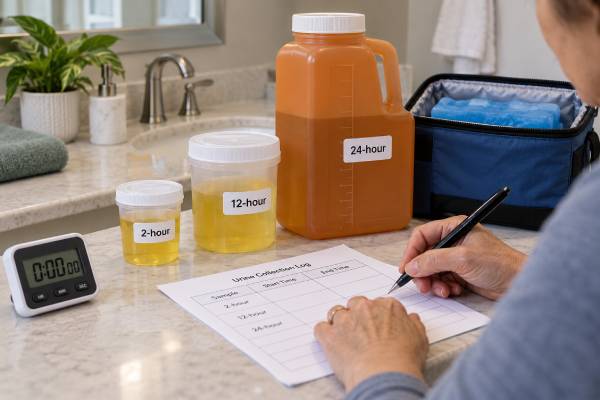
A timed urine collection measures everything excreted in urine during a defined interval, such as 2 hours, 12 hours, or 24 hours. The test is used when the amount excreted over time matters more than the concentration in one random sample. Depending on the analyte, timed collections can measure creatinine clearance, total protein, sodium, calcium, cortisol, stone-risk chemicals, and many other substances. A 24-hour sample is the best-known format because it captures day-and-night variation, but shorter collections may be used in hospitals or for specific clearance studies when a full day is impractical. The main weakness is collection error. Missing even one void, starting or stopping at the wrong time, or collecting for longer than instructed can change the result enough to affect diagnosis or treatment. For that reason, exact timing, complete collection, correct storage, and appropriate checks such as urine creatinine are as important as the laboratory measurement itself.
- A timed urine test measures the total excretion of a substance during a known interval, so both complete urine collection and exact start/stop times are essential.
- A 24-hour collection captures full daily variation, while 2-hour, 4-hour, 6-hour, or 12-hour collections are used selectively for faster clearance or hospital monitoring.
- Missing urine usually makes excretion results falsely low, while overcollection or extending the time can make them falsely high.
- Urine creatinine can help judge collection plausibility, but fixed creatinine cutoffs do not perfectly identify every incomplete sample.
- The correct collection duration depends on the test: a shorter timed sample cannot automatically replace 24-hour testing for protein, sodium, stone risk, or endocrine studies.
Table of Contents
- What a Timed Urine Collection Is
- 2-Hour, 12-Hour, and 24-Hour Collections
- How to Collect a Timed Urine Sample
- Why Collection Errors Matter
- How Labs Check Collection Accuracy
- Common Tests That Use Timed Urine
- How to Interpret and Repeat a Timed Test
What a Timed Urine Collection Is
A timed urine collection is a specimen that includes all urine produced between a precisely recorded start time and stop time. The laboratory then uses the measured urine volume and analyte concentration to calculate how much of the substance was excreted during that interval.
This differs from a spot urine test. A spot sample tells the laboratory what is present in one void at one moment. That can be very useful, especially when a result is expressed relative to urine creatinine. But some substances change throughout the day because of meals, posture, exercise, circadian rhythms, medication timing, and fluid intake. A timed collection can average or quantify that variation.
The simplest calculation is:
Total excretion = urine concentration × total collected volume
If the test involves clearance, the laboratory also divides by time and may use a matching blood concentration. Creatinine clearance, for example, requires urine creatinine, total urine volume, exact collection duration, and serum creatinine.
The phrase “timed urine” therefore describes a method rather than one specific laboratory test. The analyte determines the clinical meaning. A timed urine protein test answers a different question from a timed sodium test, cortisol test, or creatinine clearance.
For broad instructions on the most common format, see the 24-hour urine collection test.
2-Hour, 12-Hour, and 24-Hour Collections
The collection period is chosen to balance physiologic accuracy, convenience, and how quickly the result is needed.
24-hour collections
A 24-hour collection is widely used because it includes waking, sleeping, meals, activity, and normal daily changes. It is often preferred for:
- Total urine protein.
- Urine sodium used to estimate daily sodium excretion.
- Calcium, oxalate, citrate, uric acid, and other kidney-stone measurements.
- Urine creatinine and some creatinine clearance studies.
- Urinary free cortisol.
- Some catecholamine, metanephrine, and specialized metabolic tests.
The advantage is completeness across a whole day. The disadvantage is burden: the patient must collect every void for a long period, often while working, sleeping, commuting, or leaving home.
12-hour collections
A 12-hour collection is sometimes used as a practical alternative when a full day is difficult or when a clinician needs a faster estimate. It may cover daytime, nighttime, or an overnight interval. In hospitalized and critically ill patients, shorter collections are sometimes used to estimate creatinine clearance more quickly because kidney function and drug dosing decisions can change within hours.
The important point is that a 12-hour collection is valid only when the test and clinical protocol support it. Doubling a 12-hour sodium, protein, or calcium amount does not automatically produce an accurate 24-hour value because excretion is not always uniform between day and night.
2-hour and other abbreviated collections
Two-hour, 4-hour, 6-hour, and 8-hour urine collections may be used for selected clearance measurements or specialized tests, especially in inpatient settings. Shorter intervals can reduce missed samples and provide faster results, but they are more vulnerable to short-term fluctuations in creatinine excretion, urine flow, medications, and recent meals.
Recent systematic review evidence in critically ill adults suggests abbreviated urine collections can correlate well with 24-hour creatinine clearance, but may still show meaningful bias. That makes them a clinical tool, not a universal substitute for a full-day collection.
| Collection length | Main advantage | Main limitation |
|---|---|---|
| 2–6 hours | Fast and easier to supervise | More affected by short-term physiologic variation |
| 12 hours | More practical than 24 hours | May not represent opposite day/night period |
| 24 hours | Captures full daily excretion | Higher collection burden and more opportunities for missed urine |
How to Collect a Timed Urine Sample
The basic method is the same whether the interval is 2, 12, or 24 hours: empty the bladder at the start, discard that urine, then collect every drop produced until the stop time, including the final void at the endpoint.
For a 24-hour example:
- At 7:00 a.m., urinate into the toilet. Do not save it. Write down 7:00 a.m. as the start time.
- Collect all urine after that, including daytime, evening, overnight, and the next morning.
- At exactly 7:00 a.m. the next day, urinate one final time and add that sample to the collection.
- Return the container as instructed.
For a 12-hour nighttime collection starting at 8:00 p.m., the same principle applies: empty the bladder at 8:00 p.m. and discard that urine, then save everything through and including the 8:00 a.m. final void.
Storage matters. Some tests require refrigeration, some use acid or another preservative, and some require protection from light. Never pour out a preservative or transfer the specimen to an unapproved container. If the collection bottle contains a chemical, avoid skin contact and follow the laboratory’s safety instructions.
Normal diet and medications are often continued, but not always. Certain endocrine, stone, or drug-monitoring tests have specific preparation rules. Follow the instructions for the exact analyte rather than assuming every timed urine test is prepared the same way.
If you have a bowel movement, take care not to contaminate the urine with stool or toilet paper. Many laboratories provide a collection hat or separate clean cup so urine can be transferred safely to the larger container.
Why Collection Errors Matter
Timed urine testing assumes that the collected container truly represents everything excreted during the stated interval. When that assumption fails, the laboratory may report a precise number that is physiologically wrong.
Common undercollection errors include:
- Forgetting one void at work or away from home.
- Missing overnight urine.
- Spilling part of a sample.
- Forgetting the final void at the exact stop time.
- Ending the test early.
These usually make total excretion look falsely low. A 24-hour urine protein result may appear lower, urine sodium may underestimate salt intake, and creatinine clearance may look worse than it really is.
Overcollection errors include:
- Saving the first urine at the start when it should have been discarded.
- Collecting beyond the scheduled stop time.
- Accidentally combining urine from more than one collection period.
These can make total excretion falsely high.
Timing errors are especially important for clearance. If the laboratory assumes a 24-hour collection but the patient actually collected for 20 hours or 28 hours, the calculated urine flow rate is wrong. The same problem can distort shorter timed clearance studies even more because a 30- or 60-minute error represents a larger fraction of the total interval.
Recent research on 24-hour urinary free cortisol found that inaccurate collections had substantially greater measurement variability than accurate collections. That principle applies broadly: poor collection technique can create apparent biological change even when the patient’s underlying physiology has not changed.
If you know a meaningful amount of urine was missed, the most reliable choice is often to restart rather than hope the result can be mathematically repaired.
How Labs Check Collection Accuracy
The most common check is 24-hour urine creatinine excretion. Creatinine is produced from muscle metabolism and is excreted at a relatively predictable daily amount within an individual. If the total creatinine is implausibly low, the collection may be incomplete; if it is implausibly high, overcollection may be possible.
Older rules often used fixed ranges based on body weight and sex. These are useful rough guides but have limitations. Creatinine production varies with age, muscle mass, height, diet, frailty, amputation, bodybuilding, and chronic kidney disease. Recent population-based studies show that individualized expected creatinine excretion can be more accurate than simple fixed cutoffs.
A 24-hour urine creatinine test can therefore support quality assessment, but it should not be treated as a perfect pass/fail test.
Other clues to poor collection include:
- An implausibly low or high total urine volume.
- Large unexplained differences between repeated collections.
- A measured analyte result that does not fit diet, medication use, or blood tests.
- Patient-reported missed samples or timing problems.
- Start and stop times that do not match the requested interval.
For some studies, repeated collections are more informative than trying to judge one sample as absolutely complete. Sodium intake, for example, varies naturally from day to day, so several complete 24-hour collections can estimate usual intake better than one “perfect” day.
For kidney-stone testing, two separate 24-hour collections are often recommended in high-risk patients because calcium, oxalate, citrate, sodium, and volume can vary even when both collections are technically accurate.
Common Tests That Use Timed Urine
Timed urine collection appears across nephrology, endocrinology, nutrition, and urology.
Kidney filtration
A creatinine clearance test combines timed urine creatinine with serum creatinine and urine volume. Shorter collections may be used in intensive care, while 24-hour collections remain common in outpatient evaluation.
Protein and albumin
A 24-hour urine protein test measures total daily protein loss. First-morning albumin-to-creatinine and protein-to-creatinine ratios are often preferred for routine CKD screening, but full-day collections remain useful when exact excretion is needed.
Electrolytes and nutrition
Timed sodium, potassium, chloride, urea nitrogen, and other measurements can estimate dietary intake or renal handling. For sodium, a full 24 hours is much more useful for individual intake than a random spot sample because sodium excretion changes substantially across the day.
Kidney stone evaluation
Stone panels typically use 24-hour collections for calcium, oxalate, citrate, uric acid, sodium, pH, volume, and related supersaturation calculations. Shorter intervals are generally not interchangeable because meals and circadian patterns affect excretion.
Endocrine testing
Urinary free cortisol, catecholamines, metanephrines, 5-HIAA, and other endocrine markers may use timed collections. These tests often have analyte-specific dietary, medication, preservative, or storage requirements.
The key rule is simple: follow the protocol for the exact test, not just the fact that it uses a urine jug.
How to Interpret and Repeat a Timed Test
A timed result should be interpreted in three layers: Was the right interval collected? Was the collection complete? Does the result fit the clinical context?
If the first two questions are uncertain, the numerical result may not deserve detailed interpretation. This is especially important when the test will determine medication dosing, kidney donor eligibility, diagnosis of severe proteinuria, endocrine disease, or stone-prevention treatment.
Repeat testing is reasonable when:
- A sample was clearly missed or spilled.
- Start or stop times were wrong.
- Urine creatinine suggests the collection may be implausible.
- The result is dramatically different from prior measurements without a clinical explanation.
- The patient’s diet or medications were unusually different on the test day.
- The analyte has strong day-to-day variability and the clinician needs a usual level rather than one-day exposure.
For repeat collections, consistency improves interpretability. Use the same duration, follow the same preparation instructions, and collect on a reasonably typical day unless the clinician intentionally wants to test a specific diet or treatment condition.
Patient instructions also matter. Newer studies continue to show that inaccurate 24-hour collections are common even in specialty centers. Clear written instructions, a specific start/stop example, a plan for collecting urine while away from home, and a reminder for the final void can prevent many errors.
A timed urine test is valuable because it turns urinary concentration into an amount per unit time. That advantage disappears if the time or the amount collected is wrong. Careful collection is therefore not a minor technical detail; it is part of the test itself.
Planning the collection can prevent most avoidable errors. Choose a day when you can keep the container accessible, identify how you will collect urine at work or outside the home, and set alarms for the start and stop times. If refrigeration is required, arrange a cooler or a private refrigerator space in advance. For overnight collections, place the collection equipment where it is easy to use without forgetting a void.
When two timed collections are requested, do not combine them unless the laboratory specifically instructs you to do so. Each interval should have its own start time, stop time, and container. This is particularly important for consecutive 24-hour stone studies because clinicians may want to see day-to-day variation rather than only a pooled average.
The same principle applies to blood samples paired with clearance studies. A timed urine interval and a serum measurement must represent approximately the same physiologic period. If serum creatinine is drawn long before or after the urine collection, or changes rapidly during the interval, the resulting clearance can be misleading even when the urine itself was collected perfectly.
The container itself is part of the test. Some assays require a preservative already placed in the bottle, and that liquid should not be discarded unless the laboratory says otherwise. Other collections must be kept cold, protected from light, or delivered promptly. Because requirements differ by analyte, general internet instructions should never replace the written directions supplied with the specific kit.
If a collection error occurs, guessing is usually worse than documenting it. Note the time and what happened, then contact the laboratory or ordering clinician. Depending on the analyte and the size of the error, the sample may still be usable, may need a correction based on the exact interval, or may need to be repeated. Accurate documentation prevents a technically flawed specimen from being interpreted as a true biological abnormality.
References
- Recommendations for pre-analytical urine sample handling to allow optimal assessment of albuminuria and proteinuria. 2026 (Review)
- Abbreviated Urine Collection Compared With 24-Hour Urine Collection for Measuring Creatinine Clearance in Adult Critically Ill Patients: A Systematic Review 2025 (Systematic Review)
- Population-Based Limits of Urine Creatinine Excretion 2022
- Evaluating variability in 24-hour urine free cortisol measurements: impact of sample collection errors. 2026
- Racial and Demographic Variables Are Associated with Accurate 24-hour Urine Collection Completion and Results 2026
Disclaimer
This article is for general education and does not replace instructions from your laboratory or healthcare professional. Timed urine procedures differ by analyte, and some tests require special diets, medication adjustments, preservatives, refrigeration, or exact blood-test timing. If any urine is missed or the timing is incorrect, contact the ordering laboratory before submitting the specimen.