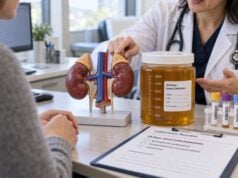
A 24-hour urine albumin test measures the total amount of albumin lost in urine over one complete day. Albumin is a major blood protein that healthy kidneys normally keep in the bloodstream. When the kidney’s filtering barrier is damaged, more albumin can pass into urine, a finding called albuminuria. A 24-hour collection can quantify that loss directly, but it is not the usual first test for most people. Current kidney guidelines generally favor a spot urine albumin-to-creatinine ratio, or uACR, because it is easier to collect and performs well for screening and follow-up. A timed 24-hour test may still be useful when a more direct daily excretion measurement is needed or when spot results do not fit the clinical picture. One abnormal result does not prove chronic kidney disease; persistence, kidney function, medical history, and possible temporary causes all matter.
- Albumin excretion below 30 mg/24 hours is generally A1: 30–300 mg/24 hours is A2, and more than 300 mg/24 hours is A3 albuminuria.
- A spot uACR is usually preferred for screening: A 24-hour collection may be used when precise daily albumin excretion or confirmation is needed.
- One high result does not automatically mean CKD: Chronic kidney disease requires a qualifying kidney abnormality to persist for at least 3 months or other clear evidence of chronicity.
- Temporary albuminuria is common: Fever, vigorous exercise, urinary infection, marked hyperglycemia, and poorly controlled blood pressure can raise urine albumin.
- Collection quality matters: Missing urine can make albumin excretion look falsely low, while collecting for longer than 24 hours can make it look falsely high.
Table of Contents
- What a 24-hour urine albumin test measures
- When the test is used
- How to collect a 24-hour urine sample
- Albumin results and A1, A2, and A3 categories
- Causes of high urine albumin
- How albumin fits into CKD evaluation
- Follow-up after an abnormal result
What a 24-hour urine albumin test measures
The test measures albumin excretion rate over a full day, usually reported as milligrams of albumin per 24 hours. Albumin is made in the liver and circulates in blood, where it helps maintain fluid balance and transports hormones, fatty acids, and other substances. Healthy glomeruli—the tiny filtering units in the kidneys—allow very little albumin to pass into urine.
When the glomerular filtration barrier becomes more permeable, albumin leakage increases. The amount can range from a small but clinically meaningful rise to heavy protein loss. Because albumin is only one type of protein, a urine albumin test is not identical to a total 24-hour urine protein test. Albumin-specific testing is particularly useful for detecting glomerular kidney damage, including early diabetic kidney disease.
A 24-hour result differs from a spot urine albumin-to-creatinine ratio. The 24-hour test directly totals albumin collected over a fixed period. A uACR test estimates albumin loss by comparing albumin with creatinine in one urine sample, which helps correct for how concentrated or dilute that sample is.
For most adults, a properly collected first-morning or random uACR is more convenient and is the preferred initial method in major CKD guidance. A 24-hour collection can be cumbersome and is vulnerable to missed samples. Its value is greatest when the clinician needs an actual daily excretion rate, when results are discordant, or when a timed collection is already being done for another reason.
The test does not measure glomerular filtration rate directly. Kidney filtration is commonly assessed with serum creatinine and an estimated glomerular filtration rate. Albuminuria and eGFR provide different but complementary information: one reflects kidney damage and vascular risk, while the other estimates filtering function.
Albumin excretion also tends to vary with posture and activity. Some younger people can have orthostatic protein excretion, with more protein appearing while upright and less after overnight rest. That is one reason a first-morning spot sample is often useful for confirmation. A 24-hour total blends daytime and nighttime excretion, which can be helpful for quantification but may hide that pattern.
When the test is used
A clinician may order 24-hour urine albumin when a spot test is abnormal and more precise quantification is useful, when repeated spot measurements vary widely, or when a timed excretion measurement is important for a specialist evaluation. It may also be included in broader 24-hour urine studies.
People at higher risk of albuminuria include those with diabetes, hypertension, cardiovascular disease, known kidney disease, or a family history of kidney failure. However, routine screening usually begins with uACR rather than a timed collection because a spot sample is easier and reduces collection error.
A 24-hour test can help when urine creatinine concentration makes a spot ratio difficult to interpret. For example, people with unusually low or high muscle mass may excrete less or more creatinine than average. The uACR remains useful in most cases, but a direct timed excretion measurement can sometimes clarify a result that seems inconsistent with the rest of the evaluation.
Nephrologists may also use timed albumin measurements in selected research, pregnancy, or complex kidney cases, although the preferred test depends on the clinical question. A 24-hour urine albumin result should not be ordered merely because it seems more comprehensive. If the collection is incomplete, a supposedly precise number can be less reliable than a well-collected spot sample.
The test is not a stand-alone way to diagnose the cause of kidney disease. Albuminuria can occur in diabetic kidney disease, glomerulonephritis, hypertension-related kidney injury, heart failure, systemic inflammatory disease, and many other conditions. The pattern of blood pressure, eGFR, urine sediment, medications, medical history, and imaging often determines what additional testing is needed.
How to collect a 24-hour urine sample
The accuracy of a 24-hour albumin result depends heavily on collecting every void during the timed period. The laboratory should provide the container and storage instructions. Preservatives are not always the same between tests, so a container from another 24-hour urine study should not be substituted without laboratory approval.
A typical collection works this way:
- Pick the instructed start time, often after waking.
- Empty the bladder into the toilet and record the time. Do not put this first urine into the container.
- Collect every urine sample after that for the next 24 hours.
- At the exact stop time the next day, urinate one final time and add it to the collection.
- Keep the container refrigerated or stored as instructed, and return it promptly.
The first discarded void marks the point at which the bladder is empty. The final void exactly 24 hours later captures urine produced during the last part of the timed period. This start-and-stop method is a key part of any timed urine collection.
If a sample is missed, spilled, or accidentally flushed, the laboratory often recommends restarting. Adding an estimated amount is not a reliable correction. Collecting 26 or 28 hours instead of 24 hours can inflate the total, while stopping early can lower it.
Hydration should generally remain usual unless the clinician gives special instructions. Drinking large amounts of water does not “wash out” albumin excretion; it mainly changes urine volume. Because the result is a total amount per day rather than a concentration, complete collection matters more than whether each individual void is dilute.
Strenuous exercise can temporarily raise albumin excretion, so the care team may ask you to avoid unusually hard activity before or during testing. Acute fever, symptomatic urinary infection, menstruation with sample contamination, or an abrupt illness may also make it better to postpone testing if the result is meant to reflect a stable baseline.
Some laboratories measure 24-hour urine creatinine along with albumin to judge whether the collection seems plausible. A very low creatinine total can suggest missed urine, but it can also occur in a person with low muscle mass. A urine creatinine test is therefore a clue to collection quality, not an absolute pass-or-fail test.
Albumin results and A1, A2, and A3 categories
Kidney guidelines classify albuminuria by the amount excreted. For a timed collection, the commonly used categories are:
| Albumin category | 24-hour albumin excretion | General meaning |
|---|---|---|
| A1 | Less than 30 mg/24 hours | Normal to mildly increased |
| A2 | 30–300 mg/24 hours | Moderately increased |
| A3 | More than 300 mg/24 hours | Severely increased |
These categories describe risk, not a specific diagnosis. A person with A2 albuminuria may have early kidney damage even if eGFR remains normal. Conversely, someone can have reduced eGFR with little albuminuria, depending on the underlying disease.
The older term “microalbuminuria” usually referred to the A2 range. Modern guidelines prefer “moderately increased albuminuria” because the albumin molecule itself is not smaller; the word “micro” described the amount, not the protein.
The albumin categories also have close uACR equivalents: A1 is generally below 30 mg/g, A2 is 30–300 mg/g, and A3 is above 300 mg/g. A broader albuminuria assessment uses these categories together with eGFR to estimate kidney and cardiovascular risk.
A result near a cutoff should not be treated as a sharp biological boundary. Albumin excretion varies from day to day. A value of 29 mg/day and one of 31 mg/day are clinically very similar; the important question is whether elevation persists and how it fits with the person’s overall risk.
Very high albumin loss may occur with nephrotic-range proteinuria, but a 24-hour albumin result alone does not define nephrotic syndrome. Clinicians assess total protein loss, serum albumin, edema, lipids, and the underlying kidney disorder. If the report includes both total protein and albumin, those values answer related but different questions.
Causes of high urine albumin
Persistent albuminuria usually reflects kidney or systemic vascular disease, but a temporary rise is common. The distinction is one reason repeat testing is so important.
Diabetes is a leading cause. Chronic hyperglycemia can damage glomerular capillaries and increase albumin leakage. Albuminuria may appear before a major fall in eGFR, which makes urine testing useful for early detection and risk stratification.
High blood pressure can both cause and worsen glomerular injury. Persistent albuminuria in a person with hypertension signals higher kidney and cardiovascular risk. Treatment often focuses on blood-pressure control and, when appropriate, kidney-protective medicines.
Primary glomerular diseases can cause substantial albumin loss. Examples include IgA nephropathy, membranous nephropathy, focal segmental glomerulosclerosis, and other inflammatory or immune-mediated disorders. Blood in urine, casts, rapidly changing kidney function, edema, or very high protein excretion may prompt a more urgent nephrology evaluation.
Temporary or functional causes include vigorous exercise, fever, acute illness, urinary infection, severe hyperglycemia, and marked blood-pressure elevation. Heart failure and other states that change kidney blood flow can also increase albumin excretion. These situations can produce a true rise in urine albumin without proving chronic structural kidney damage.
Sample contamination can confuse the result. Blood from menstruation or urinary tract bleeding can add protein to the specimen. A symptomatic urinary infection may cause both albumin and other urine abnormalities. When contamination or acute illness is likely, repeating the test after the issue resolves can provide a better baseline.
How albumin fits into CKD evaluation
Albuminuria is one of the main markers used to define and stage chronic kidney disease, but chronicity matters. CKD is generally diagnosed when kidney structure or function is abnormal for at least 3 months and has health implications. A single high albumin result during an acute illness is not enough.
The most informative kidney assessment usually combines albuminuria with eGFR. Someone with normal eGFR but persistent A3 albuminuria can still have significant CKD and substantial future risk. Someone with a low eGFR and A1 albuminuria may have a different disease pattern and risk profile.
Risk rises as either eGFR falls or albuminuria increases. That is why albumin is more than a “kidney leak” measurement. Persistent albuminuria is also associated with higher cardiovascular risk, even at levels below heavy proteinuria. The test helps identify people who may benefit from tighter blood-pressure, diabetes, and cardiovascular risk management.
Follow-up may include blood pressure checks, serum creatinine, potassium, glucose or A1C, urinalysis, and medication review. If there is blood in the urine, rapidly falling eGFR, severe albuminuria, systemic symptoms, or uncertainty about the diagnosis, clinicians may add serologic tests, imaging, or specialist referral.
A normal 24-hour albumin result is reassuring but does not rule out every form of kidney disease. Tubulointerstitial disorders, inherited kidney diseases, obstruction, and some vascular conditions can reduce kidney function without causing much albuminuria. The urine result must therefore be read beside the rest of the kidney evaluation.
Another practical point is that albumin excretion can change before serum creatinine changes enough to move eGFR. That makes persistent albuminuria an early risk signal in some diseases, especially diabetes and hypertension. It also means that a person can feel well and have no visible urine changes while clinically important albumin leakage is present. Foamy urine is not a reliable screening sign because bubbles can occur from urine concentration, stream force, or cleaning products. Laboratory measurement is much more useful than judging urine appearance.
Follow-up after an abnormal result
The first step after an unexpected high result is usually confirmation. If the person was acutely ill, had exercised intensely, had a urinary infection, or had a collection problem, repeating testing under stable conditions may be more informative than immediately labeling the finding as CKD.
For most people, follow-up is often done with a first-morning uACR rather than another 24-hour collection. The first-morning sample reduces some variation related to posture, activity, and urine concentration. If repeated results remain abnormal, the clinician considers duration, eGFR, blood pressure, diabetes status, medications, and the degree of albuminuria.
Treatment depends on the cause. Blood-pressure control, glucose management, smoking cessation, appropriate use of renin-angiotensin system blockers, sodium-glucose cotransporter-2 inhibitors, and other kidney-protective therapies may reduce albuminuria and slow CKD progression in selected patients. These medicines have specific indications and safety considerations, so a change in treatment should come from the treating clinician rather than from the urine number alone.
A rapid increase in albuminuria, very high protein loss, new swelling, visible blood in urine, or a sudden decline in kidney function deserves prompt assessment. Severe shortness of breath, confusion, very low urine output, or rapidly worsening edema can indicate an acute problem and may require urgent care.
For long-term monitoring, consistency helps. Use the same test type when possible, collect under similar conditions, and avoid comparing a stable first-morning uACR directly with a poorly collected 24-hour specimen as though they were identical measurements. The goal is not to chase small day-to-day changes but to identify a persistent trend that changes clinical risk or management.
A 24-hour urine albumin test is therefore a quantitative tool, not a diagnosis by itself. Its value comes from accurate collection, correct category interpretation, confirmation of persistence, and integration with eGFR and the person’s broader health picture.
References
- KDIGO 2024 Clinical Practice Guideline for the Evaluation and Management of Chronic Kidney Disease 2024 (Guideline)
- Executive summary of the KDIGO 2024 Clinical Practice Guideline for the Evaluation and Management of Chronic Kidney Disease: known knowns and known unknowns 2024 (Guideline)
- Urine Albumin Measurements in Clinical Diagnostics 2024 (Review)
- Albuminuria in Cardiovascular, Kidney, and Metabolic Disorders: A State-of-the-Art Review 2025 (Review)
- Developments in albuminuria testing: A key biomarker for detection, prognosis and surveillance of kidney and cardiovascular disease—A practical update for clinicians 2025 (Review)
- Screening, identifying, and treating chronic kidney disease: why, who, when, how, and what? 2023 (Review)
Disclaimer
This article provides general education about urine albumin testing and is not a diagnosis or treatment plan. Albumin results should be interpreted with the laboratory range, eGFR, blood pressure, diabetes status, recent illness, and collection quality. Seek prompt medical assessment for rapidly worsening swelling, major shortness of breath, very low urine output, or a sudden change in kidney function.