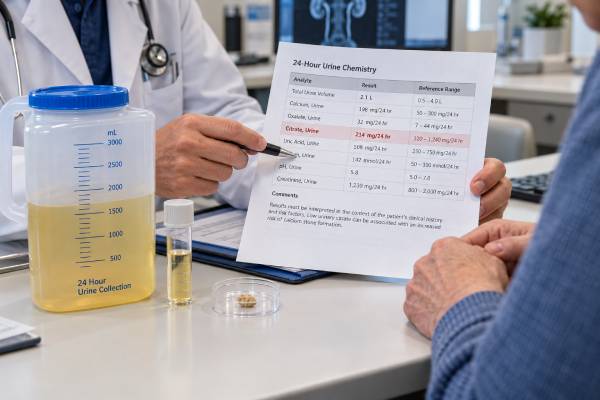
A 24-hour urine citrate test measures how much citrate is excreted over a full day, usually as part of a metabolic evaluation for kidney stones. Citrate is an important natural inhibitor of calcium stones. It binds calcium in urine, reducing the amount available to combine with oxalate or phosphate, and it can also slow crystal growth and aggregation. Low urinary citrate, called hypocitraturia, raises the risk of calcium oxalate and calcium phosphate stones, but the result must be interpreted with urine pH, volume, calcium, oxalate, sodium, potassium, and kidney function. A commonly used threshold for hypocitraturia is below about 320 mg/24 hours, although laboratory ranges differ and stone risk changes gradually rather than at one exact cutoff. Acid-base balance, diet, chronic diarrhea, low potassium, certain medicines, and kidney tubular disorders can all lower citrate. Treatment may include diet changes or potassium citrate in selected patients.
- Low urine citrate increases calcium-stone risk: A commonly used cutoff is below about 320 mg/24 hours, but the laboratory range and the whole stone profile matter.
- Citrate protects against stones in more than one way: It binds urinary calcium and can reduce crystal formation, growth, and aggregation.
- Acid load often lowers citrate: Chronic diarrhea, metabolic acidosis, high animal-protein intake, low potassium, and distal renal tubular acidosis can contribute.
- Some medicines lower citrate: Topiramate and acetazolamide can cause alkaline urine with hypocitraturia and raise calcium phosphate stone risk.
- Potassium citrate can help selected patients: It raises urine citrate and usually urine pH, so treatment should be tailored to stone type and blood potassium safety.
Table of Contents
- What citrate does in urine
- Why a 24-hour urine citrate test is ordered
- How to collect the sample correctly
- What low urine citrate can mean
- Citrate, urine pH, and stone type
- Ways to raise urine citrate
- Follow-up after 24-hour urine testing
What citrate does in urine
Citrate is a small organic molecule produced during normal energy metabolism. In the kidneys, citrate is filtered into urine and partly reabsorbed in the proximal tubule. How much remains in urine is strongly influenced by the body’s acid-base state.
Urinary citrate is protective against calcium stones. It binds, or complexes, with calcium. Once calcium is bound to citrate, less free calcium is available to combine with oxalate or phosphate. Citrate can also interfere with the nucleation, growth, and clumping of calcium crystals.
This is why a person can have only moderately high urine calcium yet still form stones if citrate is very low. Stone risk comes from the chemical balance among promoters and inhibitors rather than from one isolated analyte. A broader 24-hour kidney stone risk test measures citrate together with calcium, oxalate, uric acid, sodium, urine volume, pH, and other factors.
Citrate excretion is commonly reported in milligrams per 24 hours or millimoles per day. A frequently used definition of hypocitraturia is less than about 320 mg/day in adults. However, this number should not be treated as a rigid biological boundary. Different laboratories use different methods and ranges, and stone risk generally changes along a continuum.
Some stone specialists also consider citrate relative to urine volume or other risk factors rather than relying only on the total. A citrate value that appears acceptable may still be less protective when urine calcium is very high or urine volume is low. Conversely, a slightly low citrate value may be less concerning if the rest of the profile is favorable.
Reference ranges can also vary with laboratory technique and patient population. Children and adolescents may use age-adjusted ranges, and adults with very small or large body size may need more context than a single absolute daily value provides. If a result is unexpectedly low, clinicians first check whether the 24-hour collection appears complete before assuming a true physiologic deficiency. A low urine volume, missed samples, or a very low creatinine total can all make citrate excretion look lower than it really is. Repeating the collection is often more informative than escalating treatment from one questionable specimen.
Why a 24-hour urine citrate test is ordered
The most common reason is recurrent calcium kidney stones. Citrate measurement helps identify a modifiable risk factor that cannot be inferred reliably from a standard urinalysis or blood test.
A metabolic stone evaluation is especially useful in people with recurrent stones, multiple stones, stones at a young age, bilateral stones, nephrocalcinosis, a strong family history, unusual stone composition, or medical conditions that increase recurrence risk. Many guidelines recommend one or two 24-hour collections for higher-risk stone formers because urine chemistry varies from day to day.
The test may also be ordered when imaging shows calcium stones but the cause is unclear. If citrate is low, the clinician looks for acid-base disorders, chronic gastrointestinal bicarbonate loss, low potassium, dietary acid load, or medicines that alter kidney handling of bicarbonate and citrate.
Citrate can be particularly important in people taking topiramate for migraine prevention, seizures, or other indications. Topiramate inhibits carbonic anhydrase, which can raise urine pH and lower urine citrate. That combination can increase calcium phosphate stone risk even when urine calcium is not dramatically elevated.
A urine calcium test for kidney stones is often measured in the same collection. High calcium and low citrate together create a stronger calcium-stone environment than either abnormality alone. Similarly, a urine oxalate test helps identify excess oxalate exposure or absorption.
The test is generally not used to screen healthy people without a stone history or another clear, specific clinical indication. Its value is greatest when the result will change stone-prevention advice or help explain a recurrent pattern.
How to collect the sample correctly
A 24-hour urine citrate result depends on collecting every urine sample during the timed period. The laboratory provides the container and storage instructions. Some stone-risk panels use preservatives or specific handling methods, so patients should not transfer the urine into an unapproved container.
A typical collection is performed as follows:
- Choose the instructed start time, often after waking.
- Empty the bladder into the toilet and record that start time.
- Collect every urine sample after that for the next 24 hours.
- Keep the collection refrigerated or stored exactly as directed.
- At the same clock time the next day, collect one final void and add it to the container.
- Return the specimen with the requested start and stop times, total volume, medication list, and diet information.
Missing a void can make citrate excretion appear falsely low. Collecting longer than 24 hours can make the total appear falsely high. If urine is lost or spilled, ask the laboratory whether the collection should be restarted rather than estimating the missing amount.
For most stone evaluations, the goal is to capture the person’s usual diet and fluid habits. Suddenly drinking several extra liters of water, eliminating all salt, or eating an unusually “healthy” menu only on collection day can produce a profile that does not represent normal risk. Unless the clinician gives different instructions, the collection day should be typical.
Dietary citrate can affect urine chemistry, but it is not the only determinant of urinary citrate. Citrus foods may increase alkali intake, while the acid load from protein and the alkali content of fruits and vegetables influence kidney citrate handling. A single meal is less important than the overall pattern.
Medication information is essential. Potassium citrate directly raises urinary citrate, while topiramate and acetazolamide can lower it. Thiazide diuretics may change calcium and potassium handling. Patients should not stop these medicines unless the clinician instructs them to do so; sometimes the purpose of testing is to see how well the current regimen is working.
Urine creatinine is often included as a rough collection-quality check. Low creatinine excretion may suggest undercollection, but it can also reflect low muscle mass, older age, or small body size. A 24-hour urine creatinine test is therefore supportive rather than definitive.
What low urine citrate can mean
Low urinary citrate often reflects increased acid retention or an increased dietary acid load. When the body needs to conserve base, the kidney reabsorbs more citrate and excretes less of it in urine. That physiologic response is helpful for acid-base balance but unfavorable for calcium-stone prevention.
Chronic diarrhea and gastrointestinal bicarbonate loss are important causes. Repeated loss of bicarbonate through stool creates an acid load, which can lower urine citrate. People with inflammatory bowel disease, short bowel, ostomies, or chronic diarrheal disorders may therefore have low citrate and an increased stone risk.
Distal renal tubular acidosis, or distal RTA, is a classic kidney cause. The distal nephron cannot acidify urine normally, leading to systemic metabolic acidosis, relatively alkaline urine, hypocitraturia, and a tendency toward calcium phosphate stones or nephrocalcinosis. In incomplete distal RTA, blood bicarbonate may be near normal while urine acidification is still impaired.
Low potassium can lower citrate excretion. Potassium depletion increases intracellular acidosis in kidney tubular cells and favors citrate reabsorption. Clinicians therefore look at blood potassium and urine potassium when hypocitraturia is unexplained.
Dietary patterns matter. A high intake of animal protein can increase dietary acid load, while fruits and vegetables provide alkali precursors that may support higher citrate excretion. Excess sodium can raise urinary calcium, compounding the risk created by low citrate.
Medications are common contributors. Topiramate and acetazolamide inhibit carbonic anhydrase. They can cause bicarbonate loss, raise urine pH, and reduce citrate, a pattern that can promote calcium phosphate stones. If stones develop on these drugs, the prescriber may adjust treatment or add preventive therapy rather than stopping the medicine abruptly.
Hypocitraturia can also occur without an obvious secondary cause. Genetic factors and individual differences in renal citrate transport may contribute. The practical goal is still to correct modifiable drivers and reduce overall supersaturation.
Urine citrate also changes over the day with meals and acid-base shifts, which is another reason a full-day total can be useful. A spot result taken after a meal may not represent overnight or fasting excretion. The 24-hour value averages those changes, but it also depends on a complete collection. If an unexpectedly low citrate result is paired with other implausibly low daily analytes, undercollection should be considered before treatment is intensified.
Citrate, urine pH, and stone type
Citrate cannot be interpreted without urine pH. Raising citrate is often beneficial, but many citrate treatments also raise pH, and pH changes affect different stone types in different ways.
For calcium oxalate stones, low citrate is usually unfavorable, and increasing citrate often reduces risk. A higher urine volume, normal dietary calcium, lower excess sodium, and controlled oxalate exposure may be used at the same time.
For uric acid stones, low urine pH is a central problem. Alkali therapy such as potassium citrate can raise urine pH enough to reduce uric acid crystallization and may even help dissolve some uric acid stones. A urine pH test for kidney stones helps guide this approach.
For calcium phosphate stones, the picture is more delicate. Citrate remains a calcium-binding inhibitor, but a high urine pH increases calcium phosphate supersaturation. Potassium citrate can still be appropriate in selected patients, especially when citrate is very low, but clinicians monitor urine pH and supersaturation rather than assuming that more alkali is always better.
This tradeoff is especially relevant in distal RTA and topiramate-associated stones. These patients may already have alkaline urine. Correcting systemic acidosis and low citrate can be valuable, yet treatment needs to avoid an unnecessary rise in calcium phosphate supersaturation.
A urine supersaturation test can help integrate calcium, oxalate, phosphate, citrate, pH, and volume into a chemical risk estimate. Changes in supersaturation after therapy are often more meaningful than chasing one isolated value.
Ways to raise urine citrate
Treatment begins with the cause. A person with chronic diarrhea needs a different plan from someone whose low citrate reflects a high dietary acid load or topiramate use.
Increase fruits and vegetables when appropriate. Plant foods provide potassium and alkali precursors that can reduce net dietary acid load. Citrus fruits contain citrate, but the amount that reaches urine as citrate depends on the accompanying cation and overall metabolism. Lemon juice may help some people, but its effect is less predictable than prescribed potassium citrate.
Maintain normal dietary calcium. Severe calcium restriction is usually not the answer for calcium stones. Normal calcium intake with meals helps bind oxalate in the intestine and may lower urinary oxalate. The best amount depends on age, bone health, diet, and clinician advice.
Reduce excess sodium. Lowering high sodium intake can reduce urinary calcium and may improve the overall stone profile even if citrate itself changes little. A urine sodium test can show whether sodium reduction is having the intended effect.
Moderate excessive animal protein. Very high animal-protein intake can increase acid load, lower citrate, and affect uric acid. This does not mean every stone former needs a low-protein diet; the goal is a balanced intake matched to nutritional needs.
Potassium citrate is a common prescription therapy for hypocitraturia and certain stone types. It provides alkali and potassium, increases urine citrate, and usually raises urine pH. Dosing is individualized based on urine chemistry and tolerance.
Potassium citrate is not appropriate for everyone. People with advanced kidney disease, a tendency to high blood potassium, or certain medication combinations may be at risk for hyperkalemia. Sodium-based alkali can sometimes be used but may increase sodium load and urinary calcium. Blood chemistry monitoring is therefore part of safe treatment.
Follow-up after 24-hour urine testing
Follow-up testing is most useful after enough time has passed for a diet or medication change to affect urine chemistry. The exact interval varies, but stone specialists often repeat a 24-hour urine profile after treatment is established and then periodically if the person remains at high risk.
A repeat collection should ideally use similar conditions and the same laboratory. Day-to-day variability can be substantial, so a small change in citrate may not be meaningful. A larger rise accompanied by lower calcium oxalate or calcium phosphate supersaturation is more convincing evidence that the prevention plan is working.
The clinician also watches for tradeoffs. Potassium citrate may improve citrate while raising pH. A thiazide may lower urine calcium but also lower blood potassium in some patients, which can worsen hypocitraturia. Combining the entire urine profile with blood electrolytes helps identify these interactions.
Stone analysis is also valuable. Knowing whether a passed or removed stone is calcium oxalate, calcium phosphate, uric acid, cystine, or another material can change how a citrate result is interpreted. A low citrate value has different management implications depending on the stone type.
Seek prompt medical care for fever with flank pain, inability to urinate, severe persistent vomiting, or pain that cannot be controlled. Those symptoms can signal an obstructed or infected urinary tract and are more urgent than the citrate value itself.
A 24-hour urine citrate test is most useful as part of a complete stone-risk assessment. Low citrate is common and often treatable, but successful prevention depends on understanding why it is low, how urine pH behaves, and whether the full chemistry profile improves with therapy.
References
- Metabolic evaluation for prevention of kidney stones 2026 (Guideline)
- Prevention of Recurrent Kidney Stones: A CARI Guidelines Summary 2026 (Guideline)
- Kidney Stone Pathophysiology, Evaluation and Management: Core Curriculum 2023 2023 (Review)
- Citrate and calcium kidney stones 2025 (Review)
- Metabolic Evaluation and Recurrence Prevention 2026 (Guideline)
Disclaimer
This article is for general education and does not diagnose or treat kidney stone disease. Urine citrate should be interpreted with urine pH, volume, calcium, oxalate, sodium, kidney function, medicines, and stone composition. Potassium citrate and other alkali therapies can affect blood potassium and urine pH and should be used under appropriate medical supervision.