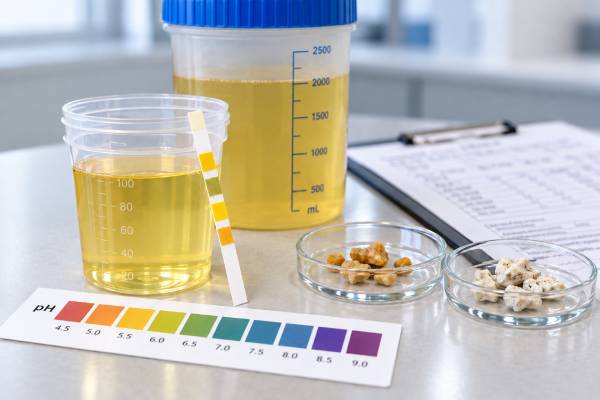
A urine pH test shows how acidic or alkaline your urine is. For kidney stone evaluation, pH is important because different stone minerals crystallize best at different acidity levels. Persistently acidic urine strongly favors uric acid stones, while higher urine pH can favor calcium phosphate stones and may occur with urease-producing urinary infections that cause struvite stones. One reading is not enough to identify a stone type because urine pH changes through the day with meals, medications, hydration, and normal kidney acid handling. The most useful interpretation combines pH with stone analysis, urine volume, calcium, citrate, uric acid, infection testing, and supersaturation. A 24-hour collection can show the average daily environment, while fresh spot measurements at several times of day are especially useful when treatment is intended to raise urine pH. Results also need to be measured accurately; pH meters are generally more reliable than ordinary dipsticks when treatment decisions depend on small changes.
- Urine pH around 5.7–6.3 is a common reference range, but stone risk depends on the pattern and stone type.
- Persistently low urine pH below about 5.5 is a major driver of uric acid stone formation.
- Higher pH, especially above about 6.5–6.8, increases calcium phosphate crystallization risk.
- Very alkaline urine with infection can point toward urease-producing bacteria and struvite stone risk.
- A single dipstick result cannot diagnose a stone type; repeat pH, urine culture, stone analysis, and 24-hour chemistry may be needed.
Table of Contents
- What urine pH measures
- Normal, acidic, and alkaline ranges
- Low pH and uric acid stones
- High pH, calcium phosphate, and struvite stones
- What can change urine pH
- How to test urine pH accurately
- What to do with an abnormal result
What urine pH measures
Urine pH is a measure of hydrogen ion activity on a scale where lower numbers are more acidic and higher numbers are more alkaline. The scale is logarithmic, so a change from pH 5 to pH 6 represents a much larger chemical shift than the one-point difference may suggest.
The kidneys help control acid-base balance by excreting acid, conserving bicarbonate, and producing ammonium that buffers hydrogen ions in urine. The resulting urine pH changes with food, metabolic acid production, gastrointestinal losses, medications, infection, and kidney tubular function.
In kidney stone disease, pH matters because it changes the solubility and charge of stone-forming substances. Uric acid becomes much less soluble as urine becomes more acidic. Phosphate chemistry shifts in the opposite direction: as pH rises, more phosphate exists in a form that can combine with calcium and form calcium phosphate crystals. Infection stones form under another alkaline condition produced by certain bacteria.
That makes urine pH different from many other stone markers. A low or high value is not universally “bad.” The same pH can reduce one stone risk while increasing another. For example, raising urine pH is a cornerstone of uric acid stone treatment, but excessive alkalinization can increase calcium phosphate supersaturation.
A clinician therefore interprets pH as part of a kidney stone test panel rather than as a stand-alone diagnosis. Relevant companion results include urine uric acid, calcium, citrate, phosphate, volume, ammonium when available, culture findings, and calculated supersaturation.
Normal, acidic, and alkaline ranges
A commonly cited 24-hour urine pH reference range for stone evaluation is roughly 5.7–6.3, although healthy urine can move outside that interval during the day. Laboratories may use different ranges, and the clinical target depends on the stone type.
Current European guidance considers a 24-hour urine pH below 5.5 hyperacidic. Persistently acidic values are particularly important in uric acid stone formers. A 24-hour pH above about 6.2, especially with a fasting morning spot pH above 5.8, can raise suspicion for distal renal tubular acidosis when infection has been excluded. Values consistently above 7.0 can suggest urinary infection, although alkaline urine alone does not prove that bacteria are present.
For calcium phosphate stones, risk tends to rise as urine pH increases. Calcium phosphate supersaturation rises rapidly above about pH 6.0, and pH above approximately 6.5–6.8 is especially favorable for brushite or apatite crystallization depending on the rest of the urine chemistry.
| pH pattern | Possible stone relevance | Important follow-up |
|---|---|---|
| Persistently below 5.5 | Strongly favors uric acid crystallization | Uric acid, volume, metabolic syndrome factors, treatment target |
| About 5.7–6.3 | Common reference range | Interpret with stone type and supersaturation |
| Above about 6.5 | Can increase calcium phosphate risk | Calcium, citrate, phosphate, medications, distal RTA |
| Persistently above 7.0 | May occur with urease-positive infection | Urinalysis and urine culture |
These cutoffs are guides, not absolute borders. A person can form uric acid stones with occasional pH values above 5.5 if most of the day remains acidic. Likewise, high pH causes calcium phosphate stones mainly when enough calcium and phosphate are present and inhibitors such as citrate are insufficient.
The laboratory report may show one pH number for the entire 24-hour collection, but clinicians often care about the pattern more than that single average. Suppose a person taking potassium citrate measures pH 6.4 after breakfast, 6.2 in the afternoon, and 5.2 overnight. The daily average may look acceptable even though several hours remain strongly favorable for uric acid crystallization. The opposite problem can occur in a calcium phosphate stone former who spends much of the day above pH 6.8 after aggressive alkali therapy.
This is also why “neutral urine” is not a universal goal. A pH of 7 sounds intuitively ideal, but it may be unnecessary or counterproductive for many stone formers. The preferred range is tied to the mineral that is forming, the reason for treatment, and the measured supersaturation response. When the stone type is unknown, clinicians generally avoid making large pH-directed changes until stone analysis and the rest of the metabolic profile are available.
Low pH and uric acid stones
Persistently acidic urine is the most important chemical driver of uric acid stones. Uric acid is much less soluble than its ionized urate form. As pH falls, more urate gains a proton and becomes poorly soluble uric acid, which can crystallize even when the total amount of uric acid in the urine is not extremely high.
This is why a person can develop a uric acid stone without marked hyperuricosuria. Low urine volume makes the problem worse by concentrating uric acid, while high urinary uric acid adds to the load. A uric acid stone risk test therefore emphasizes pH, uric acid, and volume together.
Persistently low pH is common in people with insulin resistance, type 2 diabetes, obesity, metabolic syndrome, and gout. One mechanism is reduced ammonium buffering. The kidney may excrete acid without raising free urine pH adequately because less ammonium is available to carry hydrogen ions. Chronic diarrhea can also lower urine pH by causing gastrointestinal bicarbonate loss. Diets very high in animal protein can increase acid load as well.
Uric acid stones are unusual because they can often be dissolved medically. Treatment typically aims to alkalinize urine, commonly with potassium citrate when appropriate. The dose is adjusted to urine pH rather than given blindly. Clinicians usually avoid pushing pH excessively high because very alkaline urine may raise calcium phosphate risk.
Fresh home pH measurements can be useful during alkalinization treatment because a single 24-hour average may hide periods of excessive acidity. A person may have a reasonable daily average yet spend the overnight and early morning hours below the desired range. Timing medication and fluid can sometimes improve that pattern.
The urine uric acid result still matters. High uric acid excretion can contribute to uric acid stones and may also promote calcium oxalate crystallization in some patients. But for pure uric acid stones, correcting persistent acid urine is usually the central chemical target.
High pH, calcium phosphate, and struvite stones
High urine pH is important for two different stone categories: calcium phosphate stones and infection-related struvite stones. The mechanisms are not the same.
Calcium phosphate forms more readily as urine pH rises because phosphate shifts toward a divalent form that binds calcium. Calcium phosphate stones commonly contain hydroxyapatite or brushite. Their major urinary risk factors include high pH, high urine calcium, and low citrate. The urine phosphorus test can add context, but phosphate excretion by itself does not determine calcium phosphate stone formation.
Causes of persistently high pH include distal renal tubular acidosis, carbonic anhydrase inhibitor drugs such as topiramate or acetazolamide, alkali therapy, and some dietary patterns. Distal renal tubular acidosis is especially relevant when high urine pH occurs with low citrate, kidney stones or nephrocalcinosis, low blood bicarbonate in complete forms, or unexplained calcium phosphate stones.
Struvite stones arise in the setting of infection with urease-producing organisms. Urease splits urea and generates ammonia, which raises urine pH and creates conditions favorable for magnesium ammonium phosphate and carbonate apatite. These stones can grow quickly and may become large branching or “staghorn” stones.
A very alkaline pH does not diagnose struvite. Urinary infection must be evaluated with symptoms, urinalysis, and culture. The struvite stone evaluation is particularly important when there are recurrent infections, fever, persistent bacteriuria, or imaging suggests a large infection stone.
High pH can also be caused by a urine sample that sits too long before testing because bacterial growth can alter chemistry. That is another reason fresh measurement and correct specimen handling matter.
What can change urine pH
Urine pH is dynamic. It can vary by more than a full pH unit across a day, so one unexpected result should be interpreted cautiously.
Meals often produce a temporary alkaline tide after eating. Diets rich in fruits and vegetables generally provide more alkali, while high animal-protein intake produces more net acid. This does not mean everyone with a low pH needs a vegetarian diet; the practical goal is a balanced pattern that improves the measured risk profile.
Medications can have large effects. Potassium citrate and sodium bicarbonate raise urine pH. Topiramate, acetazolamide, and similar carbonic anhydrase inhibitors can also raise urine pH while lowering citrate, a combination that can increase calcium phosphate stone risk. Some drugs and supplements affect acid-base balance indirectly.
Gastrointestinal disease matters in both directions. Chronic diarrhea can lower urine pH through bicarbonate loss and can also reduce urine volume and citrate. Vomiting can produce different acid-base effects depending on severity and kidney response.
Metabolic health is important. Insulin resistance and type 2 diabetes are strongly linked with persistently acidic urine and uric acid stones. Gout can coexist with low pH and hyperuricosuria, but serum uric acid alone cannot tell you what the urine pH is.
Urinary infection with urease-producing organisms can raise pH substantially. Common bacteria that cause ordinary UTIs do not all produce urease, so a high pH must be matched to culture results rather than assumed to mean infection.
Finally, time of day and storage affect the number. First-morning urine is often more acidic, while a delayed sample can drift because of bacterial activity or carbon dioxide loss. If treatment depends on pH, repeated fresh measurements are much more informative than an old sample tested hours later.
Hydration changes pH less predictably than it changes concentration. Drinking more water can lower stone supersaturation by dilution even if pH barely moves, so a person should not judge hydration success from pH alone. Urine volume is a separate and often more powerful prevention target. Likewise, clear urine is not proof that pH is in a desired range. These measurements answer different questions and should not be substituted for one another.
How to test urine pH accurately
There are three common ways to assess urine pH: a laboratory measurement from a 24-hour collection, a fresh spot urine measurement, and home testing.
A 24-hour pH describes the overall collection and is useful during a comprehensive metabolic evaluation. It pairs directly with calcium, citrate, oxalate, uric acid, sodium, phosphate, and volume from the same day. The main weakness is that an average can hide important peaks and troughs.
Fresh spot measurements show variation through the day. They are especially useful when managing uric acid or cystine stones with alkalinizing medication. Clinicians may ask for measurements before meals, after medication, or at bedtime depending on the treatment goal.
Ordinary urine dipsticks are convenient but may be too imprecise when a small difference changes treatment. Current CARI guidance recommends pH devices rather than standard dipsticks for clinical management of stone disease because dipsticks can be inaccurate, particularly at higher pH. A calibrated electronic meter or high-quality narrow-range pH paper may provide better resolution when used correctly.
For the most useful home log:
- test fresh urine rather than a sample that has sat for hours;
- record the time, pH, medication timing, and major meals;
- use the same method consistently;
- store strips as directed and check expiration dates; and
- bring several days of readings to the clinician rather than reacting to one value.
A home pH test should not replace a 24-hour urine collection when a full metabolic evaluation is needed. The two methods answer different questions and often complement each other.
What to do with an abnormal result
An abnormal pH should lead to a stone-specific check, not an automatic attempt to push the number toward 7. The correct response depends on whether the concern is uric acid, calcium phosphate, infection, cystine, medication effect, or an acid-base disorder.
If pH is repeatedly below 5.5, review urine uric acid, volume, diet, diabetes or metabolic syndrome, gout history, and gastrointestinal losses. If uric acid stones are known or strongly suspected, a clinician may prescribe alkali and set a pH target that is high enough to dissolve or prevent uric acid without creating excessive calcium phosphate supersaturation.
If pH is repeatedly above 6.5–7.0, review urine calcium and citrate, medications such as topiramate, serum bicarbonate and potassium when renal tubular acidosis is possible, and urine culture when infection is possible. Calcium phosphate stone formers often need careful balancing because citrate therapy can be beneficial while also raising pH.
Seek prompt medical care if an abnormal pH accompanies fever, chills, severe flank pain, vomiting, confusion, reduced urine output, or symptoms of urinary obstruction. A stone plus infection can become an emergency regardless of the pH number.
The most useful endpoint is not a single “perfect” pH. It is a urine environment in which the supersaturation for the person’s stone type is reduced and treatment remains safe. Repeating pH and 24-hour urine chemistry after a change helps confirm that the intended benefit actually occurred. If the pH pattern and stone composition do not agree, clinicians may repeat the collection, recheck the stone analysis, or look for medication, infection, and collection factors before changing treatment.
References
- Metabolic evaluation for prevention of kidney stones – CARI Guidelines 2025 (Guideline)
- Nutrition therapy for the prevention of kidney stones – CARI Guidelines 2025 (Guideline)
- Metabolic Evaluation and Recurrence Prevention for Urinary Stone Patients: An EAU Guidelines Update 2024 (Review)
- Type 4 renal tubular acidosis and uric acid nephrolithiasis: two faces of the same coin? 2023 (Review)
- Calcium Phosphate Nephrolithiasis: A Comprehensive Review 2026 (Review)
Disclaimer
This article provides general information about urine pH in kidney stone evaluation and does not replace a diagnosis or treatment plan. Urine pH targets differ by stone type, medication, infection status, and kidney function. Do not start alkalinizing medication or change a prescribed dose based only on home pH readings without guidance from a qualified clinician.