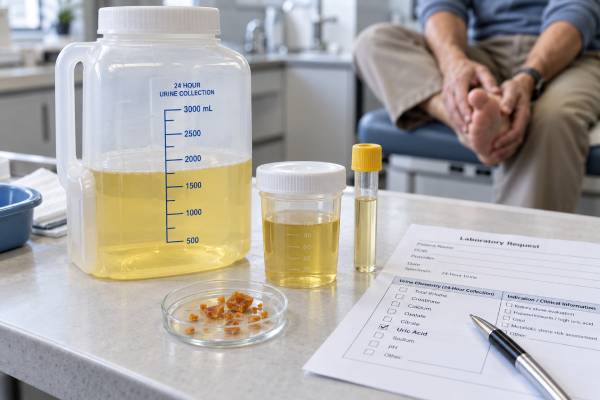
A urine uric acid test measures how much uric acid leaves the body in urine, usually over 24 hours. In kidney stone evaluation, it helps identify hyperuricosuria—excess urinary uric acid—and shows whether uric acid may be contributing to uric acid stones or calcium oxalate stones. The result is only one part of the picture. Uric acid stones often form because urine is persistently too acidic, so a person can have a uric acid stone even when total daily uric acid excretion is not markedly high. Urine volume also matters because low output concentrates uric acid and raises crystallization risk. A 24-hour stone panel therefore interprets uric acid alongside urine pH, volume, calcium, oxalate, citrate, sodium, and other markers. High urinary uric acid can reflect diet, increased urate production, some medicines, or metabolic conditions, but it does not by itself diagnose gout. The most useful result is one collected correctly during a typical day of eating and drinking.
- High 24-hour urine uric acid is often called hyperuricosuria; commonly used thresholds are about 700–800 mg/day, but sex-specific and laboratory cutoffs vary.
- Uric acid stones are driven strongly by acidic urine, especially persistent pH below about 5.5, even when total uric acid excretion is not very high.
- Low urine volume raises uric acid concentration and stone risk, so urine output is interpreted with the uric acid result.
- Gout and high blood uric acid can coexist with kidney stones, but a urine uric acid test does not diagnose gout.
- A complete 24-hour collection on your usual diet is generally more useful for stone prevention than a one-time urine sample.
Table of Contents
- What the urine uric acid test measures
- Normal ranges and what a high result means
- Uric acid stones, low urine pH, and low volume
- How high uric acid can affect calcium oxalate stones
- Gout, blood uric acid, and causes of high urine uric acid
- How to collect the test and interpret the full panel
- How to lower uric acid stone risk and use follow-up testing
What the urine uric acid test measures
The urine uric acid test measures the amount of uric acid excreted into urine over a defined period, most often 24 hours. Uric acid is the end product of purine metabolism. Purines come from normal cell turnover and from foods such as organ meats, some red meats, certain seafood, and other animal proteins.
For kidney stone evaluation, the daily total matters because it estimates the uric acid load presented to the urinary tract. The result is usually reported in milligrams per 24 hours, millimoles per 24 hours, or occasionally both. A comprehensive kidney stone urine test panel measures uric acid together with other stone promoters and inhibitors.
The test answers a different question from a blood uric acid level. Serum uric acid reflects the concentration circulating in blood at one point in time. Urinary uric acid reflects how much the kidneys excrete across the collection period. Someone can have a high blood level with modest urinary excretion, or high urinary excretion with a serum value that is not strikingly elevated.
Uric acid in urine exists in a pH-dependent balance between urate, which is relatively soluble, and undissociated uric acid, which is much less soluble. That chemistry explains why the daily uric acid amount cannot be interpreted alone. When urine is acidic, more urate becomes uric acid and crystallization becomes easier.
The test is most useful in people with recurrent stones, uric acid stones, mixed stones, gout, suspected dietary or metabolic contributors, or stones that continue despite basic prevention. Stone analysis adds important context. If a recovered stone is available, a kidney stone composition analysis can show whether uric acid is actually present.
Normal ranges and what a high result means
There is no single universal cutoff for urinary uric acid because laboratories and guidelines use different units, sex-specific limits, and reference populations. A common practical definition of hyperuricosuria is more than about 800 mg/day in men or 750 mg/day in women, while some laboratories use a general upper range near 700–800 mg/day.
European guidance uses thresholds of more than 5 mmol/day in men and 4 mmol/day in women. Using the molecular weight of uric acid, those values are roughly 840 mg/day and 670 mg/day. These numbers are close enough to show why the laboratory’s own reference interval should accompany the result rather than being replaced by a single internet cutoff.
A high result means that more uric acid than expected is reaching the urine. It can raise stone risk in two ways. First, when urine is acidic enough, uric acid can exceed its solubility and form uric acid crystals directly. Second, higher urate excretion may contribute to calcium oxalate crystallization in some people, particularly when other calcium stone risks are present.
A result that is just over the reference limit is different from a very high value. The degree of elevation, urine pH, total volume, diet on the collection day, stone composition, and repeat results all help determine significance.
A normal urine uric acid value does not rule out uric acid stones. This is one of the most important points. Many uric acid stone formers have a problem dominated by low urine pH rather than extreme uric acid production. If pH stays below about 5.5, even a usual daily uric acid load can become poorly soluble.
Low urinary uric acid is generally less important for kidney stone risk. It may occur with low purine intake, reduced uric acid production, some medications, or altered kidney handling. In a stone evaluation, clinicians usually focus more on elevated uric acid, low pH, low volume, and how these findings interact.
Uric acid stones, low urine pH, and low volume
For pure uric acid stones, persistently acidic urine is usually the central chemical problem. Uric acid has a pKa of about 5.35. As urine pH falls toward and below this level, a larger fraction exists as poorly soluble undissociated uric acid. Crystals can then form even if the total amount excreted in 24 hours is not unusually high.
A urine pH below about 5.5 is commonly considered hyperacidic in stone evaluation. Repeated low readings are more meaningful than one isolated acidic sample because urine pH normally changes with meals and time of day. The urine pH test for kidney stones is therefore essential when uric acid stone risk is being assessed.
Urine volume is the second major factor. If a person excretes 600 mg of uric acid into 1.0 L of urine, the concentration is much higher than if the same 600 mg is diluted into 2.5 L. Low volume also concentrates calcium, oxalate, and other solutes, so it can worsen several stone pathways at once.
The combination of low pH plus low volume can be enough to produce high uric acid supersaturation despite a “normal” total uric acid result. Conversely, raising urine pH and increasing volume can dramatically reduce uric acid supersaturation even if daily uric acid excretion changes only modestly.
Uric acid stones are more common in people with insulin resistance, type 2 diabetes, obesity, metabolic syndrome, and gout. One mechanism involves reduced ammonium buffering by the kidney, which leaves urine more acidic. This is why treatment often focuses on alkalinizing urine rather than simply trying to eliminate dietary purines.
Pure uric acid stones are also unusual because they may be dissolved medically in selected patients by raising urine pH under clinical guidance. Calcium stones do not dissolve this way. Imaging, stone composition, kidney function, and obstruction status matter before attempting dissolution therapy.
How high uric acid can affect calcium oxalate stones
High urinary uric acid is not relevant only to uric acid stones. Hyperuricosuria can occur in people whose stones are mainly calcium oxalate, and the excess urate may help promote calcium oxalate crystal formation.
Several mechanisms have been proposed, including reduced calcium oxalate solubility in the presence of urate and heterogeneous nucleation, where one type of crystal helps another begin to form. In practice, clinicians do not interpret urinary uric acid in isolation because calcium oxalate stones are usually influenced by several simultaneous factors.
For example, a person might have:
- urine uric acid of 900 mg/day;
- urine calcium above the laboratory target;
- urine sodium suggesting high salt intake;
- urine volume of only 1.4 L/day; and
- normal or low citrate.
In that setting, focusing only on uric acid would miss major correctable risks. Increasing urine volume and reducing excess sodium may lower supersaturation substantially. If hyperuricosuria remains important after dietary measures, a clinician may consider urate-lowering medication in selected recurrent calcium oxalate stone formers.
Allopurinol has a role in some patients with recurrent calcium oxalate stones and hyperuricosuria, but it is not a universal stone-prevention drug. It reduces uric acid production by inhibiting xanthine oxidase. The decision depends on stone type, urinary findings, recurrence history, kidney function, medication interactions, and whether diet and hydration changes are sufficient.
A useful way to think about the result is that urinary uric acid can be a primary driver, a secondary contributor, or an incidental finding. Stone composition and the rest of the 24-hour urine profile determine which of those descriptions fits best.
Gout, blood uric acid, and causes of high urine uric acid
Gout and kidney stones overlap because both involve urate biology, but the tests are not interchangeable. Gout is diagnosed clinically, often with characteristic joint attacks and, when needed, identification of monosodium urate crystals. A urine uric acid result alone cannot confirm or exclude gout.
The blood uric acid test measures circulating urate and is commonly used in gout evaluation. Blood and urine results can point in different directions because the serum level depends on both production and excretion. Kidney function, diuretics, genetics, diet, alcohol, and medicines that alter urate transport can all affect the balance.
Common reasons for high urinary uric acid include:
- High purine intake. Large amounts of organ meats, red meat, some seafood, meat extracts, and other purine-dense foods can raise uric acid production and excretion.
- High animal-protein intake. This can increase uric acid load and also make urine more acidic, creating a double effect for uric acid stones.
- High cell turnover. Myeloproliferative disorders, some cancers, chemotherapy, and tumor lysis can sharply increase uric acid production.
- Uricosuric medicines. Drugs that increase kidney excretion of urate can raise the urine value even while lowering blood uric acid.
- Genetic or metabolic variation. Some people naturally produce or excrete more uric acid.
- Body size and metabolic factors. Larger body mass and metabolic syndrome can influence total urate production and urinary chemistry.
Gout itself does not guarantee hyperuricosuria. Many people with gout have reduced renal urate excretion and therefore high serum urate without an extremely high 24-hour urine uric acid amount. That is another reason treatment should not be chosen from the urine number alone.
Very high uric acid excretion in the setting of cancer treatment, severe illness, acute kidney injury, or symptoms suggesting obstruction requires medical assessment rather than routine dietary self-management. Sudden flank pain, fever, inability to urinate, persistent vomiting, or a known obstructed kidney warrants prompt care regardless of the 24-hour urine result.
How to collect the test and interpret the full panel
A 24-hour urine test is only as useful as the collection. The usual method is to discard the first urine after waking, record that start time, then collect every drop for the next 24 hours, including the first urine at the same time the following morning. Laboratory instructions take priority because containers and preservatives vary.
During the collection, keep eating and drinking in your usual pattern unless your clinician specifically tells you otherwise. Deliberately drinking several extra liters, fasting, avoiding meat for one day, or changing supplements can create a result that does not represent your everyday stone risk.
Common collection errors include missed samples, stopping too early, collecting beyond 24 hours, spilling urine, using the wrong container, and failing to follow storage instructions. A 24-hour urine collection accuracy guide can help explain why creatinine and total volume are reviewed for plausibility.
For recurrent or high-risk stone formers, two baseline 24-hour collections are often recommended because urine chemistry varies from day to day. The sample should ideally be obtained when the acute stone episode has settled and the person is back to their ordinary environment and diet.
Interpret urinary uric acid alongside at least these findings:
| Finding | Why it matters |
|---|---|
| Urine pH | Low pH strongly increases undissociated uric acid and uric acid stone risk. |
| Urine volume | Low volume raises uric acid concentration and supersaturation. |
| Calcium and oxalate | Show whether calcium oxalate risk is also present. |
| Citrate | Low citrate removes an important inhibitor of calcium crystallization. |
| Sodium | High sodium intake can increase urine calcium and overall calcium-stone risk. |
| Creatinine | Helps assess whether a 24-hour collection may be incomplete. |
The urine uric acid value is therefore best viewed as one coordinate in a chemical profile rather than a stand-alone diagnosis.
How to lower uric acid stone risk and use follow-up testing
The most effective prevention plan depends on whether the main problem is acidic urine, high uric acid excretion, low urine volume, or a combination. Treating the dominant driver produces more useful change than chasing the uric acid number alone.
For most stone formers, fluid intake is adjusted to produce at least 2.5 L of urine per day, unless a medical condition requires a different target. The amount a person needs to drink may be higher than 2.5 L because of sweat, heat, exercise, diarrhea, or other losses. A urine volume result shows whether the fluid plan is actually producing enough urine.
For uric acid stones, urine alkalinization is often central. Potassium citrate is commonly used when appropriate because it raises urine pH and citrate. The pH target should be individualized: too little alkalinization leaves uric acid supersaturated, while excessive alkalinization can increase calcium phosphate supersaturation. Patients using alkalinization therapy may be asked to monitor urine pH at home with a meter or other clinician-approved method.
Dietary changes usually focus on a healthy eating pattern rather than an extreme “zero-purine” diet. Helpful measures can include reducing large portions of purine-rich meats and seafood, moderating animal protein, limiting excess sodium, maintaining normal dietary calcium, and avoiding heavy intake of sugar-sweetened beverages. Weight and metabolic health also matter when insulin resistance is contributing to low urine pH.
If hyperuricosuria remains high and clinically important, medicines such as allopurinol may be considered. People with gout may also need urate-lowering therapy for gout-specific reasons. Medication choice and dose require clinician review, especially with reduced kidney function or interacting drugs.
Repeat 24-hour urine testing is commonly done about 8–12 weeks after targeted treatment begins. The goal is not merely a lower uric acid number. A successful plan may show higher urine volume, a safer pH, lower uric acid supersaturation, and improvement in any calcium oxalate risks that were present at baseline.
Long-term testing intervals depend on recurrence history and how stable the chemistry becomes. If stones continue despite apparently favorable urine results, recheck stone composition, collection quality, medication adherence, anatomy, and less common causes rather than assuming the original uric acid finding explains every recurrence.
References
- Metabolic evaluation for prevention of kidney stones – CARI Guidelines 2025 (Guideline)
- Nutrition therapy for the prevention of kidney stones – CARI Guidelines 2025 (Guideline)
- Metabolic Evaluation and Recurrence Prevention for Urinary Stone Patients: An EAU Guidelines Update 2024 (Review)
- 24-Hour Urinary Chemistries and Kidney Stone Risk 2024
- Type 4 renal tubular acidosis and uric acid nephrolithiasis: two faces of the same coin? 2023 (Review)
Disclaimer
This article provides general information about urine uric acid testing for kidney stone evaluation and does not replace individualized medical care. Uric acid reference ranges, treatment targets, and urine pH goals vary with the laboratory, stone type, kidney function, medicines, and the rest of the 24-hour urine profile. Seek prompt medical care for fever with flank pain, inability to pass urine, severe persistent pain, or other symptoms of an obstructed or infected urinary tract.