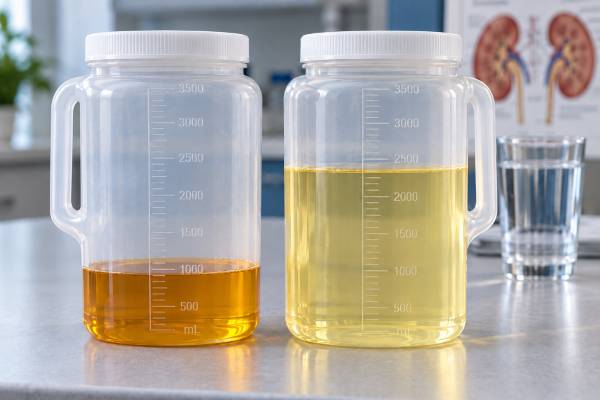
A urine volume test measures how much urine you produce over a set period, usually 24 hours, and it is one of the most important parts of a kidney stone risk evaluation. Low urine volume concentrates calcium, oxalate, uric acid, phosphate, cystine, and other dissolved substances, making it easier for crystals to form. For most adults with kidney stones, prevention guidelines aim for at least about 2.5 liters of urine per day, although the fluid intake needed to reach that output varies with body size, heat, exercise, sweating, illness, and other losses. A low result often reflects not drinking enough for your needs, but it can also follow vomiting, diarrhea, heavy sweating, limited access to fluids, or intentional fluid restriction. High urine volume is not automatically a problem, but unusually large output may need evaluation if it reflects excessive intake, diabetes, medication effects, or impaired urine concentration. The result is most useful when interpreted with the rest of a 24-hour stone panel.
- For most kidney stone formers, a common prevention target is at least 2.5 L of urine per 24 hours, unless a clinician sets a different goal.
- Low urine volume raises stone risk by concentrating stone-forming minerals even when their total daily excretion is not high.
- Drinking 2.5 L does not guarantee 2.5 L of urine because sweat, breathing, stool, heat, and exercise also remove water.
- A 24-hour collection should reflect your usual fluid habits; deliberate overhydration on test day can hide a low-volume pattern.
- Very high urine volume can be appropriate after increased fluid intake, but persistent polyuria with thirst or other symptoms may need medical evaluation.
Table of Contents
- What a urine volume test measures
- Normal, low, and target 24-hour urine volume
- Why low urine volume raises kidney stone risk
- Common causes of low urine volume
- How much to drink to reach a safer urine volume
- High urine volume and polyuria
- Collection, follow-up testing, and next steps
What a urine volume test measures
A urine volume test records the total amount of urine produced during the collection period. In kidney stone workups, that period is usually 24 hours. The laboratory reports the total in milliliters or liters per 24 hours, and the value becomes the denominator for many concentration-dependent stone risks.
Urine volume is different from how much fluid you drink. Fluid intake includes water, coffee, tea, milk, soup, and water contained in foods. Urine output is what remains after the body uses water and loses some through breathing, sweat, and stool. A person may drink 3 L in a hot environment and still produce much less than 2.5 L of urine because of heavy sweating.
That distinction is why a measured 24-hour volume is so useful. It shows whether the fluid plan is actually creating enough urinary dilution. A comprehensive 24-hour urine stone risk profile uses volume together with calcium, oxalate, citrate, uric acid, sodium, pH, and other findings.
The number also helps interpret daily excretion. Suppose two people each excrete 200 mg of calcium in 24 hours. If one produces 1.0 L of urine and the other produces 2.5 L, their total calcium excretion is identical, but the first person’s urine is much more concentrated. That difference can substantially change calcium oxalate or calcium phosphate supersaturation.
Urine volume is therefore both a risk marker and a treatment target. Unlike some genetic or anatomical risks, it can often be changed directly with fluid habits. It is also one of the few interventions that can lower the concentration of several stone-forming substances at the same time.
Normal, low, and target 24-hour urine volume
There is no single “normal” 24-hour urine volume that fits every adult because output changes with fluid intake, climate, diet, body size, and kidney concentrating ability. For kidney stone prevention, the more useful question is whether the volume is high enough to keep urine adequately diluted.
Current kidney stone guidance commonly recommends a urine output of at least 2.5 L per day for most stone formers. European guidance similarly recommends maintaining urine output above 2.5 L per 24 hours. This is a prevention target, not a statement that every healthy adult must produce that amount.
A volume below about 2.0 L/day is often considered less than ideal for a stone former, and values below 1.5 L/day indicate particularly concentrated urine in many clinical settings. Exact interpretation depends on stone type and the rest of the chemistry. A person with cystinuria, for example, may need a higher urine-volume goal than someone with an uncomplicated calcium oxalate stone history.
A single value should be interpreted in context. A 1.6 L collection after a day of outdoor work in summer may reflect heat and sweat. The same value during a typical indoor day may point more directly to low fluid intake. A 2.7 L result after intentionally drinking far more than usual during the collection may not reflect everyday protection.
The 24-hour urine volume test can also be used outside stone prevention to evaluate hydration patterns or unusually high urine output. In the stone setting, however, the goal is usually to understand how volume affects supersaturation and whether fluid changes are sustainable across ordinary days.
Why low urine volume raises kidney stone risk
Low urine volume raises kidney stone risk because it concentrates the same dissolved mineral load into less water. As concentrations rise, urine can become supersaturated with stone-forming compounds. Supersaturation means the chemical conditions increasingly favor crystal formation and growth.
The effect is broad rather than stone-specific:
- Calcium oxalate stones: low volume raises both calcium and oxalate concentrations, increasing their chance of combining.
- Calcium phosphate stones: concentrated calcium and phosphate can raise risk, especially when urine pH is relatively high.
- Uric acid stones: low volume increases uric acid concentration, while acidic pH makes uric acid much less soluble.
- Cystine stones: cystine has limited solubility, so high urine volume is especially important for people with cystinuria.
- Struvite stones: infection is the main driver, but adequate hydration still supports urinary flow and overall urinary health.
A urine supersaturation test makes this effect visible. A person may improve calcium oxalate supersaturation substantially by increasing volume even when total calcium and oxalate excretion change little.
Low volume also explains why stone attacks can cluster during hot weather, intense exercise, travel, fasting, or occupations where drinking and bathroom access are limited. The issue is not simply feeling thirsty. Thirst often develops after water losses have already begun, and some people habitually ignore it during work or sleep.
Nighttime can be another vulnerable period. Most people do not drink for several hours while sleeping, so urine becomes more concentrated overnight. Someone who already ends the day underhydrated may spend a long period producing highly concentrated urine. Spreading fluids across the day and having an appropriate amount in the evening can help, while avoiding excessive bedtime intake that disrupts sleep or creates safety issues with nighttime urination.
The benefit of higher urine volume is one reason fluid intake is considered a foundational prevention measure across most kidney stone types. It does not replace treatment of hypercalciuria, hyperoxaluria, low citrate, infection, or low pH, but it lowers the chemical pressure that allows those abnormalities to form crystals.
Common causes of low urine volume
The most common cause is simple: fluid intake is too low for the amount of water the body is losing. That can happen even when a person believes they drink “a lot,” because needs vary widely.
Common contributors include:
- Hot weather and heavy sweating. Outdoor work, saunas, fever, and warm indoor environments can shift liters of water away from urine.
- Exercise. Long or intense workouts increase sweat and respiratory water loss.
- Vomiting or diarrhea. Gastrointestinal losses can sharply reduce urine output and raise stone concentration.
- Limited fluid access. Drivers, teachers, healthcare workers, factory workers, and others may delay drinking because breaks or toilets are limited.
- Intentional restriction. Some people drink less to avoid urinary frequency, incontinence, or nighttime urination.
- Fasting or disrupted routines. Travel, illness, religious fasting, and busy schedules can reduce both food-associated water and direct fluid intake.
- Certain medical conditions. Heart failure, advanced kidney disease, liver disease, or hyponatremia may require individualized fluid advice rather than aggressive hydration.
A low result during acute illness should not always be used as the long-term baseline. Stone-prevention collections are most useful when a person is back to their usual diet, fluid pattern, and environment. If the first collection occurred during a heat wave, stomach illness, or unusual work shift, a repeat may better show the typical pattern.
Low urine volume can also accompany true dehydration. Signs may include thirst, dry mouth, dizziness, darker urine, reduced urination, and weakness, but urine color alone is not a precise stone-risk test. Some vitamins and foods alter color, and a person can still have a suboptimal 24-hour volume without obviously dark urine.
A sudden, marked drop in urine output is different from a chronically low stone-prevention volume. Very little or no urine, especially with severe flank pain, swelling, shortness of breath, vomiting, or known kidney disease, needs prompt medical assessment because obstruction or acute kidney injury may be present.
How much to drink to reach a safer urine volume
The practical goal is to drink enough to produce the target urine volume, not to hit the same fluid-intake number as everyone else. For most adult stone formers, producing at least 2.5 L of urine per day usually requires drinking more than 2.5 L because some water is lost outside the urinary tract.
Many people may need roughly 2.5–3.0 L or more of total fluid daily, with additional fluid during heat, exercise, fever, or heavy sweating. A fixed prescription should be adjusted to measured urine output and medical conditions. Someone who sweats heavily may need considerably more than a sedentary person in a cool environment to produce the same 2.5 L of urine.
Useful strategies include:
- Spread fluids across the day. Large amounts taken only at dinner do not correct long stretches of concentrated urine earlier in the day.
- Use a measurable bottle or cup. A 750 mL bottle filled four times is easier to track than guessing from scattered glasses.
- Link drinking to routines. Drink with meals, medications, work breaks, commuting stops, and after exercise.
- Replace sweat losses. Increase intake on hot days and around prolonged physical activity.
- Check the result, not just the plan. Repeat 24-hour urine testing shows whether the behavior actually produces enough urine.
Water is generally the best default beverage. Other fluids contribute to total intake, but large amounts of sugar-sweetened drinks are not a good kidney stone strategy. Citrus beverages may add citrate, but their sugar, calorie, sodium, or potassium content varies, so they should not be treated as a substitute for an individualized prevention plan.
For calcium stone prevention, normal dietary calcium and sodium control remain important even when volume improves. Drinking more water cannot fully offset very high urine calcium, severe hyperoxaluria, or marked hypocitraturia. The benefit is strongest when hydration is combined with treatment of the specific abnormalities found on testing.
People who have been told to restrict fluids because of heart failure, advanced kidney disease, severe liver disease, or a history of low blood sodium should not automatically adopt a 2.5 L urine target. Their clinician must balance stone prevention against the risk of fluid overload or electrolyte problems.
High urine volume and polyuria
A high 24-hour urine volume is often expected when someone deliberately increases fluid intake for stone prevention. In that context, a volume above 2.5 or even 3 L may be appropriate, especially for people with cystine stones or high fluid losses.
However, persistent polyuria means producing an unusually large amount of urine, often defined clinically as more than about 3 L/day in an adult. The exact threshold should be considered with body size and circumstances. Polyuria is different from urinary frequency: someone can urinate often but pass only small amounts each time, while another person can urinate less often but produce a large total volume.
Possible causes of high urine output include:
- very high fluid intake;
- uncontrolled diabetes mellitus causing glucose-related water loss;
- diabetes insipidus or impaired antidiuretic hormone action;
- diuretic medicines;
- high solute intake;
- recovery from some forms of acute kidney injury; and
- impaired kidney concentrating ability.
High volume is therefore not always a reason to keep drinking more. If a person produces 4–5 L of urine daily because of intense thirst, wakes repeatedly to urinate, develops weakness, has unexplained weight loss, or has abnormal sodium or glucose levels, the cause should be evaluated.
Excessive water intake can also be harmful. Drinking water far faster than the kidneys can excrete it can dilute blood sodium and cause hyponatremia, which may lead to headache, nausea, confusion, seizures, or worse. Stone prevention favors steady, appropriate hydration rather than forced drinking of extreme amounts in a short period.
The rest of the urine panel helps distinguish useful high volume from an underlying problem. If volume rises after a planned hydration change and stone supersaturation falls without electrolyte concerns, that is generally the intended effect. If high output is unexplained, blood glucose, electrolytes, kidney function, medication use, and symptoms may need review.
Collection, follow-up testing, and next steps
A reliable urine-volume result requires a complete 24-hour collection. In a typical protocol, you discard the first urine after waking, record the start time, collect every urination for the next 24 hours, and include the first urine at the same time the following day. Follow the laboratory’s storage and preservative instructions exactly.
Do not intentionally “ace” the test by drinking much more than usual unless your clinician specifically wants to test a prescribed fluid target. A baseline collection should show your ordinary pattern. Missing a urine sample can falsely lower the reported total volume and distort every 24-hour excretion result on the panel.
If collection quality is uncertain, the 24-hour urine collection errors guide explains how missed samples, wrong timing, overcollection, and creatinine findings can affect interpretation. Recurrent or high-risk stone formers are often asked for two baseline collections because daily urine chemistry varies.
Once a low-volume pattern is identified, a practical follow-up plan is:
- Set a clinician-approved urine-output goal, commonly at least 2.5 L/day for most stone formers.
- Increase fluids gradually and distribute them across the day.
- Add extra fluid for predictable sweat losses, travel, or exercise.
- Keep other stone-specific measures in place, such as sodium reduction, normal dietary calcium, citrate therapy, or urine alkalinization when indicated.
- Repeat the 24-hour urine collection after the plan has had time to become routine.
Repeat testing is commonly performed about 8–12 weeks after a targeted prevention change. The follow-up should show not only a higher volume but also how that change affected calcium oxalate, calcium phosphate, or uric acid supersaturation. If volume remains low despite apparently high fluid intake, review actual intake, sweat losses, collection completeness, diarrhea, work conditions, and any fluid restrictions.
Long-term success depends on consistency. A single 2.8 L collection does not protect against weeks of 1.2 L days. Seasonal habits matter too: someone may meet the target in winter but fall below it every summer. Repeating a collection when routines or climate change can reveal that pattern.
Urine volume is simple compared with many metabolic tests, but it often provides one of the clearest actions in kidney stone prevention. When the result is low, the question is not merely “drink more.” It is how to create enough urine, safely and consistently, across the person’s real schedule and environment.
References
- Nutrition therapy for the prevention of kidney stones – CARI Guidelines 2025 (Guideline)
- Metabolic evaluation for prevention of kidney stones – CARI Guidelines 2025 (Guideline)
- Diagnosis and risk factors of kidney stones – CARI Guidelines 2025 (Guideline)
- Metabolic Evaluation and Recurrence Prevention for Urinary Stone Patients: An EAU Guidelines Update 2024 (Review)
- 24-Hour Urinary Chemistries and Kidney Stone Risk 2024
Disclaimer
This article provides general information about 24-hour urine volume in kidney stone prevention and does not replace individualized medical advice. Fluid targets must be adjusted for stone type, climate, kidney function, heart or liver disease, sodium disorders, medicines, and other medical conditions. Seek prompt medical care for a sudden major drop in urine output, inability to urinate, fever with flank pain, severe persistent pain, confusion, or other concerning symptoms.