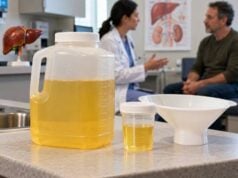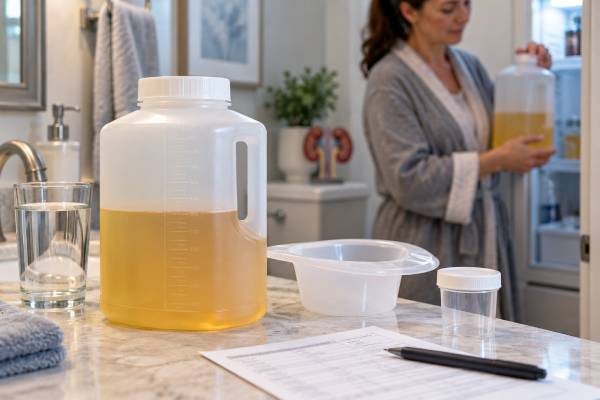
A 24-hour urine volume test measures the total amount of urine produced in one full day. The result can answer several different clinical questions: whether urine output is low enough to increase kidney stone risk, whether a person truly has polyuria, whether hydration goals are being met, or whether symptoms such as frequent urination reflect large total urine production or simply many small voids. For kidney stone prevention, urine volume is one of the most important modifiable factors because more urine dilutes calcium, oxalate, uric acid, and other stone-forming substances. At the other extreme, unusually high urine volume can signal excessive fluid intake, uncontrolled diabetes mellitus, medication effects, or disorders of arginine vasopressin and kidney water handling. The number must therefore be interpreted with fluid intake, symptoms, urine osmolality, blood sodium and glucose, kidney function, and the accuracy of the 24-hour collection.
- Adults are often considered polyuric when urine output is at least about 3 L/24 h or more than roughly 40–50 mL/kg/24 h, although definitions vary.
- For many kidney stone formers, a common prevention target is at least about 2.5 L of urine per day, unless another condition limits fluid intake.
- Low urine volume concentrates stone-forming chemicals and can increase calcium oxalate, calcium phosphate, and uric acid supersaturation.
- Frequent urination is not the same as polyuria: many small voids can occur with bladder problems even when total 24-hour volume is normal.
- A missed urine sample falsely lowers the measured daily volume, so complete collection is essential before labeling urine output low.
Table of Contents
- What the 24-Hour Urine Volume Test Measures
- Why the Test Is Ordered
- How to Collect and Measure Urine Volume
- Low Urine Volume and Hydration
- Urine Volume and Kidney Stone Risk
- High Urine Volume and Polyuria
- What Happens After an Abnormal Result
What the 24-Hour Urine Volume Test Measures
The test measures the total volume of urine produced over exactly 24 hours, usually reported in milliliters per 24 hours (mL/24 h) or liters per 24 hours (L/24 h). Unlike a blood test, it does not measure a chemical concentration by itself. It measures output.
Urine volume reflects the balance between fluid entering the body, fluid lost outside the kidneys, the amount of dissolved solute that must be excreted, and the kidneys’ ability to concentrate or dilute urine. Heat, exercise, sweating, fever, diarrhea, fluid intake, dietary salt and protein, blood glucose, medications, and hormone signaling can all change the total.
A “normal” adult volume varies widely. Many healthy adults produce somewhere around 1–2 L/day under ordinary conditions, but the exact amount depends heavily on intake and environment. For clinical purposes, thresholds are usually used to answer a specific question rather than to define one ideal number.
For example, in kidney stone prevention, the concern is whether urine is dilute enough to lower supersaturation. For suspected polyuria, the concern is whether total output is genuinely excessive. Those are different uses of the same measurement.
The test may be ordered by itself, but it is often one item in a larger 24-hour urine stone risk profile or in a diagnostic evaluation of excessive thirst and urination.
Why the Test Is Ordered
A clinician may request 24-hour urine volume when the question cannot be answered reliably from a single urine sample or from the patient’s estimate of how often they urinate.
Common reasons include:
- Kidney stone prevention: to determine whether fluid intake produces enough urine to lower stone risk.
- Suspected polyuria: to confirm that total urine output is truly excessive.
- Excessive thirst: to help evaluate primary polydipsia, arginine vasopressin deficiency, or arginine vasopressin resistance.
- Diabetes mellitus: high glucose can cause osmotic diuresis and large urine volumes.
- Medication effects: diuretics, lithium, SGLT2 inhibitors, and other drugs can alter urine volume.
- Fluid-balance assessment: selected kidney, endocrine, or electrolyte disorders may require a measured daily output.
- Monitoring treatment: stone formers may repeat the test after a hydration plan to see whether urine output actually increased.
The test also helps distinguish polyuria from urinary frequency. Someone who urinates 12 times a day may have normal total output if each void is small. That pattern can occur with overactive bladder, urinary tract irritation, prostate problems, pelvic-floor dysfunction, or anxiety. In true polyuria, the total daily volume is excessive.
This distinction matters because the workup is completely different. A bladder problem is not diagnosed or treated the same way as a water-balance disorder.
How to Collect and Measure Urine Volume
A correct result requires every urine void during the timed interval.
Typical instructions are:
- When you begin, urinate into the toilet and do not save that first void. Record the exact start time.
- Collect all urine after that for the next 24 hours, including overnight urine.
- Store the container as the laboratory directs, often in a refrigerator or cooler.
- At exactly the end time the next day, urinate once more and add that final void to the container.
- Return the collection promptly.
If the test is being used to measure your usual urine volume, follow your usual drinking pattern unless your clinician gives a specific fluid prescription. Do not intentionally force several extra liters of water just to create a “better” result. That would answer a different question from how much urine you normally produce.
If the test is checking whether a prescribed hydration plan works, follow that plan closely. Record unusual events such as heavy exercise, a long shift in hot conditions, vomiting, diarrhea, or unusually large alcohol intake because those can change the result.
Missing a single large void can make a normal collection appear low. Collecting for 26 or 28 hours can make it look high. If timing is wrong or urine is spilled, contact the laboratory about whether to restart. The 24-hour urine collection errors article explains why these mistakes matter across timed urine tests.
Low Urine Volume and Hydration
Low urine volume usually means the kidneys are producing relatively concentrated urine, but the reason can range from normal low fluid intake to significant volume depletion.
Common causes include:
- Not drinking enough fluid.
- Heavy sweating from exercise, work, or hot weather.
- Fever.
- Vomiting or diarrhea.
- Reduced intake from nausea, illness, or limited access to fluids.
- Fluid losses from drains, wounds, or burns.
- Strong kidney water conservation during dehydration.
In stone formers, low output is important even when blood tests are normal. When water volume falls, the same amount of calcium, oxalate, uric acid, and other solutes is dissolved in less fluid. Concentrations and supersaturation rise, making crystals more likely to form and grow.
Low output does not always mean simple dehydration, however. A person with advanced kidney failure may make little urine despite fluid retention. Severe urinary obstruction can also reduce output and requires urgent assessment. The clinical context matters.
For everyday hydration, urine color can provide a rough clue but is not a precise substitute for 24-hour volume. Supplements, foods, medications, and urinary blood can change color. For stone prevention, measured daily volume is much more useful because the target is quantitative.
Urine Volume and Kidney Stone Risk
Higher urine volume is one of the most reliable general strategies for reducing kidney stone risk. It dilutes stone-forming substances and lowers supersaturation regardless of whether the main stone is calcium oxalate, calcium phosphate, or uric acid.
Many modern guidelines recommend enough fluid intake to produce at least about 2.5 L of urine per day in adults with recurrent stones. Some high-risk conditions, such as cystinuria or primary hyperoxaluria, may require even higher urine-output goals under specialist supervision.
The amount a person needs to drink to produce 2.5 L of urine is not fixed. A sedentary person in a cool environment may reach that output with less fluid than someone who sweats heavily at work. Food also contains water, and some beverages contribute more effectively than others. The useful endpoint is urine output, not a universal “eight glasses” rule.
Hydration should also be spread through the day. Long periods with little intake can allow urine to become concentrated even if a large amount is consumed later. For people who repeatedly form stones overnight, clinicians may recommend some fluid in the evening while balancing sleep and nocturia concerns.
Recent evidence examining thousands of 24-hour collections found urine volume to be among the urinary factors most strongly associated with stone risk. Behavioral studies also show that many patients with prior stones struggle to maintain high enough intake, which is why repeat urine testing can be useful.
A measured 24-hour urine calcium result and urine citrate may change the rest of the prevention plan, but increasing low urine volume is often useful across stone types.
High Urine Volume and Polyuria
Polyuria means abnormally large urine output, not simply frequent trips to the bathroom. In adults, a common threshold is at least 3 L/24 h. Some experts also use weight-based definitions such as more than 40 or 50 mL/kg/24 h.
Once polyuria is confirmed, the next question is whether the kidneys are excreting extra water or extra solute.
Water diuresis
A water diuresis produces unusually dilute urine. Major causes include:
- Primary polydipsia, in which fluid intake is excessive.
- Arginine vasopressin deficiency, formerly called central diabetes insipidus.
- Arginine vasopressin resistance, formerly called nephrogenic diabetes insipidus.
Urine osmolality, blood sodium, plasma osmolality, and specialized testing such as stimulated copeptin can help distinguish these conditions. Modern endocrine evaluation increasingly uses copeptin-based approaches rather than relying only on the traditional water-deprivation test.
Osmotic diuresis
An osmotic diuresis occurs when extra dissolved particles pull water into urine. Common examples include:
- Uncontrolled diabetes mellitus with glucosuria.
- SGLT2 inhibitor therapy, which intentionally increases urinary glucose.
- High urea excretion from very high protein intake or catabolic states.
- Mannitol or other osmotic agents.
- Large sodium loads in some clinical situations.
Urine osmolality is usually higher than in pure water diuresis, although mixed patterns can occur.
If a person reports extreme thirst and urination, the 24-hour urine osmolality test or spot urine osmolality may help show whether the urine is appropriately concentrated.
What Happens After an Abnormal Result
Follow-up depends on whether the output is too low for the clinical goal, unexpectedly high, or inconsistent with symptoms.
For a low stone-prevention volume, clinicians usually begin with practical hydration changes. These may include carrying a measured bottle, setting reminders, drinking with meals and medication times, replacing sweat losses, and spreading intake across waking hours. A repeat 24-hour collection can show whether those habits actually increased urine output.
For polyuria, blood glucose, sodium, potassium, calcium, creatinine, and serum osmolality are often checked. Urine osmolality helps classify the problem as water or solute diuresis. Medication review is essential. If hypotonic polyuria remains unexplained, endocrine testing may evaluate vasopressin-related disorders.
Seek prompt medical evaluation when very high urine output is accompanied by severe thirst, weakness, confusion, dehydration, or high blood sodium, because water losses can become dangerous if intake cannot keep up. Low urine output also needs urgent assessment when it develops suddenly with swelling, shortness of breath, severe illness, or possible urinary obstruction.
For most outpatient collections, the best interpretation is purpose-specific. A urine volume of 2.0 L/day may be perfectly adequate for one general-health question yet still be below the target for a recurrent stone former. A volume of 3.2 L/day may be intentional in a high-risk stone patient but abnormal in someone who is constantly thirsty without trying to drink extra. The number has meaning only when matched to the reason it was measured.
A useful distinction in polyuria is whether the person is passing large amounts of urine because the kidneys cannot conserve water or because the kidneys are appropriately excreting a large solute load. Urine osmolality helps make that distinction. Very dilute urine points toward a water diuresis, while a higher osmolality suggests glucose, urea, sodium, or another osmole is carrying water into the urine. A mixed pattern is common, so clinicians also review serum sodium, glucose, kidney function, and medication use.
Nocturia adds another layer. Waking several times to urinate does not necessarily mean total daily urine volume is high. Some people produce a disproportionate share of their daily urine at night, a pattern called nocturnal polyuria. Others have normal nighttime urine production but a bladder that holds only small volumes. A 24-hour volume together with a voiding diary can separate these patterns better than counting bathroom trips alone.
For stone prevention, the practical challenge is often maintaining urine output on difficult days. Hot weather, long flights, endurance exercise, outdoor work, and fasting can all reduce volume despite a generally good hydration routine. People with recurrent stones often benefit from planning around predictable fluid-loss periods rather than relying on thirst. A measured bottle, scheduled drinks, and extra replacement during sweating can help.
More fluid is not always safer. People with heart failure, advanced CKD, cirrhosis, or low blood sodium may be harmed by indiscriminate fluid loading. Likewise, extreme water intake over a short period can cause hyponatremia. A high urine-output goal used for kidney stone prevention should therefore be adjusted when another medical condition changes how much fluid the body can safely handle.
When a repeat test is used to assess hydration treatment, compare not only the total volume but also the stone-risk chemistries. Increasing urine from 1.3 L to 2.5 L should generally reduce concentrations and supersaturation, but persistent high calcium, oxalate, uric acid, or very low citrate may still need separate treatment. The goal is better urine chemistry, not simply a larger number on the volume line.
Collection context is especially important when the volume seems inconsistent with daily life. A patient who usually works outdoors may collect on a cool day at home and produce much more urine than usual. Someone with vomiting, diarrhea, heavy exercise, or fever may produce much less. A single 24-hour value is therefore a snapshot. When the result will guide long-term treatment, a repeat collection on a representative day may better show the person’s usual pattern.
The color of urine can provide a rough hydration clue, but it cannot replace a measured 24-hour volume. Vitamins, foods, medicines, blood, and liver or urinary conditions can change color, while very pale urine can occur because of intentional high fluid intake or an inability to concentrate urine. Similarly, a normal serum creatinine does not prove that urine output is appropriate. Volume answers a different question: how much water, together with dissolved substances, actually left the body through the kidneys during the interval.
For people trying to raise urine volume for stone prevention, spreading fluid intake usually works better than drinking a very large amount at once. Urine production falls overnight and during periods of sweating, so bedtime, early morning, exercise, and hot-weather intake may matter. The practical target is not constant clear urine; it is a sustainable daily pattern that produces the urine volume recommended for that person without causing sleep disruption, low sodium, swelling, or other problems from excessive intake.
References
- Hydration for Adult Patients with Nephrolithiasis: Specificities and Current Recommendations 2023 (Review)
- 24-Hour Urinary Chemistries and Kidney Stone Risk 2024
- Approach to the Patient With Suspected Hypotonic Polyuria 2025 (Review)
- Arginine vasopressin deficiency: diagnosis, management and the relevance of oxytocin deficiency 2024 (Review)
- Urges to Drink Predict Urine Output Volume in Patients With Kidney Stones. 2025
- Metabolic Evaluation and Recurrence Prevention – EAU Guidelines on Urolithiasis – Uroweb 2026 (Guideline)
Disclaimer
This article is for general education and does not replace medical advice. Urine-volume targets depend on the reason for testing, kidney and heart function, medications, climate, and other health conditions. People with fluid restrictions, sudden changes in urine output, severe thirst, dehydration symptoms, or suspected obstruction should seek individualized medical guidance.