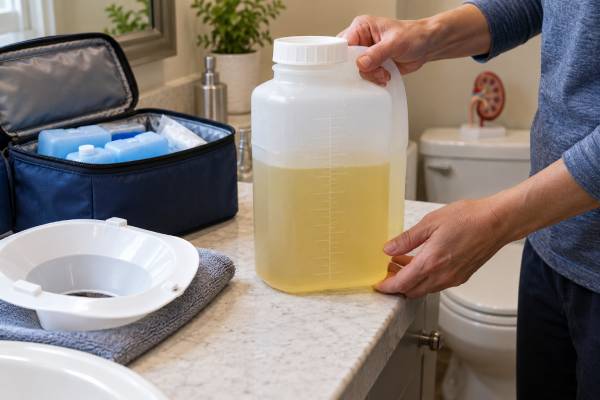
A 24-hour urine stone risk profile measures several urine factors that can either promote or prevent kidney stones. Instead of looking at one result in isolation, the panel shows how urine volume, calcium, oxalate, citrate, uric acid, sodium, pH, and other measurements interact over a full day. That combination matters because stones usually form from more than one risk factor. A person may have high urine calcium but excellent urine volume and citrate, while another may have only modest calcium but very low volume and citrate. The test is most useful after a stone has passed or been removed, especially for recurrent stones, high-risk patients, or anyone who needs a personalized prevention plan. Collection quality is critical: missing urine can distort nearly every result. Interpretation should also consider stone composition, diet, medications, kidney function, and whether one or two separate 24-hour collections were obtained.
- The most actionable results are usually urine volume, calcium, oxalate, citrate, uric acid, sodium, and pH, interpreted together rather than as independent “good” or “bad” numbers.
- A urine volume of at least about 2.5 L/day is a common prevention target for many stone formers, unless fluid intake must be restricted for another condition.
- High urine calcium, high oxalate, high sodium, low citrate, and low urine volume can raise calcium-stone risk, but the degree of risk depends on the full profile.
- Uric acid stone risk depends strongly on urine pH as well as uric acid excretion, so a “normal” uric acid amount does not exclude uric acid stones.
- Two 24-hour collections may be more informative than one because diet and urine chemistry can vary substantially from day to day.
Table of Contents
- What a 24-Hour Urine Stone Risk Profile Measures
- Who Needs the Test
- Key Results and What They Mean
- How the Results Work Together
- How to Collect the Urine Correctly
- Using Results to Prevent More Stones
- Repeat Testing and Common Mistakes
What a 24-Hour Urine Stone Risk Profile Measures
A stone risk profile is a metabolic urine evaluation designed to identify conditions that make crystals more likely to form and grow. Laboratories vary, but a typical panel includes urine volume, calcium, oxalate, citrate, uric acid, sodium, potassium, creatinine, pH, phosphorus, magnesium, and calculated supersaturation values.
The advantage of a 24-hour collection is that it captures total daily excretion rather than a single moment. Meals, fluid intake, exercise, and sleep all change urine chemistry. A complete day gives a more representative picture of the chemical environment in which stones form.
The panel is especially useful because stone risk is not controlled by one threshold. Urine can become supersaturated when stone-forming substances are concentrated enough that crystals are favored. High calcium or oxalate increases calcium oxalate supersaturation, while low urine volume concentrates almost everything. Citrate works in the opposite direction by binding calcium and inhibiting crystal growth.
Many laboratories report supersaturation for calcium oxalate, calcium phosphate, and uric acid. These calculated values combine several measurements and can help show whether the urine environment favors a particular stone type. They are useful summaries, but clinicians still look at the individual drivers because treatment targets those drivers.
If the stone itself is available, stone analysis adds important information. A calcium oxalate stone, uric acid stone, calcium phosphate stone, cystine stone, and infection-related struvite stone require different prevention strategies. The urine profile helps explain why the stone formed and what can be changed.
Who Needs the Test
Not every person with a first uncomplicated kidney stone needs an extensive metabolic evaluation. A 24-hour urine profile is most valuable when the chance of recurrence is high or when the result is likely to change prevention treatment.
Common reasons include:
- Recurrent kidney stones.
- Stones at a young age or a strong family history.
- Multiple stones or stones in both kidneys.
- A solitary kidney or chronic kidney disease.
- Uric acid, cystine, calcium phosphate, or unusual stone composition.
- Gastrointestinal disease, bariatric surgery, chronic diarrhea, or malabsorption.
- Osteoporosis, hyperparathyroidism, gout, or other metabolic conditions.
- Continued stone formation despite general prevention advice.
- A need to guide medication such as potassium citrate or a thiazide-type diuretic.
Stone guidelines commonly recommend metabolic testing for high-risk patients and often use two consecutive 24-hour collections because a single day may not reflect usual intake or excretion. The exact protocol depends on the clinic and laboratory.
The test is usually done when the patient is back on a typical diet and not in the immediate aftermath of severe vomiting, dehydration, or an obstructing stone. A very unusual day can produce results that are technically accurate but not representative.
For someone whose main issue is recurrent stones, the stone profile is more informative than a single 24-hour urine calcium test because calcium is only one contributor.
Key Results and What They Mean
Reference ranges vary by laboratory, sex, body size, diet, and stone type. The most useful question is not whether each number sits inside a population reference interval, but whether it is contributing to the patient’s stone risk.
| Measurement | Why it matters | Common concern |
|---|---|---|
| Urine volume | Dilutes stone-forming chemicals | Low volume increases supersaturation |
| Calcium | Major component of calcium oxalate and calcium phosphate stones | High urinary calcium can promote calcium stones |
| Oxalate | Combines with calcium to form calcium oxalate | High oxalate can strongly raise calcium oxalate supersaturation |
| Citrate | Binds calcium and inhibits crystal formation | Low citrate removes an important natural defense |
| Uric acid | Can form uric acid stones and influence calcium stone risk | High excretion matters, especially with acidic urine |
| Sodium | Reflects recent salt intake and affects calcium excretion | High sodium can increase urinary calcium |
| pH | Controls which crystals are favored | Low pH favors uric acid; high pH can favor calcium phosphate |
Urine volume
Low urine volume is one of the most common and correctable stone risks. Current stone-prevention guidance commonly aims for at least 2.5 L of urine per day in adults with stones, although people with heart failure, advanced kidney disease, or other fluid-sensitive conditions need individualized advice. A 24-hour urine volume result shows whether actual urine output matches the hydration plan.
Calcium
Urinary calcium is influenced by sodium intake, genetics, hormones, dietary calcium, and some medications. Many laboratories flag values above roughly 250 mg/day in women or 300 mg/day in men, but modern interpretation increasingly treats risk as continuous rather than assuming a sharp line between safe and unsafe. Higher urine calcium generally means higher calcium-stone risk.
Oxalate
Oxalate comes from both diet and normal metabolism. Markedly high values may reflect enteric hyperoxaluria from intestinal malabsorption, bariatric surgery, inflammatory bowel disease, or rare primary hyperoxaluria. More modest elevations can reflect dietary patterns or low calcium intake with meals. A 24-hour urine oxalate measurement is especially important in calcium oxalate stone formers.
Citrate
Citrate inhibits calcium crystal formation. Low citrate, called hypocitraturia, may occur with metabolic acidosis, chronic diarrhea, high dietary acid load, low fruit and vegetable intake, or certain medications. Potassium citrate can be prescribed when low citrate or low urine pH persists despite dietary measures.
Uric acid and pH
Uric acid excretion and urine acidity must be interpreted together. Uric acid becomes much less soluble as urine pH falls. A person can therefore form uric acid stones even without extremely high uric acid excretion if the urine is persistently acidic. Conversely, raising urine pH can be a central treatment for uric acid stones.
Sodium
Urine sodium is a practical marker of salt intake. High sodium can increase urinary calcium and may reduce citrate in some settings. For calcium-stone formers, recent CARI guidance recommends sodium intake below 100 mmol, or about 2,300 mg, per day. The 24-hour urine sodium test helps show whether a low-sodium plan is actually being achieved.
How the Results Work Together
The greatest value of the panel comes from patterns, not isolated flags.
Consider three simplified examples:
- A patient with urine calcium of 320 mg/day, sodium of 220 mmol/day, and low urine volume may benefit from higher fluid intake and lower sodium before medication is considered.
- A patient with calcium oxalate stones, normal calcium, high oxalate, and a history of gastric bypass may need evaluation and treatment for enteric hyperoxaluria rather than a general “low-calcium” diet.
- A patient with uric acid stones, urine pH of 5.2, and only mildly high uric acid may benefit more from urine alkalinization than from focusing only on purine intake.
This is also why broad dietary restriction can backfire. People with calcium oxalate stones are sometimes told to avoid calcium, yet normal dietary calcium with meals helps bind oxalate in the intestine. Very low calcium intake can increase oxalate absorption and may raise stone risk.
Likewise, a “low-oxalate” diet is not automatically the best answer for every stone former. Restricting many vegetables without evidence of high urine oxalate can make the diet less nutritious and more difficult to follow. Current nutrition guidance emphasizes a healthy eating pattern, adequate calcium, lower sodium, appropriate animal-protein intake, and targeted changes based on the urine profile.
The panel can also reveal tradeoffs. Potassium citrate may raise citrate and urine pH, which is helpful for many calcium oxalate and uric acid stone formers. But excessive alkalinization can increase calcium phosphate supersaturation in susceptible people. Follow-up urine testing helps make sure treatment improves the intended risk without creating another.
How to Collect the Urine Correctly
A stone profile is only useful if the urine collection is complete. Missing urine falsely lowers the measured amounts of calcium, oxalate, citrate, sodium, uric acid, and creatinine.
The usual method is:
- On the start morning, urinate into the toilet and record the time.
- Collect every urine sample after that for 24 hours.
- Store the container exactly as instructed, often refrigerated.
- At the 24-hour endpoint, collect one final urine sample and add it to the container.
- Return the container promptly.
Some stone clinics ask for two separate 24-hour collections on consecutive days. Each container must have its own exact start and stop times.
Follow the diet and medication instructions given by the ordering clinician. When the goal is to assess usual stone risk, many specialists prefer the patient’s typical diet rather than a temporary “perfect” diet. If treatment has already started, the test may instead be used to see whether the intervention is working.
Creatinine excretion is often used as a rough check on completeness. An unexpectedly low amount may suggest missed urine, while an implausibly high amount can suggest overcollection. Because creatinine varies with muscle mass and other factors, it is a clue rather than a perfect validator. For more detail, review 24-hour urine collection errors.
Using Results to Prevent More Stones
The goal is to convert the profile into a small number of targeted changes that lower supersaturation and recurrence risk.
For many stone formers, the foundation includes:
- Drink enough fluid to produce about 2.5 L or more of urine daily, unless medically restricted.
- Keep sodium intake moderate, often around or below 2,300 mg/day for calcium stones.
- Maintain normal dietary calcium, usually about 1,000–1,200 mg/day for many adults, preferably from food and with meals.
- Eat a pattern rich in fruits and vegetables.
- Avoid excessive non-dairy animal protein when it contributes to low citrate, high uric acid, or acidic urine.
- Target high oxalate intake only when urine oxalate and clinical context support doing so.
Medication may be added when diet and fluid changes are not enough. Potassium citrate is used for persistent hypocitraturia or low urine pH in appropriate stone types. Thiazide-type diuretics may be used for recurrent calcium stones with hypercalciuria, especially when sodium intake is controlled. Allopurinol may be considered in selected calcium oxalate stone formers with hyperuricosuria or in gout-related settings, depending on the clinical picture.
The profile makes treatment measurable. If urine sodium falls and calcium falls with it, the dietary change is producing the expected physiologic effect. If citrate remains low despite improved diet, medication may become more reasonable. If urine volume remains 1.4 L/day despite advice to “drink more,” the target can be made more concrete.
Repeat Testing and Common Mistakes
A 24-hour urine stone profile is not a one-time score. It is a tool for baseline assessment and follow-up. Many clinicians repeat the collection several months after major dietary or medication changes and periodically thereafter in patients with recurrent disease.
Common interpretation mistakes include:
- Treating a laboratory reference range as a sharp risk threshold.
- Focusing on calcium while ignoring volume, citrate, sodium, or pH.
- Restricting dietary calcium without a clear reason.
- Using one unusual day to represent long-term diet.
- Ignoring collection completeness.
- Changing many variables at once, making follow-up difficult to interpret.
- Assuming a “normal” panel means stone risk is zero.
Recent cohort data reinforce that many urinary factors have continuous relationships with stone risk. This means improvement can matter even when a value was not technically outside the laboratory range. A urine volume increase from 1.5 L to 2.3 L, or a reduction in sodium and calcium, can still be clinically meaningful.
The best interpretation combines the urine profile with the actual stone composition, imaging history, medications, comorbidities, and patient preferences. That approach turns a long list of laboratory numbers into a practical prevention plan rather than a restrictive diet based on guesswork.
One practical way to read a follow-up profile is to compare the direction of change in the main drivers. If urine volume rises from 1.4 L to 2.6 L, sodium falls, and calcium supersaturation decreases, the prevention plan is working even if one analyte remains slightly outside the laboratory range. If sodium falls but calcium stays very high, the clinician may look for additional causes such as hyperparathyroidism, excess vitamin D exposure, or persistent idiopathic hypercalciuria. If citrate improves but urine pH becomes too alkaline in a calcium phosphate stone former, the alkali dose may need adjustment.
Diet should also be interpreted through the urine rather than by food labels alone. A patient may report drinking three liters daily yet produce only 1.8 L of urine because of heavy sweating. Another may report a low-salt diet but still have high urinary sodium from restaurant meals or packaged foods. Likewise, a person with high urine oxalate may need to pair calcium-containing foods with meals rather than simply eliminating vegetables. These examples show why the panel is most useful as feedback on what the kidneys actually excreted.
Finally, remember that supersaturation values are calculated from several measured variables. They can summarize risk efficiently, but they are not diagnoses and they can shift when urine volume, pH, or one solute changes. A strong prevention plan therefore focuses on the modifiable causes behind the supersaturation rather than chasing a single calculated target.
A useful repeat profile should be compared under conditions that make clinical sense. If the purpose is to see whether a lower-sodium diet or citrate treatment worked, the patient should follow that plan during the new collection rather than intentionally changing habits only for test day. Clinicians may request two separate 24-hour collections because calcium, sodium, oxalate, citrate, and volume can vary from day to day. Consistent improvement across repeated collections gives stronger evidence that the prevention plan is changing urine chemistry in the intended direction.
References
- 24-Hour Urinary Chemistries and Kidney Stone Risk 2024
- Nutrition therapy for the prevention of kidney stones – CARI Guidelines 2025 (Guideline)
- Pharmacological Prevention of Kidney Stones – CARI Guidelines 2025 (Guideline)
- Metabolic Evaluation and Recurrence Prevention – EAU Guidelines on Urolithiasis – Uroweb 2026 (Guideline)
- Risk factors for nephrolithiasis formation: an umbrella review. 2024 (Systematic Review)
Disclaimer
This article is for general education and does not replace individualized medical care. Kidney stone targets depend on stone type, kidney function, medications, other medical conditions, and the laboratory method used. Discuss a stone-risk profile with a clinician before starting supplements, restricting major food groups, or changing prescription treatment.