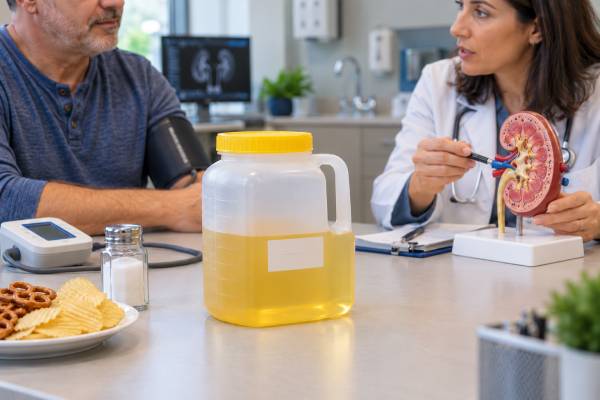
A 24-hour urine sodium test measures how much sodium leaves your body in urine over a full day. Because most absorbed dietary sodium is eventually excreted by the kidneys, the result can provide a useful estimate of recent sodium intake and can also help assess fluid balance, blood pressure management, and kidney stone risk. The test is more informative than a single urine sodium concentration when the goal is to understand an entire day of sodium excretion, but it is highly sensitive to collection errors and normal day-to-day diet changes. A high result often reflects a high-salt diet, although medicines, kidney handling of sodium, and medical conditions can affect the number. A low result may reflect low intake or sodium retention, but it cannot be interpreted in isolation. Clinicians usually consider the result together with blood pressure, kidney function, urine volume, medications, and the reason the test was ordered.
- A 24-hour urine sodium result is commonly reported in mmol/24 h or mEq/24 h; for sodium, 1 mmol equals 1 mEq.
- About 100 mmol of urinary sodium corresponds to roughly 2,300 mg of sodium or about 5.8 g of salt, although a single day does not perfectly measure usual intake.
- High urine sodium most often reflects high recent sodium intake and can contribute to higher blood pressure and greater urinary calcium excretion.
- For kidney stone prevention, many clinicians aim for lower sodium intake rather than a universal urine sodium cutoff, because targets should match the patient’s diet and stone profile.
- An incomplete 24-hour collection can make urine sodium look falsely low, so collection quality is essential before drawing conclusions.
Table of Contents
- What the 24-Hour Urine Sodium Test Measures
- Why the Test Is Ordered
- How to Collect the Sample
- How to Read a 24-Hour Urine Sodium Result
- Sodium, Blood Pressure, and Fluid Balance
- Sodium and Kidney Stone Risk
- Common Accuracy Problems and Next Steps
What the 24-Hour Urine Sodium Test Measures
The test measures the total amount of sodium excreted in urine during a timed 24-hour period. Laboratories commonly report the result as millimoles per 24 hours (mmol/24 h) or milliequivalents per 24 hours (mEq/24 h). For sodium, those numbers are numerically the same.
Sodium is the main positively charged electrolyte in fluid outside cells. It helps regulate blood volume, nerve activity, muscle function, and blood pressure. The kidneys constantly adjust how much sodium they retain or release according to blood flow, hormones, fluid status, and dietary intake.
For most healthy people in a stable state, urinary sodium is strongly influenced by the sodium eaten in the previous day or two. This makes a complete 24-hour collection one of the best practical ways to estimate recent sodium intake. It is still an estimate, not a direct dietary measurement. Some sodium is lost in sweat and stool, and daily excretion can lag behind intake, especially when intake changes abruptly.
To convert urinary sodium into an approximate amount of dietary sodium, multiply mmol by about 23 mg. For example, 100 mmol of sodium equals about 2,300 mg of sodium. To convert sodium to salt, remember that table salt is sodium chloride, not pure sodium. About 2,300 mg sodium equals roughly 5.8 g of salt.
A 24-hour urine chloride test may provide complementary information because sodium and chloride are commonly consumed together as salt. In selected situations, sodium is also interpreted alongside potassium, creatinine, calcium, and urine volume.
Why the Test Is Ordered
A clinician may order a 24-hour urine sodium test when a whole-day measure is more useful than a random urine sodium concentration. The two tests answer different questions.
Common reasons include:
- Estimating dietary sodium intake, particularly when blood pressure remains high despite counseling.
- Evaluating kidney stone risk, because high sodium intake can increase urinary calcium.
- Checking adherence to a sodium-restricted diet in selected patients.
- Interpreting a 24-hour metabolic urine panel, where sodium helps explain other abnormalities.
- Investigating unusual fluid or electrolyte problems, when sodium excretion must be considered together with clinical volume status.
- Research or population studies that need a standardized measure of sodium exposure.
A 24-hour urine sodium test is not the usual first test for an emergency sodium problem. When blood sodium is too low or too high, clinicians often use blood tests, spot urine sodium, urine osmolality, and physical examination because those results can be obtained faster and interpreted in the immediate physiologic context.
The test is particularly useful in stone prevention because it can reveal a mismatch between perceived and actual salt intake. A person may rarely use a salt shaker yet still consume large amounts of sodium from bread, restaurant meals, sauces, processed meats, cheese, snack foods, canned foods, and packaged meals.
For a broader kidney-stone evaluation, sodium is only one part of the 24-hour urine stone risk profile, which usually includes urine volume, calcium, oxalate, citrate, uric acid, pH, and creatinine.
How to Collect the Sample
Collection accuracy matters because the laboratory calculates total sodium excretion from the entire 24-hour urine volume. Missing even one large void can make the result look lower than it really is.
A typical collection follows these steps:
- On the start day, urinate into the toilet when you wake up. Do not save that first urine. Record the exact time.
- Collect every urine sample after that for the next 24 hours, including urine passed overnight.
- Keep the container as instructed, often refrigerated or in a cooler.
- At exactly the same time the next day, urinate one final time and add it to the container.
- Return the complete sample promptly according to the laboratory’s instructions.
If you start at 6:30 a.m. on Tuesday, for example, the collection ends with a saved urine sample at 6:30 a.m. on Wednesday.
Unless told otherwise, eat and drink normally. A sodium test is often most useful when it reflects your usual diet, not an unusually “good” low-salt day chosen just for testing. If your clinician is specifically checking response to a prescribed sodium target, follow that plan consistently during the days leading up to and during collection.
Do not change diuretics, blood pressure medicines, or supplements without instructions. Diuretics can greatly alter sodium excretion, and the clinician needs to know whether they were taken during the test.
If you miss urine, spill a sample, or accidentally collect beyond 24 hours, contact the laboratory. Restarting may be preferable to submitting a collection you know is incomplete. Practical instructions for start and stop timing are also covered in the 24-hour urine collection test guide.
How to Read a 24-Hour Urine Sodium Result
There is no single universal “normal” urine sodium value that applies to every purpose. A laboratory may provide a broad reference interval, but dietary goals and clinical interpretation are more useful than treating that interval as an ideal target.
A practical conversion table can help:
| Urine sodium | Approximate sodium amount | Approximate salt equivalent |
|---|---|---|
| 50 mmol/24 h | 1,150 mg sodium | 2.9 g salt |
| 100 mmol/24 h | 2,300 mg sodium | 5.8 g salt |
| 150 mmol/24 h | 3,450 mg sodium | 8.8 g salt |
| 200 mmol/24 h | 4,600 mg sodium | 11.7 g salt |
These are approximate intake equivalents, not proof that exactly that amount was eaten. Day-to-day variation can be substantial. If the goal is to estimate a person’s usual sodium intake, several complete 24-hour collections on nonconsecutive days are more informative than a single collection.
High urine sodium
A high result most often means sodium intake has been high recently. It may also be influenced by diuretic use, intravenous saline, certain hormonal states, or altered kidney handling of sodium. In a stone evaluation, high urine sodium is particularly relevant when urine calcium is also high.
Low urine sodium
A low result may reflect a low-sodium diet, low food intake, heavy sweating, vomiting or diarrhea, or the kidney’s attempt to conserve sodium when effective circulating volume is low. Heart failure, cirrhosis, and some kidney conditions can produce sodium retention, but a 24-hour value cannot diagnose those disorders by itself.
A low result is also a classic sign of an incomplete urine collection. If urine creatinine or total volume is unexpectedly low, collection quality should be reviewed before interpreting sodium as truly low.
Sodium, Blood Pressure, and Fluid Balance
Higher sodium intake tends to raise blood pressure because sodium influences extracellular fluid volume and vascular function. The effect varies between people, but controlled trials show that reducing sodium lowers blood pressure on average, with larger effects often seen in people who already have hypertension.
A 24-hour urine sodium result can therefore be useful when blood pressure remains above target despite medication or dietary advice. It provides an objective snapshot that can uncover hidden sodium sources. For example, someone may avoid adding salt while still eating restaurant food several times a week, which can produce high sodium excretion.
The result should not be used as a stand-alone “salt sensitivity test.” Two people with the same urine sodium may have different blood pressure responses. Age, kidney function, genetics, potassium intake, body weight, medication use, and baseline blood pressure all influence the effect.
In kidney disease, sodium restriction may help reduce blood pressure, edema, and the amount of protein in urine in some patients. However, dietary advice should be individualized. People with certain conditions, heavy sweating, low blood pressure, or unusual sodium losses may need different targets.
Urine sodium also changes with water balance, but urine sodium concentration and total 24-hour sodium excretion are not the same thing. A concentrated spot urine can have a high sodium concentration even when the day’s total excretion is modest. Conversely, high fluid intake can dilute sodium concentration while the total amount excreted remains high.
That is one reason the full-day collection is useful when the question is dietary exposure. It adds up the total sodium rather than relying on the concentration in one sample.
Sodium and Kidney Stone Risk
High sodium intake can increase urinary calcium because sodium and calcium handling are linked in the kidney. When more calcium enters the urine, the urine may become more supersaturated with calcium oxalate or calcium phosphate, increasing the conditions that favor calcium stone formation.
This does not mean sodium is the only important factor. Stone risk depends on a combination of urine volume, calcium, oxalate, citrate, uric acid, pH, and other variables. Recent 24-hour urine research has found higher urine sodium to be associated with higher stone risk, while urine volume and citrate are among the strongest protective features.
For recurrent calcium stone formers, stone guidelines generally recommend reducing salt while maintaining normal dietary calcium, not severely restricting calcium. Very low calcium intake can increase intestinal oxalate absorption and may worsen calcium oxalate stone risk. The useful pattern is usually moderate sodium, adequate fluid, normal dietary calcium, and adjustments based on the person’s urine profile.
European urolithiasis guidance recommends limiting sodium chloride to about 4–5 g/day for stone prevention, equivalent to roughly 1,600–2,000 mg of sodium. Other guidelines and cardiovascular recommendations commonly use sodium targets around 2,000–2,300 mg/day. The exact goal should reflect the patient’s blood pressure, stone type, urine calcium, kidney function, and clinician’s plan.
If urine calcium is high, a 24-hour urine calcium test can help show whether sodium reduction is part of the strategy. A repeat urine panel after dietary changes can then show whether sodium and calcium excretion moved in the desired direction.
Common Accuracy Problems and Next Steps
The biggest limitation of 24-hour urine sodium testing is not the laboratory assay; it is collecting a complete and representative day.
Common problems include:
- Missing one or more urine samples.
- Collecting for fewer or more than 24 hours.
- Changing diet dramatically only on the test day.
- Testing on an unusual day after a restaurant meal, fasting, intense exercise, or heavy sweating.
- Taking or withholding a diuretic differently from the prescribed routine.
- Storing the container incorrectly.
- Interpreting a single day as a precise estimate of long-term intake.
Spot urine formulas have been studied as an easier alternative, but they can misestimate true 24-hour sodium, especially at the individual level. They may be useful in population research, yet a directly measured complete 24-hour collection remains a stronger reference method for personal daily excretion.
Clinicians often check 24-hour urine creatinine to judge whether the sample seems complete. If creatinine excretion is implausibly low, missed urine becomes more likely. If the goal is stone prevention, the total urine volume also matters because very low volume increases supersaturation even when sodium is not extreme. A 24-hour urine volume test helps put sodium in that context.
After a high result, the next step is usually not to chase a specific number immediately. Instead, identify major sodium sources, make sustainable dietary changes, and recheck when appropriate. Reading food labels by milligrams of sodium per serving, comparing products, cooking more meals from basic ingredients, and reducing restaurant or packaged foods often has a larger effect than simply removing the salt shaker.
If the result is unexpectedly low or high, ask whether the collection was complete and whether the day was representative. Repeat testing can be especially valuable when the result will change medication, dietary treatment, or a kidney stone prevention plan.
A useful way to review a high result is to translate it into familiar food choices. For example, 180 mmol of sodium in a complete collection is roughly equivalent to 4,140 mg of sodium, or more than 10 g of salt, assuming intake and excretion are close to balance. That does not prove exactly what was eaten that day, but it can show that intake was well above common cardiovascular and stone-prevention targets. The next step is to look for concentrated sources rather than trying to eliminate every food that naturally contains sodium. Restaurant sauces, cured meats, instant noodles, salty snacks, pickled foods, processed cheese, and many breads can contribute hundreds of milligrams per serving.
Likewise, one apparently low collection should not automatically prompt salt loading. If the person had vomiting, diarrhea, heavy exercise with sweating, poor food intake, or was taking a diuretic, the result may reflect those circumstances. In edema-forming conditions, the body can retain sodium even when total body sodium is high, so low urinary excretion may coexist with fluid overload. This is why urine sodium should be interpreted with symptoms, examination, blood electrolytes, kidney function, and medication history rather than as a diet score by itself. When several measurements are available, the trend is usually more informative than one isolated day.
References
- Evaluation of three prediction formulas of 24-hour urinary sodium excretion in Chinese residents: a systematic review and meta-analysis 2024 (Systematic Review)
- Comparison of three spot urine formulae and their validation using 24-hour urine sodium for estimation of daily salt intake: a cross-sectional study among Bangladeshi adults. 2022
- 24-Hour Urinary Chemistries and Kidney Stone Risk 2024
- Dietary Sodium and Potassium Intakes and Kidney Stone Prevalence: The National Health and Nutrition Examination Survey 2011-2018 2024
- Metabolic Evaluation and Recurrence Prevention – EAU Guidelines on Urolithiasis – Uroweb 2026 (Guideline)
Disclaimer
This article is for general education and does not replace medical advice. A 24-hour urine sodium result depends on collection completeness, recent diet, medications, fluid status, and the reason for testing. Discuss unusually high or low results with a healthcare professional before changing prescribed medicines or making major dietary changes.