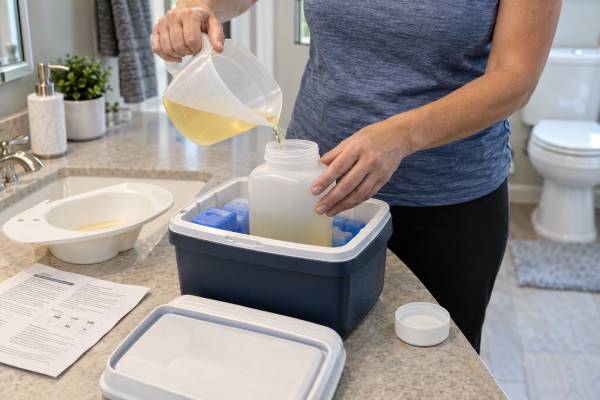
A 24-hour urine collection test measures the total amount of one or more substances excreted in urine during a complete day. Unlike a spot urine sample, which captures one moment, a timed collection can quantify daily protein, creatinine, calcium, sodium, citrate, oxalate, hormones, metabolites, or other analytes. The exact meaning depends on what was ordered; there is no single “24-hour urine result.” Accurate collection is essential because missing urine usually makes daily totals look falsely low, while collecting for too long can make them falsely high. The standard method is to discard the first void at the start time, collect every void for the next 24 hours, and include one final void at the exact stop time. Storage and preservative requirements vary by test. Clinicians interpret the result with the laboratory range, total volume, collection quality, medicines, diet, kidney function, and the reason the test was ordered.
- A 24-hour urine test is a timed measurement, not one specific analyte: The container may be tested for protein, creatinine, calcium, sodium, citrate, hormones, or several substances at once.
- Correct timing is essential: Discard the first void, collect every urine sample for 24 hours, then include the final void at the exact stop time.
- Missing urine usually lowers the reported daily total: Overcollection or including urine from outside the time window can make results appear falsely high.
- Storage depends on the test: Some collections require refrigeration, acid or another preservative, or special trace-element containers.
- The result must match the clinical question: A “normal” value for one analyte does not make the entire 24-hour collection normal.
Table of Contents
- What a 24-hour urine test measures
- Why a 24-hour collection is ordered
- How to collect urine for 24 hours
- Preparation, storage, and preservatives
- How 24-hour urine results are interpreted
- Common collection problems
- When repeat testing is useful
What a 24-hour urine test measures
A 24-hour urine collection measures excretion over time. The laboratory first receives the combined urine produced during the timed period, usually measures the total volume, mixes the specimen, and then analyzes an aliquot for the requested substances. The final report often expresses results as an amount per 24 hours.
That format is useful because urine concentration changes during the day. A single void may be concentrated after sleep or dilute after drinking water. A timed collection adds together excretion across those fluctuations and can answer questions that a spot concentration cannot.
There is no single panel that every 24-hour collection includes. Common measurements include:
- Protein or albumin to quantify urinary protein loss.
- Creatinine to assess creatinine excretion, support clearance calculations, or provide a collection-quality clue.
- Calcium, oxalate, citrate, uric acid, sodium, and volume for kidney stone risk assessment.
- Sodium, potassium, and chloride for electrolyte or dietary studies.
- Hormones and metabolites, such as metanephrines, catecholamines, 5-HIAA, cortisol, or copper, for selected endocrine, metabolic, or liver evaluations.
A timed urine collection can also last 2, 12, or another number of hours. The principle is the same: the start and stop times define the denominator. A 24-hour period is common because it captures a full day-night cycle and can smooth short-term variation.
Some tests that once relied heavily on 24-hour collections now have convenient spot alternatives. For example, a urine albumin-creatinine ratio is preferred for most CKD screening and follow-up because it avoids the burden and error risk of a full-day collection. The best specimen ultimately depends on what the clinician needs to know and measure accurately in routine clinical practice settings.
The laboratory may also use the total urine volume to calculate a concentration-based result into a daily excretion amount. This is why writing down the full volume or returning the entire collection exactly as instructed matters. Pouring out urine because the container seems too full, combining urine from an unapproved container, or estimating the volume at home can introduce errors even if the timing was otherwise correct. When one jug is not large enough, the laboratory can usually provide an additional approved container.
Some laboratories ask patients to record height and weight because these values help interpret creatinine clearance or expected creatinine excretion. Others need the exact collection duration if it was not precisely 24 hours. Providing complete paperwork is part of specimen quality: a technically complete jug can still be hard to interpret when the laboratory does not know the timing, total volume, or key patient information required for the calculation.
Why a 24-hour collection is ordered
The main reason to order a 24-hour urine collection is to measure total daily excretion when a spot sample may be insufficient or when a validated clinical threshold is based on a daily amount.
In kidney stone evaluation, a 24-hour collection can show whether low urine volume, high calcium, high oxalate, low citrate, high sodium, high uric acid, or an unfavorable pH is contributing to recurrence. These factors often interact, so comprehensive stone profiles are more useful than measuring one analyte alone.
In kidney disease, 24-hour urine protein may be used when precise quantification is needed, although spot protein- or albumin-to-creatinine ratios are often preferred for convenience. A creatinine clearance test combines urine creatinine, urine volume, blood creatinine, and collection time to estimate kidney filtration, but it has important limitations and is not the routine first estimate of GFR.
In endocrine testing, a full-day collection can reduce the effect of episodic secretion. Urine metanephrines, catecholamines, free cortisol, or 5-HIAA may be measured when specific disorders are suspected. Each of these tests has its own food, medication, and preservative instructions.
In nutritional and electrolyte assessment, 24-hour urine sodium can estimate recent sodium excretion, and potassium, chloride, urea, or other measures may add context. A single day may not represent habitual intake, so repeated collections can be needed for research or detailed dietary assessment.
In metabolic or liver disease, specialized 24-hour tests such as urine copper or amino acids may quantify abnormal excretion. These tests are usually interpreted alongside blood measurements, genetics, imaging, or other biochemical studies.
A 24-hour urine collection should therefore have a defined purpose. The burden of collecting every void is justified when the daily total provides information that is difficult to obtain more reliably another way.
How to collect urine for 24 hours
The standard method is simple but easy to misunderstand. The collection should represent exactly 24 hours of urine production, not 24 hours plus the urine already sitting in the bladder at the start.
A typical process is:
- Choose the start time. Morning is convenient for many people, but follow the laboratory’s instructions.
- Empty the bladder into the toilet at the start time. Do not collect this first urine. Record the exact time.
- Collect every void after that. This includes daytime, evening, overnight, and early-morning urine.
- Store the urine as instructed. Refrigeration or a chemical preservative may be required.
- At exactly the same time the next day, collect one final void. Add it to the container. The collection is now complete.
- Return the specimen promptly. Bring any paperwork that asks for start time, stop time, total volume, medications, height, weight, or other details.
The first urine is discarded because it formed before the timer began. The final urine is included because it contains urine produced during the last part of the 24-hour interval. If the collection starts at 7:00 a.m. Monday, the final void should be collected at 7:00 a.m. Tuesday.
A practical way to reduce mistakes is to place a note near the toilet and set phone alarms. If the main collection jug is difficult to use, many laboratories provide or allow a smaller clean collection cup for each void, which can then be transferred to the main container.
If you have a bowel movement, collect urine separately so stool or toilet water does not contaminate the sample. Menstrual blood can also interfere with some urine measurements; ask the laboratory whether the test should be postponed if contamination is likely.
If a meaningful void is missed, spilled, or accidentally flushed, contact the laboratory. For many tests, restarting is more reliable than trying to estimate what was lost. The 24-hour urine creatinine test may provide a clue to completeness, but it cannot reconstruct a missing sample.
Preparation, storage, and preservatives
Preparation varies much more than the basic timing procedure. Some 24-hour tests are meant to reflect normal daily life, while others require specific dietary or medication restrictions.
For a kidney stone profile, clinicians often want the person’s usual diet and fluid intake. Drinking an unusually large amount of water or avoiding all salt only on collection day can make the result less representative. The goal is to identify real-world risk factors that can later be changed.
For 5-HIAA, certain serotonin-rich foods and interfering medications may need to be avoided for a defined period. For catecholamine or metanephrine testing, caffeine, nicotine, exercise, stress, and some medicines can matter. For trace elements such as copper, the container itself must minimize contamination.
Do not stop a prescription medication without instructions from the prescriber or laboratory. In some cases, stopping a medicine is unsafe; in others, the clinician specifically wants to know what the urine looks like while treatment continues.
Storage requirements protect analytes from degradation or chemical change. Many collections are kept refrigerated or on ice. Some containers include acid, which can preserve hormones or metabolites. If acid is present, handle the container carefully because splashes can injure skin or eyes. Follow the laboratory’s directions for transferring urine into the container.
Not every test uses the same preservative. A container intended for one analyte may be unsuitable for another. If several 24-hour tests are ordered together, confirm with the laboratory whether they can share one container or require separate collections.
The collection day should also be documented if something unusual occurs. Fever, heavy exercise, vomiting, diarrhea, major dietary changes, or a medication dose change may affect some analytes even when the collection itself is technically complete.
How 24-hour urine results are interpreted
There is no universal normal range for a 24-hour urine collection because each analyte has its own reference interval and clinical purpose. The laboratory report may contain many individual results, and each must be interpreted separately.
For example, urinary calcium may be evaluated in milligrams per day for stone risk, while protein may be reported in milligrams or grams per day. Sodium and chloride are often reported in millimoles per day. Hormones and metabolites may use micrograms, nanomoles, or other units. Comparing values without checking units can produce serious misunderstandings.
Clinicians also ask whether the collection appears plausible. Total urine volume provides information about hydration and urine production. Creatinine excretion can help identify possible undercollection or overcollection. Neither is a perfect quality check.
Low 24-hour creatinine may reflect missed urine, but it can also occur with low muscle mass, older age, small body size, or low meat intake. High creatinine can reflect overcollection, greater muscle mass, meat intake, or creatine supplementation. Population research has shown that simple fixed creatinine cutoffs can misclassify valid collections.
The result should be connected to the clinical question. A high urine sodium result may support high salt intake in a stable outpatient but may reflect active diuretic therapy in another patient. A low citrate value may increase calcium-stone risk, while a high 5-HIAA value may have an entirely different endocrine meaning.
Trends can be more useful than isolated values. In recurrent stone disease, repeated 24-hour profiles can show whether changes in fluid intake, sodium, calcium excretion, or citrate improved after treatment. In other settings, repeat testing may confirm that a borderline abnormality persists under standardized conditions.
Common collection problems
The most common problem is undercollection. Missing urine lowers the measured total for whatever analytes were present in that void. A person may therefore appear to excrete less protein, calcium, sodium, citrate, creatinine, or hormone metabolite than they truly do.
Overcollection has the opposite effect. Including the first urine at the start, ending late, or adding a sample after the official stop time extends the collection beyond 24 hours and can raise daily totals.
Wrong timing can be subtle. A collection from 8:00 a.m. to 6:00 a.m. the next day is only 22 hours. A collection ending at noon is 28 hours. Unless the test was designed for a different interval, both are inaccurate representations of a 24-hour day.
Poor storage can alter unstable analytes. Leaving urine warm when refrigeration is required may allow bacterial growth or chemical degradation. Bacteria can also change urine pH.
Wrong container or preservative can invalidate specialized testing. Trace-metal contamination is particularly important for some tests. Acid-preserved collections may require specific transfer methods and safety precautions.
Changing behavior only for the collection day can produce technically accurate but clinically unrepresentative results. This is common in dietary stone profiles: a person may suddenly drink far more water or eat far less sodium because they want to “do well” on the test. Unless directed otherwise, usual habits provide the most actionable baseline.
A dedicated article on 24-hour urine collection errors can help explain why low creatinine, missed samples, and overcollection change results in different directions.
When repeat testing is useful
Repeat testing is useful when the collection was known to be incomplete, the result is implausible, or a borderline value would change management. Repeating a questionable collection is usually safer than trying to mathematically “correct” for missing urine.
For kidney stone prevention, two collections may be recommended because both diet and urine chemistry vary from day to day. If the two profiles are very different, the clinician can examine whether fluid intake, meals, medications, or collection completeness changed.
Repeat testing is also valuable after treatment. A lower urine calcium after sodium reduction or thiazide therapy, a higher citrate after alkali treatment, or a higher urine volume after a fluid plan can show that the intervention changed the intended target. The broader clinical outcome—such as fewer stones—still matters.
Some 24-hour tests do not need to be repeated routinely. If a specialized endocrine test is clearly normal in a low-risk patient, another collection may add little. If a result is strongly abnormal and fits the clinical picture, the next step may be confirmatory testing or imaging rather than simply repeating the same urine study.
A spot test may sometimes replace repeat 24-hour testing. CKD monitoring commonly uses spot uACR, and other conditions have validated spot ratios or blood tests. Reducing collection burden can improve real-world accuracy when a timed total is not essential.
The key to a useful 24-hour urine test is matching the method to the question. A full-day collection can provide powerful quantitative information, but only when the timing is exact, every void is collected, storage is correct, and the final result is interpreted in context rather than as a stand-alone number.
References
- Population-Based Limits of Urine Creatinine Excretion 2022 (Research Article)
- Specialist Care, Metabolic Testing, and Testing Completeness Among U.S. Veterans with Urinary Stone Disease 2022 (Research Article)
- From collection to correction: Can serial 24-hour urine collections demonstrate improved urinary stone parameters? 2025 (Research Article)
- 24-h urine test application in patients with kidney stone disease: a population-based study in a primary care setting 2025 (Research Article)
- Metabolic evaluation for prevention of kidney stones 2026 (Guideline)
- Metabolic Evaluation and Recurrence Prevention 2026 (Guideline)
Disclaimer
This article is for general education and does not replace the instructions from the laboratory that supplied your collection container. Preparation, preservatives, refrigeration, and medication restrictions vary by test. If urine was missed, spilled, collected for the wrong duration, or stored incorrectly, contact the laboratory or ordering clinician before relying on the result.