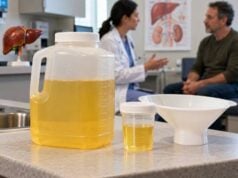
A 24-hour urine osmolality test measures the average concentration of dissolved particles in urine collected over one full day. It reflects the relationship between the amount of water excreted and the amount of dissolved solute, including sodium, potassium, urea, and other molecules. The test can help assess whether the kidneys are producing appropriately concentrated or dilute urine and can add context to daily urine volume, habitual fluid intake, and kidney stone prevention. It is different from a single random urine osmolality, which is often more useful for diagnosing acute sodium or water-balance disorders because it captures the kidney’s response at one moment. A 24-hour average can look normal even if urine becomes very dilute at one time and concentrated at another. Interpretation therefore depends on total urine volume, blood sodium and serum osmolality, fluid intake, diet, medications, kidney function, and the reason the test was ordered. A high or low number alone does not diagnose dehydration, diabetes insipidus, or kidney disease.
- Urine osmolality is reported in mOsm/kg and shows how concentrated or dilute urine is relative to water.
- One current laboratory lists a 24-hour reference interval of 150–1,150 mOsm/kg after 12 months of age, but everyday values commonly cluster around 500–850 mOsm/kg with usual diet and fluid intake.
- Low 24-hour urine osmolality usually reflects relatively high water intake or impaired urine concentration; total urine volume helps distinguish these possibilities.
- High 24-hour urine osmolality can reflect lower water intake or a high solute load and must be interpreted with blood sodium, serum osmolality, and clinical volume status.
- A 24-hour average is not a substitute for properly timed spot urine osmolality when evaluating hyponatremia or a polyuria-polydipsia disorder.
Table of Contents
- What 24-Hour Urine Osmolality Measures
- Normal Range and What the Number Means
- Causes of Low 24-Hour Urine Osmolality
- Causes of High 24-Hour Urine Osmolality
- Osmolality, Urine Volume, and Fluid Balance
- How the 24-Hour Collection Is Done
- How Results Guide Follow-Up Testing
What 24-Hour Urine Osmolality Measures
Osmolality is the number of dissolved particles per kilogram of water. In urine, the main contributors are electrolytes and metabolic waste products, especially sodium salts, potassium salts, and urea. The laboratory measures how many osmotically active particles are present, regardless of their individual identity.
A high osmolality means there is relatively little water for the amount of solute in the urine, so the urine is concentrated. A low osmolality means there is relatively more water, so the urine is dilute. This is one of the clearest ways to assess the kidney’s ability to adjust water excretion.
The kidneys change urine concentration through a coordinated system involving filtration, the kidney medulla, thirst, and the hormone arginine vasopressin, also called antidiuretic hormone. When the body needs to conserve water, vasopressin promotes water reabsorption in the collecting ducts and urine becomes more concentrated. When water is abundant, vasopressin activity falls and the kidneys can excrete very dilute urine.
A standard urine osmolality test is often performed on a single sample. That spot measurement is especially useful when paired with a blood sodium and serum osmolality during an active water-balance problem. The 24-hour test asks a different question: what was the average urine concentration across an entire day?
That average can be helpful when clinicians want to understand habitual fluid intake relative to solute intake, examine overall concentrating and diluting behavior, or interpret a kidney stone profile. It is less useful for detecting short episodes. For example, a person may produce dilute urine after drinking several glasses of water and concentrated urine overnight. The 24-hour average may sit in the middle and hide both extremes.
Osmolality should also not be confused with specific gravity. A urine specific gravity test estimates urine density compared with water and is influenced by particle size and weight, while osmolality counts particles. The two often move in the same direction but are not identical.
Normal Range and What the Number Means
Reference limits vary with age, laboratory method, diet, and fluid intake. One current laboratory lists 150–1,150 mOsm/kg for a 24-hour urine osmolality in people aged 12 months and older. It also notes that with ordinary fluid intake and diet, many people produce urine averaging about 500–850 mOsm/kg.
Those figures illustrate why there is no narrow “ideal” osmolality for everyone. Healthy kidneys can vary urine concentration widely. Under appropriate conditions, a normal kidney can produce very dilute urine after excess water intake and very concentrated urine during water conservation. The number that is appropriate depends on what the blood and body are asking the kidneys to do.
For example:
| Clinical setting | Expected direction of urine osmolality |
|---|---|
| Large water intake with normal regulation | Lower as excess water is excreted |
| Water restriction or dehydration | Higher as the kidneys conserve water |
| High solute intake with similar fluid intake | Often higher because more particles must be excreted |
| Impaired concentrating ability | May remain lower than expected when the body needs water conservation |
| Persistent vasopressin effect | May remain concentrated when free-water excretion should increase |
Age also affects maximal concentrating ability. Kidney concentration tends to decline with aging, so an older adult may not reach the same peak urine osmolality as a younger adult even without a new disease.
The 24-hour value is especially dependent on the day’s behavior. Drinking much more or less than usual can move it substantially. So can a major change in protein, salt, or total food intake because those alter the osmoles that must be excreted.
A value inside the laboratory range does not prove that water balance is normal. If blood sodium is very low or high, the important question is whether the urine concentration is appropriate for that blood state. For acute hyponatremia workups, clinicians usually use a contemporaneous spot urine osmolality and urine sodium rather than relying on a 24-hour average.
Causes of Low 24-Hour Urine Osmolality
Low 24-hour urine osmolality means the day’s urine was relatively dilute. The most common explanation is simply that water intake was high relative to the amount of solute excreted. In that setting, a larger urine volume is expected and the kidneys may be functioning normally.
Low values become more clinically important when they occur with persistent polyuria, excessive thirst, abnormal blood sodium, or an inability to concentrate urine when water conservation should be active.
Possible causes include:
- High habitual fluid intake. Drinking large amounts of water can appropriately suppress vasopressin and produce dilute urine.
- Primary polydipsia. Excessive fluid intake can become sustained enough to produce hypotonic polyuria and, in some cases, low blood sodium.
- Arginine vasopressin deficiency. Formerly called central diabetes insipidus, this occurs when the body cannot produce or release enough vasopressin.
- Arginine vasopressin resistance. Formerly called nephrogenic diabetes insipidus, this occurs when the kidneys do not respond properly to vasopressin.
- Certain medications or electrolyte disorders. Lithium, significant hypercalcemia, and hypokalemia are examples that can impair kidney concentration.
- Kidney tubulointerstitial disease or advanced chronic kidney disease. Damage to the concentrating mechanism can reduce the kidney’s ability to make highly concentrated urine.
A low number is not enough to distinguish these causes. Total daily urine volume matters. True polyuria in adults is often defined by an unusually large 24-hour volume, commonly around 3 liters or more per day, though thresholds can be adjusted for body size and context. A 24-hour urine volume measurement helps establish whether excessive urine production is actually present.
If polyuria is confirmed, the next distinction is often between a water diuresis and an osmotic or solute diuresis. Very dilute urine supports water diuresis, whereas urine that remains relatively concentrated despite high volume suggests substantial solute excretion, such as glucose or urea. Modern evaluation may use serum sodium, serum and urine osmolality, glucose, kidney function, medication review, and specialized testing rather than a 24-hour average alone.
Causes of High 24-Hour Urine Osmolality
High 24-hour urine osmolality means the urine was concentrated on average. This can be entirely appropriate. Someone who drinks less fluid, sweats more, or has a high solute intake may produce a smaller amount of more concentrated urine.
Common explanations include:
- Lower fluid intake or dehydration, including fluid loss from fever, sweating, vomiting, or diarrhea.
- Higher solute intake, especially a diet with more protein or salt, which increases the number of particles that must be excreted.
- Persistent vasopressin activity, which promotes renal water conservation.
- Conditions associated with low effective circulating volume, such as some cases of heart failure or cirrhosis, where the body may retain water despite total body fluid excess.
- Syndrome of inappropriate antidiuresis, in which vasopressin activity is inappropriately high for the blood osmolality and contributes to hypotonic hyponatremia.
The last point shows why “concentrated urine” is not the same as “dehydration.” A person with syndrome of inappropriate antidiuresis may have concentrated urine while total body water is excessive relative to sodium. Similarly, edema does not guarantee that the kidneys will excrete dilute urine if the body senses reduced effective circulation.
For hyponatremia, clinicians first determine whether the blood is truly hypotonic. They then often use a spot urine osmolality to assess whether vasopressin is effectively suppressing water excretion. A low spot urine osmolality can point toward appropriate suppression, as in excess water intake, while a higher value indicates ongoing antidiuretic activity. A urine sodium test and clinical assessment of volume status add further context.
A high 24-hour osmolality may also reflect concentrated urine because total volume was low. For kidney stone prevention, that can be unfavorable because many stone-forming salts become more concentrated as water volume falls. The goal in that setting is often to increase urine volume enough to reduce supersaturation rather than to treat osmolality as an isolated abnormality.
Osmolality, Urine Volume, and Fluid Balance
Osmolality and urine volume should be read together. They represent two sides of the same water-solute relationship, but they are not exact opposites because the amount of solute excreted can also change.
Imagine two people who each excrete the same amount of osmoles in a day. If one produces 1 liter of urine and the other produces 3 liters, the first person’s urine will be much more concentrated. But if the second person also eats much more protein and salt, total osmole excretion may rise enough that the relationship becomes less predictable.
This is why a high urine output does not always mean “too much water.” Osmotic diuresis occurs when extra solute holds water in the urine. Uncontrolled diabetes mellitus can do this through glucose in the urine. High urea excretion can contribute in people receiving high protein loads or recovering from certain illnesses. Diuretics also change sodium and water excretion.
Likewise, low urine output can reflect dehydration, reduced kidney perfusion, acute kidney injury, obstruction, or simply lower intake. Osmolality can help, but it cannot by itself identify the cause.
The total daily osmole excretion can sometimes be estimated from urine osmolality and 24-hour volume. That calculation can help explain why someone is producing a large amount of urine: the problem may be excess water, excess solute, or a mixture of both. Clinicians use this type of reasoning when a high urine volume is persistent and the cause is not obvious from glucose, medicines, or fluid intake.
For kidney stone prevention, a 24-hour average provides a practical summary of urine dilution. One current laboratory suggests a rough treatment target below 400 mOsm/kg for stone formers, noting that this often corresponds to urine volume above 2 liters in an average person. That is not a universal target for every stone patient. Many guidelines focus more directly on urine volume, and the needed fluid intake varies with climate, body size, exercise, diet, and stone risk.
The safest approach is to interpret osmolality alongside the full urine electrolyte pattern, daily volume, serum sodium, kidney function, and the clinical question.
How the 24-Hour Collection Is Done
The accuracy of the average depends on collecting every urine sample for the full 24 hours. Missing urine can distort both the measured volume and the osmolality profile represented by the combined specimen.
A typical collection is performed as follows:
- Start at a chosen time, usually in the morning. Urinate into the toilet and record the time. This first urine is discarded.
- Collect every urine sample after that for the next 24 hours in the designated container.
- Store the collection as instructed. Many laboratories recommend refrigeration, but follow the exact instructions provided.
- At exactly the same time the next day, urinate one final time and add that specimen to the container.
- Return the sample with total volume and collection duration information if the laboratory requests it.
Do not intentionally dehydrate yourself or perform a home water-deprivation experiment to make the urine more concentrated. Formal testing for vasopressin disorders requires medical supervision because restricting water can be dangerous in someone who cannot conserve it properly.
Unless the clinician gives special instructions, a usual day of eating and drinking often provides the most useful picture of habitual fluid balance. Record unusual events such as vomiting, heavy sweating, very intense exercise, unusually high fluid intake, or a change in diuretic use because these can shift the result.
If you miss a void or collect for substantially more or less than 24 hours, contact the laboratory. Restarting may be necessary. A well-collected sample is especially important when the result is being compared with total urine volume or other 24-hour analytes.
How Results Guide Follow-Up Testing
Follow-up depends on why the test was ordered. The same 24-hour osmolality may be reassuring in one person and inappropriate in another.
For polyuria and excessive thirst, clinicians first confirm that urine volume is truly elevated. They then examine blood sodium, glucose, kidney function, calcium, potassium, and urine concentration. If a hypotonic polyuria syndrome is suspected, endocrinology or nephrology may use modern diagnostic approaches involving carefully controlled testing and, in some centers, copeptin measurements. These evaluations are safer and more informative than unsupervised fluid restriction.
For hyponatremia, a same-time serum osmolality, spot urine osmolality, and urine sodium are generally more useful than a 24-hour average. Severe hyponatremia with confusion, seizures, severe headache, vomiting, or reduced consciousness is a medical emergency because rapid changes in brain water can be dangerous.
For high blood sodium, dilute urine despite hypernatremia may indicate inadequate vasopressin effect or kidney resistance, while concentrated urine suggests that the kidneys are attempting to conserve water. Again, the key is the urine response relative to the blood state.
For kidney stone prevention, follow-up usually focuses on daily urine volume and the stone-forming chemistry. Increasing fluid intake may lower average urine osmolality, but the appropriate goal should be individualized rather than pursued as a number in isolation.
A 24-hour urine osmolality test is therefore best viewed as a summary of one day’s water-to-solute balance. It can show whether urine was dilute or concentrated on average, but the diagnosis comes from combining that average with urine volume, blood measurements, symptoms, medications, and the timing of the problem being investigated.
References
- Diagnostic Updates for Polyuria-Polydipsia Syndromes 2026 (Review)
- Diagnostic algorithm of hyponatremia 2026 (Review)
- Lesson for the clinical nephrologist: diagnostic approach to polyuria-polydipsia syndrome in the adult 2024
- [Consensus recommendations on the diagnosis and treatment of hyponatremia from the Austrian Society for Nephrology 2024] 2024 (Position Statement)
- OSM24 – Overview: Osmolality, 24 Hour, Urine 2026
Disclaimer
This article is for general education and does not replace medical evaluation of sodium, water-balance, or kidney disorders. Urine osmolality must be interpreted with urine volume, blood sodium, serum osmolality, medications, and the reason for testing. Do not attempt unsupervised water deprivation, and seek urgent care for severe neurologic symptoms or a critically abnormal sodium level.