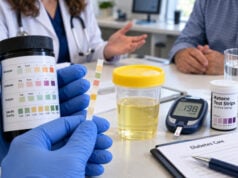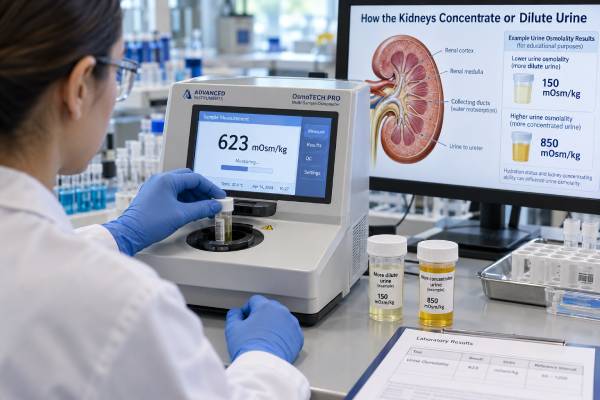
A urine osmolality test measures how concentrated or dilute urine is by counting the number of dissolved particles in a given amount of water. It is one of the most direct ways to assess how the kidneys are handling water. A high urine osmolality means the urine is concentrated; a low value means it is dilute. Neither result is automatically abnormal, because healthy kidneys change urine concentration throughout the day in response to fluid intake, thirst, hormones, salt and protein intake, medicines, and illness. The test becomes most useful when it is interpreted with serum sodium, plasma osmolality, urine volume, and the clinical situation. It can help evaluate dehydration, excessive urination, low or high blood sodium, suspected arginine vasopressin disorders such as diabetes insipidus, and other problems with kidney concentrating ability. A single random result can be informative, but controlled testing or a 24-hour urine collection may be needed when the question is more complex.
- Urine osmolality is usually reported in mOsm/kg and shows the number of dissolved particles relative to water.
- Low urine osmolality means dilute urine; values at or below about 300 mOsm/kg are important when evaluating hypotonic polyuria.
- High urine osmolality means concentrated urine; values above about 800 mOsm/kg during polyuria usually point away from diabetes insipidus and toward a solute-driven diuresis.
- A “normal range” is very broad because hydration changes the result; interpretation requires the reason for testing and often a simultaneous blood sodium or plasma osmolality.
- Water-deprivation testing should be medically supervised because it can cause dangerous dehydration or high sodium in people who cannot concentrate urine normally.
Table of Contents
- What Urine Osmolality Measures
- Normal and Expected Urine Osmolality Results
- What High Urine Osmolality Means
- What Low Urine Osmolality Means
- Osmolality in Polyuria and Diabetes Insipidus
- Urine Osmolality vs. Specific Gravity
- Testing, Preparation, and Follow-Up
What Urine Osmolality Measures
Urine osmolality measures the concentration of dissolved particles—called osmoles—in urine. The result is usually reported as milliosmoles per kilogram of water, or mOsm/kg. The major contributors include sodium and its accompanying anions, potassium salts, urea, glucose when present, and other small dissolved substances.
The kidneys continuously adjust water excretion to keep blood osmolality within a narrow range. When the body needs to conserve water, arginine vasopressin (AVP), also called antidiuretic hormone, signals the collecting ducts to reabsorb more water. Urine becomes more concentrated and urine osmolality rises. When the body needs to eliminate excess water, AVP activity falls, more water remains in the urine, and osmolality drops.
Because of this normal flexibility, urine osmolality can range from very dilute to highly concentrated in healthy people. A random urine result cannot be labeled good or bad without context.
The test may be ordered to investigate:
- unusually high urine volume or excessive thirst;
- dehydration or suspected water deficit;
- low or high blood sodium;
- suspected AVP deficiency or AVP resistance, historically called central or nephrogenic diabetes insipidus;
- primary polydipsia, meaning excessive water intake;
- kidney disease that may impair concentrating ability;
- response to a water-deprivation or desmopressin test;
- unexplained changes in fluid balance in hospitalized patients.
A 24-hour urine osmolality test can provide a broader picture when urine concentration changes substantially over the day.
Normal and Expected Urine Osmolality Results
There is no single narrow “normal” urine osmolality range that applies to every spot sample. Laboratories may publish broad reference intervals, often spanning roughly 50 to 1,200 mOsm/kg, because a healthy kidney should be able to produce both very dilute and very concentrated urine depending on fluid balance.
The better question is whether the urine concentration is appropriate for the person’s blood osmolality, sodium level, urine volume, and hydration state.
For example:
- After drinking a large amount of water, a low urine osmolality can be completely appropriate.
- After an overnight fast from fluids or mild dehydration, urine should normally become more concentrated.
- During true water deprivation, healthy kidneys can often raise urine osmolality to roughly 800 mOsm/kg or higher, with some references describing 800–1,200 mOsm/kg as a typical strong concentrating response.
- In a person producing very large volumes of urine, a urine osmolality of 300 mOsm/kg or less indicates hypotonic, or water-rich, urine and directs the evaluation toward a water-balance disorder.
These thresholds are decision points used in specific clinical questions, not universal reference limits for every urine specimen.
The same number can therefore mean different things in different people. A urine osmolality of 250 mOsm/kg after several large glasses of water may represent an appropriate response. The same 250 mOsm/kg in someone with a serum sodium of 150 mmol/L would be inappropriately dilute because the body should be conserving water. Likewise, a urine osmolality of 700 mOsm/kg can be a healthy response to overnight fluid restriction, but in a person with low serum sodium it may indicate that water excretion is being limited when the body would normally need to produce more dilute urine.
Age also matters. Healthy younger adults usually have greater concentrating ability than many older adults, whose maximum urine concentration can decline with age. Chronic kidney disease, medullary damage, and some tubulointerstitial disorders can blunt both concentrating and diluting capacity. In advanced kidney dysfunction, urine may remain in a relatively narrow concentration range even when fluid intake changes.
For these reasons, laboratories often provide a reference interval while clinicians focus more heavily on whether the kidney response is physiologically appropriate. A paired blood and urine sample can be far more informative than comparing a spot urine result with a broad printed “normal range.”
A single result also depends on timing. First-morning urine is often more concentrated than a sample collected soon after several glasses of water. Diuretics, sodium-glucose cotransporter-2 inhibitors, high glucose, intravenous fluids, tube feeding, high protein intake, and recent imaging contrast can all change the particle load or urine volume.
What High Urine Osmolality Means
High urine osmolality means the kidneys are excreting urine with many dissolved particles relative to water. In many situations, that is a normal response to dehydration or reduced water intake. It can also reflect a high solute load rather than water conservation alone.
Common reasons include:
- dehydration from limited intake, sweating, fever, diarrhea, or vomiting;
- increased AVP release when the body is trying to conserve water;
- syndrome of inappropriate antidiuretic hormone secretion in the right blood-sodium context;
- glucose in the urine from uncontrolled hyperglycemia or some medications;
- increased urea excretion after high protein intake, tube feeding, tissue breakdown, or recovery from kidney injury;
- mannitol or other osmotically active substances;
- concentrated first-morning urine in a healthy person.
The blood result changes the interpretation. In hyponatremia, for example, the kidneys would normally suppress AVP and produce very dilute urine. If urine remains inappropriately concentrated, that suggests the body is retaining water under hormonal or physiologic signals. Clinicians then assess volume status, medicines, kidney function, adrenal and thyroid factors when relevant, and urine sodium.
In contrast, high urine osmolality during very high urine output may indicate solute diuresis rather than simple water loss. Glucose, urea, sodium, or mannitol can pull water into the urine. A person can therefore have both high urine volume and a relatively high urine osmolality.
This is why urine osmolality should not be interpreted as a hydration meter in isolation. A high value can reflect appropriate water conservation, excess solute excretion, or a pathologic hormonal response depending on the rest of the data.
One practical distinction is between water diuresis and solute diuresis. In water diuresis, the kidneys excrete a large amount of relatively particle-poor urine, so osmolality is low. In solute diuresis, an increased load of glucose, urea, sodium, or another osmole carries water with it, so urine volume can be high even though urine osmolality is not low. This distinction helps prevent a common mistake: assuming every person with polyuria has a problem with AVP.
Urine osmolality can also help interpret hyponatremia. When blood sodium is low, a urine osmolality near the kidney’s minimum dilution—often around 50 to 100 mOsm/kg in a healthy adult—suggests that AVP is appropriately suppressed and the kidneys are trying to excrete free water. If the urine is substantially more concentrated, AVP activity is present. That may occur with volume depletion, nausea, pain, some medicines, adrenal insufficiency, or SIADH, among other causes. Further testing is needed because osmolality alone cannot distinguish them.
What Low Urine Osmolality Means
Low urine osmolality means the urine contains relatively few dissolved particles and a high proportion of water. It can be completely normal after high fluid intake, but persistent dilute urine can indicate a problem with water regulation or kidney concentrating ability.
Common causes include:
- drinking large amounts of water;
- primary polydipsia;
- AVP deficiency, formerly called central diabetes insipidus;
- AVP resistance, formerly called nephrogenic diabetes insipidus;
- certain kidney tubule or medullary disorders that impair concentration;
- low potassium or high calcium states that reduce the kidney’s response to AVP;
- medications such as lithium that can cause nephrogenic AVP resistance;
- recovery phases of some kidney injuries or urinary obstruction.
A low urine osmolality is most important when it is inappropriately low for the blood state. If blood sodium or plasma osmolality is high, the body should be strongly conserving water. Persistently dilute urine in that setting raises concern for AVP deficiency or resistance.
Medication history is especially important in low-osmolality polyuria. Lithium is a well-known cause of acquired AVP resistance, but other drugs and electrolyte disturbances can also reduce collecting-duct responsiveness. Conversely, a person taking desmopressin may produce concentrated urine even when their untreated physiology would not. Stopping or changing these medicines solely to “see what the urine does” can be dangerous, so diagnostic adjustments should be clinician-directed.
If both blood osmolality and urine osmolality are low, excessive water intake becomes more likely. However, partial AVP disorders and chronic primary polydipsia can overlap, so further testing may be needed.
Urine volume is crucial. Someone who urinates frequently but produces a normal total daily volume may have bladder irritation, overactive bladder, urinary infection, or another lower urinary tract problem rather than true polyuria. Measuring 24-hour urine volume helps distinguish frequent small voids from genuine excess urine production.
Osmolality in Polyuria and Diabetes Insipidus
Urine osmolality is central to the evaluation of polyuria-polydipsia syndromes. These include AVP deficiency, AVP resistance, and primary polydipsia.
A practical sequence is:
- Confirm that true polyuria is present, often with a 24-hour urine collection.
- Determine whether the urine is hypotonic by measuring osmolality.
- Use blood sodium, plasma osmolality, history, medicines, and further testing to identify the cause.
Definitions of adult polyuria vary, but commonly used thresholds include around 3 L/day or more than 40–50 mL/kg/day. A urine osmolality of 300 mOsm/kg or less supports hypotonic polyuria. A value of 800 mOsm/kg or more during polyuria points toward a solute diuresis and strongly argues against complete AVP deficiency or resistance.
Values between about 300 and 800 mOsm/kg are an overlap zone. Partial AVP deficiency, partial AVP resistance, chronic primary polydipsia, or mixed conditions may all fall there.
Water deprivation and desmopressin testing
Traditional water-deprivation testing evaluates whether the kidneys can concentrate urine when water is withheld. In a person with normal AVP release and kidney response, urine osmolality rises as dehydration develops. If the urine stays very dilute despite rising blood osmolality or sodium, an AVP disorder becomes more likely.
Desmopressin, a synthetic AVP analogue, may then be given. A substantial increase in urine osmolality supports AVP deficiency because the kidneys can respond once the missing hormone signal is replaced. A limited response suggests AVP resistance.
This testing is not a do-it-yourself dehydration challenge. It requires serial body weight, urine output, urine osmolality, serum sodium, and clinical monitoring, with clear stopping rules. People with significant AVP deficiency can become dangerously hypernatremic if deprived of water without supervision.
Newer diagnostic approaches use copeptin, a stable blood marker released with AVP, after controlled stimulation. In specialized centers, copeptin-based testing can distinguish AVP deficiency from primary polydipsia more accurately than classic water deprivation in some patients.
Urine Osmolality vs. Specific Gravity
Urine osmolality and urine specific gravity both describe urine concentration, but they measure different properties.
| Feature | Urine osmolality | Urine specific gravity |
|---|---|---|
| What it reflects | Number of dissolved particles | Density of urine compared with water |
| Typical units | mOsm/kg | Unitless ratio, such as 1.010 |
| Effect of particle size | Mostly independent of particle size | Larger molecules can raise the value disproportionately |
| Best use | Precise water-balance and polyuria evaluation | Rapid estimate of urine concentration |
Large molecules such as glucose, protein, or radiographic contrast can raise specific gravity more than they raise the particle count represented by osmolality. That can create a mismatch between the two tests.
For a quick urinalysis, the urine specific gravity test is convenient. For detailed evaluation of hypotonic polyuria and AVP disorders, urine osmolality is generally preferred because it directly reflects the number of particles.
Testing, Preparation, and Follow-Up
A random urine osmolality test usually requires only a urine sample. Preparation depends on the reason for testing. If the goal is to assess everyday fluid balance, the clinician may want you to drink normally. If the test is part of a controlled diagnostic protocol, you may receive specific instructions about fluids, caffeine, smoking, or medicines that affect urine output.
Do not intentionally restrict water unless a clinician specifically instructs and supervises you. This is particularly important if you have intense thirst, large-volume urination, known AVP deficiency, kidney disease, or a history of high sodium.
Interpretation commonly includes:
- serum sodium and potassium;
- plasma osmolality;
- glucose;
- creatinine and kidney function;
- calcium when polyuria is unexplained;
- 24-hour urine volume;
- urine sodium or glucose in selected cases;
- medication and fluid-intake history.
A low or high result often needs no treatment by itself. Treatment targets the cause. Dehydration may require fluid replacement; uncontrolled diabetes may require glucose management; AVP deficiency may be treated with desmopressin; AVP resistance may require medication changes and other targeted measures; primary polydipsia is managed differently and can be dangerous if mistaken for AVP deficiency.
Seek prompt medical care if excessive urination or thirst is accompanied by confusion, severe weakness, fainting, inability to keep up with fluid losses, very high or low sodium, or rapidly changing neurologic symptoms. Infants, young children, older adults, and people who cannot independently access water are at particular risk when the kidneys cannot concentrate urine normally.
For persistent polyuria, a single spot osmolality is usually only the beginning. The most useful diagnosis comes from matching urine concentration to urine volume and the blood’s osmotic state, then investigating why the kidney response is appropriate or inappropriate.
References
- Office-Based Urinalysis: A Comprehensive Review 2022 (Review)
- Approach to the Patient With Suspected Hypotonic Polyuria 2025 (Review)
- Arginine vasopressin deficiency: diagnosis, management and the relevance of oxytocin deficiency 2024 (Review)
- Central and nephrogenic diabetes insipidus: updates on diagnosis and management 2025 (Review)
- Diagnostic Tests for Diabetes Insipidus 2025 (Review)
- Diagnostic Utility of Copeptin in Pediatric Patients with Polyuria-Polydipsia Syndrome: A Systematic Review and Meta-Analysis 2024 (Systematic Review)
Disclaimer
This article is for general educational purposes and does not diagnose a fluid-balance, kidney, or hormone disorder. Urine osmolality must be interpreted with urine volume, blood sodium or plasma osmolality, medicines, and clinical context. Do not attempt unsupervised water deprivation; seek medical care for severe thirst or urination with confusion, fainting, dehydration, or other serious symptoms.