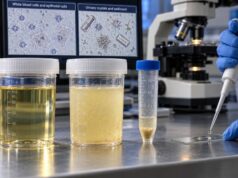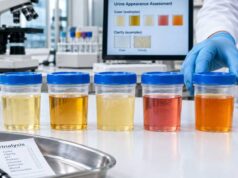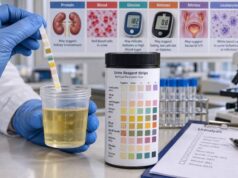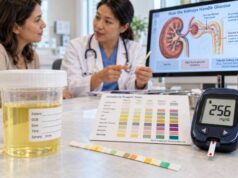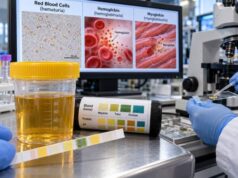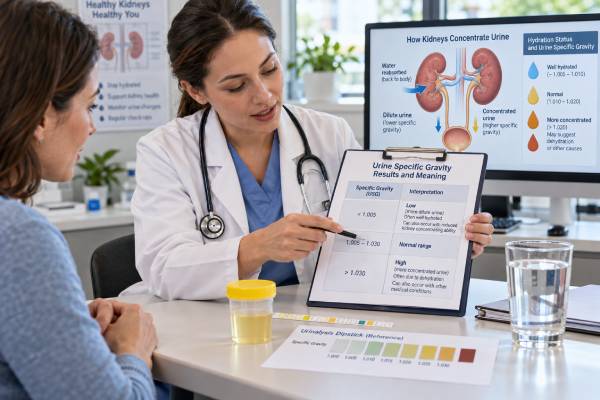
A urine specific gravity test shows how concentrated or dilute a urine sample is compared with pure water. It is part of many routine urinalyses and can give a quick clue about hydration, fluid intake, and the kidneys’ ability to conserve or release water. A high specific gravity often means concentrated urine, as can happen with dehydration, but glucose, protein, contrast material, and other dissolved substances can also raise the reading. A low result usually means dilute urine and may simply follow heavy fluid intake; persistent low values can occur when the kidneys cannot concentrate urine normally, including in diabetes insipidus or some kidney disorders. A single result should therefore be interpreted with symptoms, recent drinking, medications, blood sodium, glucose, kidney function, and sometimes urine osmolality. The test is useful as a screening marker, but it does not by itself diagnose dehydration or a kidney disease.
- A common urine specific gravity reference range is about 1.005 to 1.030, although laboratories and methods vary.
- High specific gravity usually means concentrated urine, but glucose, protein, and some imaging contrast agents can also increase the result.
- Low specific gravity usually means dilute urine; repeated very low readings can point to excess water intake or impaired kidney concentration.
- A value around 1.010 can be normal in a well-hydrated person, but a persistently fixed value near this level may need kidney evaluation.
- Urine osmolality is often more precise when clinicians need to assess a suspected water-balance disorder such as diabetes insipidus.
Table of Contents
- What Urine Specific Gravity Measures
- Normal Urine Specific Gravity Range
- What High Urine Specific Gravity Means
- What Low Urine Specific Gravity Means
- Hydration and Specific Gravity
- Kidney Concentration, Osmolality, and Persistent Abnormal Results
- Testing, Interference, and Follow-Up
What Urine Specific Gravity Measures
Urine specific gravity, often shortened to USG, compares the density of urine with the density of pure water. Pure water has a specific gravity of 1.000. Urine is normally denser because it contains electrolytes, urea, creatinine, and many other dissolved substances.
The result gives a quick estimate of how concentrated the sample is. When the kidneys conserve water, urine usually becomes more concentrated and specific gravity rises. When the kidneys release more water, urine becomes more dilute and specific gravity falls.
That makes USG useful for questions such as:
- Is this urine sample concentrated or dilute?
- Does recent fluid intake help explain the result?
- Are the kidneys responding appropriately to a water-balance problem?
- Could an unexpectedly high reading be caused by glucose, protein, or another heavy dissolved substance?
Specific gravity is related to urine concentration, but it is not identical to osmolality. Specific gravity is influenced by the number and weight of particles in urine. Osmolality reflects the number of dissolved particles regardless of their size. A large molecule can therefore raise specific gravity more than it raises osmolality.
This difference matters when urine contains unusual amounts of glucose, protein, or radiographic contrast. In those situations, a urine osmolality test can provide a clearer measure of water concentration.
Specific gravity may be measured by a reagent strip, a refractometer, or laboratory instrumentation. The method can affect the number slightly. A dipstick gives a practical screening estimate, while refractometry measures how dissolved substances change the refractive properties of the sample.
Normal Urine Specific Gravity Range
A commonly used reference range is about 1.005 to 1.030. Some sources use a broader physiologic range, such as roughly 1.003 to 1.030. The correct comparison is always the reference interval printed by the laboratory that performed the test.
The number can change substantially over a single day. A first-morning sample is often more concentrated because a person usually has not been drinking overnight. Urine collected soon after drinking several glasses of water can be much more dilute.
A useful way to read the number is:
| Result pattern | What it often suggests | Important limitation |
|---|---|---|
| Below about 1.005 | Very dilute urine | May be normal after high fluid intake; persistent results need context |
| About 1.005–1.030 | Common laboratory range | A value inside the range does not prove normal hydration or kidney function |
| Near 1.010 | Moderately dilute to intermediate concentration | Can be normal once; a repeatedly fixed value can be more significant |
| Above about 1.020 | Relatively concentrated urine | May reflect dehydration, but glucose or other solutes can also raise it |
| Above the laboratory range | Highly concentrated or solute-rich urine | Method interference and unusual solutes should be considered |
There is no single specific-gravity cutoff that can diagnose dehydration in every person. A reading of 1.020 or higher is often used in sports and field settings as a marker of concentrated urine or possible hypohydration, but research shows that body size, muscle mass, diet, recent fluid intake, and timing can affect this threshold. Clinical dehydration assessment should not rely on USG alone.
Age and kidney function also matter. Infants, older adults, and people with kidney disease may have a different concentrating response than healthy younger adults. Medications that alter water balance can shift the result as well.
For home or point-of-care testing, the most useful question is usually not whether a value is “perfect,” but whether it fits the circumstances and whether an abnormal pattern persists.
What High Urine Specific Gravity Means
High urine specific gravity most often means the sample contains relatively little water compared with dissolved substances. Dehydration is one common cause, but it is not the only cause.
Situations that can produce a high result include:
- not drinking enough fluid;
- heavy sweating from exercise or hot weather;
- fever;
- vomiting or diarrhea;
- reduced access to water;
- glucose in urine from marked hyperglycemia;
- substantial protein in urine;
- increased antidiuretic hormone activity, including some cases of syndrome of inappropriate antidiuretic hormone secretion;
- recent administration of radiographic contrast or certain large-molecule solutions.
When water loss is the main reason, other clues may include thirst, dry mouth, darker urine, reduced urine volume, dizziness, or a recent fall in body weight. A 24-hour urine volume can help when total urine output, rather than one sample’s concentration, is clinically important.
Glucose deserves special attention. If blood glucose rises above the kidney’s reabsorption capacity, glucose spills into urine. That glucose adds density and can push specific gravity upward even when the person is also losing large amounts of water through osmotic diuresis. In other words, a high USG does not always mean the body is successfully conserving water.
Protein can have a similar effect, especially when present in substantial amounts. A high reading together with dipstick protein should therefore be interpreted differently from an isolated high USG after a long period without fluids.
Very high readings that do not fit the clinical picture deserve confirmation. Recent intravenous contrast can make some measurement methods read unexpectedly high. The laboratory may repeat the test, use a different method, or measure osmolality if the distinction matters.
A high USG is most useful as a clue. It becomes more meaningful when paired with the reason for testing, urine volume, blood pressure, serum sodium, glucose, kidney function, and the rest of the urinalysis.
What Low Urine Specific Gravity Means
Low urine specific gravity means the urine is dilute. The simplest explanation is often that the person recently drank a large amount of fluid. A low value after intentional hydration can be completely expected.
Other causes include:
- high habitual water intake;
- intravenous fluids;
- medicines that increase urine output;
- primary polydipsia, in which a person drinks excessive amounts of water;
- arginine vasopressin deficiency, historically called central diabetes insipidus;
- arginine vasopressin resistance, historically called nephrogenic diabetes insipidus;
- impaired concentrating ability from some kidney diseases;
- certain electrolyte or endocrine disorders that affect water handling.
A single low USG is rarely enough to diagnose any of these conditions. The pattern becomes more important when dilute urine persists despite limited fluid intake or appears with polyuria, meaning unusually high urine volume.
Diabetes insipidus is a classic example. In this disorder, the body either does not produce enough arginine vasopressin, also called antidiuretic hormone, or the kidneys do not respond to it properly. The result can be large volumes of very dilute urine, intense thirst, and sometimes high blood sodium if water intake cannot keep up with losses.
Primary polydipsia can look similar because heavy water intake also produces dilute urine. Distinguishing the two may require serum sodium, plasma osmolality, urine osmolality, medication review, and specialist testing. A low USG by itself cannot make that distinction.
Kidney disease can also reduce the ability to concentrate urine. This does not mean every person with chronic kidney disease will have low specific gravity. Early disease may leave concentrating ability relatively intact, and many other factors influence a spot sample.
Repeated results near the density of plasma ultrafiltrate—often discussed as being around 1.010—can raise concern when the kidneys seem unable to make urine either more concentrated or more dilute despite changing fluid conditions. This pattern is sometimes called isosthenuria. It is not diagnosed from one urine sample, because a healthy person can also produce urine near 1.010 at a particular moment.
Hydration and Specific Gravity
Urine specific gravity is a convenient hydration marker, but it reflects recent kidney water handling more than it measures total-body hydration directly. That distinction explains why the number can be useful without being definitive.
If a healthy person drinks less than usual or loses water through sweat, the kidneys normally conserve water. Urine volume falls and concentration rises. If that person drinks a large volume of water, the kidneys excrete the excess and USG falls.
Timing can therefore change the result quickly. For example, a first-morning sample may be 1.025, while a sample collected later after a large breakfast and several drinks may be 1.008. Both may reflect normal kidney responses.
In athletes, a threshold of 1.020 or higher is commonly used to flag possible hypohydration. It is practical, but it is not a universal diagnostic line. Studies suggest that fat-free mass and other individual characteristics can influence USG, and reviews of hydration markers do not identify one urine measure that is perfect in every setting.
For everyday hydration assessment, clinicians may combine several clues:
- recent fluid intake and losses;
- thirst;
- change in body weight;
- urine volume and color;
- blood pressure and heart rate;
- serum sodium and osmolality when clinically indicated;
- USG or urine osmolality.
Urine color can broadly track concentration, but foods, vitamins, medications, blood, bilirubin, and other pigments can change color independently. Specific gravity is more objective than color alone, yet it still needs context.
Drinking excessive water just to “improve” a urine specific gravity result is not useful and can sometimes be unsafe. It may also dilute other urine markers and make a sample less representative. Unless a clinician gives special instructions, normal fluid intake is usually more informative than forced hydration before routine urinalysis.
Kidney Concentration, Osmolality, and Persistent Abnormal Results
Persistent abnormal specific gravity can help identify a kidney concentration problem, but clinicians usually combine it with more precise tests. Urine osmolality is especially useful because it directly reflects the number of dissolved particles.
The kidneys regulate water balance in response to plasma osmolality, blood volume, and hormones. When the body needs to conserve water, arginine vasopressin signals the collecting ducts to reabsorb more water. Urine becomes more concentrated. When the body has excess water, vasopressin falls and urine becomes dilute.
A person with suspected diabetes insipidus or primary polydipsia may have testing that includes:
- serum sodium;
- plasma osmolality;
- urine osmolality;
- urine volume over a defined period;
- glucose and calcium testing;
- kidney function tests;
- medication review;
- selected dynamic testing under medical supervision.
Modern evaluation of polyuria-polydipsia disorders may use copeptin, a stable marker released with vasopressin, in specialized protocols. Water-deprivation testing is still used in some settings but should be supervised because withholding water from a person with true diabetes insipidus can cause dangerous dehydration and hypernatremia.
For general kidney assessment, USG is only one part of the picture. Blood creatinine and estimated glomerular filtration rate assess filtration, while urine albumin identifies kidney damage that may exist even with preserved filtration. A creatinine blood test therefore answers a different question from urine specific gravity.
Persistent loss of concentrating ability can appear in tubulointerstitial disease, advanced chronic kidney disease, or other disorders that affect the renal medulla and collecting system. The interpretation depends on the entire clinical pattern rather than a single numeric cutoff.
A normal USG also does not rule out kidney disease. Someone can have significant albuminuria, abnormal urine sediment, or reduced eGFR while a spot urine specific gravity falls inside the reference range.
Testing, Interference, and Follow-Up
Urine specific gravity is easy to measure, but the result can be distorted by collection timing, storage, testing method, and dissolved substances. An unexpected result should be checked against the clinical situation before it is treated as evidence of disease.
For a routine sample, follow the collection instructions from the clinic or laboratory. A clean container is important, and a first-morning urine may be requested when a concentrated baseline sample would be useful. For many routine urinalyses, however, a random sample is acceptable. Following the same collection conditions can make repeat values easier to compare over time.
Potential sources of misleading results include:
- Very alkaline urine: some reagent-strip methods can read specific gravity lower than expected.
- Protein or glucose: these can increase urine density and may raise readings, especially with methods sensitive to particle mass.
- Radiographic contrast: recent contrast exposure can markedly increase density by refractometry.
- Dextran or other large molecules: these can also produce unusually high readings with some methods.
- Sample timing: recent heavy fluid intake can make a normal kidney produce a very low value.
- Method differences: a dipstick and refractometer do not measure urine concentration in exactly the same way.
Follow-up depends on the pattern. A mildly high USG after exercise on a hot day may only require normal rehydration and repeat testing if clinically needed. A low USG after drinking a large volume of water may be expected. Persistent abnormalities, especially with symptoms, deserve a broader evaluation.
Seek prompt medical care for marked thirst and very high urine output with weakness, confusion, inability to keep up with fluid losses, or signs of severe dehydration. Urgent evaluation is also appropriate for reduced urine output with swelling or shortness of breath, severe vomiting or diarrhea, fainting, or neurologic symptoms. These problems can involve sodium and fluid disturbances that are more important than the urine specific gravity number itself.
When repeat testing is needed, try to compare samples collected under similar conditions unless a clinician asks for a specific fluid challenge or restriction. Consistent timing makes trends easier to interpret. The goal is not to force the number into the reference range; it is to determine whether the kidneys are adjusting urine concentration appropriately for the body’s fluid state.
References
- Office-Based Urinalysis: A Comprehensive Review 2022 (Review)
- Diagnostic Tests for Diabetes Insipidus 2025 (Review)
- Approach to the Patient With Suspected Hypotonic Polyuria 2025 (Review)
- Central and nephrogenic diabetes insipidus: updates on diagnosis and management 2025 (Review)
- Fat-Free Mass Is Positively Associated With Urine Specific Gravity in Athletes and Active Adults: A Quantitative Review 2024 (Review)
Disclaimer
Urine specific gravity should be interpreted with symptoms, fluid intake, medications, and other laboratory results. A single high or low value cannot diagnose dehydration, diabetes insipidus, or kidney disease. Seek medical care for persistent abnormal results or symptoms of a significant fluid or electrolyte disturbance.