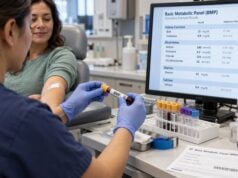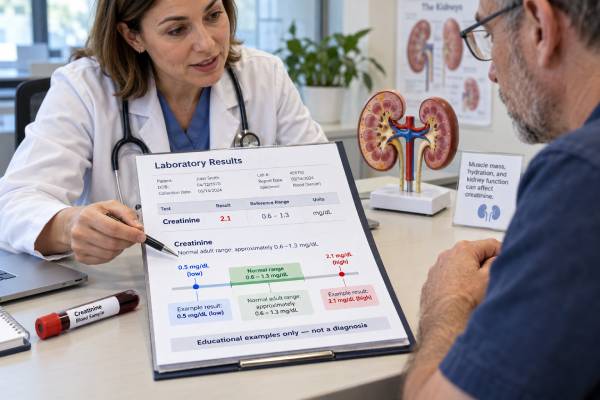
A creatinine blood test measures the amount of creatinine in your bloodstream and is one of the most common ways to assess kidney filtration. Creatinine is a waste product generated mainly by normal muscle metabolism. Healthy kidneys remove most of it from the blood, so a rising blood creatinine can signal that filtration has decreased. The number is useful, but it is not a direct measurement of kidney function and should not be interpreted alone. Muscle mass, age, recent meat intake, intense exercise, hydration, pregnancy, certain medicines, and acute illness can all change creatinine without representing the same degree of kidney damage. For that reason, laboratories commonly use serum creatinine to calculate estimated glomerular filtration rate (eGFR). A single abnormal creatinine result usually needs comparison with prior values, eGFR, urine testing, symptoms, and the clinical situation before its meaning is clear.
- Common adult creatinine ranges are roughly 0.5–1.3 mg/dL, but the correct reference interval is the one printed by your laboratory and varies by sex, muscle mass, and method.
- High creatinine usually means reduced clearance or increased creatinine production, with causes ranging from dehydration and medicines to acute kidney injury, chronic kidney disease, obstruction, or muscle breakdown.
- Low creatinine is usually linked to low muscle mass, frailty, pregnancy-related changes, malnutrition, or severe liver disease rather than “overactive” kidneys.
- eGFR is usually more informative than creatinine alone because it converts creatinine into an estimate of filtration using an equation that includes age and sex.
- A rapid rise matters even when the number is only moderately high, especially with low urine output, swelling, vomiting, confusion, shortness of breath, or other signs of acute illness.
Table of Contents
- What the Creatinine Blood Test Measures
- Normal Creatinine Range
- High Creatinine: Common Causes and Meaning
- Low Creatinine: Common Causes and Meaning
- Creatinine, eGFR, and Kidney Function
- Preparing for the Test
- Follow-Up After Abnormal Results
What the Creatinine Blood Test Measures
Creatinine forms as creatine and phosphocreatine are used in muscle. The body produces it continuously, and the kidneys remove it mainly through glomerular filtration, with a smaller amount secreted by kidney tubules. Because production is relatively steady in many people, the blood concentration can act as an indirect marker of filtration.
The test is often reported as serum creatinine in milligrams per deciliter (mg/dL) in the United States or micromoles per liter (µmol/L) in many other countries. To convert mg/dL to µmol/L, multiply by about 88.4.
Creatinine is commonly included in a basic metabolic panel, a comprehensive metabolic panel, or a dedicated kidney panel. It may be ordered for routine screening, before imaging or medications that can affect the kidneys, during an acute illness, or to monitor chronic kidney disease.
The key limitation is that blood creatinine reflects both production and clearance. Two people with the same kidney filtration rate can have different creatinine levels if their muscle mass differs. Likewise, the same creatinine value can represent different levels of kidney function in a younger muscular adult and an older frail adult.
This is why clinicians rarely ask only, “Is the creatinine normal?” More useful questions are: What was the person’s usual creatinine? Has it changed quickly? What is the eGFR? Is urine albumin present? Are there symptoms, medication changes, dehydration, infection, or obstruction?
Normal Creatinine Range
There is no single universal normal creatinine range. A commonly cited adult reference interval is approximately 0.7–1.3 mg/dL for men and 0.5–0.95 mg/dL for women, but laboratories use different assays and reference populations. Some reports use one combined interval rather than sex-specific ranges.
| Result context | General interpretation | Important limitation |
|---|---|---|
| Within the lab range | Often reassuring if stable | Does not rule out early kidney disease, especially with low muscle mass |
| Slightly above the lab range | May reflect reduced filtration, dehydration, muscle mass, diet, medicines, or recent exercise | Trend and eGFR are more informative than one isolated value |
| Clearly elevated or rapidly rising | Raises concern for acute or chronic reduction in kidney filtration | Cause still requires clinical evaluation |
| Below the lab range | Often reflects low creatinine production | Usually not a sign that the kidneys are filtering “too well” |
A result should also be compared with the person’s baseline. For example, a rise from 0.7 to 1.2 mg/dL may still fall within or near some laboratory ranges, but it represents a large relative increase and can be clinically important. By contrast, a stable creatinine of 1.3 mg/dL in a muscular person may have a different meaning.
Age matters indirectly because muscle mass often falls with aging. An older adult can have substantially reduced filtration without a dramatic creatinine elevation. This is one reason the estimated glomerular filtration rate is routinely reported alongside creatinine.
High Creatinine: Common Causes and Meaning
A high creatinine most often means that the kidneys are clearing creatinine less efficiently, but the reason can be temporary, acute, chronic, or unrelated to intrinsic kidney damage.
Common causes include:
- Dehydration or reduced blood flow to the kidneys. Vomiting, diarrhea, fever, poor fluid intake, bleeding, severe infection, or heart failure can reduce kidney perfusion and raise creatinine.
- Acute kidney injury (AKI). Infection, shock, medications, inflammation, toxins, or other acute problems can cause creatinine to rise over hours to days.
- Chronic kidney disease (CKD). Long-term damage from diabetes, high blood pressure, glomerular disease, inherited conditions, or other causes can produce a persistent elevation.
- Urinary obstruction. Kidney stones, an enlarged prostate, tumors, or other blockages can prevent urine drainage and raise creatinine.
- Medication effects. Some drugs reduce kidney filtration; others, such as trimethoprim or cimetidine, can increase serum creatinine partly by reducing tubular secretion without the same degree of true GFR decline.
- High creatinine production. A large cooked-meat meal, creatine supplements, intense exercise, or substantial muscle injury can increase creatinine.
- Rhabdomyolysis. Major muscle breakdown can sharply raise creatinine and may itself cause kidney injury.
When creatinine rises suddenly, clinicians evaluate the pattern as possible acute kidney injury. The speed and magnitude of change matter. AKI is not diagnosed by one universal creatinine cutoff; it is defined partly by a rise from baseline over a specified time and, in some cases, reduced urine output.
BUN can help provide context. If both BUN and creatinine are elevated, dehydration or reduced kidney function may be contributing, but the BUN/creatinine ratio is only a clue and should not be used as a stand-alone diagnosis.
A high creatinine does not tell you where the problem is. The cause may be before the kidney, within the kidney, or after the kidney in the urinary tract. History, examination, urinalysis, urine albumin, electrolytes, imaging, and repeat blood tests often narrow the cause.
Low Creatinine: Common Causes and Meaning
Low creatinine is much less often a kidney problem. It usually means the body is producing less creatinine because there is less muscle mass or altered creatine metabolism.
Possible causes include low muscle mass from aging, prolonged illness, immobility, amputation, neuromuscular disease, or severe weight loss. Malnutrition can reduce muscle mass and creatinine production. Severe liver disease can also lower creatinine because creatine synthesis is impaired. Pregnancy often lowers serum creatinine because kidney filtration increases and blood volume changes.
A low result can create an important interpretation problem: creatinine-based eGFR may overestimate kidney function in someone with very low muscle mass. A frail older adult, for example, may have a creatinine that looks reassuring even when true filtration is reduced.
In these situations, a cystatin C blood test may provide useful additional information because cystatin C is less dependent on muscle mass. The combined creatinine-cystatin C equation can improve GFR estimation in many patients.
Low creatinine by itself generally does not require treatment. The focus is on the underlying reason, such as nutritional status, muscle loss, liver disease, or pregnancy. If kidney function is the question, the goal is to choose a filtration estimate that is less distorted by the person’s body composition.
Creatinine, eGFR, and Kidney Function
Creatinine is a raw laboratory measurement; eGFR is an estimate derived from a filtration marker. In adults, current race-free equations commonly use creatinine together with age and sex. Some equations use cystatin C, and the most accurate routinely available estimate in many situations combines both creatinine and cystatin C.
An eGFR is usually reported in mL/min/1.73 m². The 1.73 m² refers to a standardized adult body surface area. This normalization helps compare kidney function across people, although drug dosing sometimes requires a non-indexed estimate or a different approach in people at extremes of body size.
For chronic kidney disease classification, eGFR categories are:
| GFR category | eGFR (mL/min/1.73 m²) | Description |
|---|---|---|
| G1 | ≥90 | Normal or high filtration; CKD requires another marker of kidney damage |
| G2 | 60–89 | Mildly decreased; CKD requires another marker of kidney damage |
| G3a | 45–59 | Mild to moderately decreased |
| G3b | 30–44 | Moderately to severely decreased |
| G4 | 15–29 | Severely decreased |
| G5 | <15 | Kidney failure category |
One low eGFR does not automatically establish CKD. Chronic kidney disease requires abnormalities of kidney structure or function present for at least three months. A person with a temporary low eGFR during dehydration or infection may have acute kidney dysfunction rather than CKD.
Urine albumin is the other major piece of chronic kidney risk assessment. A person can have an eGFR above 60 but still have kidney disease if persistent albuminuria or another marker of kidney damage is present. Conversely, a mildly lower eGFR in an older adult needs interpretation in the full clinical context.
Preparing for the Test
A creatinine blood test uses a standard venous blood sample and usually takes only a few minutes. No special preparation is always required, but the ordering clinician may give instructions based on why the test is being done and whether it is part of a larger panel.
Cooked meat can temporarily raise creatinine, so some patients are told to avoid meat for about 24 hours before testing when precise interpretation is important. Very strenuous exercise can also raise creatinine, especially after unusually intense activity. Creatine supplements can increase creatinine and should be reported.
Hydration should be reasonably normal unless a clinician gives different instructions. Drinking excessive water solely to lower creatinine is not useful and can create electrolyte problems. Likewise, intentionally restricting fluids can falsely worsen the picture.
Tell the care team about prescription drugs, over-the-counter medicines, and supplements. Medicines that can alter creatinine or kidney function include some anti-inflammatory drugs, certain antibiotics, diuretics, renin-angiotensin system blockers, and drugs that interfere with tubular creatinine secretion. Do not stop them on your own; whether a medication should be held depends on the clinical situation.
If creatinine is being measured as part of a CMP or another fasting test, you may be told to avoid food for a set period. Follow the instructions for the entire ordered panel, not just creatinine.
Follow-Up After Abnormal Results
The next step after an abnormal creatinine depends on whether the change is new, how large it is, and whether symptoms or other abnormal tests are present. A mildly abnormal, stable result in an otherwise well person often leads to repeat testing and review of eGFR, urine albumin, blood pressure, diabetes risk, medications, and hydration.
A new rise may prompt a more urgent evaluation. Common follow-up tests include electrolytes, BUN, urinalysis, urine albumin-creatinine ratio, repeat creatinine, and sometimes cystatin C. Kidney or bladder imaging may be ordered if obstruction is possible. If muscle breakdown is suspected, creatine kinase and other tests may be added.
A creatinine clearance test can estimate filtration from blood and timed urine creatinine, but collection errors are common and clearance tends to overestimate true GFR because the kidneys secrete some creatinine into urine. It is used selectively rather than as the routine first choice.
Seek prompt medical attention if a creatinine rise is accompanied by very low urine output, rapidly increasing swelling, severe shortness of breath, persistent vomiting, confusion, fainting, severe weakness, chest symptoms, or a major potassium abnormality. These features can indicate serious kidney or electrolyte complications.
For chronic abnormalities, the most useful approach is trend-based. Ask how creatinine and eGFR have changed over months or years, whether urine albumin is present, and whether blood pressure and diabetes are controlled. Kidney function is a pattern over time, not a single number.
Examples of how creatinine can be misleading
Creatinine is easy to measure, but the same number can mean different things in different people. Consider three examples.
A 30-year-old strength athlete may have a creatinine of 1.3 mg/dL after heavy training and a high-meat meal. That value could be flagged as high by some laboratories, yet the person’s true filtration may be normal. The interpretation should consider muscle mass, recent exercise, diet, eGFR, urine findings, and possibly cystatin C rather than assuming kidney disease from the creatinine alone.
An 82-year-old with severe muscle loss may have a creatinine of 0.8 mg/dL, which looks comfortably normal. Because creatinine production is low, however, that value may hide reduced kidney filtration. A creatinine-based eGFR is more informative than the raw number, and cystatin C can be especially useful if the estimate still seems inconsistent with the clinical picture.
A third person may have a baseline creatinine of 0.7 mg/dL that rises to 1.2 mg/dL after several days of vomiting. Even though 1.2 mg/dL may fall within the reference range for some adults, the relative rise is substantial. That change can represent acute kidney injury and deserves assessment of hydration, blood pressure, medicines, urine output, electrolytes, and repeat kidney tests.
These examples show why “normal range” is only one layer of interpretation. Baseline and trajectory matter at least as much as the printed high/low flag.
Medicines, supplements, and creatinine
Some medicines can increase serum creatinine because they reduce true kidney filtration. Others raise creatinine by interfering with tubular secretion, producing a laboratory change that may be larger than the actual change in GFR. Trimethoprim and cimetidine are classic examples of medicines that can raise creatinine partly through this mechanism. Creatine supplements and large amounts of cooked meat increase the amount of creatinine available to measure.
This distinction matters when a creatinine rise appears soon after a medication change. Clinicians review the timing, eGFR, potassium, blood pressure, urine findings, and symptoms before deciding whether the medicine is harmful, expected to cause a small change, or unrelated. Some kidney-protective therapies can cause a modest early change in filtration while improving long-term outcomes, so stopping treatment solely because the creatinine moved slightly can be a mistake.
Never stop a prescribed drug based only on a creatinine result without discussing it with the prescribing clinician. The safer approach is to identify the size and timing of the change and determine whether repeat testing or dose adjustment is needed.
A final practical point is to avoid comparing your creatinine with another person’s result. Body size, muscle mass, age, sex, diet, and baseline kidney function differ too much for that comparison to be useful. The most meaningful reference is your own prior result under similar conditions. If your creatinine has changed, ask how the eGFR, urine albumin, potassium, and overall trend have changed with it.
References
- Creatinine Test 2023
- Creatinine blood test 2025
- Estimated Glomerular Filtration Rate (eGFR) 2026
- Advantages, Limitations, and Clinical Considerations in Using Cystatin C to Estimate GFR 2022 (Review)
- CKD Evaluation and Management 2024 (Guideline)
Disclaimer
Creatinine results should be interpreted with your laboratory’s reference range, prior results, eGFR, medications, body composition, and clinical circumstances. A single high or low value cannot diagnose or exclude kidney disease. Seek urgent medical evaluation for a rapid creatinine rise with severe symptoms, markedly reduced urine output, or a serious electrolyte abnormality.