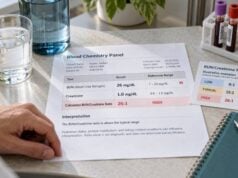
A bicarbonate blood test helps show whether the body is keeping acids and bases in balance. On a routine chemistry panel, bicarbonate is usually reported as total carbon dioxide (CO2) because most CO2 in blood exists in the form of bicarbonate. The kidneys help maintain bicarbonate by reclaiming filtered bicarbonate and excreting acid. As chronic kidney disease (CKD) becomes more advanced, those processes can become less effective and serum bicarbonate may fall, producing metabolic acidosis.
A low bicarbonate result does not automatically mean CKD is the cause. Diarrhea, ketoacidosis, lactic acidosis, certain medications, renal tubular acidosis, and respiratory conditions can also change the result. Clinicians therefore interpret bicarbonate with creatinine/eGFR, sodium, chloride, potassium, glucose, the anion gap, symptoms, and sometimes a blood gas. In stable CKD, persistently low bicarbonate can signal impaired acid handling and may contribute to muscle, bone, and metabolic complications, but treatment thresholds have evolved as newer trials have questioned routine bicarbonate supplementation for milder abnormalities.
- A typical serum bicarbonate or total CO2 range is roughly 22–29 mmol/L, although the laboratory’s own range should be used.
- Low bicarbonate in CKD can indicate metabolic acidosis, especially when the reduction is persistent and kidney function is significantly impaired.
- Bicarbonate below 18 mmol/L is an example of clinically important acidosis cited in the 2024 KDIGO CKD guideline when considering treatment.
- A low result is not specific for kidney disease; diarrhea, ketoacidosis, lactic acidosis, toxins, and renal tubular acidosis are other important causes.
- Treatment is individualized and may include correcting the cause, dietary changes, or alkali such as sodium bicarbonate while monitoring blood pressure, potassium, and fluid status.
Table of Contents
- What the Bicarbonate Blood Test Measures
- Normal, Low, and High Bicarbonate Levels
- Why CKD Causes Low Bicarbonate
- How Low Bicarbonate Is Interpreted
- Symptoms and Health Effects of Metabolic Acidosis
- Treatment of Low Bicarbonate in CKD
- Monitoring and When to Seek Care
What the Bicarbonate Blood Test Measures
Bicarbonate, written chemically as HCO3−, is one of the body’s main buffers. It helps keep blood pH in the narrow range needed for normal enzyme, heart, muscle, and nervous-system function. The lungs and kidneys work together to maintain this balance: the lungs remove carbon dioxide, while the kidneys reclaim bicarbonate and excrete hydrogen ions and other acids.
On a basic metabolic panel or comprehensive metabolic panel, the laboratory usually measures total CO2 rather than bicarbonate directly. Because bicarbonate makes up most of the total CO2 in venous serum, the value is commonly used as an estimate of serum bicarbonate.
A blood gas is different. Arterial or venous blood gas testing directly evaluates pH and carbon dioxide pressure and calculates bicarbonate. It is often used when the acid-base disturbance is severe, mixed, or unclear. A routine chemistry CO2 value is usually sufficient for screening and monitoring stable CKD, but it cannot fully describe acid-base physiology on its own.
Bicarbonate is not a measure of filtration in the way creatinine and eGFR are. It reflects one of the kidneys’ other major functions: maintaining acid-base homeostasis. A person can therefore have a normal eGFR with abnormal bicarbonate, or advanced CKD with bicarbonate that remains within the reference range.
This is also why bicarbonate is valuable during CKD follow-up even when creatinine has changed little. Filtration, potassium handling, and acid excretion can worsen at different rates, so a stable creatinine does not guarantee that every kidney function is unchanged. Looking at these markers together gives a more complete picture.
Normal, Low, and High Bicarbonate Levels
Many laboratories use an adult serum total CO2 or bicarbonate reference interval around 22–29 mmol/L or 23–29 mmol/L. The exact range varies by method and laboratory.
A low value is often called hypobicarbonatemia. It can indicate metabolic acidosis, but it can also be a compensatory response to respiratory alkalosis. That distinction is why a low chemistry CO2 value should not be interpreted without clinical context.
High bicarbonate deserves context too. It can occur with vomiting, volume depletion, certain diuretics, excess alkali intake, mineralocorticoid excess, or as compensation for chronic carbon dioxide retention from lung disease. In CKD, a high value is not automatically reassuring if it results from over-treatment with alkali or significant fluid and electrolyte shifts. Clinicians usually compare it with chloride, potassium, blood pressure, respiratory history, and recent medications.
The chemistry result is also sensitive to pre-analytical factors. Delayed processing or prolonged exposure of a specimen to air can allow CO2 to escape and make the measured value look lower than it truly is. When an isolated low result is unexpected and the patient is otherwise stable, repeating the test before labeling chronic metabolic acidosis is often reasonable.
| Bicarbonate pattern | Possible meaning | Common next questions |
|---|---|---|
| Within range | Acid-base balance may be stable | Does not exclude early acid retention or another compensated disorder |
| Mildly low | CKD, diarrhea, medications, renal tubular acidosis, respiratory alkalosis, or other causes | Repeat result, anion gap, kidney function, symptoms, medications |
| Markedly low | More significant metabolic acidosis or mixed acid-base disorder | Urgency depends on pH, potassium, cause, symptoms, and clinical stability |
| High | Metabolic alkalosis or compensation for chronic respiratory acidosis | Vomiting, diuretics, dehydration, lung disease, hormone disorders |
Historically, many CKD discussions used less than 22 mmol/L as the definition of metabolic acidosis. Current guidance is more nuanced. The 2024 KDIGO CKD guideline gives a practice point to consider pharmacologic treatment, with or without dietary intervention, to prevent acidosis with potential clinical implications, giving serum bicarbonate below 18 mmol/L in adults as an example. This does not mean that 18 mmol/L is the only clinically meaningful threshold or that 19–21 mmol/L should be ignored. It means treatment decisions should consider severity, persistence, symptoms, comorbidities, and the uncertain benefit-to-risk balance of routine alkali therapy.
Why CKD Causes Low Bicarbonate
Every day, normal metabolism produces nonvolatile acids that must be excreted by the kidneys. Healthy kidneys remove these acids mainly by producing ammonium and excreting titratable acids while regenerating bicarbonate.
As functioning nephron mass declines in CKD, the remaining nephrons compensate by increasing acid excretion. For a time, serum bicarbonate can stay normal even though each surviving nephron is working harder. With more advanced disease, total acid excretion may no longer keep pace with acid production. Acid accumulates and serum bicarbonate falls.
This explains why metabolic acidosis becomes more common as eGFR declines, but there is no exact eGFR at which it must appear. Diet, diabetes, medications, tubular function, gastrointestinal losses, and the underlying kidney disease all influence the result.
CKD-related acidosis is often a normal-anion-gap pattern earlier in disease because bicarbonate falls while chloride rises. In advanced kidney failure, retained sulfate, phosphate, and other unmeasured acids can also increase the anion gap.
Kidney tubule disorders can cause low bicarbonate even when glomerular filtration is relatively preserved. This is called renal tubular acidosis (RTA). Different forms affect hydrogen secretion or bicarbonate handling and may have distinct potassium patterns. Therefore, low bicarbonate with a near-normal creatinine does not rule out a kidney-related acid-base disorder.
A CKD blood test panel often tracks bicarbonate alongside creatinine/eGFR and potassium because worsening acid handling and potassium excretion may occur together as kidney disease advances.
How Low Bicarbonate Is Interpreted
The first step is usually to confirm that the result is real and persistent. Sample handling can affect total CO2 because carbon dioxide can escape from a specimen exposed to air. An unexpectedly low value may therefore be repeated, especially if the patient feels well and other results do not fit.
Clinicians then look at the surrounding chemistry.
Anion gap: The anion gap is commonly calculated as sodium minus chloride plus bicarbonate. A high anion gap points toward accumulation of unmeasured acids, as in lactic acidosis, ketoacidosis, advanced kidney failure, or certain poisonings. A normal anion gap with low bicarbonate is more consistent with bicarbonate loss or impaired renal acid excretion, such as diarrhea or RTA.
Potassium: Potassium helps narrow the differential. Some forms of RTA cause low potassium, while type 4 RTA—often associated with diabetes, reduced aldosterone activity, ACE inhibitors, ARBs, or other medications—typically causes hyperkalemia. The potassium blood test in kidney disease is particularly important because severe hyperkalemia can be immediately dangerous.
Creatinine and eGFR: Reduced filtration supports CKD as a contributor, but eGFR alone does not prove that low bicarbonate is renal in origin. Acute kidney injury can also cause acidosis.
Glucose and ketones: High glucose with ketones can indicate diabetic ketoacidosis. People taking SGLT2 inhibitors can rarely develop ketoacidosis with less dramatic glucose elevation, so symptoms and ketones matter.
Lactate: Severe infection, shock, low oxygen delivery, seizures, certain drugs, and other conditions can raise lactate and lower bicarbonate.
Diarrhea or gastrointestinal losses: Stool contains bicarbonate. Prolonged diarrhea can cause substantial normal-anion-gap metabolic acidosis even when the kidneys are otherwise healthy.
Respiratory status: Fast breathing from pain, anxiety, lung disease, pregnancy, sepsis, or other causes can lower carbon dioxide and lead to a compensatory drop in bicarbonate. A blood gas may be needed to distinguish this from primary metabolic acidosis.
A low bicarbonate result should first be confirmed in context. On a basic or comprehensive metabolic panel, the reported carbon dioxide value is used as an estimate of serum bicarbonate. A low value can occur with metabolic acidosis, but it does not identify the cause by itself. Clinicians review chloride, sodium, potassium, kidney function, glucose, medications, gastrointestinal losses, and the overall clinical picture. Depending on the situation, they may repeat the chemistry panel or order a blood gas to clarify the acid-base disturbance.
The anion gap can provide another clue. It is commonly calculated from sodium, chloride, and bicarbonate and helps separate broad categories of metabolic acidosis. A higher anion gap can occur when unmeasured acids accumulate, whereas a normal-gap pattern is often associated with bicarbonate loss or reduced acid excretion with a compensating rise in chloride. The calculation still requires clinical interpretation, and albumin can affect the expected anion gap. For people with CKD, the important point is that a bicarbonate value below the laboratory range is a signal to evaluate the full acid-base pattern, not a diagnosis by itself.
Repeat measurements also matter because treatment decisions generally depend on a persistent abnormality, symptoms, CKD severity, and the cause. One unexpectedly low value—especially if it conflicts with prior results—may lead to confirmation before long-term alkali therapy is started.
Symptoms and Health Effects of Metabolic Acidosis
Mild chronic metabolic acidosis may cause no obvious symptoms. When acidosis is more severe, people can develop faster or deeper breathing, fatigue, weakness, nausea, poor appetite, headache, or confusion. Symptoms often come from the underlying illness as much as from the bicarbonate level itself.
In CKD, persistent acid retention has been linked to several long-term concerns. Acid can increase muscle protein breakdown and may contribute to reduced muscle mass. Bone buffers can participate in neutralizing acid, creating concern about bone health. Observational studies have also associated lower bicarbonate with faster CKD progression and worse outcomes.
However, association does not prove that raising bicarbonate with medication improves every outcome. Earlier small trials suggested kidney and nutritional benefits from alkali therapy, but more recent trials have been mixed. That uncertainty is one reason KDIGO 2024 moved away from a broad graded recommendation to treat all CKD patients below 22 mmol/L and instead emphasizes treatment when acidosis is more clinically significant and careful monitoring for harms.
Acidosis can also interact with potassium. Hydrogen and potassium handling are linked across cell membranes and kidney tubules. Severe acidosis may accompany hyperkalemia, although the relationship varies by the type of acidosis.
A very low bicarbonate level should be interpreted with pH and the cause. A bicarbonate of 16 mmol/L in a stable patient with chronic CKD is different from the same value in someone with septic shock, diabetic ketoacidosis, or toxin exposure.
Treatment of Low Bicarbonate in CKD
Treatment starts with identifying the cause. A person with diarrhea needs management of gastrointestinal losses; diabetic ketoacidosis requires insulin and fluid/electrolyte treatment; lactic acidosis requires treatment of the underlying perfusion or metabolic problem. Simply giving bicarbonate does not replace cause-specific care.
For chronic CKD-related metabolic acidosis, clinicians may consider oral sodium bicarbonate or another alkali strategy. Sodium bicarbonate can raise serum bicarbonate, but the sodium load may worsen blood pressure, swelling, or fluid overload in susceptible patients. Monitoring is therefore essential.
Recent evidence remains mixed. Meta-analyses have found that sodium bicarbonate reliably raises serum bicarbonate and may have favorable effects on some kidney or nutritional outcomes, but trial quality and consistency vary. A 2025 systematic review found clear correction of bicarbonate but no significant pooled improvement in eGFR, highlighting why treatment should not be presented as a guaranteed method to slow CKD.
KDIGO 2024 advises monitoring therapy so bicarbonate does not exceed the upper limit of normal and so treatment does not adversely affect blood pressure, serum potassium, or fluid status.
Diet can also influence net acid production. Diets with more fruits and vegetables and less acid-producing animal protein can reduce dietary acid load in some people. But CKD diets must be individualized. People prone to hyperkalemia should not greatly increase high-potassium foods without guidance. A renal dietitian can help design a plant-forward pattern that fits potassium, protein, sodium, calorie, and diabetes needs.
Do not self-treat a low bicarbonate result with baking soda. The sodium content can be substantial, dosing is not standardized for an individual patient, and the wrong treatment can worsen fluid overload or alkalosis.
Monitoring and When to Seek Care
For stable CKD, bicarbonate is often followed with routine chemistry panels. The interval depends on eGFR, prior bicarbonate levels, medications, potassium, and whether treatment is being adjusted. More advanced CKD generally requires more frequent monitoring.
After starting oral alkali, clinicians may recheck bicarbonate, sodium, potassium, creatinine/eGFR, blood pressure, body weight, and edema. The goal is not simply to push bicarbonate as high as possible. The aim is to correct clinically important acidosis without causing alkalosis, sodium overload, uncontrolled hypertension, or worsening heart failure.
Seek urgent medical care when a low bicarbonate result occurs with severe illness, very rapid or deep breathing, confusion, fainting, chest symptoms, persistent vomiting, severe weakness, very high glucose with ketones, suspected poisoning, shock, or a major potassium abnormality. These situations may represent acute metabolic acidosis that requires rapid evaluation rather than routine outpatient follow-up.
For a mild unexpected decrease, a clinician may first repeat the chemistry panel and review medications, diarrhea, dietary changes, diabetes control, and kidney function. A renal function panel can provide bicarbonate alongside the electrolyte and kidney markers needed to interpret the pattern.
The most useful way to understand bicarbonate in CKD is to treat it as an acid-base signal rather than a stand-alone kidney-function number. Persistent low values can reveal an important loss of renal acid-handling capacity, but the right response depends on severity, cause, potassium, fluid status, and the person’s broader kidney and cardiovascular health.
References
- KDIGO 2024 Clinical Practice Guideline for the Evaluation and Management of Chronic Kidney Disease 2024 (Practice Guideline)
- Metabolic Acidosis in Patients with Chronic Kidney Disease: Diagnosis, Pathogenesis, and Treatment-A Narrative Review 2025 (Review)
- Safety and efficacy of sodium bicarbonate for treating metabolic acidosis in chronic kidney disease: A systematic review and meta-analysis 2025 (Systematic Review)
- Sodium Bicarbonate Treatment and Clinical Outcomes in Chronic Kidney Disease with Metabolic Acidosis: A Meta-Analysis 2024 (Meta-Analysis)
- CO2 blood test 2025 (Official)
Disclaimer
This article is for general education and does not diagnose or treat metabolic acidosis. A low bicarbonate result can have kidney and non-kidney causes, and urgent acid-base disorders require clinical assessment rather than self-treatment. Do not start sodium bicarbonate or make major diet changes for CKD without guidance from a qualified clinician.