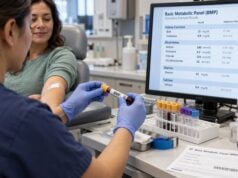
A blood urea nitrogen (BUN) test measures the nitrogen portion of urea in the blood. Urea is a waste product made mainly in the liver when the body breaks down protein, and the kidneys normally remove much of it in urine. Because BUN can rise when kidney filtration falls, it is commonly included in kidney-function testing, a basic metabolic panel, or a comprehensive metabolic panel.
BUN is useful, but it is not a stand-alone measure of kidney health. The result can change with hydration, protein intake, gastrointestinal bleeding, severe illness, certain medicines, liver function, and the rate at which the body is breaking down tissue. A high BUN can occur even when the kidneys are structurally normal, and a person with kidney disease can sometimes have only a modest BUN elevation. For that reason, clinicians interpret BUN together with creatinine, estimated glomerular filtration rate (eGFR), electrolytes, symptoms, urine findings, and the trend over time.
- A common adult BUN reference range is about 6–20 mg/dL, but the exact range varies by laboratory, age, and method.
- High BUN does not automatically mean kidney disease. Dehydration, gastrointestinal bleeding, high protein intake, catabolic illness, and reduced blood flow to the kidneys can also raise it.
- Low BUN is usually less concerning for kidney filtration and may occur with low protein intake, malnutrition, severe liver dysfunction, or excess body water.
- BUN is most informative when read with creatinine and eGFR, not in isolation.
- A rapid change matters. A rising BUN with rising creatinine, low urine output, vomiting, swelling, shortness of breath, confusion, or abnormal potassium deserves prompt clinical assessment.
Table of Contents
- What the BUN Test Measures
- BUN Normal Range
- What Causes High BUN?
- What Causes Low BUN?
- BUN and Kidney Function
- BUN/Creatinine Ratio and Dehydration
- Preparing for the Test and When to Seek Care
What the BUN Test Measures
BUN stands for blood urea nitrogen. It does not measure the entire urea molecule. Instead, it reports the amount of nitrogen contained in urea circulating in the blood. Urea forms primarily in the liver as ammonia from protein metabolism is converted into a less toxic compound that can be transported in blood and excreted by the kidneys.
The kidneys filter urea at the glomeruli, but urea handling is more complicated than simple filtration. Some filtered urea is reabsorbed in the kidney tubules, and the amount reabsorbed changes with urine flow and the body’s effort to conserve water. This is one reason BUN responds strongly to hydration and blood flow to the kidneys.
BUN is commonly measured as part of a basic metabolic panel, comprehensive metabolic panel, or a focused kidney function blood test panel. It may be ordered during routine care, before some procedures, when monitoring medicines, or when a person has symptoms that could reflect dehydration, kidney dysfunction, heart failure, gastrointestinal bleeding, or another acute illness.
In the United States, BUN is generally reported in milligrams per deciliter (mg/dL). Some countries report urea rather than urea nitrogen, often in millimoles per liter (mmol/L). The values are not interchangeable without conversion. A report labeled “urea” should therefore be interpreted using that laboratory’s own units and reference interval rather than compared directly with a BUN number.
A single BUN result is a snapshot. The trend is often more informative. For example, a change from 14 to 34 mg/dL over a short period is clinically different from a stable BUN of 24 mg/dL that has been present for years. The accompanying creatinine, eGFR, urine output, blood pressure, and clinical circumstances help determine what the change means.
BUN Normal Range
A commonly quoted adult BUN reference range is approximately 6–20 mg/dL. Some laboratories use ranges such as 7–20 mg/dL, and ranges can differ by assay, age, sex, and local population. The correct comparison is always the reference interval printed on the laboratory report.
| BUN result | General interpretation | Important context |
|---|---|---|
| Within the laboratory range | Urea nitrogen is within the expected interval | Does not rule out early kidney disease; eGFR and urine albumin may still be abnormal |
| Above the range | Urea nitrogen is accumulating or being produced/reabsorbed at a higher rate | Kidney dysfunction is one possibility, but dehydration and several non-kidney causes are common |
| Below the range | Urea production may be reduced or body water may be increased | Often relates to low protein intake, liver dysfunction, malnutrition, pregnancy, or overhydration |
BUN tends to rise with age in many people, partly because kidney filtration and body composition change over time. Diet can also shift the value. A protein-heavy meal or supplement may increase urea production, while a very low-protein diet may lower it. These effects are usually modest but can matter near the laboratory limits.
The degree of abnormality does not map neatly to a specific stage of kidney disease. A BUN of 35 mg/dL cannot by itself tell whether a person has acute kidney injury, chronic kidney disease (CKD), dehydration, or another cause. Likewise, a normal BUN does not prove that kidney function is normal. Creatinine-based eGFR is much more useful for estimating glomerular filtration in stable patients.
If the BUN is unexpectedly abnormal, repeating the test after reviewing hydration, medicines, recent illness, diet, and prior results may be more useful than interpreting one isolated number. The clinician may also order creatinine, electrolytes, urinalysis, urine albumin-creatinine ratio, or imaging depending on the situation.
What Causes High BUN?
A high BUN is called azotemia when it occurs as part of an increased concentration of nitrogen-containing waste products in blood. The reason can be broadly thought of as reduced kidney clearance, reduced blood flow to the kidneys, increased urea production, or increased urea reabsorption.
Kidney dysfunction is an important cause. Both acute kidney injury and advanced CKD can reduce the filtration and excretion of urea. When kidney function worsens, BUN and creatinine often rise together, although not always at the same rate. A rising BUN plus rising creatinine and falling urine output is more concerning for an acute kidney problem than an isolated BUN elevation.
Dehydration or reduced effective blood volume can raise BUN because the kidneys conserve sodium and water and more urea is reabsorbed. Common settings include vomiting, diarrhea, poor fluid intake, fever, heavy sweating, bleeding, or diuretic use. Heart failure and cirrhosis can also reduce effective kidney perfusion even when the body appears fluid overloaded.
Gastrointestinal bleeding, especially from the upper digestive tract, can increase BUN. Digested blood acts as a protein load, increasing urea production. At the same time, blood loss may reduce kidney perfusion. A high BUN in a person with black tarry stools, vomiting blood, dizziness, or fainting requires urgent evaluation rather than assuming the result is simply dehydration.
High protein intake and increased tissue breakdown can also raise BUN. Examples include high-protein diets, major burns, severe infections, trauma, fever, or treatment with corticosteroids. These situations increase the amount of nitrogen the liver converts to urea.
Some medicines can affect kidney perfusion, kidney function, or protein breakdown and indirectly change BUN. Nonsteroidal anti-inflammatory drugs (NSAIDs), certain blood-pressure medicines, diuretics, and other drugs may be relevant depending on the clinical setting. The medication list should be reviewed rather than stopping a prescribed medicine without guidance.
A high BUN result is therefore a clue, not a diagnosis. The pattern of BUN, creatinine, eGFR, electrolytes, urine findings, vital signs, and symptoms is what identifies the likely cause.
What Causes Low BUN?
A low BUN generally receives less attention than a high value because it usually does not indicate impaired kidney filtration. Instead, it often reflects reduced urea production or dilution from excess body water.
Low protein intake is one common explanation. Because urea is generated from protein metabolism, people consuming very little protein may have a lower BUN. The same pattern can occur with malnutrition, especially when overall calorie and protein intake are inadequate.
Severe liver dysfunction can lower BUN because the liver is responsible for converting ammonia to urea through the urea cycle. If hepatic urea synthesis is reduced, the BUN may be low even when kidney filtration is reduced. For this reason, BUN can be a less reliable kidney marker in advanced liver disease.
Overhydration can dilute blood urea nitrogen. This may occur after large amounts of intravenous fluid or in conditions that cause excess water retention. Pregnancy may also lower BUN because plasma volume expands and kidney filtration increases.
A low BUN should be interpreted with the rest of the metabolic panel. If sodium is also low, the clinician may consider excess water relative to body sodium. If albumin, liver enzymes, or other nutritional markers are abnormal, liver disease or malnutrition may be more relevant. If creatinine and eGFR are reassuring, an isolated mildly low BUN is often not a sign of kidney failure.
Very low values should still be discussed when they are new, persistent, or accompanied by weight loss, poor intake, jaundice, swelling, confusion, or other symptoms. The goal is to identify the underlying reason rather than to “raise the BUN” itself.
BUN and Kidney Function
BUN is a traditional kidney-related blood test, but it is less specific for kidney filtration than creatinine and eGFR. The kidneys remove urea, yet BUN is influenced by how much urea the liver produces and how much the tubules reabsorb. That makes it sensitive to changes outside the kidneys.
Creatinine comes mainly from muscle creatine metabolism. It is also imperfect because muscle mass, diet, age, and some medicines affect it, but it is the standard filtration marker used in modern eGFR equations. A creatinine blood test is therefore usually more central than BUN when estimating stable glomerular filtration.
eGFR converts creatinine, and in some equations cystatin C, into an estimate of filtration normalized to body surface area. In stable adults, eGFR categories are used to classify the level of kidney function. CKD is not diagnosed from one low eGFR alone; chronicity generally requires abnormalities present for at least 3 months or other evidence of chronic kidney damage.
BUN remains useful because it adds physiologic context. Consider two people with the same creatinine. If one has a BUN of 14 mg/dL and the other has a BUN of 45 mg/dL, the second pattern raises additional questions about dehydration, gastrointestinal bleeding, high protein breakdown, steroid use, or reduced kidney perfusion. It does not answer those questions by itself, but it changes what clinicians investigate.
During acute kidney injury testing, both BUN and creatinine can rise, but neither identifies the cause alone. Volume status, urine output, urinalysis, medication exposure, obstruction, hemodynamics, and the rate of change are crucial. In rapidly changing kidney function, calculated eGFR is also less reliable because creatinine has not reached a steady state.
For CKD monitoring, BUN may rise as kidney function declines, but treatment decisions are usually anchored more strongly to eGFR, urine albumin, potassium, bicarbonate, blood pressure, symptoms, and complications. BUN is one piece of the broader picture rather than a staging test.
BUN/Creatinine Ratio and Dehydration
The BUN/creatinine ratio compares BUN in mg/dL with serum creatinine in mg/dL. A rough adult ratio of about 10:1 to 20:1 is often described as typical, while a ratio above 20:1 has traditionally been associated with reduced kidney perfusion or volume depletion.
The physiology makes sense: when blood flow to the kidneys falls, the kidneys increase sodium and water reabsorption, and urea reabsorption rises as well. Creatinine is not reabsorbed in the same way, so BUN may increase disproportionately. This is why a high ratio can support a suspicion of dehydration or “prerenal” physiology.
However, the ratio is not a dehydration test. High ratios also occur with upper gastrointestinal bleeding, high protein intake, catabolic states, corticosteroid exposure, and low muscle mass that keeps creatinine relatively low. Conversely, dehydration may be present without a ratio above 20, particularly when kidney disease, unusual muscle mass, diet, or medications alter either component.
Recent evidence also supports caution when using urea-based indices to distinguish prerenal from intrinsic acute kidney injury. Even fractional excretion of urea, a more elaborate urine-based index, has only limited to moderate diagnostic performance across studies. The simpler blood ratio should therefore be treated as supporting context rather than a definitive classifier.
A dedicated BUN/creatinine ratio interpretation should include blood pressure, heart rate, symptoms, fluid losses, physical examination, urine output, urinalysis, prior laboratory values, and response to treatment. A high ratio can point clinicians toward a cause, but it cannot establish one on its own.
BUN is best read as a trend and in combination with other results. A value that changes substantially from a person’s usual level can be clinically important even when it remains near the laboratory reference range, while a stable mild elevation may be expected in someone with established kidney impairment. Recent fluid intake, illness, bleeding, diet, and medication changes can all shift BUN, so clinicians often compare the result with creatinine, eGFR, electrolytes, blood pressure, and symptoms. When the reason for an abnormal result is unclear, repeat testing can show whether the change was temporary or persistent.
Preparing for the Test and When to Seek Care
A BUN test requires a routine blood sample, usually from a vein in the arm. Special preparation is usually not needed when BUN is ordered by itself. Fasting may be requested if the sample is being used for other tests that require it, so follow the instructions provided with the laboratory order.
Before testing, it is useful to tell the clinician about recent vomiting or diarrhea, heavy exercise, major changes in protein intake, supplements, and all prescription and nonprescription medicines. Do not intentionally overdrink water to “improve” the BUN unless a clinician has advised increased fluids; excess water can be unsafe in heart failure, advanced kidney disease, severe low sodium, or other conditions.
When a result is abnormal, the next step depends on the pattern. A mildly high BUN with normal creatinine after a day of poor fluid intake may lead to hydration advice and repeat testing. A high BUN with rising creatinine, abnormal potassium, low bicarbonate, swelling, or reduced urine output requires more urgent evaluation. The CKD blood test panel may be appropriate when abnormalities persist, while acute symptoms may require an emergency-focused assessment.
Seek urgent medical care for symptoms such as very little or no urine, severe weakness, confusion, fainting, shortness of breath, chest pain, persistent vomiting, black tarry stools, vomiting blood, rapidly worsening swelling, or signs of severe dehydration. These symptoms can indicate kidney injury, major bleeding, dangerous electrolyte disturbance, or another serious condition regardless of the BUN value.
The safest way to read BUN is as part of a pattern: compare it with prior values, creatinine and eGFR, review the circumstances around the test, and use the laboratory’s own reference range. A number outside the range is a prompt for interpretation, not a diagnosis by itself.
References
- BUN (Blood Urea Nitrogen) 2024 (Official Medical Test Guide)
- BUN – blood test 2025 (Official Medical Encyclopedia)
- KDIGO 2024 Clinical Practice Guideline for the Evaluation and Management of Chronic Kidney Disease 2024 (Practice Guideline)
- Novel monitoring of renal function and medication levels in saliva and capillary blood of patients with kidney disease 2022 (Review)
- Utility of fractional excretion of urea in acute kidney injury with comparison to fractional excretion of sodium: A systematic review and meta-analysis 2024 (Systematic Review and Meta-Analysis)
Disclaimer
This article is for general education and does not diagnose the cause of a high or low BUN result. Kidney function, hydration, diet, liver function, medications, bleeding, and acute illness can all change BUN, so results should be interpreted by a qualified health professional using the full clinical picture. Seek urgent care for severe symptoms such as very low urine output, confusion, major bleeding, chest pain, severe shortness of breath, or fainting.