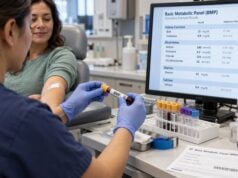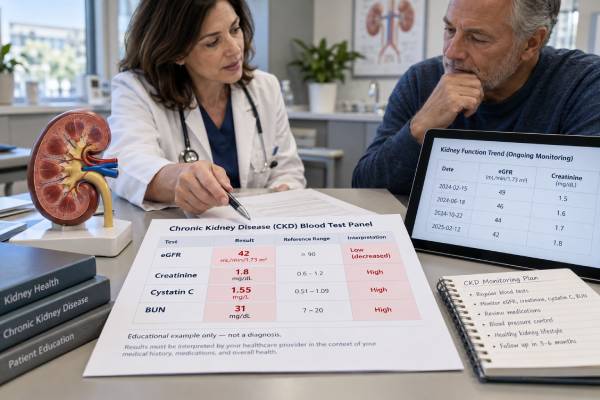
A chronic kidney disease (CKD) blood test panel is not one universal laboratory package. Instead, clinicians combine several tests to estimate kidney filtration, check complications, monitor treatment safety, and decide whether kidney function is stable or changing. Serum creatinine with calculated estimated glomerular filtration rate (eGFR) is the core blood assessment. Cystatin C can improve filtration estimates in selected situations, especially when creatinine may be misleading or when an accurate result is important near a clinical decision point. BUN, potassium, bicarbonate, sodium, calcium, phosphorus, albumin, and a complete blood count may provide additional information depending on CKD stage and treatment.
Blood testing is only part of CKD evaluation. Urine albumin-creatinine ratio (uACR) is a separate urine test that complements eGFR and is central to risk classification. CKD generally requires evidence of abnormal kidney structure or function for at least 3 months. Monitoring frequency should therefore be individualized according to eGFR, albuminuria, rate of change, medications, and overall risk rather than based on one isolated blood result.
- Creatinine with eGFR is the foundation of CKD blood testing, but eGFR is an estimate rather than a direct measurement of filtration.
- Cystatin C can improve eGFR accuracy when combined with creatinine, particularly when muscle mass, diet, frailty, or a decision threshold makes creatinine less reliable.
- BUN adds context but does not stage CKD. Hydration, protein intake, bleeding, liver function, and catabolism can change BUN independently of filtration.
- Potassium and bicarbonate are important complication and safety markers, especially as CKD advances or kidney-active medicines are adjusted.
- KDIGO recommends checking GFR and albuminuria at least annually in CKD, with more frequent monitoring when progression risk is higher or results will affect treatment decisions.
Table of Contents
- What Is in a CKD Blood Test Panel?
- eGFR and Creatinine
- Cystatin C and Combined eGFR
- BUN, Electrolytes, and Acid-Base Tests
- CKD Stages and Urine Albumin
- How Often to Monitor CKD Blood Tests
- How to Read Changes and When Results Are Urgent
What Is in a CKD Blood Test Panel?
There is no single standardized “CKD panel” used by every laboratory. A clinician may order a basic metabolic panel, renal function panel, comprehensive metabolic panel, cystatin C, complete blood count, and other tests separately. The exact combination depends on why the patient is being evaluated, the stage of CKD, medications, symptoms, and known complications.
| Test | Main purpose in CKD | Important limitation |
|---|---|---|
| Creatinine | Primary blood filtration marker used to calculate eGFR | Affected by muscle mass, diet, age, and some medicines |
| eGFR | Estimates filtration and helps classify CKD G category | Less reliable when creatinine is changing rapidly or non-GFR factors are strong |
| Cystatin C | Alternative filtration marker; can be combined with creatinine for a more accurate eGFR | Affected by factors such as inflammation, thyroid status, corticosteroids, obesity, and smoking |
| BUN | Shows urea nitrogen accumulation and adds hydration/metabolic context | Strongly affected by non-kidney factors |
| Potassium | Checks for hyperkalemia and medication safety | Can be falsely elevated by sample hemolysis |
| Bicarbonate/total CO2 | Screens for metabolic acidosis | Low values have kidney and non-kidney causes |
| Calcium and phosphorus | Help assess CKD-mineral and bone disorder as disease advances | Interpretation often requires PTH, vitamin D, albumin, and trends |
| Hemoglobin/CBC | Checks for anemia and other blood-count abnormalities | Anemia has many causes besides CKD |
A renal function panel commonly bundles creatinine, BUN, electrolytes, bicarbonate, calcium, phosphorus, albumin, and glucose, although panel contents vary by laboratory. A kidney function blood test panel may also include cystatin C when a more detailed filtration assessment is needed.
Blood tests answer different questions. Creatinine and cystatin C are filtration markers. Potassium and bicarbonate help detect complications and treatment effects. Calcium, phosphorus, parathyroid hormone, and vitamin D relate to mineral-bone disease. Hemoglobin helps identify anemia. No single number captures all aspects of CKD.
eGFR and Creatinine
Serum creatinine is the most widely used blood marker for estimating kidney filtration. It is generated largely from muscle metabolism and removed mainly by the kidneys. When glomerular filtration falls, serum creatinine usually rises. However, the relationship is nonlinear, which means a seemingly small creatinine change can represent a clinically meaningful filtration change, particularly when the baseline creatinine is low.
Because the raw creatinine value is affected by muscle production, laboratories use it in an estimating equation to calculate eGFR. In the United States, adult laboratories commonly use the 2021 CKD-EPI creatinine equation, which does not include a race coefficient. Other regions may use a locally validated equation. KDIGO recommends using a validated GFR estimating equation rather than relying on the filtration marker alone.
The eGFR is reported in mL/min/1.73 m², which standardizes filtration to a typical body surface area. This is useful for CKD classification and prognosis. For some drug-dosing decisions, especially at unusual body sizes, clinicians may need an unindexed estimate in mL/min or another validated dosing approach.
A dedicated eGFR test is more informative than creatinine alone for stable CKD, but it remains an estimate. Creatinine-based eGFR can be less accurate in people with very low muscle mass, amputations, paralysis, severe frailty, body building, major muscle disease, unusual dietary patterns, or rapidly changing kidney function.
The creatinine blood test is also less suited to acute changes because eGFR equations assume a relatively stable concentration. During acute kidney injury, the change in creatinine over time and urine output are more useful than treating the automatically reported eGFR as a precise measurement.
For CKD, trends matter. A single eGFR below 60 mL/min/1.73 m² does not by itself establish chronic disease. Abnormal kidney structure or function generally must persist for at least 3 months, unless prior information already establishes chronicity.
Cystatin C and Combined eGFR
Cystatin C is a low-molecular-weight protein produced by nucleated cells and filtered by the glomeruli. Unlike creatinine, it is much less dependent on muscle mass or meat intake. That makes it valuable when creatinine may overestimate or underestimate filtration because of body composition.
Cystatin C is not completely independent of non-kidney factors. Levels may be influenced by inflammation, thyroid dysfunction, corticosteroid exposure, smoking, obesity, and some malignancies. It is therefore best understood as a complementary filtration marker rather than a flawless replacement for creatinine.
Current guidance gives an important role to combined creatinine-cystatin C eGFR (eGFRcr-cys). When both markers are available, the combined equation is generally more accurate than an equation based on either marker alone. This can matter when eGFR is close to a clinical decision threshold—for example, a medication dose boundary, transplant evaluation, or confirmation of CKD classification.
A cystatin C blood test is particularly useful when the clinician suspects that creatinine is distorted by unusual muscle mass or other non-GFR determinants. It can also clarify situations in which creatinine-based eGFR and the overall clinical picture do not agree.
The two eGFR estimates may differ substantially. A 2025 systematic review found that discordance between creatinine-based and cystatin C-based eGFR carries prognostic information, especially when cystatin C gives a much lower estimate. However, discordance is not automatically proof that one marker is “wrong.” It may reflect the different biological influences on each test.
Cystatin C does not need to be repeated at every routine CKD visit for every patient. A 2024 prospective study of stage 3 CKD found that including cystatin C modestly improved GFR estimation accuracy but did not support routine annual cystatin C for monitoring progression in that population. In practice, testing is individualized according to whether the result is likely to change diagnosis, risk assessment, or management.
BUN, Electrolytes, and Acid-Base Tests
Blood urea nitrogen (BUN) often rises as kidney filtration declines, but it is not used to stage CKD. Urea production increases with high protein intake, gastrointestinal bleeding, severe illness, corticosteroids, and tissue breakdown. BUN also rises with dehydration or reduced kidney perfusion because more urea is reabsorbed. Conversely, low protein intake, malnutrition, liver dysfunction, or excess body water can lower it.
That makes the BUN test useful as supporting information rather than a direct substitute for eGFR. A rising BUN together with rising creatinine and symptoms can signal worsening kidney function, but the cause must be determined clinically.
Potassium becomes increasingly important as CKD advances and when medicines that affect the renin-angiotensin-aldosterone system are used. ACE inhibitors, ARBs, mineralocorticoid receptor antagonists, potassium-sparing diuretics, trimethoprim, and other drugs can contribute to hyperkalemia. Severe hyperkalemia can affect cardiac conduction and may require urgent treatment.
The potassium blood test in kidney disease is often repeated after starting or changing kidney-protective medicines. Unexpectedly high potassium may also need confirmation because hemolysis during collection can falsely elevate the result.
Bicarbonate, often reported as total CO2 on a chemistry panel, helps assess acid-base balance. CKD can reduce the kidneys’ ability to excrete acid, causing metabolic acidosis. Low bicarbonate is more common with advanced CKD, although diarrhea, ketoacidosis, lactic acidosis, and other conditions can produce the same laboratory finding.
Sodium and chloride add information about water balance and acid-base status. Calcium and phosphorus become important for CKD-mineral and bone disorder, especially in later stages. Albumin may help assess nutrition, inflammation, liver disease, and protein loss, but low serum albumin is not specific for any one cause.
Together, these values are often more actionable than BUN alone because they identify complications that may require dietary changes, medication adjustment, supplementation, or urgent treatment.
CKD Stages and Urine Albumin
KDIGO classifies CKD by cause, GFR category, and albuminuria category, often abbreviated CGA. The blood-based eGFR defines the G category, but the urine albumin-creatinine ratio defines the A category. Both dimensions are needed for a meaningful assessment of progression and cardiovascular and kidney-failure risk.
| GFR category | eGFR (mL/min/1.73 m²) | Description |
|---|---|---|
| G1 | ≥90 | Normal or high |
| G2 | 60–89 | Mildly decreased |
| G3a | 45–59 | Mildly to moderately decreased |
| G3b | 30–44 | Moderately to severely decreased |
| G4 | 15–29 | Severely decreased |
| G5 | <15 | Kidney failure |
G1 or G2 alone does not establish CKD when there are no other markers of kidney damage. CKD may still be present with eGFR above 60 if a person has persistent albuminuria, structural abnormalities, urine-sediment findings, tubular disorders, kidney histology abnormalities, or a kidney transplant history.
The urine albumin-creatinine ratio is therefore a critical partner to the blood panel. KDIGO albuminuria categories are approximately A1: less than 30 mg/g, A2: 30–300 mg/g, and A3: greater than 300 mg/g. Albuminuria can identify kidney damage even when eGFR is preserved and substantially changes risk at any given GFR.
A single abnormal uACR also requires context because exercise, fever, urinary infection, menstruation, marked hyperglycemia, and acute illness can transiently increase urine albumin. Persistent abnormalities are more informative than one isolated sample.
The combination of G and A categories determines monitoring intensity much better than eGFR alone. For example, a patient with eGFR 52 and minimal albuminuria has a different risk profile from a patient with the same eGFR and severely increased albuminuria.
How Often to Monitor CKD Blood Tests
KDIGO 2024 recommends assessing GFR and albuminuria at least annually in people with CKD. Testing should be more frequent when the risk of progression is higher and when new results could change treatment. This means there is no single schedule that fits every person with CKD.
As risk rises across lower GFR categories and higher albuminuria categories, suggested monitoring may increase from roughly once a year to two, three, or four or more times per year. People with G4–G5 CKD, severe albuminuria, rapid progression, recent acute kidney injury, unstable electrolytes, or important medication changes often need closer follow-up than someone with stable early-stage disease.
Blood tests may also be repeated sooner after starting or increasing medicines that can change creatinine, eGFR, potassium, or blood pressure. These include ACE inhibitors, ARBs, mineralocorticoid receptor antagonists, diuretics, and some other kidney-active drugs. The appropriate interval depends on the medicine, baseline kidney function, potassium, blood pressure, and comorbid conditions.
Monitoring has two goals: detect real progression and avoid overreacting to normal biological or laboratory variation. KDIGO notes that in a person with CKD, an eGFR change greater than 20% on a subsequent test exceeds expected variability and warrants evaluation. After starting a hemodynamically active therapy, a GFR reduction greater than 30% exceeds expected variability and should be evaluated rather than assumed to be a routine treatment effect.
For urine albumin monitoring, a doubling of ACR exceeds expected laboratory variability and warrants evaluation. These thresholds are not automatic signals to stop treatment. They are prompts to review hydration, blood pressure, medications, acute illness, obstruction, adherence, and other causes.
More frequent testing is also appropriate after hospitalization, during intercurrent illness, or when symptoms suggest fluid, electrolyte, or acid-base complications. Stable patients may need fewer tests once a consistent pattern has been established.
How to Read Changes and When Results Are Urgent
CKD laboratory interpretation is based on patterns and trends. Start with eGFR and creatinine: are they stable, slowly changing, or abruptly different? Then review potassium, bicarbonate, BUN, sodium, and any stage-specific tests. Compare the results with prior values and with recent medication or illness changes.
A gradual eGFR decline over months to years suggests a different process from a sudden creatinine rise over days. The latter may represent acute kidney injury superimposed on CKD and requires evaluation for dehydration, infection, low blood pressure, medication effects, obstruction, or other acute causes.
A high BUN that rises disproportionately to creatinine may suggest dehydration, reduced kidney perfusion, gastrointestinal bleeding, or increased protein breakdown. A low bicarbonate can suggest metabolic acidosis. A high potassium may reflect reduced excretion, medication effects, acidosis, or a collection artifact. Each result becomes more meaningful when interpreted alongside the rest of the panel.
Do not adjust prescribed medicines, potassium intake, bicarbonate supplements, protein intake, or fluid intake solely from one laboratory value without clinical guidance. Kidney-protective medicines can cause expected early changes in filtration, while stopping them unnecessarily may lose long-term benefit. Conversely, true AKI or dangerous hyperkalemia may require rapid medication changes under medical supervision.
Contact a clinician promptly for a substantial new eGFR decline, rapidly rising creatinine, persistent potassium or bicarbonate abnormalities, worsening edema, repeated vomiting, reduced urine output, or new symptoms. Seek urgent medical care for severe shortness of breath, chest pain, confusion, fainting, major muscle weakness, palpitations, seizures, very little or no urine, or rapidly worsening swelling.
A well-designed CKD monitoring plan answers three questions repeatedly: How well are the kidneys filtering? Is there evidence of kidney damage or progression? Are complications or treatments creating safety problems? Creatinine/eGFR, cystatin C when useful, BUN and chemistry tests, and urine albumin together provide a much clearer answer than any one result alone.
References
- KDIGO 2024 Clinical Practice Guideline for the Evaluation and Management of Chronic Kidney Disease 2024 (Practice Guideline)
- Evaluation and Management of Chronic Kidney Disease: Synopsis of the Kidney Disease: Improving Global Outcomes 2024 Clinical Practice Guideline 2025 (Guideline Synopsis)
- Glomerular Filtration Rate (GFR) Estimation with Cystatin C-Past, Present, and Future 2025 (Review)
- Accuracy of glomerular filtration rate estimation using creatinine and cystatin C for identifying and monitoring moderate chronic kidney disease: the eGFR-C study 2024 (Prospective Study)
- Advantages, Limitations, and Clinical Considerations in Using Cystatin C to Estimate GFR 2022 (Review)
Disclaimer
This article is for general education and is not a substitute for individualized CKD diagnosis, staging, or treatment. eGFR, creatinine, cystatin C, BUN, electrolytes, and urine albumin can be affected by acute illness, medications, body composition, and other conditions, so results should be interpreted by a qualified health professional using trends and clinical context. Seek urgent care for severe symptoms such as very low urine output, chest pain, severe shortness of breath, fainting, confusion, seizures, or major weakness or palpitations.