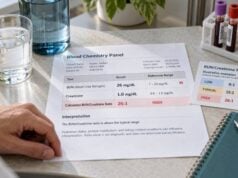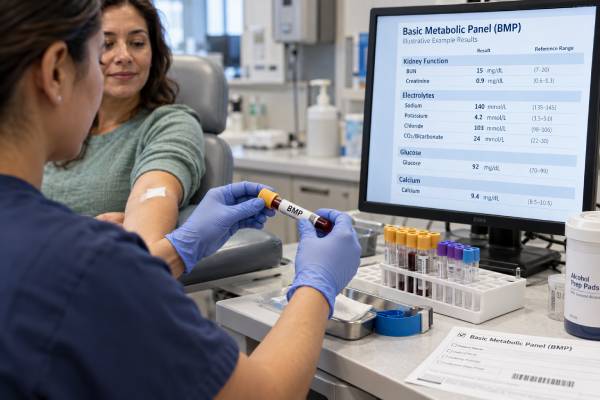
A basic metabolic panel (BMP) is a common blood test that checks eight measurements related to kidney function, electrolytes, acid-base balance, blood sugar, and calcium. It typically includes glucose, calcium, sodium, potassium, chloride, bicarbonate or total carbon dioxide (CO2), blood urea nitrogen (BUN), and creatinine. Together, these results give a quick picture of how the kidneys are filtering waste, how the body is handling water and salts, and whether glucose or acid-base problems may be present.
A BMP does not diagnose kidney disease by itself. Creatinine and BUN can change for reasons other than kidney damage, while electrolyte abnormalities may come from medications, dehydration, endocrine disorders, vomiting, diarrhea, or other illnesses. The most useful interpretation looks at the whole pattern and compares current values with previous results. Many laboratories also calculate an estimated glomerular filtration rate (eGFR) from creatinine, age, and sex, although eGFR is a calculated result rather than one of the eight BMP measurements.
- A BMP usually measures eight items: glucose, calcium, sodium, potassium, chloride, bicarbonate/CO2, BUN, and creatinine.
- Creatinine and the calculated eGFR are the main kidney-filtration clues, while BUN adds context about hydration, protein metabolism, and waste removal.
- Potassium and bicarbonate can become urgent when severely abnormal because they affect heart rhythm and acid-base balance.
- Fasting is not always required for a BMP, but some clinicians or laboratories request 8 hours of fasting, especially when glucose interpretation is important.
- Reference ranges vary by laboratory, so use the limits on the actual report rather than treating one generic range as universal.
Table of Contents
- What Is in a Basic Metabolic Panel?
- BMP Normal Ranges
- Kidney Function Results: Creatinine, BUN, and eGFR
- Electrolytes and Acid-Base Results
- Glucose and Calcium Results
- How to Prepare and What Can Affect Results
- How Doctors Interpret Abnormal BMP Patterns
What Is in a Basic Metabolic Panel?
The BMP is sometimes called a chemistry panel, chemistry screen, metabolic panel, Chem-7, or SMA-7. Modern BMPs usually report eight measurements because calcium is commonly included along with the classic seven chemistry values.
| BMP measurement | Main role | Why it matters for kidney or metabolic health |
|---|---|---|
| Glucose | Main blood sugar | High levels can suggest diabetes or stress hyperglycemia; diabetes is a major kidney-risk condition |
| Calcium | Bone, nerve, muscle, and heart function | Can change with parathyroid disorders, vitamin D problems, cancer, medications, and kidney disease |
| Sodium | Water balance and nerve function | Reflects the relationship between body sodium and water more than kidney filtration alone |
| Potassium | Muscle and heart electrical activity | May rise when kidney potassium excretion falls or with certain medications |
| Chloride | Fluid and acid-base balance | Helps interpret sodium and bicarbonate patterns |
| Bicarbonate/CO2 | Acid-base balance | Low values may indicate metabolic acidosis, including from advanced kidney dysfunction |
| BUN | Urea nitrogen waste | Often rises when filtration falls, but also changes with hydration and protein breakdown |
| Creatinine | Waste product from muscle metabolism | Used to estimate glomerular filtration and track kidney function |
A BMP is used for routine screening, medication monitoring, evaluation of symptoms, emergency assessment, and follow-up of conditions such as kidney disease, hypertension, diabetes, heart failure, and electrolyte disorders. It is also commonly repeated before or after starting medications that can affect creatinine or potassium.
In outpatient care, the same panel may be ordered weeks or months apart to follow a chronic condition. In emergency or inpatient care, it can be repeated within hours when kidney function, potassium, sodium, bicarbonate, or glucose is changing quickly. That difference in timing is clinically important for safe interpretation: a stable mildly abnormal value has a different meaning from a rapidly worsening result, even when the two numbers are identical.
A comprehensive metabolic panel includes the BMP-type measurements plus liver enzymes, bilirubin, albumin, and total protein. The choice between BMP and CMP depends on what the clinician needs to assess.
BMP Normal Ranges
Normal ranges depend on the laboratory, assay, age, hydration status, and whether glucose was measured fasting. The following are common adult examples, not universal cutoffs:
| Test | Example adult reference range |
|---|---|
| Glucose | About 70–100 mg/dL when fasting |
| Calcium | About 8.5–10.2 mg/dL |
| Sodium | About 135–145 mmol/L |
| Potassium | About 3.5–5.2 mmol/L |
| Chloride | About 96–106 mmol/L |
| Bicarbonate/total CO2 | About 22–29 mmol/L |
| BUN | About 6–20 mg/dL |
| Creatinine | Often about 0.6–1.3 mg/dL, with substantial variation by muscle mass, age, and sex |
A result one or two units outside a range is not automatically a diagnosis. Reference intervals are statistical ranges, and healthy people can occasionally fall just outside them. Conversely, a value inside the laboratory range can still be important if it has changed sharply from a person’s baseline. A creatinine rise from 0.6 to 1.0 mg/dL, for example, may be clinically meaningful even if 1.0 mg/dL is labeled “normal.”
For glucose, fasting status changes interpretation. A fasting glucose of 100–125 mg/dL is commonly considered in the prediabetes range, while 126 mg/dL or higher on appropriate repeat or confirmatory testing can meet a diabetes criterion. Random glucose values require different context and should not be interpreted as fasting values.
Kidney Function Results: Creatinine, BUN, and eGFR
Creatinine is the key kidney-filtration measurement in a BMP. It is produced from normal muscle metabolism and cleared largely through the kidneys. When glomerular filtration falls, serum creatinine usually rises. Because creatinine production varies with muscle mass, diet, age, sex, and some medications, the raw number is only part of the story.
Laboratories commonly use creatinine to calculate eGFR. Current adult equations estimate filtration using creatinine along with age and sex. eGFR is generally more useful than creatinine alone for classifying stable chronic kidney function. However, it is less reliable when creatinine is changing rapidly, such as during acute kidney injury, because the equations assume a relatively steady creatinine level.
A dedicated creatinine blood test interpretation should consider both the result and the trend. A sudden increase can indicate acute kidney injury, while a persistently reduced eGFR for at least 3 months may support a diagnosis of CKD when interpreted with other findings.
BUN measures the nitrogen portion of urea, a waste product formed when the body metabolizes protein. Like creatinine, BUN can rise when kidney filtration declines. But BUN is more sensitive to non-kidney factors. Dehydration, gastrointestinal bleeding, high protein intake, corticosteroids, fever, and tissue breakdown can increase it; severe liver disease or low protein intake can lower it.
That is why the BUN blood test is usually interpreted with creatinine rather than alone. The BUN/creatinine ratio can sometimes add context, but it cannot reliably diagnose dehydration or distinguish kidney causes by itself.
A BMP does not measure urine albumin. For CKD detection, creatinine/eGFR is often paired with a urine albumin-creatinine ratio because filtration loss and albumin leakage provide different information about kidney health.
Electrolytes and Acid-Base Results
Electrolytes are electrically charged minerals that help regulate water distribution, nerve impulses, muscle contraction, and acid-base balance. Kidney disease can disrupt them, but abnormal electrolyte values can also occur with normal kidney function.
Potassium is often the most urgent BMP electrolyte. The kidneys are central to potassium excretion, so advanced CKD or acute kidney injury can lead to hyperkalemia. ACE inhibitors, ARBs, potassium-sparing diuretics, mineralocorticoid receptor antagonists, trimethoprim, and potassium supplements can also raise it. Severe hyperkalemia can cause dangerous cardiac conduction problems. A potassium blood test in kidney disease is commonly repeated promptly if the initial value is unexpectedly high because hemolysis during the blood draw can falsely elevate potassium.
Sodium reflects water balance more than total body sodium. Low sodium can occur when water is retained disproportionately, as in some cases of heart failure, advanced kidney disease, or syndrome of inappropriate antidiuretic hormone secretion. It can also follow vomiting, diarrhea, diuretics, or excessive water intake. High sodium usually means there is too little water relative to sodium.
Chloride often moves with sodium but is especially useful in acid-base interpretation. High chloride may accompany normal-anion-gap metabolic acidosis, including after large volumes of normal saline or with gastrointestinal bicarbonate loss. Low chloride can occur with vomiting or certain diuretics.
Bicarbonate, reported by many chemistry analyzers as total CO2, is a major buffer in blood. Low values may suggest metabolic acidosis. CKD can cause low bicarbonate as acid excretion becomes impaired, although diarrhea, ketoacidosis, lactic acidosis, and other conditions are also common causes. The bicarbonate blood test in kidney disease helps assess this complication.
The BMP can also be used to calculate the anion gap, usually from sodium minus chloride and bicarbonate. The anion gap is not a separately measured BMP analyte, but it helps categorize metabolic acidosis and narrow the differential diagnosis.
Glucose and Calcium Results
Glucose is included because metabolic health and kidney health are closely connected. Diabetes is a major cause of CKD, and severe hyperglycemia can cause dehydration through osmotic diuresis. A high BMP glucose may reflect diabetes, stress from acute illness, corticosteroid use, recent food intake, or another endocrine issue.
A single elevated glucose does not always establish diabetes. Clinicians may repeat fasting glucose, check hemoglobin A1c, or use other diagnostic testing. Very high glucose accompanied by dehydration, vomiting, abdominal pain, deep breathing, confusion, or ketones can signal a hyperglycemic emergency and requires prompt care.
Calcium in a BMP is total serum calcium, which includes calcium bound to proteins—mainly albumin—as well as free ionized calcium. A low total calcium can partly reflect low albumin rather than a true reduction in biologically active ionized calcium. When the result is unexpected or clinically important, albumin or ionized calcium may be checked.
Kidney disease can alter calcium balance through changes in phosphorus handling, vitamin D activation, and parathyroid hormone. These problems are more characteristic of established moderate-to-advanced CKD than of a minor isolated creatinine change. A BMP does not include phosphorus, parathyroid hormone, or vitamin D, so additional tests are needed when CKD-related mineral and bone disorder is suspected.
High calcium can result from hyperparathyroidism, malignancy, medications, supplements, dehydration, or other causes. Marked calcium abnormalities can affect the nervous system, heart, gastrointestinal tract, and kidneys and should be interpreted promptly.
How to Prepare and What Can Affect Results
A BMP requires a standard venous blood sample. The draw itself usually takes only a few minutes. Whether fasting is required depends on why the test is being ordered and the laboratory or clinician’s instructions. Some centers request about 8 hours without food or caloric drinks, particularly if fasting glucose is important; others obtain BMPs without fasting in emergency, inpatient, or medication-monitoring settings.
Do not stop prescribed medication just to “improve” a BMP result unless a clinician has told you to do so. The medication list is part of the interpretation.
Factors that can shift results include:
- dehydration or unusually high fluid intake;
- recent meals, especially for glucose and sometimes BUN;
- intense exercise, which can affect creatinine and potassium;
- a recent large meat meal, which can temporarily raise creatinine;
- diuretics, ACE inhibitors, ARBs, NSAIDs, SGLT2 inhibitors, and many other medications;
- supplements containing potassium, calcium, or creatine;
- vomiting or diarrhea;
- IV fluids;
- blood-sample hemolysis, which can falsely increase potassium;
- acute illness, fever, infection, surgery, or trauma.
When monitoring CKD or medication effects, consistency helps. Comparing results from similar conditions and looking at trends over time is usually more informative than reacting to one small fluctuation.
A BMP becomes more useful when several values are read as a pattern rather than as eight unrelated numbers. For example, vomiting or volume loss can change sodium, chloride, bicarbonate, BUN, and creatinine together, while reduced kidney filtration can raise creatinine and BUN and may also disturb potassium or bicarbonate. A high glucose level can influence fluid balance and sodium interpretation. These relationships are why clinicians rarely make a diagnosis from one flagged value alone. They compare the pattern with symptoms, medications, vital signs, prior laboratory results, and the reason the test was ordered.
Trends are especially important for kidney-related values. A creatinine result that remains stable near a person’s established baseline has a different meaning from the same number after a rapid rise. Similarly, a potassium or sodium result that changes sharply over a short period may require faster attention than a mild, stable abnormality that is already known and being monitored. Laboratories also use their own reference intervals, so the range printed next to the result should take priority over a generic range from a website or another health system.
A BMP is not a complete kidney evaluation by itself. It usually does not include cystatin C, serum albumin, phosphorus, magnesium, or a urine albumin-to-creatinine ratio. Depending on the clinical question, a clinician may add those tests, a urinalysis, blood count, imaging, or other studies. In suspected chronic kidney disease, blood filtration estimates are commonly paired with urine albumin testing because these provide different information: eGFR reflects filtration, while urine albumin can reveal kidney damage even when filtration is still relatively preserved.
How Doctors Interpret Abnormal BMP Patterns
Clinicians read a BMP as a pattern, not eight unrelated numbers. A few common combinations illustrate why.
High creatinine plus high BUN: This may reflect reduced kidney filtration. If BUN rises disproportionately, dehydration, gastrointestinal bleeding, or increased protein breakdown may contribute. The timing and urine output help distinguish acute from chronic problems.
High creatinine plus high potassium: This raises concern for impaired potassium excretion, especially if kidney function has worsened suddenly or the patient takes medicines that raise potassium. The potassium level, ECG, symptoms, and repeat sample determine urgency.
High creatinine plus low bicarbonate: This can occur with more advanced kidney dysfunction or AKI and may indicate metabolic acidosis. Clinicians may calculate the anion gap, check a blood gas when needed, and look for other acid-producing conditions.
Low sodium plus high glucose: Marked hyperglycemia pulls water into the bloodstream and can lower measured sodium. Corrected sodium calculations may be used before labeling the problem as a primary sodium disorder.
Normal creatinine with abnormal electrolytes: Kidney filtration may be preserved even though the body has a sodium, potassium, chloride, bicarbonate, glucose, or calcium problem. Endocrine disease, gastrointestinal losses, medications, and fluid imbalance remain possible.
A stable abnormal creatinine: A creatinine that is consistently above a laboratory reference range may reflect stable CKD, high muscle mass, medication effects, or another baseline characteristic. eGFR, urine albumin, imaging, and history help clarify the meaning.
Urgent evaluation is appropriate for severe potassium abnormalities, rapidly worsening kidney function, very low urine output, severe sodium disturbances, significant acidosis, extreme glucose elevations with illness, or symptoms such as confusion, fainting, palpitations, chest pain, or shortness of breath.
For routine results, small isolated abnormalities are often rechecked before major conclusions are drawn. The best BMP interpretation answers three questions: What changed? Do the results form a coherent pattern? And does that pattern fit the person’s symptoms, medications, fluid status, and prior kidney function?
References
- Basic Metabolic Panel (BMP) 2024 (Official)
- Basic metabolic panel 2025 (Official)
- KDIGO 2024 CKD Guideline 2024 (Guideline)
- Pathophysiology and clinical management of hyperkalemia in chronic kidney disease 2023 (Review)
- Metabolic acidosis in chronic kidney disease: mere consequence or also culprit? 2024 (Review)
Disclaimer
This article is for general education and does not diagnose kidney, electrolyte, glucose, or calcium disorders. BMP reference ranges and treatment thresholds vary, and results must be interpreted with symptoms, medications, previous values, and clinical context. Seek urgent medical care for severe weakness, palpitations, confusion, fainting, breathing difficulty, very low urine output, or critically abnormal laboratory results.