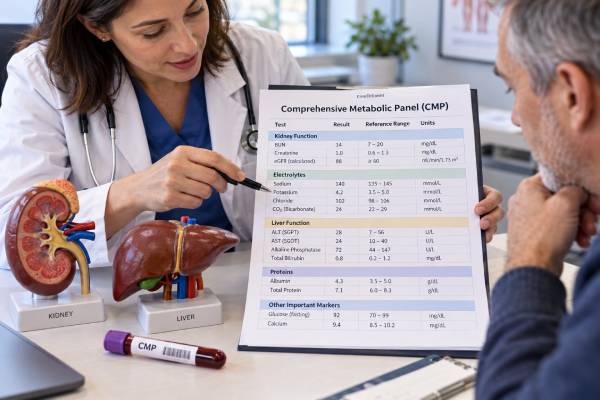
A comprehensive metabolic panel (CMP) is a group of 14 blood measurements that gives a broad snapshot of kidney function, liver-related markers, electrolytes, blood sugar, calcium, and blood proteins. It is commonly ordered during routine care, before some procedures or treatments, and when symptoms such as fatigue, swelling, vomiting, weakness, or dehydration could have several possible causes. A CMP does not diagnose a specific disease by itself. Instead, clinicians interpret the pattern of results, compare it with earlier tests, and consider medicines, hydration, diet, illness, and medical history. For kidney health, the most useful CMP components are creatinine, blood urea nitrogen (BUN), potassium, bicarbonate, sodium, and sometimes calcium and albumin. A CMP can reveal an important problem quickly, but a normal CMP does not rule out early kidney disease because urine albumin testing and an estimated glomerular filtration rate (eGFR) may provide additional information.
- A CMP measures 14 substances covering kidney-related waste products, electrolytes, glucose, calcium, proteins, bilirubin, and liver enzymes.
- Creatinine and BUN help assess kidney function, while potassium, bicarbonate, sodium, and chloride show electrolyte and acid-base balance.
- Reference ranges vary by laboratory, so compare each result with the range printed on your report rather than a universal cutoff.
- Fasting may be requested, especially when glucose is being assessed, but follow the specific instructions from the ordering clinician or laboratory.
- Urgent follow-up may be needed for severe potassium abnormalities, rapidly rising creatinine, major acid-base disturbances, or symptoms such as chest pain, confusion, severe weakness, or shortness of breath.
Table of Contents
- What a CMP Measures
- Kidney-Related CMP Results
- Liver, Protein, and Glucose Markers
- How to Read Abnormal Results
- Preparation and Test Process
- When Follow-Up Is Needed
- CMP vs. Other Kidney Tests
What a CMP Measures
A CMP combines several common chemistry tests into one blood draw. The exact report format varies by laboratory, but a standard CMP usually contains 14 measurements. These can be grouped into five practical areas: kidney waste products, electrolytes and acid-base markers, glucose, calcium and proteins, and liver-related tests.
| Group | Typical CMP components | What they help show |
|---|---|---|
| Kidney-related waste products | Creatinine, BUN | How well the kidneys are clearing waste and how hydration or protein metabolism may be affecting the blood |
| Electrolytes and acid-base balance | Sodium, potassium, chloride, bicarbonate/CO2 | Fluid balance, nerve and muscle function, and acid-base status |
| Energy metabolism | Glucose | Blood sugar at the time of testing |
| Mineral and proteins | Calcium, albumin, total protein | Calcium balance, nutrition-related clues, liver protein production, and protein loss |
| Liver-related markers | ALT, AST, alkaline phosphatase, bilirubin | Patterns that may suggest liver-cell injury, bile-flow problems, or other causes of abnormal liver chemistry |
A CMP is broader than a basic metabolic panel (BMP). A BMP usually includes glucose, calcium, sodium, potassium, chloride, bicarbonate, BUN, and creatinine. The CMP adds albumin, total protein, bilirubin, alkaline phosphatase, ALT, and AST.
The panel is useful because related abnormalities can strengthen or weaken a particular explanation. For example, a mildly high creatinine together with a high BUN and concentrated clinical picture may fit dehydration better than an isolated creatinine change. A low bicarbonate with reduced kidney filtration may point toward metabolic acidosis associated with kidney disease, while a low albumin plus edema raises a different set of questions, including protein loss, inflammation, liver disease, or poor nutritional intake.
Normal ranges are not identical across laboratories. Methods, calibration, population, age, sex, and units all matter. For that reason, the safest way to read a CMP is to use the laboratory’s own reference interval and then interpret the pattern rather than judging one number in isolation.
Kidney-Related CMP Results
The kidney-related part of a CMP is most informative when creatinine, BUN, electrolytes, and bicarbonate are viewed together. None of these values is a perfect stand-alone measure of kidney health.
Creatinine
Creatinine is produced from normal muscle metabolism and is cleared largely by the kidneys. When kidney filtration falls, blood creatinine often rises. However, creatinine is also influenced by muscle mass, recent cooked-meat intake, intense exercise, supplements containing creatine, hydration, and some medicines. A person with low muscle mass can have a “normal” creatinine despite reduced kidney filtration, while a very muscular person may have a somewhat higher level without kidney disease.
Many laboratories report an eGFR automatically with serum creatinine. The eGFR result is usually more useful than creatinine alone because it translates creatinine into an estimate of filtration. Still, eGFR is an estimate rather than a direct measurement.
Blood urea nitrogen (BUN)
BUN measures nitrogen from urea, a waste product formed as the body processes protein. A high BUN can occur with reduced kidney clearance, but also with dehydration, gastrointestinal bleeding, high protein intake, increased tissue breakdown, corticosteroid use, and other conditions. A low BUN may occur with low protein intake, overhydration, or severe liver dysfunction.
The BUN test is therefore best interpreted beside creatinine and the clinical situation. The BUN-to-creatinine relationship can sometimes provide clues, but it is not diagnostic by itself.
Potassium, bicarbonate, sodium, and chloride
Potassium deserves particular attention because severe abnormalities can affect heart rhythm. Reduced kidney function can impair potassium excretion, but high potassium can also result from certain medicines, uncontrolled diabetes, tissue breakdown, adrenal disorders, or a falsely elevated sample caused by red-cell damage during collection. A potassium blood test often requires prompt interpretation when the value is substantially abnormal, especially in kidney disease.
Bicarbonate, often labeled total CO2 on a chemistry panel, helps reflect the body’s acid-base balance. Low bicarbonate can occur with metabolic acidosis from advanced kidney disease, diarrhea, diabetic ketoacidosis, lactic acidosis, and other causes. A high bicarbonate can occur with vomiting, certain diuretics, chronic carbon dioxide retention, or other causes of metabolic alkalosis.
Sodium mainly reflects water balance relative to sodium, not simply how much salt a person has eaten. Chloride often shifts with sodium and bicarbonate and can help clinicians interpret acid-base patterns.
Liver, Protein, and Glucose Markers
The added value of a CMP over a BMP is that it combines kidney and electrolyte markers with proteins and liver-related chemistry. This matters because illness in one organ system can affect another, and some symptoms overlap.
ALT and AST are enzymes that may rise when liver cells are injured, although AST is also found in muscle and other tissues. Alkaline phosphatase can rise with bile-duct problems and with increased bone activity. Bilirubin comes from the breakdown of red blood cells and is processed by the liver and biliary system. A pattern of abnormal liver markers is more informative than any single result.
Albumin is the main protein in blood and is made by the liver. Low albumin can occur with inflammation, reduced liver synthesis, malnutrition, or protein loss through the kidneys or gastrointestinal tract. In kidney disease, substantial urinary protein loss can lower blood albumin and contribute to swelling. If albumin is low and kidney disease is suspected, an albumin blood test in kidney disease should be interpreted together with urine protein or urine albumin measurements.
Total protein includes albumin plus globulins. An abnormal total protein result can reflect changes in either group and may lead to more specific testing when clinically appropriate.
Glucose is another important CMP component. A high result can be temporary after a meal, stress, illness, or certain medicines, or it may suggest diabetes when confirmed by appropriate testing. Diabetes is a major cause of chronic kidney disease, so persistently abnormal glucose matters to long-term kidney risk even when the immediate kidney values look normal.
Calcium is influenced by albumin because a substantial amount of calcium circulates bound to protein. A low total calcium result in someone with low albumin may not mean the biologically active ionized calcium is truly low. Chronic kidney disease can also disturb calcium, phosphorus, vitamin D, and parathyroid hormone regulation, especially in later stages.
How to Read Abnormal Results
The best way to interpret a CMP is to ask four questions: how abnormal is the value, is it new, do related values move in a consistent pattern, and does the result fit the person’s symptoms and medical history?
A result just outside the reference range may be clinically minor, especially if it is stable over time. In contrast, a rapid change from a person’s usual baseline can be important even if the value has not crossed a dramatic threshold. Trends matter greatly for creatinine, sodium, potassium, bicarbonate, glucose, and liver enzymes.
Common patterns include:
- Creatinine and BUN both increased: may occur with reduced kidney filtration or dehydration; the context and prior values help distinguish causes.
- Creatinine increased with a lower eGFR: supports reduced filtration, but the cause may be acute or chronic and requires timing and clinical context.
- High potassium with reduced kidney function: can reflect impaired potassium excretion and may need urgent reassessment depending on severity and symptoms.
- Low bicarbonate with reduced eGFR: may represent metabolic acidosis related to kidney disease, though other causes must be considered.
- Low albumin with swelling: can result from kidney protein loss, liver disease, inflammation, or inadequate protein intake; urine testing often clarifies whether kidney loss is contributing.
- High ALT/AST with bilirubin or alkaline phosphatase changes: may indicate a liver or biliary pattern rather than a kidney problem.
- High glucose plus kidney abnormalities: may require evaluation for diabetes and diabetic kidney disease if the findings persist.
One common mistake is assuming every flagged result is a disease. Reference ranges typically include most healthy people, not every healthy person. Some healthy individuals will naturally fall just outside a range, and some people with disease can still have results inside it. That is why repeat testing, previous results, and targeted follow-up are often more informative than the red or high/low flag on a single report.
Another mistake is treating the CMP as a complete kidney screen. It is not. Early kidney damage can occur while creatinine, BUN, and electrolytes remain normal. Urine albumin testing can detect kidney damage that a CMP misses.
Preparation and Test Process
A CMP requires a routine blood draw, usually from a vein in the arm. The collection itself generally takes only a few minutes. Mild bruising or soreness can occur afterward.
Fasting is sometimes requested for 8 to 12 hours, particularly when the CMP is being used to evaluate fasting glucose or when it is combined with other tests that require fasting. Water is usually allowed unless the care team gives different instructions. Do not assume fasting is required for every CMP; follow the order-specific instructions.
Several factors can shift results enough to complicate interpretation:
- A large meat meal can temporarily increase creatinine.
- Heavy exercise can increase creatinine and AST and can occasionally affect potassium.
- Dehydration can raise BUN and creatinine and change sodium concentration.
- Vomiting or diarrhea can alter sodium, potassium, chloride, and bicarbonate.
- Some diuretics, blood-pressure medicines, antibiotics, anti-inflammatory medicines, supplements, and other drugs can affect kidney function or electrolytes.
- A difficult blood draw can cause hemolysis, which may falsely elevate potassium.
Before testing, give the clinician a complete medication and supplement list. Do not stop prescription medicines simply to “improve” the panel unless the ordering clinician specifically instructs you to do so.
If the panel is being repeated after an abnormal result, consistency helps. Testing under roughly similar hydration and dietary conditions can make trends easier to interpret, although clinical urgency always takes priority over standardization.
When Follow-Up Is Needed
Follow-up depends on the degree of abnormality, symptoms, medical history, and how quickly the result changed. A small isolated abnormality may only require a repeat test. A major or rapidly changing abnormality can require same-day evaluation.
Clinicians may repeat the CMP to confirm a result and add more focused tests. Kidney follow-up may include eGFR, urinalysis, a urine albumin-creatinine ratio, cystatin C, or imaging depending on the situation. Liver abnormalities may lead to repeat liver chemistry, viral hepatitis testing, medication review, or imaging. Persistent glucose abnormalities may lead to fasting glucose or hemoglobin A1c testing.
Seek urgent medical evaluation when a CMP abnormality is accompanied by symptoms such as chest pain, severe shortness of breath, fainting, new confusion, severe weakness, seizures, persistent vomiting, very low urine output, or rapidly worsening swelling. These symptoms are not specific to one CMP component, but they can accompany dangerous electrolyte disturbances, acute kidney injury, severe metabolic problems, or advanced organ dysfunction.
A potassium result that is markedly high or low deserves special caution because dangerous levels can disrupt the heart’s electrical activity. The seriousness of a potassium value depends on the number, symptoms, electrocardiogram findings, speed of change, and whether the sample may be falsely abnormal. Do not try to correct a severe potassium result with food or supplements without medical guidance.
For creatinine, the change from baseline is often as important as the absolute number. A person whose creatinine rises substantially over a short period may have acute kidney injury even if the final number does not look extremely high. Conversely, a stable abnormal creatinine over months may fit chronic kidney disease, which is evaluated differently.
CMP vs. Other Kidney Tests
A CMP is a useful starting point, but it does not replace a dedicated kidney evaluation. The kidney function blood test panel may emphasize filtration markers such as eGFR, creatinine, BUN, and cystatin C, while a CMP also covers liver markers, glucose, calcium, and proteins.
For chronic kidney disease, two broad questions matter: how well the kidneys filter blood, and is there evidence of kidney damage? Creatinine-based eGFR addresses filtration. Urine albumin-to-creatinine ratio addresses albumin leakage, an important marker of kidney damage. A person can have preserved eGFR but abnormal urine albumin, especially early in diabetes or hypertension.
Cystatin C can be helpful when creatinine may be misleading because of very low or high muscle mass, amputation, frailty, unusual diet, or when a more accurate estimate near an important clinical decision point is needed. A combined creatinine-cystatin C eGFR often improves accuracy compared with creatinine alone.
Creatinine clearance is another way to estimate filtration using blood creatinine and a timed urine collection, usually 24 hours. It is more cumbersome and can be distorted by missed or extra urine collections. It may still be useful in selected situations, particularly when body composition makes standard estimates less reliable.
The practical takeaway is that the CMP answers a broad question: are there chemistry abnormalities involving kidneys, electrolytes, glucose, proteins, or the liver? If the concern is specifically kidney disease, the next step is usually to interpret creatinine-derived eGFR together with urine albumin testing, prior results, blood pressure, diabetes status, medicines, and symptoms.
What a repeat CMP can clarify
A repeat CMP is often useful when one result is unexpected but the person is otherwise stable. The goal is not simply to see whether the value moves back into the reference range. Repeating the panel can show whether the abnormality was temporary, whether related markers are moving in the same direction, and whether a treatment or change in hydration altered the pattern.
For example, dehydration may produce higher BUN and creatinine, sometimes with changes in sodium. After fluids and recovery from vomiting or diarrhea, those values may move toward baseline. By contrast, persistently elevated creatinine with a consistently reduced eGFR suggests that the change is less likely to be explained by a brief fluid problem alone. Repeated low bicarbonate can point toward a sustained acid-base disorder that deserves specific evaluation rather than being dismissed as a one-time chemistry fluctuation.
A repeat panel can also help distinguish a real potassium problem from pseudohyperkalemia caused by collection issues. If the laboratory reports hemolysis or if a high potassium result does not fit the clinical picture, a promptly repeated sample may be necessary. This should be done under medical guidance because a truly high potassium level can be dangerous.
When comparing two CMP reports, use the same units and pay attention to the laboratory reference intervals. Small differences can result from normal biological variation or assay differences. The most meaningful changes are those that are large, persistent, consistent with related markers, or associated with new symptoms.
References
- Comprehensive Metabolic Panel (CMP) 2023
- Kidney function tests 2024
- BUN (Blood Urea Nitrogen) 2024
- Potassium Blood Test 2024
- CKD Evaluation and Management 2024 (Guideline)
Disclaimer
CMP results must be interpreted with your symptoms, medical history, medications, and the reference ranges used by the testing laboratory. A single abnormal value does not establish a diagnosis, and a normal CMP does not rule out early kidney disease. Seek prompt medical care for severe symptoms or if a clinician tells you a potassium, kidney, or acid-base result needs urgent assessment.