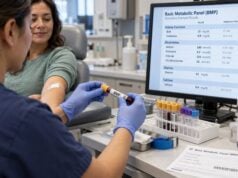
A kidney function blood test panel combines several measurements that help show how well the kidneys filter blood and whether complications of reduced kidney function may be developing. There is no single universally standardized “kidney panel,” but the core tests often include serum creatinine, estimated glomerular filtration rate (eGFR), and blood urea nitrogen (BUN). Many panels also include sodium, potassium, bicarbonate, calcium, and other chemistry tests. Cystatin C may be added when creatinine could be misleading or when a more accurate eGFR is important. No single marker gives a complete picture. Creatinine and cystatin C estimate filtration, BUN reflects waste handling but is influenced by hydration and protein metabolism, and electrolytes show consequences of impaired kidney regulation. Urine albumin testing is also essential because kidney damage can be present even when blood filtration markers are still near normal.
- The core kidney blood tests are creatinine, eGFR, and BUN, with electrolytes and bicarbonate commonly added for context.
- Creatinine-based eGFR is the usual first-line filtration estimate, while cystatin C can refine the estimate when muscle mass or other factors make creatinine unreliable.
- BUN is less specific for kidney function because dehydration, protein intake, bleeding, liver function, and illness can change it.
- Potassium and bicarbonate become especially important as kidney function worsens because dangerous hyperkalemia and metabolic acidosis can develop.
- Blood tests should be paired with urine albumin testing when screening or monitoring chronic kidney disease.
Table of Contents
- What a Kidney Function Panel Includes
- Creatinine and eGFR
- BUN and the BUN/Creatinine Ratio
- Cystatin C and Combined eGFR
- Electrolytes and Acid-Base Balance
- How to Interpret the Panel as a Pattern
- Follow-Up Tests and Monitoring
What a Kidney Function Panel Includes
A kidney function panel may be ordered as a renal function panel, a metabolic panel, or a custom group of tests. The exact components vary by laboratory and clinical setting.
A practical kidney evaluation often includes:
| Test | Main role |
|---|---|
| Creatinine | Waste marker used to estimate filtration |
| eGFR | Estimated glomerular filtration rate used for CKD classification and monitoring |
| BUN | Urea nitrogen waste marker influenced by kidney clearance and non-kidney factors |
| Cystatin C | Alternative filtration marker used selectively or to improve eGFR accuracy |
| Potassium | Shows whether kidney potassium regulation is impaired |
| Bicarbonate/CO2 | Helps identify metabolic acidosis |
| Sodium and chloride | Provide fluid and electrolyte context |
| Calcium and phosphorus | May become abnormal in more advanced chronic kidney disease |
A renal function panel may also include albumin and phosphorus. A comprehensive metabolic panel includes kidney markers plus liver-related tests, glucose, protein, and calcium.
The panel’s strength is pattern recognition. One high or low value can have several causes. When related markers shift together, the interpretation becomes more specific.
Creatinine and eGFR
Creatinine is produced from normal muscle metabolism and removed mainly by the kidneys. When filtration falls, blood creatinine usually rises. However, the level is affected by muscle mass, recent meat intake, intense exercise, creatine supplements, and some medicines.
For that reason, clinicians usually interpret creatinine through eGFR rather than alone. The eGFR test estimates filtration in mL/min/1.73 m² and places kidney function into G categories.
| G category | eGFR | Description |
|---|---|---|
| G1 | ≥90 | Normal or high |
| G2 | 60–89 | Mildly decreased |
| G3a | 45–59 | Mild to moderately decreased |
| G3b | 30–44 | Moderately to severely decreased |
| G4 | 15–29 | Severely decreased |
| G5 | <15 | Kidney failure category |
A single low eGFR does not prove chronic kidney disease. CKD requires abnormal kidney structure or function lasting at least three months. A temporary drop during dehydration, infection, obstruction, or medication-related acute kidney injury may recover.
The creatinine blood test is especially useful as a trend. A change from 0.8 to 1.3 mg/dL can be clinically important even if 1.3 falls close to a laboratory reference limit. Relative change and baseline matter.
BUN and the BUN/Creatinine Ratio
BUN measures the nitrogen portion of urea, a waste product generated when the body breaks down protein. The kidneys excrete urea, so BUN often rises when kidney function falls. However, BUN is more influenced by non-kidney factors than creatinine.
BUN can rise with dehydration, gastrointestinal bleeding, a high-protein diet, corticosteroid use, fever, infection, and increased tissue breakdown. It can be low with severe liver dysfunction, low protein intake, malnutrition, or overhydration.
The BUN test is therefore a supporting marker rather than a direct measure of filtration. A high BUN does not automatically mean kidney failure.
Clinicians sometimes calculate the BUN/creatinine ratio. A high ratio can occur with reduced kidney blood flow, dehydration, or upper gastrointestinal bleeding, while a low ratio may occur with low urea production or disproportionately high creatinine production. The BUN/creatinine ratio is a clue, not a stand-alone diagnosis.
The most useful interpretation comes from the combination. For example, high BUN and creatinine after several days of vomiting may fit volume depletion. High creatinine with relatively modest BUN in a patient with muscle injury may reflect a different process.
Cystatin C and Combined eGFR
Cystatin C is a protein produced by cells throughout the body and filtered by the kidneys. It is much less dependent on muscle mass than creatinine, which makes it valuable in people with frailty, severe muscle wasting, amputation, paralysis, or unusually high muscle mass.
A cystatin C blood test can be used to calculate eGFRcys. More importantly, laboratories can combine creatinine and cystatin C to produce eGFRcr-cys, which is generally more accurate than either single-marker estimate.
Cystatin C is not free of non-kidney influences. Glucocorticoids, thyroid dysfunction, inflammation, adiposity, and other systemic factors can change the level. Because these influences differ from those affecting creatinine, the two markers often complement one another.
The combined creatinine-cystatin C eGFR is especially useful when the filtration estimate is near a treatment threshold, when creatinine seems inconsistent with the clinical picture, or when body composition makes creatinine unreliable.
Not every patient needs cystatin C on every panel. For most adults, creatinine-based eGFR is an appropriate starting point. Cystatin C is an accuracy tool for selected situations.
Electrolytes and Acid-Base Balance
The kidneys do more than remove waste. They regulate potassium, sodium, water, and acid-base balance. As kidney function declines, these control systems can become impaired.
Potassium is the most urgent electrolyte in many cases. High potassium can result from reduced kidney excretion, certain blood-pressure medicines, potassium-sparing drugs, uncontrolled diabetes, tissue breakdown, or other causes. Severe hyperkalemia can trigger dangerous heart rhythm problems. A falsely high result can also occur if red blood cells rupture during collection.
Bicarbonate, often reported as total CO2, helps assess acid-base status. Chronic kidney disease can cause metabolic acidosis because the kidneys cannot excrete acid and regenerate bicarbonate adequately. Persistently low bicarbonate may require evaluation and treatment.
Sodium reflects the balance between sodium and water. It can be high with water loss or low with excess water relative to sodium, including in advanced kidney or heart disease. Chloride helps interpret sodium and bicarbonate patterns.
Calcium and phosphorus can become abnormal in later CKD as vitamin D activation, phosphate excretion, and parathyroid hormone regulation change. These abnormalities are part of chronic kidney disease-mineral and bone disorder and may require separate testing beyond a basic blood panel.
How to Interpret the Panel as a Pattern
A kidney panel is most useful when results are interpreted together and compared with prior values. Isolated flags often have multiple explanations.
Common patterns include:
- High creatinine with lower eGFR: suggests reduced filtration, but the cause may be acute or chronic.
- High BUN and creatinine after fluid loss: may fit dehydration or reduced kidney perfusion.
- Low eGFR with high potassium and low bicarbonate: suggests more significant loss of kidney regulatory function and may require urgent assessment.
- Normal creatinine with unexpectedly low cystatin C eGFR: may indicate that low muscle mass is making creatinine-based eGFR look better than actual filtration.
- High creatinine with relatively normal cystatin C in a muscular person: may reflect high creatinine production rather than the same degree of filtration loss.
- Stable mildly reduced eGFR with no albuminuria: carries a different risk profile from the same eGFR with severe albuminuria.
The time course is essential. A sudden increase in creatinine over days points toward acute kidney injury until proven otherwise. A stable abnormal pattern over months fits chronic kidney disease more closely.
A normal panel also does not exclude early kidney disease. Creatinine and eGFR can remain near normal while albumin begins leaking into urine. That is why blood testing and urine testing should be viewed as complementary.
Follow-Up Tests and Monitoring
The most important follow-up test for many people is a urine albumin-creatinine ratio. It detects albumin leakage and is used with eGFR to assess CKD risk. Urinalysis can reveal blood, protein, glucose, casts, infection clues, and other abnormalities.
Repeat blood testing may be needed to confirm a new abnormality or determine whether kidney function is changing. The timing depends on severity. A small stable abnormality may be rechecked later, while a rapid creatinine rise or significant potassium abnormality may require same-day repeat testing and treatment.
Other tests are selected based on the pattern. Kidney ultrasound can look for obstruction and structural disease. Phosphorus, parathyroid hormone, vitamin D, blood count, and iron studies may be added in advanced CKD. Autoimmune or protein studies may be ordered if glomerular or systemic disease is suspected.
Medication review is a routine part of kidney interpretation. Some drugs can reduce kidney filtration, raise potassium, or accumulate when GFR falls. Others may cause a small expected early eGFR change while providing long-term kidney protection. Changes should be made by a clinician rather than from the lab report alone.
People with diabetes, hypertension, cardiovascular disease, a family history of kidney failure, or known CKD often need periodic eGFR and urine albumin monitoring. Frequency is based on kidney stage, albuminuria, rate of change, and treatment.
Seek prompt medical care for markedly reduced urine output, severe shortness of breath, rapidly worsening swelling, confusion, fainting, chest symptoms, persistent vomiting, profound weakness, or a laboratory-reported critical potassium value.
Example patterns and what they can suggest
A useful way to understand a kidney panel is to look at realistic patterns rather than isolated values.
Pattern 1: creatinine and BUN rise after several days of vomiting. If blood pressure is low and the patient appears volume depleted, reduced kidney perfusion is a plausible explanation. Potassium and sodium may also be abnormal. Repeat testing after appropriate treatment can show whether kidney function returns toward baseline.
Pattern 2: creatinine is stable but cystatin C gives a much lower eGFR in a frail older adult. Low muscle mass may be causing creatinine-based eGFR to overestimate filtration. The combined creatinine-cystatin C estimate can provide a better basis for CKD classification and drug dosing.
Pattern 3: eGFR is moderately reduced and urine albumin is severely increased. This combination carries greater kidney and cardiovascular risk than the same eGFR with little or no albuminuria. It also suggests active kidney damage rather than age-related filtration change alone.
Pattern 4: creatinine is elevated, potassium is high, and bicarbonate is low. This pattern can indicate a more significant loss of kidney filtration and regulatory function. Depending on the degree of abnormality, symptoms, and speed of change, urgent treatment may be needed.
Pattern 5: BUN is very high while creatinine is only moderately increased. Dehydration, gastrointestinal bleeding, increased protein breakdown, or steroid use can raise BUN disproportionately. The ratio can guide questions but does not establish the diagnosis.
How blood tests fit with urine tests
Blood and urine tests answer different questions. Blood filtration markers show how effectively the kidneys clear selected substances from circulation. Urine tests can reveal damage to the kidney filters or tubules even before filtration declines substantially.
Urine albumin-creatinine ratio is central to CKD detection and risk assessment. Persistent albuminuria may be the earliest abnormality in diabetic kidney disease and hypertension-related kidney damage. Urinalysis can detect blood, protein, glucose, white blood cells, casts, and other findings that point toward a specific process.
This distinction explains why a person with a normal creatinine and eGFR can still have kidney disease. It also explains why a low eGFR with no albuminuria may require a different evaluation from a low eGFR with heavy protein loss and blood in the urine.
Monitoring frequency depends on risk
There is no one schedule for repeating kidney blood tests. Someone with normal eGFR, no albuminuria, and few risk factors may be tested only during routine preventive care. A person with diabetes or hypertension may need periodic eGFR and urine albumin testing even when results are normal.
Established CKD is monitored more often as eGFR falls, albuminuria increases, or the rate of decline accelerates. Medication changes that can affect kidney function or potassium often trigger extra checks. Acute illness can also justify earlier testing because dehydration, infection, and medication interactions can destabilize kidney function quickly.
The goal is not to chase every small fluctuation. Monitoring should detect changes large enough to alter treatment, reveal complications early, and confirm whether a concerning result is persistent.
Questions worth asking about a kidney panel
When reviewing results with a clinician, useful questions include: What is my baseline creatinine and eGFR? Is this change likely acute or chronic? Do I have urine albumin? Could a medicine, supplement, or recent illness explain the result? Does cystatin C add useful information in my case? Are potassium or bicarbonate abnormalities present? How soon should the tests be repeated?
These questions shift the discussion from one flagged value to the clinical meaning of the full pattern, which is the most reliable way to use a kidney function panel.
Why a “normal” panel may still need kidney screening
A normal blood panel does not exclude early kidney damage. The kidneys have substantial reserve, and serum creatinine may remain within the reference interval until filtration has declined enough to change the blood concentration. In people with diabetes, hypertension, cardiovascular disease, or a family history of kidney disease, urine albumin can become abnormal before the blood tests do.
This is why screening should not stop at a normal creatinine. eGFR should be calculated, and a urine albumin-creatinine ratio should be obtained when risk factors or guidelines support it. Repeating both over time can identify persistent disease and separate a transient abnormality from a chronic pattern.
What can make a panel temporarily abnormal
Recent illness can shift several kidney markers at once. Fever, poor intake, vomiting, diarrhea, heavy exercise, infection, and major surgery can change creatinine, BUN, sodium, potassium, and bicarbonate without representing a new permanent baseline. Medication changes can also cause predictable shifts.
When a panel is obtained during an acute illness, the clinician may repeat it after recovery to establish the person’s stable kidney status. That repeat result is especially important before labeling a person with chronic kidney disease or making long-term medication decisions.
The safest interpretation is therefore time-based: identify the acute context, compare with prior tests, correct reversible problems, and confirm whether abnormalities persist.
References
- KDIGO 2024 Clinical Practice Guideline for the Evaluation and Management of Chronic Kidney Disease 2024 (Guideline)
- Kidney function tests 2024
- Creatinine Test 2023
- Which is the best glomerular filtration marker: Creatinine, cystatin C or both? 2024 (Review)
- Cystatin C 2023
Disclaimer
Kidney blood-test results are estimates and markers, not a diagnosis by themselves. Interpretation should include prior values, urine albumin, medications, body composition, symptoms, and the laboratory’s own reference ranges. Urgent symptoms or critical potassium and kidney results require prompt medical evaluation.