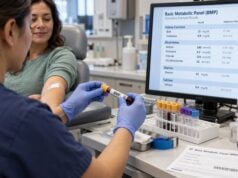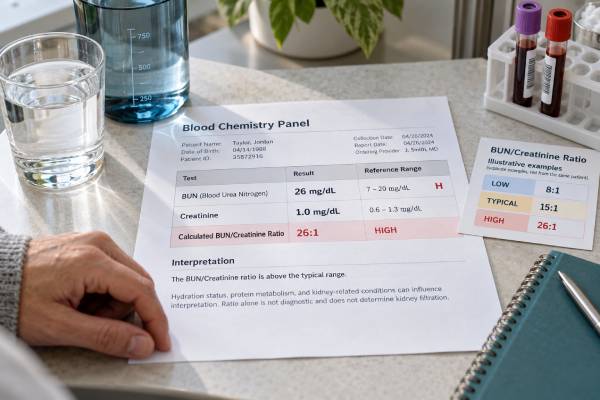
The BUN/creatinine ratio compares two blood measurements that are commonly used when evaluating kidney function: blood urea nitrogen (BUN) and serum creatinine. The ratio can provide useful context because BUN and creatinine respond differently to hydration, blood flow to the kidneys, protein metabolism, gastrointestinal bleeding, muscle mass, and kidney injury. It is often calculated automatically from a basic or comprehensive metabolic panel rather than ordered as a separate blood test.
A ratio above about 20:1 is traditionally associated with reduced kidney perfusion, including dehydration, but it is not specific enough to diagnose dehydration or “prerenal” acute kidney injury by itself. A low ratio is also nonspecific and may reflect low urea production, low protein intake, severe liver dysfunction, excess body water, or a relatively high creatinine from muscle-related causes. The safest interpretation uses the actual BUN and creatinine values, eGFR, urine output, symptoms, medications, volume status, and laboratory trends rather than relying on the ratio alone.
- A rough BUN/creatinine ratio of about 10:1 to 20:1 is often considered typical, but there is no universal diagnostic range.
- A ratio above 20:1 can occur with dehydration or reduced kidney blood flow, but also with upper gastrointestinal bleeding, high protein breakdown, corticosteroids, and low muscle mass.
- A low ratio does not automatically mean kidney damage. Low BUN production or a disproportionately high creatinine can lower the ratio.
- The ratio has limited accuracy for separating prerenal from intrinsic acute kidney injury, so it should not be used as a stand-alone diagnostic test.
- Always check the individual BUN and creatinine values and their units. The familiar 10–20 ratio applies when both are reported in mg/dL as BUN and creatinine.
Table of Contents
- What Is the BUN/Creatinine Ratio?
- Normal BUN/Creatinine Ratio
- What a High BUN/Creatinine Ratio Means
- What a Low BUN/Creatinine Ratio Means
- Dehydration and Prerenal Kidney Injury
- Kidney Function and Acute Kidney Injury
- How to Interpret Your Result
What Is the BUN/Creatinine Ratio?
The BUN/creatinine ratio is calculated by dividing blood urea nitrogen (BUN) by serum creatinine when both are expressed in mg/dL. For example, a BUN of 18 mg/dL and creatinine of 1.0 mg/dL gives a ratio of 18:1. A BUN of 36 mg/dL and creatinine of 1.5 mg/dL gives a ratio of 24:1.
BUN and creatinine are both waste-related blood markers, but they come from different processes. BUN reflects the nitrogen portion of urea, which is produced mainly in the liver when protein is metabolized. Urea is filtered by the kidneys, but some is reabsorbed in the tubules. The amount reabsorbed increases when the body is conserving sodium and water.
Creatinine is produced largely from normal muscle creatine metabolism. The kidneys filter creatinine, and serum levels generally rise when filtration falls. Creatinine is affected by muscle mass, diet, age, and some medications, but unlike urea it is not passively reabsorbed to the same extent. These physiologic differences are the reason the ratio can sometimes add information beyond either number alone.
The ratio is commonly generated from results in a basic metabolic panel or comprehensive metabolic panel. It may also appear on laboratory reports when BUN and creatinine are ordered together. It does not require an additional blood draw.
The term “BUN/creatinine ratio” should not be confused with a urea/creatinine ratio reported in other unit systems. If a laboratory reports urea rather than BUN, or uses mmol/L or µmol/L, the numerical ratio will differ. Applying the familiar 10:1 to 20:1 range to mismatched units can produce a meaningless result.
Normal BUN/Creatinine Ratio
A commonly taught adult BUN/creatinine ratio is approximately 10:1 to 20:1 when BUN and creatinine are both measured in mg/dL. This is a practical rule of thumb, not a universal reference interval or a diagnostic cutoff. Laboratories may use different ranges, and the ratio changes with age, diet, muscle mass, hydration, illness, and the individual values used in the calculation.
| Approximate ratio pattern | Possible interpretation | Why it is not diagnostic |
|---|---|---|
| About 10:1–20:1 | Often considered a typical adult pattern | Kidney disease can still be present if both BUN and creatinine are elevated proportionally |
| Above about 20:1 | May support reduced kidney perfusion or increased urea production | Dehydration, GI bleeding, protein intake, catabolism, steroids, and low creatinine can all contribute |
| Below about 10:1 | May reflect relatively low BUN or relatively high creatinine | Diet, liver function, body water, muscle injury, and other factors can alter either component |
The most important step is to look beyond the ratio. A ratio of 18:1 could come from a BUN of 18 mg/dL and creatinine of 1.0 mg/dL, both near typical adult ranges. The same ratio could come from a BUN of 54 mg/dL and creatinine of 3.0 mg/dL, a pattern that can indicate major kidney dysfunction. The ratio is identical, but the clinical meaning is completely different.
Similarly, a ratio of 25:1 might result from a BUN of 25 mg/dL and creatinine of 1.0 mg/dL, or from a BUN of 75 mg/dL and creatinine of 3.0 mg/dL. The first may be a mild, transient abnormality; the second can reflect severe illness or substantial kidney impairment. The absolute numbers, trend, and clinical setting always take priority.
What a High BUN/Creatinine Ratio Means
A high BUN/creatinine ratio means BUN is elevated more than creatinine, or that creatinine is unusually low relative to BUN. The classic explanation is increased urea reabsorption when kidney blood flow is reduced, but several other mechanisms can produce the same pattern.
Dehydration and other low-perfusion states can increase the ratio. When circulating volume falls, the kidneys conserve sodium and water. Urea reabsorption increases with this response, causing BUN to rise disproportionately. Vomiting, diarrhea, fever, poor fluid intake, blood loss, or excessive diuretic effect may create this pattern.
Heart failure and cirrhosis can also reduce effective blood flow to the kidneys even when the body has visible swelling or excess total fluid. A high ratio in these conditions does not necessarily mean the person should simply drink more water; fluid management can be complex and must account for the underlying disease.
Upper gastrointestinal bleeding is another important cause. Blood digested in the stomach or small intestine acts as a protein load, increasing urea production, while bleeding may simultaneously reduce kidney perfusion. A 2026 systematic review and meta-analysis found that the BUN/creatinine ratio had moderate—not definitive—accuracy for distinguishing upper from lower gastrointestinal bleeding. A high ratio can support suspicion, but stool color, symptoms, hemoglobin, vital signs, endoscopy, and the overall clinical picture remain essential.
High protein intake or increased tissue breakdown can raise BUN more than creatinine. Severe infection, burns, trauma, fever, or corticosteroid therapy may increase protein catabolism. A person with low muscle mass can also have a relatively low creatinine, making the ratio look high even without marked BUN elevation.
The BUN blood test should therefore be evaluated on its own as well as in relation to creatinine. A high ratio points toward possibilities; it does not identify a single cause.
What a Low BUN/Creatinine Ratio Means
A low ratio means BUN is low relative to creatinine. This can happen because less urea is being produced, because blood urea is diluted, or because creatinine is higher than expected for reasons related to muscle or kidney function.
Low protein intake or malnutrition can reduce urea production. Because urea is made from nitrogen generated during protein metabolism, people who eat very little protein may have a lower BUN and therefore a lower ratio.
Severe liver dysfunction can also lower BUN. The liver converts ammonia to urea through the urea cycle. If this process is impaired, BUN may remain low even when kidney function is reduced. In that setting, relying on BUN or the ratio as a kidney marker can be misleading.
Excess body water can dilute BUN. Pregnancy can also lower BUN because plasma volume expands and glomerular filtration increases. These situations are interpreted differently from kidney failure and should be assessed with sodium, liver tests, nutritional status, and the broader metabolic panel.
The ratio can also fall if creatinine rises disproportionately. Intense muscle injury or rhabdomyolysis can increase creatinine production, although creatine kinase and other findings are usually more important for diagnosing muscle breakdown. Greater muscle mass may raise baseline creatinine compared with a person of the same age who has less muscle.
A low ratio is not a standard way to diagnose intrinsic kidney damage. If creatinine is elevated, clinicians focus on the creatinine trend, eGFR when appropriate, urine findings, urine output, medications, and the cause of kidney injury rather than treating the low ratio as a separate disease.
A dedicated creatinine blood test interpretation is especially important when body composition is unusual, because the denominator of the ratio may be higher or lower for reasons unrelated to filtration.
Dehydration and Prerenal Kidney Injury
The BUN/creatinine ratio is often discussed as a dehydration marker. A value above about 20:1 can be compatible with volume depletion because reduced renal perfusion promotes water and urea reabsorption. However, there is no single blood test that serves as a gold standard for dehydration in all adults, and the ratio should not be used as one.
Dehydration can be hypertonic, isotonic, or hypotonic depending on the balance of water and electrolyte loss. Sodium may therefore be high, normal, or low. Clinical assessment considers recent fluid losses, oral intake, thirst, weight change, blood pressure, heart rate, mucous membranes, urine concentration, urine output, serum osmolality, and other findings.
The concept of prerenal acute kidney injury (AKI) is related but not identical to dehydration. Prerenal AKI means kidney filtration has fallen because perfusion is inadequate, while the kidney tissue may initially remain structurally intact. Causes include true volume loss, hemorrhage, sepsis-related hemodynamic changes, severe heart failure, cirrhosis, or medications that alter renal blood flow.
Textbooks have traditionally used a ratio above 20:1 to support prerenal physiology. Newer evidence shows the distinction is much less reliable in real patients. A 2026 systematic review and meta-analysis of the blood urea-to-creatinine ratio found limited diagnostic accuracy for differentiating prerenal or transient AKI from other AKI causes, with substantial heterogeneity and low to very low certainty of evidence.
The reason is straightforward: BUN and creatinine have many non-kidney determinants. A patient can be dehydrated and have a ratio under 20, or have a ratio over 20 because of gastrointestinal bleeding, steroid use, catabolism, or low muscle mass. Existing CKD can further blur the pattern.
When AKI is suspected, clinicians use a broader acute kidney injury blood test panel, urine output, urinalysis, medication history, hemodynamics, and sometimes ultrasound or other imaging. Response to appropriate treatment may also clarify the mechanism over time.
Kidney Function and Acute Kidney Injury
The BUN/creatinine ratio is not a direct measurement of glomerular filtration rate. Creatinine-based eGFR is the standard estimate used to classify stable kidney function in adults. Modern equations incorporate serum creatinine with age and sex; when cystatin C is available, combined creatinine-cystatin C equations can improve accuracy in selected situations.
The ratio can be normal even when kidney function is severely reduced. If both BUN and creatinine rise proportionally, the ratio may stay between 10 and 20 despite substantial CKD or AKI. This is why a “normal ratio” should never be read as “normal kidneys.”
Conversely, a high ratio can occur with normal or near-normal eGFR. Someone who is mildly dehydrated after vomiting may have a disproportionate BUN rise while creatinine remains close to baseline. A frail older adult with low muscle mass may also have a low creatinine that inflates the ratio.
In acute kidney injury, creatinine changes over hours to days, and standard eGFR equations become less dependable because they assume a relatively steady creatinine concentration. The diagnosis instead focuses on the change in serum creatinine and urine output over defined time periods, together with the clinical cause.
In chronic kidney disease, the CKD blood test panel places more emphasis on eGFR, creatinine, electrolytes, bicarbonate, and sometimes cystatin C, while urine albumin provides a complementary measure of kidney damage. The BUN/creatinine ratio may add context but is not used to stage CKD.
If kidney function is uncertain because muscle mass is very low or very high, cystatin C may help. That approach addresses a limitation of creatinine itself rather than trying to correct the problem with the BUN/creatinine ratio.
The ratio is most useful when the underlying BUN and creatinine values are reviewed at the same time. A ratio can look high because BUN rose, because creatinine is unusually low, or because both values changed by different amounts. Likewise, a low ratio may reflect a low BUN, a relatively high creatinine, or both. Two people can therefore have the same ratio for very different reasons. Always check the units as well: the familiar BUN/creatinine ratio is generally calculated from BUN and creatinine reported in mg/dL, so ratios derived from different unit systems should not be compared without conversion.
How to Interpret Your Result
Start with the two actual numbers. Ask whether the BUN is high, low, or within the laboratory range, and do the same for creatinine. Then check the eGFR if it is reported and compare all values with previous tests. Trends often reveal more than one isolated ratio.
Next, consider the circumstances around the blood draw. Recent vomiting, diarrhea, fever, poor intake, bleeding, high-protein meals, intense exercise, major illness, steroids, diuretics, and changes in muscle mass can alter the result. Medicines that affect kidney blood flow or filtration may also matter.
| Pattern | Questions clinicians may ask |
|---|---|
| High ratio, mildly high BUN, stable creatinine | Recent fluid loss? High protein intake? Low muscle mass? Steroid use? |
| High ratio, high BUN and rising creatinine | Volume depletion, bleeding, heart failure, sepsis, AKI, obstruction, medication effect? |
| Low ratio, low BUN | Low protein intake, malnutrition, liver dysfunction, pregnancy, excess body water? |
| Low ratio, high creatinine | Kidney dysfunction, high muscle mass, muscle injury, medication effect, rapidly changing creatinine? |
Do not try to correct a high ratio by drinking large amounts of water without considering the clinical setting. Aggressive fluid intake can be harmful in heart failure, advanced kidney disease, severe hyponatremia, or other conditions. If dehydration is likely and there is no fluid restriction, a clinician can advise an appropriate rehydration plan.
Seek urgent care for very little or no urine, fainting, severe weakness, confusion, chest pain, shortness of breath, persistent vomiting, black tarry stools, vomiting blood, severe abdominal pain, or rapidly worsening swelling. These symptoms can signal serious bleeding, AKI, electrolyte disturbance, or circulatory problems regardless of the ratio.
For a stable outpatient result, the most useful question is not “Is the ratio high or low?” but “What explains the BUN and creatinine pattern in this person?” That keeps the ratio in its proper role: a clue that can sharpen interpretation, not a stand-alone diagnosis.
References
- Diagnostic accuracy of the blood urea-to-creatinine ratio for differentiating AKI etiologies and dialysis prediction in adults: A systematic review and meta-analysis. 2026 (Systematic Review and Meta-Analysis)
- Blood Urea Nitrogen-to-Creatinine Ratio to Differentiate Upper From Lower Gastrointestinal Bleeding: A Systematic Review and Meta-Analysis 2026 (Systematic Review and Meta-Analysis)
- BUN (Blood Urea Nitrogen) 2024 (Official Medical Test Guide)
- Creatinine Test 2023 (Official Medical Test Guide)
Disclaimer
This article is for general education and cannot determine the cause of an individual BUN/creatinine ratio. The ratio is affected by hydration, bleeding, diet, liver function, muscle mass, medications, acute illness, and kidney function, so it should be interpreted with the full laboratory and clinical picture. Seek urgent medical care for major bleeding, very low urine output, fainting, confusion, severe shortness of breath, or other severe symptoms.