A creatinine clearance test estimates how much blood the kidneys clear of creatinine each minute by comparing creatinine in a timed urine collection with creatinine in the blood. The test usually requires a 24-hour urine collection plus a blood sample taken during or near the collection period. It was once a routine way to estimate glomerular filtration rate (GFR), but creatinine-based eGFR has replaced it for most everyday kidney assessment because eGFR is simpler and avoids collection errors. Creatinine clearance still has useful roles when standard estimates may be less reliable, when a timed urine study is already being performed, or when a clinician needs information about actual urinary creatinine excretion. The result is not identical to true GFR: creatinine is filtered and also secreted by kidney tubules, so creatinine clearance generally overestimates measured GFR. Accurate timing and complete urine collection are essential for a meaningful result.
- Creatinine clearance uses both blood and timed urine creatinine to estimate kidney filtration, usually in mL/min.
- A 24-hour urine collection is common, and missed urine can falsely lower the result while overcollection can distort it in either direction.
- Typical adult values are often around 80–120 mL/min, but reference ranges vary with age, sex, body size, and laboratory method.
- Creatinine clearance usually runs higher than true GFR because kidney tubules secrete some creatinine into urine.
- eGFR is preferred for routine kidney assessment, while creatinine clearance is reserved for selected clinical questions and situations where standard equations may be less reliable.
Table of Contents
- What Creatinine Clearance Measures
- How the Blood and Urine Samples Are Collected
- How Creatinine Clearance Is Calculated
- Normal, High, and Low Results
- Collection Errors and Test Limitations
- Creatinine Clearance vs. eGFR and Measured GFR
- When the Test Is Useful and What Comes Next
What Creatinine Clearance Measures
Creatinine clearance estimates the volume of plasma from which the kidneys remove creatinine per unit of time. Creatinine is generated from normal muscle metabolism, circulates in blood, passes through the kidney filters, and is excreted in urine. By knowing the blood creatinine concentration, urine creatinine concentration, and urine volume over a known time, a laboratory can estimate how efficiently the kidneys are clearing creatinine.
The concept is closely related to GFR, the amount of plasma filtered by all functioning glomeruli each minute. However, creatinine clearance and GFR are not exactly the same. Creatinine is freely filtered at the glomerulus, but a small additional amount is secreted into the urine by the renal tubules. As kidney function declines, the relative contribution of tubular secretion can become more important. The result is that creatinine clearance tends to overestimate true GFR.
Creatinine clearance is different from a serum creatinine blood test. Serum creatinine gives one concentration in blood. Clearance combines that concentration with how much creatinine appears in urine over a measured period.
It is also different from a simple 24-hour urine creatinine result. A 24-hour urine creatinine test reports how much creatinine was excreted in a day and can help judge whether the collection was plausible. Clearance adds the blood value and the urine flow rate so the result reflects estimated filtration.
How the Blood and Urine Samples Are Collected
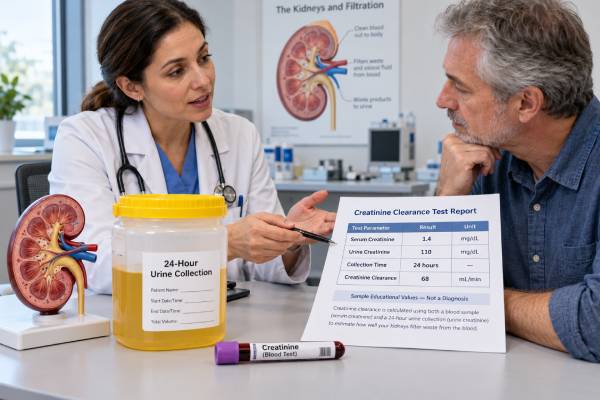
Most creatinine clearance tests use a 24-hour urine collection. The exact instructions can vary, so the laboratory’s directions take priority. A standard collection usually works like this:
- Choose the instructed start time and empty your bladder into the toilet. Do not save that first urine. Record the time.
- Collect every urine sample after that for the next 24 hours in the provided container or collection device.
- Store the urine as directed, commonly refrigerated or kept in a cooler.
- At the same time on the next day, urinate one final time and add that sample to the collection.
- Return the complete collection to the laboratory as instructed.
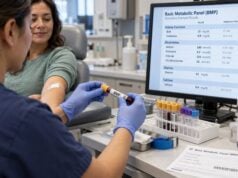
A blood sample for serum creatinine is usually obtained during the collection period or close to its completion. This matters because the calculation assumes the blood creatinine is reasonably stable during the timed urine collection.
If you miss even one urine void, tell the laboratory or clinician. Do not guess the volume or try to compensate by extending the collection without instructions. A missed sample means some creatinine and urine volume are absent, which can make the calculated clearance inaccurate.
The same is true if urine is spilled, the start or stop time is wrong, or the collection goes well beyond 24 hours. Timed collections can be useful, but their biggest practical weakness is that they depend on careful collection behavior outside the laboratory.
A related 24-hour urine collection test may measure several other substances at the same time, such as protein, sodium, calcium, oxalate, or urea. In that setting, the urine creatinine amount can also help clinicians judge whether the collection appears complete.
How Creatinine Clearance Is Calculated
The basic creatinine clearance formula is:
Creatinine clearance = (urine creatinine × urine flow rate) ÷ serum creatinine
Urine flow rate is the urine volume divided by the collection time. When units are entered consistently, the result is usually expressed in mL/min. Some laboratories also adjust the value to a standard body surface area of 1.73 m², producing mL/min/1.73 m².
For example, suppose a person’s urine creatinine concentration is 100 mg/dL, the 24-hour urine volume is 1,440 mL, and serum creatinine is 1.0 mg/dL. The urine flow rate is 1 mL/min because 1,440 mL was collected over 1,440 minutes. The estimated creatinine clearance would therefore be about 100 mL/min.
This example shows why both concentration and total volume matter. A very concentrated urine sample can contain a high urine creatinine concentration but may represent a lower total daily urine volume. Conversely, dilute urine can have a lower concentration but a larger volume. The clearance calculation combines both.
Some reports normalize clearance to body surface area. That can be helpful when comparing with standardized GFR categories, but a non-indexed value may be more relevant for certain medication dosing decisions. Clinicians may convert between indexed and non-indexed values when body size is substantially different from average.
The calculation also assumes steady creatinine production and a stable serum creatinine. In rapidly changing acute kidney injury, that assumption can break down, which is one reason no single clearance number should be interpreted without timing and clinical context.
Normal, High, and Low Results
Reference intervals differ by laboratory, age, sex, and whether the result is adjusted for body surface area. A commonly cited adult range is roughly 80–120 mL/min, but younger adults may have higher values and clearance normally declines with age. Some laboratories use sex-specific or age-adjusted ranges.
A low creatinine clearance means less creatinine is being cleared from plasma each minute. Common explanations include reduced kidney filtration from chronic kidney disease, acute kidney injury, reduced kidney blood flow, or urinary obstruction. It can also be falsely low if the urine collection is incomplete.
A high creatinine clearance can occur in states of increased filtration, sometimes called hyperfiltration, such as early pregnancy or in some people with diabetes. It can also be produced by a collection error, high creatinine generation, or inaccurate timing. A high clearance result is not automatically evidence of exceptionally healthy kidneys.
| Result pattern | Possible meaning | Common issue to check |
|---|---|---|
| Low clearance with high serum creatinine | Reduced kidney filtration is likely | Was the urine collection complete and was creatinine stable? |
| Low clearance with near-normal serum creatinine | Could reflect reduced filtration, low muscle mass, or incomplete collection | Compare eGFR, body composition, and urine creatinine excretion |
| Unexpectedly high clearance | Possible hyperfiltration or collection/calculation issue | Check collection duration, body-size indexing, and clinical context |
| Large mismatch with eGFR | One or both estimates may be distorted | Consider muscle mass, diet, collection quality, and cystatin C |
A single creatinine clearance does not diagnose chronic kidney disease. CKD requires evidence of abnormal kidney structure or function lasting at least three months. When a low clearance is new, clinicians first consider whether an acute and potentially reversible cause is present.
Collection Errors and Test Limitations
The most common problem with creatinine clearance testing is an inaccurate timed urine collection. Missing urine usually lowers measured urinary creatinine and can produce a falsely low clearance. Collecting for too long, adding urine outside the intended period, or recording the wrong timing can distort the result.
Laboratories often look at total daily urine creatinine excretion as a plausibility check. Historically, broad expected ranges based on sex and body weight have been used, but modern research shows that creatinine excretion varies substantially with age, body size, race/ethnicity, muscle mass, diet, and health. A result outside a textbook range does not prove the collection was wrong.
Other limitations include:
- Tubular secretion: creatinine clearance overestimates true GFR because the tubules add some creatinine to urine.
- Changing serum creatinine: in acute kidney injury, creatinine may be rising or falling during the collection, so a clearance based on one blood level may be misleading.
- Muscle mass and diet: unusually high or low creatinine generation can affect both blood and urine creatinine.
- Medications: some drugs change tubular creatinine secretion or kidney function.
- Body surface area adjustment: comparing an indexed result with a non-indexed value can create apparent disagreement.
- Practical burden: collecting every urine sample for 24 hours is inconvenient and increases the chance of errors.
Shorter timed collections are sometimes used in intensive care or other settings where clinicians need a more immediate estimate of renal clearance. Evidence suggests shorter collections can correlate with 24-hour clearance, but their accuracy is not uniform. The appropriate duration depends on the clinical question and local protocol.
Because of these limitations, creatinine clearance is not automatically “more accurate” than eGFR simply because it uses urine. A poorly collected 24-hour sample can be less useful than a well-interpreted blood-based estimate.
Creatinine Clearance vs. eGFR and Measured GFR
For routine kidney evaluation, eGFR testing is usually preferred. Modern eGFR equations use standardized serum creatinine, age, and sex, and current equations do not include a race coefficient. eGFR can be calculated from a single blood draw and avoids timed urine collection errors.
Creatinine clearance can still differ from eGFR for several reasons. It measures urinary clearance of creatinine rather than estimating GFR from population equations. It is affected by collection accuracy and tubular secretion. eGFR, meanwhile, can be inaccurate when creatinine production is unusual, such as in severe muscle wasting, amputation, extreme muscularity, or unusual dietary patterns.
Cystatin C offers another option. The creatinine-cystatin C eGFR is generally more accurate than creatinine-based eGFR alone and is especially useful when a precise estimate matters near an important clinical decision point.
Measured GFR is different from both. It uses an external filtration marker such as iohexol or another agent whose clearance can be measured directly. These tests are more complex, costly, and less widely available, but they are preferred when an especially accurate GFR is required, such as selected transplant evaluations or certain high-stakes drug dosing decisions.
| Method | Main input | Main advantage | Main limitation |
|---|---|---|---|
| Creatinine-based eGFR | Blood creatinine, age, sex | Easy, widely available | Affected by muscle mass and other non-GFR factors |
| Creatinine-cystatin C eGFR | Blood creatinine and cystatin C | Usually improves accuracy | Cystatin C may not be routinely available everywhere |
| Creatinine clearance | Blood creatinine plus timed urine | Uses actual urinary creatinine excretion | Collection errors and tubular secretion |
| Measured GFR | Clearance of an external marker | Most direct filtration assessment | Complex, time-consuming, less available |
When the Test Is Useful and What Comes Next
Creatinine clearance is most useful when a clinician has a specific reason to want timed urinary clearance rather than routine eGFR alone. Examples include unusual body composition, a large discrepancy between the clinical picture and creatinine-based eGFR, selected medication-dosing questions, or situations where a 24-hour urine study is already being collected for another purpose.
It can also provide information when creatinine production is atypical. For example, a person with very high muscle mass may have a higher serum creatinine than expected despite preserved filtration. A complete timed urine collection shows how much creatinine is actually being excreted, although it still does not eliminate every limitation of creatinine as a marker.
If the result is low, the next step is not automatically another clearance test. Clinicians usually compare it with serum creatinine, eGFR, urine albumin, blood pressure, diabetes status, electrolytes, and previous results. A kidney function blood test panel may help determine whether the problem is isolated or part of a broader kidney pattern.
If collection quality is questionable, repeating the test may be more useful than over-interpreting the number. When creatinine-based estimates remain uncertain, cystatin C or measured GFR may be considered.
Seek urgent medical care if reduced kidney function is accompanied by very low urine output, rapidly worsening swelling, severe shortness of breath, confusion, chest symptoms, persistent vomiting, or a dangerous potassium abnormality. A clearance value is only one part of deciding how urgent a kidney problem is; symptoms and electrolyte disturbances can be more immediately important.
How to improve collection accuracy
A creatinine clearance result is only as good as the timed urine collection. A few practical steps reduce the chance of an unusable result. Choose a start day when you can reliably collect every void, keep the container where the laboratory recommends, and use a smaller clean collection vessel if needed before transferring urine to the main container. Record the start and stop times immediately rather than relying on memory.
If the collection begins at 7:00 a.m., the first 7:00 a.m. urine is discarded and the bladder is considered empty at the start. Every urine after that is collected, including nighttime samples. At 7:00 a.m. the next day, the final urine is added. This “discard first, collect last” rule is one of the most commonly misunderstood parts of a 24-hour collection.
Do not deliberately drink extra water to increase the urine volume. Excess fluid changes urine concentration and can affect other substances being measured. Follow normal fluid intake unless the care team has given specific instructions. Likewise, do not alter protein intake, exercise, or supplements unless the laboratory or clinician specifically requests it.
If any urine is lost, spilled, or forgotten, report it. In many cases the collection should be restarted rather than producing a number that looks precise but is based on incomplete data.
Why creatinine clearance may differ from medication dosing estimates
People sometimes see a creatinine clearance on one report and a different eGFR in the medical record and assume one must be wrong. The values are generated by different methods and may use different body-size adjustments. Creatinine clearance from a timed urine collection can overestimate true GFR because of tubular secretion. eGFR is derived from a population equation and is usually indexed to 1.73 m² of body surface area.
Medication labels may specify a particular kidney-function method, historically often Cockcroft-Gault creatinine clearance. That calculated creatinine clearance is not the same as a measured 24-hour urine creatinine clearance. For drugs with narrow safety margins, clinicians follow the dosing method supported by the drug’s evidence and may use additional testing when estimates disagree.
References
- Abbreviated Urine Collection Compared With 24-Hour Urine Collection for Measuring Creatinine Clearance in Adult Critically Ill Patients: A Systematic Review 2025 (Systematic Review)
- Population-Based Limits of Urine Creatinine Excretion 2022
- Performance and pitfalls of the tools for measuring glomerular filtration rate to guide chronic kidney disease diagnosis and assessment 2023 (Review)
- KDIGO 2024 Clinical Practice Guideline for the Evaluation and Management of Chronic Kidney Disease 2024 (Guideline)
- Creatinine Test 2023
Disclaimer
Creatinine clearance results depend heavily on accurate urine collection, timing, serum creatinine stability, body size, and laboratory methods. The test estimates kidney filtration but is not identical to measured GFR and should be interpreted with eGFR, urine findings, medical history, and symptoms. Contact a healthcare professional promptly if an abnormal result occurs with severe symptoms or markedly reduced urine output.