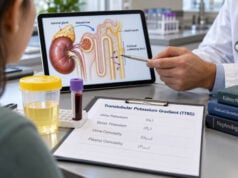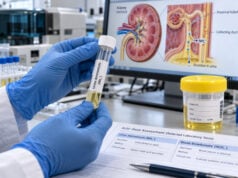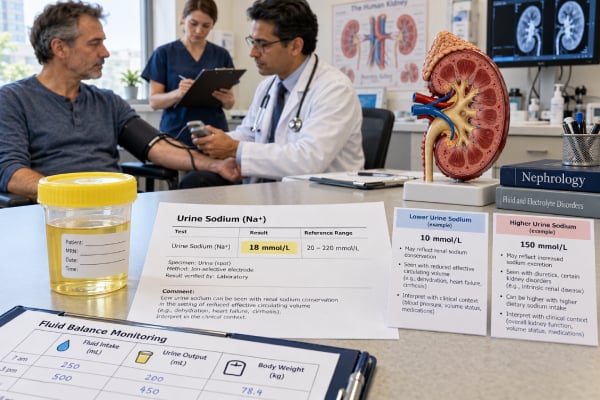
A urine sodium test measures the amount or concentration of sodium your kidneys are excreting. It is commonly used to help evaluate low blood sodium, changes in effective circulating volume, and some forms of acute kidney injury. A 24-hour urine sodium collection can also estimate sodium intake when a person is in a relatively steady state. The test is often described as a “hydration” test, but urine sodium does not directly tell you how much water is in the body. Its meaning depends on blood sodium, urine osmolality, kidney function, recent fluids, diet, diuretics, hormones, and whether the body is trying to conserve sodium. A low spot urine sodium may reflect an appropriate kidney response to reduced effective blood volume, while a higher value can occur with diuretics, kidney salt loss, adrenal insufficiency, or syndrome of inappropriate antidiuresis. Context is essential.
- Urine sodium shows how the kidneys are handling sodium; it is not a stand-alone measure of hydration.
- In hypotonic hyponatremia, urine sodium and urine osmolality help separate low-volume states from SIADH and other causes.
- A low urine sodium often means the kidneys are conserving sodium, while a high value can reflect renal sodium loss or normal sodium excretion in euvolemic states.
- Fractional excretion of sodium (FENa) can support evaluation of acute kidney injury, but diuretics and chronic kidney disease reduce its reliability.
- A 24-hour urine sodium result is strongly influenced by dietary salt intake and collection completeness.
Table of Contents
- What urine sodium measures
- Why the test is ordered
- Collection methods and reference values
- What low urine sodium can mean
- What high urine sodium can mean
- Urine sodium in hyponatremia and volume status
- FENa, kidney function, and next steps
What urine sodium measures
Sodium is the major positively charged ion in extracellular fluid. It helps regulate fluid distribution, blood pressure, nerve signaling, and muscle function. The kidneys filter large amounts of sodium each day and normally reabsorb almost all of it. Small changes in reabsorption determine how much sodium appears in urine.
A urine sodium test can be reported in two very different ways. A spot urine sodium concentration tells you how much sodium is present in one urine sample, typically in mmol/L or mEq/L. A 24-hour urine sodium measures the total amount excreted during an entire day, usually in mmol/24 hours. These results answer different questions and should not be used interchangeably.
Spot urine sodium is often used in urgent diagnostic work, especially when evaluating hyponatremia or acute kidney injury. The kidneys may sharply lower sodium excretion when the body senses reduced effective circulating volume. This response is driven by the renin-angiotensin-aldosterone system, sympathetic nervous system, and other signals that promote sodium retention.
A 24-hour urine sodium collection is more closely related to sodium balance. In a stable person who is not rapidly gaining or losing sodium, daily urinary sodium excretion roughly tracks dietary sodium intake. That is why repeated 24-hour collections are often used in research and sometimes in clinical nutrition assessment.
Urine sodium should not be confused with blood sodium on a basic metabolic panel. Blood sodium mainly reflects the relationship between body water and exchangeable sodium and potassium, not simply how much salt someone has eaten. A person can have low blood sodium while total body sodium is low, normal, or even increased.
This distinction explains why clinicians combine urine sodium with serum osmolality, urine osmolality, blood sodium, creatinine, and the clinical volume assessment rather than treating a urine sodium number as a diagnosis by itself.
Why the test is ordered
The most common diagnostic use is hyponatremia, usually defined as a blood sodium concentration below about 135 mmol/L. Once true hypotonic hyponatremia is confirmed, urine osmolality shows whether the kidneys are appropriately excreting dilute water, and urine sodium helps indicate whether the kidneys are conserving sodium because effective circulating volume is low.
Urine sodium may also be ordered in acute kidney injury. In selected patients, a low urine sodium or low fractional excretion of sodium can support a picture of reduced kidney perfusion with intact tubular sodium conservation. A higher value may occur with acute tubular injury or other intrinsic kidney problems. This use has important limitations, especially with diuretics, chronic kidney disease, sepsis, and several specific kidney disorders.
Other reasons for urine sodium testing include:
- suspected dehydration or volume depletion from vomiting, diarrhea, bleeding, or poor intake;
- edema states such as heart failure, cirrhosis, or nephrotic syndrome;
- suspected SIADH, adrenal insufficiency, or salt-wasting kidney disease;
- monitoring a prescribed sodium intake;
- estimating habitual sodium intake with 24-hour urine collections;
- evaluating hypertension or stone risk as part of a broader 24-hour urine panel;
- interpreting renin and aldosterone testing in selected endocrine evaluations.
The term volume status is more precise than “hydration” in many of these situations. A person may have excess total body water yet low effective arterial volume, as can happen in advanced heart failure or cirrhosis. The kidneys may respond by retaining sodium even though swelling is present. Conversely, a person with SIADH may have excess water relative to sodium without obvious edema and can continue excreting sodium in the urine.
For acute kidney problems, urine findings are interpreted alongside creatinine, BUN, electrolytes, and urine output. No single urine electrolyte replaces the broader clinical assessment.
Collection methods and reference values
A spot urine sodium sample usually requires no special collection beyond providing a clean urine specimen. The timing matters because sodium excretion varies during the day and changes rapidly after meals, IV fluids, diuretics, and shifts in circulation.
A 24-hour collection requires every urine specimen over a full day. Typically, the first morning urine is discarded and the start time is recorded. Every subsequent void is collected, including overnight urine, with a final specimen at the same time the next morning. Missing a void can make the total falsely low. Collecting longer than 24 hours can make it falsely high.
A major reference laboratory lists an adult 24-hour urine sodium interval of approximately 22–328 mmol per 24 hours. That wide interval illustrates an important point: population “normal” values are strongly influenced by diet. A high result may simply reflect high sodium intake, while a low result may reflect low intake. In diagnostic settings, clinicians often care more about whether sodium excretion is appropriate for the person’s blood pressure, blood sodium, volume status, and kidney function than whether it falls inside a general reference range.
There is no universal spot urine sodium “normal range” that applies to every situation. Common diagnostic cutoffs are context-dependent. In hypotonic hyponatremia, values below roughly 20–30 mmol/L often support sodium conservation from low effective circulating volume, while values above roughly 30 mmol/L can support SIADH or renal sodium loss when other criteria fit. Diuretics, recent IV saline, chronic kidney disease, adrenal insufficiency, and low dietary sodium can blur these patterns.
Do not intentionally load or restrict salt before testing unless instructed. Report diuretic use and recent IV fluids, because both can change the result quickly. For dietary assessment, one 24-hour collection may not represent usual intake because sodium consumption varies from day to day; multiple collections are more reliable.
For dietary context, sodium can be converted between millimoles and milligrams: 1 mmol of sodium is about 23 mg, so 100 mmol is about 2,300 mg of sodium. That conversion can help compare a 24-hour urine result with food-label targets, but it is still only an approximation of intake. Some sodium leaves through sweat and stool, and the body can temporarily retain or release sodium during changes in diet, fluid balance, illness, or medication use. A single 24-hour collection is therefore a snapshot rather than a perfect accounting of every milligram eaten.
When accurate habitual intake matters, repeated collections on ordinary days are more informative than one unusually careful day. This is especially important for people whose sodium intake changes substantially between home meals, restaurant meals, workdays, and weekends.
What low urine sodium can mean
Low urine sodium most often means the kidneys are actively conserving sodium. Whether that response is appropriate depends on the clinical setting.
In true volume depletion from vomiting, diarrhea, bleeding, sweating, or poor intake, the kidneys normally retain sodium to defend circulation. A low urine sodium therefore supports an extrarenal source of sodium and fluid loss when the rest of the clinical picture fits. A person may have thirst, dizziness on standing, low blood pressure, tachycardia, dry mucous membranes, or reduced urine output, although physical findings are not always reliable.
A low urine sodium can also occur in heart failure, cirrhosis, and nephrotic syndrome. These conditions may involve edema or increased total body fluid, yet the kidneys sense reduced effective arterial filling and retain sodium. This is a key reason low urine sodium should not automatically be translated as “dehydrated.”
In acute kidney injury, a low urine sodium and FENa below about 1% have traditionally supported a prerenal pattern, meaning reduced kidney perfusion with relatively preserved tubular function. However, several intrinsic kidney conditions can also have low FENa, and diuretics or chronic kidney disease can make the test less accurate. The finding is supportive, not definitive.
Low urine sodium in hyponatremia often points toward reduced effective circulating volume, but there are exceptions. Someone with SIADH who is eating very little sodium may have a lower urine sodium than expected. Conversely, recent saline can raise urine sodium even if the person had been volume depleted.
A low 24-hour urine sodium can simply reflect a low-sodium diet. In a stable outpatient without electrolyte or volume problems, that is often a nutritional finding rather than evidence of kidney disease.
What high urine sodium can mean
High urine sodium can be either normal excretion or inappropriate sodium loss. The blood sodium and clinical setting determine which interpretation makes sense.
Recent salt intake is a common reason for a high 24-hour urine sodium result. Packaged foods, restaurant meals, breads, sauces, cured meats, cheeses, snacks, and other processed foods can contribute large amounts of sodium even when the salt shaker is rarely used. If kidney function is normal and sodium balance is stable, the kidneys excrete most of this excess.
Diuretics can produce high urine sodium by blocking sodium reabsorption in the nephron. This effect can persist long enough to confuse evaluation of hyponatremia or volume depletion. A patient can be clinically volume depleted yet still have a relatively high urine sodium after a diuretic dose.
SIADH commonly causes hypotonic hyponatremia with urine that remains more concentrated than it should be and urine sodium that is not suppressed. The body retains water because antidiuretic hormone activity remains inappropriately high, while urinary sodium excretion generally continues. SIADH is a diagnosis of exclusion: adrenal insufficiency, severe hypothyroidism, kidney failure, diuretics, and other causes must be considered.
Adrenal insufficiency can cause renal sodium loss and hyponatremia. In primary adrenal insufficiency, mineralocorticoid deficiency can produce volume depletion, high urine sodium, low blood pressure, and often high potassium. Secondary adrenal insufficiency may resemble SIADH more closely because aldosterone is usually preserved.
Salt-wasting kidney disorders and some forms of tubular injury can also increase urine sodium. Acute tubular injury reduces the nephron’s ability to reclaim filtered sodium, although urine sodium alone is not sufficiently specific to establish that diagnosis.
In a 24-hour stone evaluation, high sodium excretion matters for another reason: higher sodium intake can increase urinary calcium excretion in susceptible people. That is why a high 24-hour urine sodium may lead to dietary sodium counseling even when the blood sodium level is completely normal.
Urine sodium in hyponatremia and volume status
Urine sodium is most useful in hyponatremia after confirming that the blood is truly hypotonic. High glucose and certain uncommon laboratory situations can produce low measured blood sodium without the usual hypotonic physiology.
Once hypotonic hyponatremia is established, urine osmolality is often the first urine measurement to interpret. If urine osmolality is very low, generally below about 100 mOsm/kg, the kidneys are appropriately suppressing antidiuretic hormone and excreting dilute water. This pattern can occur with primary polydipsia or very low solute intake.
If urine osmolality is above about 100 mOsm/kg, antidiuretic activity is present. Urine sodium then helps narrow the cause:
| Typical pattern | Possible interpretation |
|---|---|
| Urine osmolality >100 + urine Na <20–30 mmol/L | Low effective circulating volume, including GI loss, heart failure, or cirrhosis |
| Urine osmolality >100 + urine Na >30 mmol/L | SIADH, adrenal insufficiency, diuretic effect, or renal salt loss |
| Urine osmolality <100 | Excess water intake or very low solute intake is more likely |
These are patterns, not rigid rules. Clinical volume examination is imperfect, and medications can alter urine values. Contemporary approaches increasingly combine serum osmolality, urine osmolality, urine sodium, medication history, and targeted endocrine testing rather than relying on bedside volume classification alone.
Urine sodium also needs to be timed against treatment. IV saline can raise urine sodium, and loop or thiazide diuretics can keep sodium excretion elevated even when the person is volume depleted. In suspected SIADH, clinicians also look for a urine that is not maximally dilute, relative clinical euvolemia, and exclusion of adrenal, thyroid, and advanced kidney disorders. No single urine sodium cutoff can establish SIADH by itself.
Severe or symptomatic hyponatremia can cause headache, vomiting, confusion, seizures, reduced consciousness, or respiratory compromise. Treatment must be carefully controlled because correcting chronic hyponatremia too quickly can cause osmotic demyelination. The urine sodium result helps identify cause, but treatment urgency is determined by symptoms, duration, and the blood sodium level.
FENa, kidney function, and next steps
Fractional excretion of sodium (FENa) estimates the percentage of filtered sodium that is ultimately excreted. It uses urine sodium, blood sodium, urine creatinine, and blood creatinine. A FENa below about 1% has traditionally been associated with prerenal acute kidney injury, while values above about 2% can support intrinsic tubular injury.
The calculation is FENa (%) = (urine sodium × serum creatinine) ÷ (serum sodium × urine creatinine) × 100. All measurements need compatible units and should come from roughly the same time. The formula is useful only when the physiologic assumptions make sense; it is not a substitute for determining why kidney function changed.
The useful part of FENa is its physiology: functioning tubules under low-perfusion conditions can conserve sodium intensely. The limitation is that real patients do not always fit the textbook pattern. A 2022 systematic review found FENa performed best in oliguric patients without chronic kidney disease and without diuretic therapy. Diagnostic accuracy fell substantially in people taking diuretics or with CKD.
Fractional excretion of urea has sometimes been suggested as an alternative during diuretic use, but newer evidence also shows important limitations. Neither FENa nor FE urea should override the clinical picture, urine sediment, kidney imaging when needed, medication history, and changes in creatinine and urine output.
If a urine sodium result is unexpected, clinicians often repeat or expand testing. Common companion measurements include serum sodium, serum and urine osmolality, creatinine, eGFR, BUN, glucose, potassium, bicarbonate, urine chloride, and sometimes cortisol, thyroid tests, renin, or aldosterone. A renal function panel can provide several of these blood measurements at once.
For a high 24-hour dietary sodium result, the next step may be nutrition review rather than more kidney testing. For hyponatremia, the priority is identifying the underlying water-balance disorder. For acute kidney injury, the priority is determining whether reduced perfusion, intrinsic kidney injury, or obstruction is present.
Seek urgent medical care for severe confusion, seizures, loss of consciousness, severe weakness, breathing difficulty, or rapidly worsening illness associated with a sodium disorder. For routine results, ask what clinical question the test was meant to answer, whether diuretics or IV fluids affected it, and how the urine sodium fits with blood sodium, osmolality, and kidney function.
References
- Diagnostic algorithm of hyponatremia 2025 (Review)
- Hyponatraemia-treatment standard 2024 2024 (Review)
- Syndrome of Inappropriate Antidiuresis: From Pathophysiology to Management 2023 (Review)
- Approach to the Patient: Hyponatremia and the Syndrome of Inappropriate Antidiuresis (SIAD) 2022 (Review)
- Diagnostic Performance of Fractional Excretion of Sodium for the Differential Diagnosis of Acute Kidney Injury: A Systematic Review and Meta-Analysis 2022 (Systematic Review)
- Sodium, 24 Hour, Urine 2026
Disclaimer
Urine sodium cannot be interpreted safely without the blood sodium level, kidney function, medications, fluid history, and clinical context. This article is for general education and does not replace medical evaluation. Severe neurologic symptoms or rapidly worsening illness with an abnormal sodium level require urgent care.