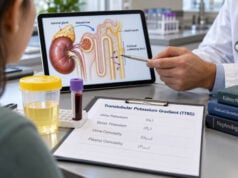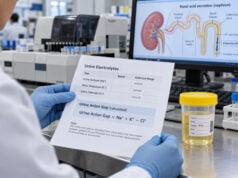
A fluid balance urine test panel combines urine osmolality, sodium, and creatinine to show how the kidneys are concentrating urine and handling water and salt. It is most useful when a clinician needs to sort out dehydration, low blood sodium, excessive urination, suspected kidney concentrating problems, or changes in effective blood volume. No single number proves that someone is “dehydrated” or “overhydrated.” Results make sense only when they are paired with symptoms, serum sodium and osmolality, kidney function, medications, and the timing of the urine sample. A concentrated urine can be appropriate after water loss, while a very dilute urine can be normal after high fluid intake. Urine sodium can fall when the kidneys are conserving salt, but diuretics and kidney disease can change that pattern. Urine creatinine helps show how concentrated the sample is and supports ratio-based interpretation.
- Urine osmolality shows urine concentration: low values mean dilute urine; high values mean concentrated urine.
- Urine sodium reflects kidney sodium handling: low values often occur with sodium conservation, while higher values can occur with diuretics, kidney salt loss, or SIAD.
- Urine creatinine helps judge sample concentration: it is especially useful in spot urine ratios and when checking timed collections.
- A single urine panel does not diagnose hydration status by itself: serum tests, urine output, medications, and clinical volume status matter.
- Urgent evaluation is needed when fluid-balance problems cause confusion, seizures, severe weakness, fainting, or very low urine output.
Table of Contents
- What the Fluid Balance Urine Panel Measures
- How Osmolality, Sodium, and Creatinine Work Together
- How Results Are Interpreted
- Common Result Patterns and Causes
- Collection, Timing, and Preparation
- Limitations, Follow-Up Tests, and When to Seek Care
What the Fluid Balance Urine Panel Measures
The panel answers three related questions: how concentrated is the urine, how much sodium is being excreted at that moment, and how concentrated is the sample relative to creatinine. These measurements are often ordered together because water balance and sodium balance are tightly linked but are not the same thing.
Urine osmolality measures the number of dissolved particles per kilogram of urine water and is reported in mOsm/kg. It reflects the kidney’s response to arginine vasopressin, also called antidiuretic hormone, as well as the amount of solute that must be excreted. A low result means the urine is dilute; a high result means it is concentrated. Laboratories often list broad reference intervals, commonly extending from roughly 50 to more than 1,000 mOsm/kg, because normal values change dramatically with fluid intake, diet, time of day, and physiologic stress. The clinical question is usually whether the urine concentration is appropriate for the blood osmolality and sodium level, not whether it falls inside a generic range.
Urine sodium is reported in mmol/L or mEq/L. In a spot sample, it measures concentration rather than total daily sodium excretion. A low urine sodium can reflect active kidney sodium conservation. A higher value can reflect higher salt intake, diuretic use, impaired sodium reabsorption, or conditions in which water retention occurs without true sodium depletion. The related urine sodium test is therefore best interpreted with the clinical setting.
Urine creatinine is produced from muscle creatine and is excreted in urine. In a spot sample it acts partly as a concentration marker. It is commonly used as the denominator in urine ratios because water intake can greatly change the concentration of many urine analytes. A separate urine creatinine test can also help assess the completeness of timed collections.
The panel is often paired with serum sodium, potassium, glucose, urea nitrogen, creatinine, and measured or calculated serum osmolality. Those blood results establish the extracellular fluid environment to which the kidneys are responding.
How Osmolality, Sodium, and Creatinine Work Together
The most useful interpretation comes from asking whether the kidney response matches the body’s need.
When the body needs to conserve water, vasopressin increases water reabsorption in the collecting ducts. Urine volume falls and urine osmolality rises. When the body has excess water, vasopressin should be suppressed, allowing a larger volume of dilute urine. A urine osmolality test therefore gives more direct information about water handling than urine color or specific gravity alone.
Urine sodium answers a different question. A person can have concentrated urine but low urine sodium because both water and sodium are being conserved after vomiting, diarrhea, bleeding, or reduced effective circulating volume. Conversely, a person with the syndrome of inappropriate antidiuresis, or SIAD, can have concentrated urine and a urine sodium that is not low because the body is retaining water despite having no true sodium deficit.
Urine creatinine adds context. Imagine two spot samples containing the same amount of sodium excreted over a short period. The sample collected after drinking a large amount of water may have a much lower sodium concentration simply because it is diluted. Creatinine concentration usually falls with the same dilution. This is why spot ratios can sometimes be more stable than raw concentrations, although urine sodium itself is often interpreted directly in acute fluid-balance workups.
For a general look at sodium, potassium, chloride, and osmolality together, a broader urine electrolyte panel may be ordered.
Osmolality is not the same as specific gravity
Urine specific gravity estimates density, whereas osmolality counts dissolved particles. The two often move in the same direction, but large molecules such as glucose, protein, or radiographic contrast can disproportionately affect specific gravity. When precise assessment of kidney concentration is needed, osmolality is usually more informative than the urine specific gravity test.
How Results Are Interpreted
There is no universal “optimal” value for this panel. Interpretation depends on the reason for testing.
In low blood sodium
For hypotonic hyponatremia, urine osmolality helps determine whether the kidneys are appropriately getting rid of free water. A urine osmolality below about 100 mOsm/kg usually indicates that vasopressin is largely suppressed and the kidney is producing very dilute urine. This pattern can occur with primary polydipsia or very low dietary solute intake.
A urine osmolality above 100 mOsm/kg means water excretion is being limited by vasopressin activity or by impaired kidney dilution. Urine sodium then adds information. In many clinical algorithms, a urine sodium below roughly 20–30 mmol/L supports sodium conservation from low effective circulating volume, whereas a value above about 30 mmol/L can be seen with SIAD, diuretics, adrenal insufficiency, or renal salt wasting. These thresholds are not absolute.
In high blood sodium or excessive urination
When serum sodium is high, the expected kidney response is concentrated urine. A low urine osmolality in that setting raises concern for impaired vasopressin production or response, historically called central or nephrogenic diabetes insipidus and now also described as arginine vasopressin deficiency or resistance.
In true polyuria, clinicians often first confirm urine volume. Adults generally need more than about 3 L/day or more than 40–50 mL/kg/day before “polyuria” is used in a diagnostic sense. Dilute urine suggests a water diuresis; concentrated urine with high output suggests an osmotic diuresis from substances such as glucose or urea. A formal evaluation may include serum osmolality, glucose, electrolytes, and specialized copeptin testing rather than an unsupervised water-deprivation test.
In suspected low circulating volume or acute kidney injury
Low urine sodium and a concentrated urine can support a sodium-conserving response, but the result is not definitive. Loop and thiazide diuretics increase urine sodium. Chronic kidney disease can impair concentrating ability. Sepsis, recent intravenous fluids, vomiting, heart failure, cirrhosis, and adrenal disorders can produce mixed patterns.
If acute kidney injury is present, the clinician may calculate fractional excretion of sodium (FENa) using paired blood and urine sodium and creatinine. FENa can be useful in selected patients, but it should not be treated as a stand-alone test of “dehydration.”
Common Result Patterns and Causes
The table below summarizes common patterns. Real patients may not fit neatly into one row.
| Pattern | Possible interpretation | Important caveats |
|---|---|---|
| High osmolality + low urine sodium | Water and sodium conservation, often from volume depletion or low effective circulating volume | Heart failure and cirrhosis can mimic true dehydration |
| High osmolality + urine sodium above about 30 mmol/L | SIAD, diuretic effect, adrenal insufficiency, or renal salt loss | Must confirm hypotonic hyponatremia before labeling SIAD |
| Very low osmolality | High water intake, primary polydipsia, or impaired vasopressin action if serum sodium is high | Meaning depends strongly on serum sodium and urine volume |
| High urine output + high osmolality | Osmotic diuresis | Check glucose, urea, sodium, medications, and other osmoles |
| Low urine creatinine concentration | Dilute spot sample or low creatinine generation | Not proof of kidney failure or collection error by itself |
Dehydration from gastrointestinal losses, sweating, fever, or inadequate intake usually stimulates both thirst and vasopressin. Urine becomes more concentrated, and the kidneys often reduce sodium excretion. However, a person can be “dehydrated” in the everyday sense yet have atypical urine results if diuretics, kidney disease, or recent intravenous fluids are involved.
Heart failure and cirrhosis deserve special attention. Total body water and sodium may be increased, yet the kidneys sense reduced effective arterial blood volume and conserve sodium. This can produce edema at the same time as a low urine sodium.
SIAD is another reason not to equate urine sodium with total body sodium. In SIAD, excess water retention lowers serum sodium. The urine remains inappropriately concentrated for the low serum osmolality, and urine sodium is often above 30 mmol/L if intake is adequate and no strong confounder is present.
A basic metabolic panel or serum chemistry panel is often more important than the urine panel for detecting dangerous sodium, potassium, glucose, and kidney-function abnormalities.
Collection, Timing, and Preparation
Most acute fluid-balance evaluations use a spot urine sample collected near the time of blood testing. Pairing serum and urine results matters because fluid status can change within hours after drinking, intravenous fluids, diuretics, vomiting, or changes in urine output.
Preparation depends on why the test was ordered. Unless instructed otherwise, do not deliberately dehydrate yourself or drink excessive water to “improve” the result. Both can make the test less representative and, in vulnerable people, can be unsafe.
Tell the ordering clinician about:
- diuretics such as furosemide, hydrochlorothiazide, chlorthalidone, or spironolactone;
- desmopressin, lithium, corticosteroids, and medicines that can affect sodium or vasopressin;
- recent IV fluids or contrast studies;
- vomiting, diarrhea, fever, heavy exercise, or unusually high water intake;
- kidney, adrenal, heart, or liver disease.
For some questions, a timed collection may be needed. A 24-hour urine volume test is useful when confirming polyuria. Timed sodium or creatinine measurements can also help estimate daily excretion, but collection errors are common if even one void is missed.
The best sample is not necessarily the first-morning urine. First-morning urine is naturally more concentrated in many people. In an acute hospital evaluation, the most useful sample is usually the one collected at the same physiologic moment as the blood tests and before major treatment changes when practical.
Limitations, Follow-Up Tests, and When to Seek Care
This panel is a physiologic snapshot. It does not directly measure total body water, extracellular fluid volume, or daily sodium intake.
Several factors can distort interpretation. Diuretics can raise urine sodium even when circulating volume is low. Reduced kidney function can limit the ability to concentrate or dilute urine. Glucose, urea, mannitol, and other osmoles can raise urine osmolality. Low muscle mass can reduce creatinine generation. High meat intake or intense exercise can affect creatinine. A single spot sample may not represent a full day.
Follow-up testing depends on the pattern. Clinicians may repeat serum sodium and osmolality, check glucose and kidney function, measure urine output, review medications, or order endocrine testing. In suspected SIAD, thyroid and adrenal causes usually need to be excluded. In persistent hypotonic polyuria, supervised testing with copeptin may help distinguish vasopressin deficiency, vasopressin resistance, and primary polydipsia.
When kidney injury is part of the picture, serum creatinine, estimated GFR, urine output, and urine microscopy often matter more than any one urine electrolyte.
Seek urgent medical care for confusion, seizures, severe drowsiness, new severe weakness, repeated fainting, inability to keep fluids down, signs of shock, rapidly worsening swelling with breathlessness, or very low urine output. Severe sodium disturbances can affect the brain and should not be corrected rapidly without medical supervision.
For non-urgent abnormal results, the most useful next step is usually not to chase a single “normal range,” but to ask whether the urine response is appropriate for the serum sodium, osmolality, blood pressure, urine volume, symptoms, and medications at that same time.
Putting the results together: practical examples
The value of a fluid-balance urine panel comes from the pattern, not from any single result. A few examples show why.
Concentrated urine with low urine sodium: Suppose a patient has vomiting, low blood pressure, high urine osmolality, and urine sodium below about 20–30 mmol/L. If kidney function and recent medications do not distort the pattern, the kidneys are responding as expected to reduced effective circulating volume: vasopressin is conserving water, while sodium-retaining systems are conserving sodium. A high urine creatinine concentration may simply reflect the concentrated sample. The interpretation changes if the person recently received saline or is taking a diuretic.
Concentrated urine with higher urine sodium: In hyponatremia, urine that remains concentrated despite low plasma osmolality means water excretion is being limited. If urine sodium is also above roughly 30 mmol/L, SIAD becomes one possibility, but adrenal insufficiency, kidney disease, recent diuretics, and some endocrine disorders can produce a similar pattern. Clinical volume assessment and blood testing are needed before assigning a cause.
Very dilute urine: A urine osmolality below about 100 mOsm/kg indicates that the kidney is strongly suppressing vasopressin effect and excreting relatively free water. In hyponatremia, this can fit excessive water intake or very low solute intake. In a patient with excessive thirst and large urine volumes, however, persistently dilute urine may instead raise concern for diabetes insipidus or another concentrating defect. The same number can therefore mean different things in different clinical settings.
High urine osmolality during hypernatremia: When blood sodium is high because of water loss, a healthy kidney should usually concentrate urine. A high urine osmolality supports an appropriate renal response and points toward water loss outside the kidney or inadequate water access. An inappropriately low urine osmolality suggests impaired vasopressin production or action, although partial disorders and recent fluid intake can blur the picture.
Unexpected urine creatinine: Urine creatinine is useful for judging whether a sample is very dilute or concentrated and for checking timed collections. In a spot sample, it should not be interpreted as a direct measure of kidney filtration. A low urine creatinine concentration may simply mean the person drank a large amount of water. In a 24-hour collection, an unexpectedly low total creatinine excretion can suggest incomplete collection, but age, sex, body size, and muscle mass also affect the expected amount.
Why trends can be more useful than one sample
Urine composition can change within hours after drinking water, receiving IV fluids, taking a diuretic, vomiting, or changing salt intake. For this reason, a result obtained before treatment may answer a different question from one obtained several hours later. In acute hyponatremia or suspected volume depletion, timing should be documented carefully.
When monitoring a chronic problem, comparisons are most useful when the patient is in a similar clinical state and the samples were collected under comparable conditions. A shift from concentrated to dilute urine after treatment may be expected and clinically reassuring rather than evidence that the first test was wrong.
The panel should also be reconciled with the serum results. Urine osmolality is most informative when plasma osmolality and serum sodium are known. Urine sodium is most informative when blood pressure, edema, kidney function, and recent diuretic exposure are considered. Urine creatinine helps put spot concentrations into context but cannot substitute for a serum creatinine or eGFR. Together, these checks reduce the risk of labeling a normal kidney response as disease or overlooking a kidney response that is inappropriate for the patient’s current fluid and electrolyte state.
References
- Hyponatremia: Evolving diagnostics and emerging therapeutics in clinical practice 2026 (Review)
- Diagnostic algorithm of hyponatremia 2026 (Review)
- Arginine vasopressin deficiency: diagnosis, management and the relevance of oxytocin deficiency 2024 (Review)
- Long-term health outcomes associated with hydration status 2024 (Review)
- Copeptin in the diagnosis and management of renal tubular disorders 2026 (Review)
- Use of Urine Electrolytes and Urine Osmolality in the Clinical Diagnosis of Fluid, Electrolytes, and Acid-Base Disorders 2021 (Review)
Disclaimer
Fluid-balance urine results require interpretation with blood tests, symptoms, medications, and clinical examination. Do not intentionally restrict or overload fluids, or change diuretics or desmopressin, based on a urine result without medical guidance. Severe sodium or fluid-balance symptoms require urgent evaluation.