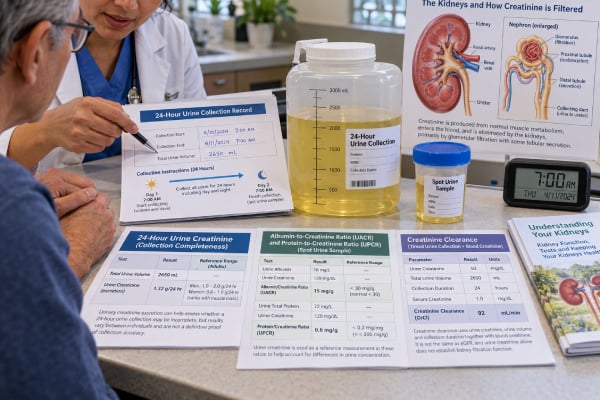
A urine creatinine test measures creatinine, a waste product generated from normal muscle metabolism, in a urine sample. It can be reported as a concentration in a spot sample or as the total amount excreted during a timed collection, most often 24 hours. Urine creatinine is useful for several different reasons: it helps estimate whether a 24-hour urine collection is plausible, serves as the denominator in urine albumin-creatinine and protein-creatinine ratios, and is used with blood creatinine in creatinine clearance calculations. A urine creatinine result by itself does not directly tell you whether kidney function is normal. The number changes with muscle mass, age, sex, diet, exercise, urine concentration, collection accuracy, and kidney function. A low spot urine creatinine can simply reflect dilute urine, while a high spot concentration can reflect concentrated urine. The clinical meaning therefore depends on why the test was ordered and what other measurements were collected at the same time.
- Spot urine creatinine mainly reflects urine concentration and is most useful as part of a ratio, such as uACR or UPCR, rather than as a stand-alone kidney function test.
- 24-hour urine creatinine helps assess timed-collection completeness, but expected excretion varies with age, sex, body size, muscle mass, diet, and kidney disease.
- Low 24-hour creatinine may suggest a missed or incomplete collection, but it can also be appropriate in a person with low muscle mass.
- High 24-hour creatinine may reflect greater muscle mass, meat intake, exercise, or overcollection, so it does not automatically mean kidney damage.
- Creatinine clearance combines urine creatinine, urine volume, collection time, and blood creatinine to estimate filtration, but it can overestimate true GFR.
Table of Contents
- What Urine Creatinine Measures
- Spot Versus 24-Hour Urine Creatinine
- Urine Creatinine and Collection Quality
- Creatinine Ratio Tests
- Creatinine Clearance and Kidney Function
- Why Urine Creatinine Can Be High or Low
- How to Prepare and What to Do Next
- Practical Urine Creatinine Examples
What Urine Creatinine Measures
Creatinine forms continuously as creatine and phosphocreatine in skeletal muscle turn over. It enters the bloodstream, is filtered by the kidneys, and is excreted in urine. Because production is related to muscle mass and is relatively steady within an individual from day to day, creatinine is useful as a reference marker in both blood and urine testing.
The key distinction is that blood creatinine and urine creatinine answer different questions. A creatinine blood test is used with age and other variables to estimate glomerular filtration rate. Urine creatinine, in contrast, usually helps normalize another urine marker, check a timed collection, or calculate creatinine clearance.
A spot urine creatinine result is typically reported in mg/dL, mmol/L, or a similar concentration unit. The concentration depends heavily on water content. If you have been drinking large amounts of fluid, the urine may be dilute and creatinine concentration low. After overnight fluid restriction or dehydration, the same person may produce a much higher concentration. This variation is why a random urine creatinine concentration does not have a single useful “normal range” for kidney function.
A timed result is different. A 24-hour urine creatinine result reports the total mass excreted per day, often in mg/24 hours or mmol/24 hours. Total excretion is more closely related to creatinine production and collection completeness than to how concentrated any one urine sample is.
Kidneys also secrete a small amount of creatinine into the tubule in addition to filtering it. As kidney function declines, this secretion can become a larger proportion of total creatinine clearance. That is one reason measured creatinine clearance tends to be higher than true GFR.
Spot Versus 24-Hour Urine Creatinine
The collection method should match the clinical question.
| Test format | Main use | Major limitation |
|---|---|---|
| Spot urine creatinine | Denominator for albumin, protein, calcium, oxalate, and other ratios | Strongly affected by urine dilution and muscle mass |
| 24-hour urine creatinine | Collection-quality check, total creatinine excretion, clearance calculations | Missed or extra urine can materially distort the result |
| Timed shorter collection | Selected clearance or research protocols | Timing must be precise |
Spot testing is practical and reduces collection errors. For kidney disease screening, major guidelines prefer a urine albumin-creatinine ratio rather than a raw urine albumin concentration because creatinine partly corrects for how dilute or concentrated the sample is. A first-morning sample is often preferred because it reduces variation from recent fluid intake and activity.
A 24-hour collection is still valuable when total daily excretion matters. It may be ordered for creatinine clearance, kidney stone risk testing, sodium or protein excretion, or selected endocrine and metabolic evaluations. Urine creatinine is then often included as a plausibility check: if the creatinine amount is very different from what would be expected for that person, the clinician may question whether urine was missed or collected for too long.
However, no universal mg/kg/day cutoff can perfectly classify a collection as complete or incomplete. Modern population studies show wide biological variation and demonstrate that older fixed expectations can misclassify valid samples, particularly in older adults, people with obesity, people with chronic kidney disease, and those with unusually low or high muscle mass.
Urine Creatinine and Collection Quality
Completeness matters because every analyte in a 24-hour collection depends on capturing all urine produced during the time window. Missing even one substantial void can make sodium, calcium, protein, oxalate, citrate, and other daily excretion values look falsely low.
Clinicians have traditionally compared 24-hour creatinine excretion with expected values based on body weight and sex. Rough historical rules sometimes cited are around 15–20 mg/kg/day for women and 20–25 mg/kg/day for men, but these numbers should not be used as rigid pass-fail thresholds. Creatinine excretion tends to fall with age and lower muscle mass, and it can differ across body composition and populations. Newer predictive equations incorporate variables such as age, sex, weight, and height.
A collection can look suspicious in several ways:
- Unexpectedly low total creatinine: missed samples, shortened collection, very low muscle mass, frailty, amputation, severe malnutrition, or low creatinine generation.
- Unexpectedly high total creatinine: collection longer than 24 hours, inclusion of urine from outside the time window, high muscle mass, recent heavy meat intake, or strenuous exercise.
- Very low volume with otherwise ordinary daily habits: possible missed voids, though true low intake or fluid loss can also explain it.
- Large mismatch with prior collections: either real biological change or collection inconsistency.
Urine creatinine should therefore be treated as a quality-control clue, not a lie detector for a urine jug. Even complete collections show day-to-day variation. Conversely, an incomplete collection can occasionally produce a creatinine value that falls inside an expected range.
If a 24-hour result will materially change treatment, repeating the collection may be more reliable than forcing an interpretation from a questionable sample. A proper 24-hour urine collection is especially important when evaluating recurrent kidney stones or calculating measured clearance.
Creatinine Ratio Tests
One of the most important uses of urine creatinine is to correct another urine measurement for concentration. A ratio divides the concentration of the target substance by urine creatinine from the same sample. This makes a random sample more comparable across different levels of hydration.
Urine albumin-creatinine ratio
The urine albumin-creatinine ratio, or uACR, is the preferred screening test for albuminuria in most adults at risk for chronic kidney disease. Results are usually expressed as mg of albumin per g of creatinine or mg/mmol. Common categories are less than 30 mg/g, 30–300 mg/g, and more than 300 mg/g, although interpretation depends on persistence and clinical context.
The ratio works because urine creatinine provides a rough estimate of how concentrated the sample is. If two samples contain the same albumin concentration but one is much more dilute, their raw albumin values can be misleading; dividing by creatinine reduces that problem.
Urine protein-creatinine ratio
The urine protein-creatinine ratio, or UPCR, estimates total protein excretion and is useful when proteins other than albumin may be important. Like uACR, it is often obtained from a spot sample.
Ratios are not perfect. A person who excretes unusually little creatinine because of low muscle mass can have a ratio that appears higher, while a very muscular person can have a lower ratio for the same absolute albumin or protein excretion. This is one reason clinicians interpret a ratio with age, sex, body composition, and repeat measurements.
Creatinine is also used in urine calcium-creatinine, oxalate-creatinine, sodium-creatinine, and other ratios. Pediatric testing commonly relies on ratios because full-day urine collection is difficult, and age-specific reference ranges are essential because creatinine excretion changes as children grow.
Creatinine Clearance and Kidney Function
Creatinine clearance estimates the volume of plasma cleared of creatinine per unit time. A traditional measured creatinine clearance uses four pieces of information: urine creatinine concentration, urine volume, collection duration, and serum creatinine concentration.
In simplified form:
Creatinine clearance = (urine creatinine × urine flow rate) ÷ serum creatinine
The result is usually adjusted to a standard body surface area for comparison among people. A creatinine clearance test can be useful when an estimated GFR may be unreliable, when kidney function must be assessed with a measured urine collection, or in selected drug-dosing and clinical situations.
Measured clearance has important limitations. Tubular secretion of creatinine causes clearance to overestimate actual glomerular filtration, particularly as GFR falls. Collection errors can produce even larger mistakes. A falsely low urine volume or missed void can lower calculated clearance, while an overlong collection can raise it.
For routine chronic kidney disease evaluation, estimated GFR from blood creatinine, cystatin C, or both is generally more practical than 24-hour creatinine clearance. The eGFR test avoids timed urine collection and is standardized for broad clinical use. Measured creatinine clearance is best viewed as a specific tool rather than the default kidney function test.
Why Urine Creatinine Can Be High or Low
A high or low urine creatinine result has different meanings depending on whether it is a concentration or a 24-hour total.
Low spot urine creatinine
A low spot concentration often means the urine is dilute. Heavy fluid intake, intravenous fluids, or impaired urine-concentrating ability can all lower the concentration. It may also be lower in people with reduced muscle mass. A dilute spot sample can make raw urine albumin or protein concentration look reassuringly low even when the ratio is abnormal, which is another reason ratios are used.
High spot urine creatinine
A high concentration often reflects concentrated urine from limited fluid intake, overnight fasting, sweating, or dehydration. It is not the same as high blood creatinine and does not by itself indicate kidney failure.
Low 24-hour creatinine excretion
True low daily excretion can occur with low muscle mass, aging, malnutrition, paralysis, amputation, or severe chronic illness. An incomplete collection is another common explanation. In advanced kidney disease, excretion and creatinine generation relationships can also become less predictable.
High 24-hour creatinine excretion
Greater muscle mass is a common physiologic reason. Recent cooked meat intake can transiently increase creatinine generation, and strenuous exercise may contribute. Overcollection should be considered if the collection duration exceeded instructions.
Because creatinine reflects muscle biology as well as kidney handling, comparing a urine result with body composition and prior values is often more informative than comparing it with a single population cutoff.
How to Prepare and What to Do Next
For a spot urine creatinine or ratio test, follow the collection instructions and avoid deliberately overhydrating. A first-morning midstream sample may be requested. Heavy exercise can transiently affect several urine markers, so routine rather than extreme activity before testing usually gives a more representative result.
For a 24-hour collection, accuracy depends on timing and completeness:
- Choose a day when you can collect every void.
- At the start time, urinate and discard that sample.
- Record the exact start time.
- Collect all urine afterward for the full period.
- Store the container as instructed.
- At the same time the next day, collect one final void and add it to the container.
If you miss a sample, tell the laboratory or clinician. Starting over is often better than submitting a known incomplete collection.
An unexpected urine creatinine value may lead to a repeat sample, review of muscle mass and diet, or comparison with serum creatinine and eGFR. If a ratio is abnormal, the important issue is usually the numerator—albumin, protein, calcium, or another analyte—not the creatinine denominator alone. Chronic kidney disease is diagnosed from persistent kidney abnormalities, not from one isolated urine creatinine concentration.
Seek prompt medical evaluation if abnormal kidney tests occur with markedly reduced urine output, swelling, shortness of breath, severe weakness, confusion, or rapidly worsening illness. These symptoms matter far more than a urine creatinine number by itself.
Practical Urine Creatinine Examples
A few common scenarios show why urine creatinine should not be interpreted as if it were a blood creatinine test.
Low spot urine creatinine with normal uACR: A patient provides a very pale urine sample after drinking a large bottle of water. The urine creatinine concentration is low, but albumin is also low and the albumin-creatinine ratio is normal. The low creatinine concentration mainly reflects dilution. No diagnosis of kidney failure can be made from that spot value.
Low spot creatinine with a high uACR: In an older adult with low muscle mass, the creatinine denominator may be small, which can make the ratio higher for a given albumin concentration. The result still deserves attention, but confirmation with a first-morning sample and repeat testing helps establish persistent albuminuria. Clinical interpretation should consider body composition rather than dismissing or accepting one ratio mechanically.
Low 24-hour creatinine and low calcium, sodium, and oxalate: When several daily excretion values are all unexpectedly low, an incomplete collection becomes more plausible. If the patient remembers missing an afternoon void, repeating the collection is preferable to concluding that all dietary and metabolic risk factors are low.
High 24-hour creatinine in a muscular athlete: A daily amount above a generic reference expectation may be entirely consistent with large muscle mass. Recent heavy exercise or a meat-rich meal can further increase creatinine excretion. In this setting, the result may support rather than undermine the plausibility of the collection.
Creatinine clearance higher than eGFR: This does not automatically mean the estimated GFR is wrong. Measured creatinine clearance tends to overestimate true filtration because creatinine is secreted by the tubules, and a small collection error can widen the difference. When an accurate filtration estimate matters, clinicians may use cystatin C or a measured exogenous filtration marker rather than relying on urine clearance alone.
These examples reinforce a useful principle: urine creatinine is usually a denominator, a timed-collection quality clue, or one variable in a clearance equation. It should almost never be interpreted as an isolated marker of kidney damage.
References
- New equations to estimate 24-h urinary creatinine excretion 2025
- Population-Based Limits of Urine Creatinine Excretion 2022
- Systematic review and meta-analysis of biological variation data of urine albumin, albumin to creatinine ratio and other markers in urine 2025 (Systematic Review)
- KDIGO 2024 CKD Guideline 2024 (Guideline)
- Recommendations for pre-analytical urine sample handling to allow optimal assessment of albuminuria and proteinuria 2026 (Review)
- [Performance of formulas for the evaluation of 24-hour urine collections using urine creatinine excretion] 2021 (Review)
Disclaimer
This article is for general education and cannot determine whether an individual urine collection is complete or whether kidney function is normal. Urine creatinine must be interpreted according to the collection method, body composition, blood creatinine, eGFR, and the reason the test was ordered. Discuss unexpected results with a qualified clinician rather than changing fluid intake, diet, or medications on your own.