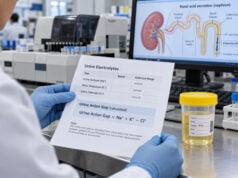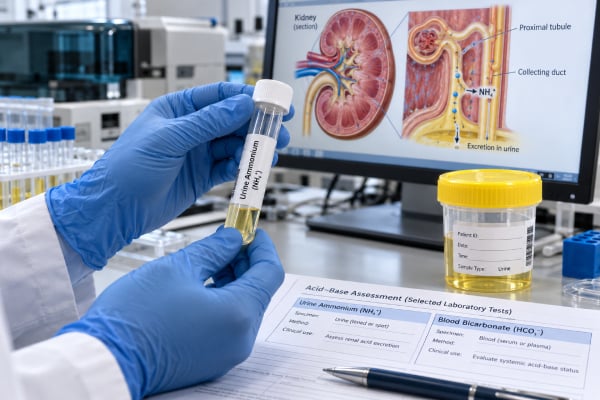
A urine ammonium test measures ammonium (NH₄⁺), the major form in which the kidneys excrete daily acid. It is most useful when blood tests show metabolic acidosis and the clinician needs to know whether the kidneys are responding appropriately. In a normal-anion-gap, or hyperchloremic, metabolic acidosis caused by diarrhea, healthy kidneys should increase ammonium excretion substantially. In renal tubular acidosis (RTA) or advanced chronic kidney disease, ammonium excretion may remain inappropriately low. Direct urine ammonium measurement is more informative than older surrogate calculations such as the urine anion gap, although many laboratories still do not offer it routinely. There is no single cutoff that applies to every diet, collection type, kidney function level, or degree of acidosis. Interpretation depends on serum bicarbonate and pH, kidney function, urine pH, potassium, chloride, medications, and whether the sample is spot or timed. The test describes renal acid handling; it does not by itself identify the exact cause of acidosis.
- Urine ammonium is the kidney’s main adjustable route for excreting nonvolatile acid, especially during metabolic acidosis.
- In metabolic acidosis, high ammonium excretion usually means the kidneys are responding appropriately; low excretion suggests impaired renal acid handling.
- Direct ammonium measurement is preferred when available because urine anion gap and urine osmolal gap are imperfect surrogates.
- Low urine ammonium can occur in renal tubular acidosis and chronic kidney disease, sometimes before serum bicarbonate becomes clearly low.
- Severe acidosis with rapid breathing, confusion, shock, high potassium, or major kidney dysfunction needs urgent medical evaluation.
Table of Contents
- What Urine Ammonium Measures
- How the Kidneys Use Ammonium to Excrete Acid
- How Urine Ammonium Results Are Interpreted
- Urine Ammonium in RTA and Chronic Kidney Disease
- Direct Measurement Versus Urine Anion and Osmolal Gaps
- Collection, Diet, Medications, and Confounders
- Follow-Up and Urgent Findings
What Urine Ammonium Measures
Urine ammonium is reported as a concentration, such as mmol/L, or as a timed excretion rate, such as mmol/day. The timed value more directly shows how much acid is being eliminated, but a spot sample can still be clinically useful when interpreted with urine creatinine and the current acid-base state.
Ammonium is not the same as ammonia. Ammonia (NH₃) is uncharged and can diffuse across membranes. Ammonium (NH₄⁺) carries a positive charge. In the kidney, ammonia produced mainly in the proximal tubule moves through the nephron and binds secreted hydrogen ions, becoming ammonium that is trapped in tubular fluid and excreted.
That process allows the kidneys to remove acid without requiring urine pH to become impossibly low. Each ammonium ion excreted with an accompanying anion contributes to net acid excretion and effectively supports generation of new bicarbonate for the blood.
A serum bicarbonate test usually identifies whether a metabolic acidosis may be present. Urine ammonium then asks whether the renal response is appropriate for that blood abnormality.
The test is particularly valuable in normal-anion-gap metabolic acidosis, where the differential diagnosis often includes gastrointestinal bicarbonate loss, renal tubular acidosis, and reduced kidney ammonium production.
How the Kidneys Use Ammonium to Excrete Acid
The body continuously produces nonvolatile acids from metabolism, especially from sulfur-containing amino acids and other dietary components. The lungs remove carbon dioxide, but nonvolatile acid must ultimately be handled by the kidneys.
The kidney maintains acid-base balance in three broad ways:
- reclaiming filtered bicarbonate;
- excreting hydrogen ions buffered by urinary substances such as phosphate;
- generating and excreting ammonium.
Ammonium is especially important because its production can rise several-fold during sustained acidosis. Proximal tubular cells metabolize glutamine, generating ammonium and bicarbonate. The ammonium enters tubular fluid, participates in medullary recycling, and is ultimately secreted into the collecting duct system, where acid secretion traps it as NH₄⁺.
A healthy person eating a typical mixed diet may excrete on the order of several tens of millimoles of ammonium per day, but the range is broad. During chronic metabolic acidosis, excretion can rise markedly—sometimes well above 100 mmol/day—if kidney function and the ammoniagenic response are intact.
This adaptive capacity is why a single “normal range” is misleading. A urine ammonium of 30 mmol/day may be reasonable without systemic acidosis but inappropriately low during substantial metabolic acidosis.
Potassium strongly influences ammonium production. Hypokalemia tends to stimulate renal ammoniagenesis, whereas hyperkalemia suppresses it. This is one reason type 4 RTA, which is commonly associated with hyperkalemia and reduced aldosterone effect, can produce low ammonium excretion.
How Urine Ammonium Results Are Interpreted
The key question is not simply “Is ammonium high or low?” It is whether ammonium excretion is appropriate for the degree and type of acidosis.
| Urine ammonium pattern | Interpretation | Common examples |
|---|---|---|
| High/increased | Kidneys are increasing acid excretion appropriately | Diarrhea or other gastrointestinal bicarbonate loss |
| Low/inappropriately normal | Renal acid excretion is impaired | Distal RTA, type 4 RTA, advanced CKD |
| Variable | Depends on phase and bicarbonate level | Proximal RTA, mixed acid-base disorders |
Normal-anion-gap metabolic acidosis caused by diarrhea is a classic example of high urine ammonium. The body loses bicarbonate through the gastrointestinal tract, but kidney acidification remains intact. The kidneys respond by excreting more NH₄Cl. Urine pH may become low, although pH alone is not a reliable substitute for ammonium excretion.
By contrast, distal RTA can produce low ammonium excretion because distal acid secretion is defective. Type 4 RTA can also produce low ammonium, largely through hyperkalemia and reduced mineralocorticoid effect.
A high blood anion gap changes the question. Lactic acidosis, ketoacidosis, toxic alcohol exposure, and advanced kidney failure may require a different diagnostic pathway. Urine ammonium can still be physiologically interesting, but it is most established for evaluating normal-anion-gap acidosis.
The urine pH test adds context, especially for suspected distal RTA, but urine pH reflects free hydrogen ion activity rather than total acid excretion.
Urine Ammonium in RTA and Chronic Kidney Disease
Renal tubular acidosis describes disorders in which kidney acid-base handling is impaired out of proportion to glomerular filtration.
Distal RTA
In distal, or type 1, RTA, the collecting duct cannot adequately acidify urine. Patients typically have a normal-anion-gap metabolic acidosis, and urine pH often remains above about 5.3–5.5 despite systemic acidosis. Ammonium excretion is inappropriately low.
Distal RTA can be inherited or acquired. Autoimmune disease, certain drugs, and tubulointerstitial disease are recognized causes. Chronic acid retention can contribute to bone disease, nephrocalcinosis, and calcium phosphate stones. A urine calcium test and stone-risk evaluation may therefore be relevant.
Proximal RTA
In proximal, or type 2, RTA, bicarbonate reabsorption in the proximal tubule is impaired. Once serum bicarbonate falls below the reduced reabsorptive threshold, distal acidification may still function and urine pH can become low. Ammonium excretion may be relatively preserved, especially after the steady state is reached.
Generalized proximal tubular dysfunction can also cause glucose, phosphate, urate, and amino acid wasting.
Type 4 RTA
Type 4 RTA usually involves reduced aldosterone effect and hyperkalemia. Hyperkalemia suppresses ammonium generation in the proximal tubule, so urine ammonium can be low even though urine pH may be below 5.5. Diabetes and chronic kidney disease are common clinical settings.
Chronic kidney disease
As functioning nephron mass falls, total ammonium excretion tends to decrease. Remaining nephrons increase ammonium production per nephron, but total capacity eventually becomes insufficient. Reduced urinary ammonium can precede overt low serum bicarbonate and has been associated in observational studies with greater risk of CKD progression and adverse outcomes.
This makes urine ammonium a potential marker of tubular acid-handling reserve rather than merely a test for classic RTA. It is not yet a universal routine CKD monitoring test, however. The standard CKD panel, albuminuria, potassium, and bicarbonate remain more established.
Direct Measurement Versus Urine Anion and Osmolal Gaps
Historically, direct urine ammonium testing was not widely available, so clinicians used indirect calculations.
The urine anion gap (UAG) is:
UAG = urine sodium + urine potassium − urine chloride
Because ammonium in metabolic acidosis is commonly excreted with chloride, a large increase in NH₄Cl tends to make urine chloride high and the UAG more negative. A negative UAG has therefore been used as a rough sign of high ammonium excretion.
The problem is that UAG is influenced by dietary and extrarenal sodium, potassium, and chloride balance and by unmeasured urinary ions. Modern reviews emphasize that its relationship with ammonium is not reliable in every setting. The urine anion gap test remains useful as a bedside approximation, but direct NH₄⁺ is better when available.
The urine osmolal gap compares measured urine osmolality with osmolality calculated from measured solutes. Ammonium salts contribute to measured osmolality but are usually omitted from the calculation, so the gap can estimate ammonium. It can outperform UAG in some settings, yet glucose, mannitol, alcohols, ketoacid salts, and other unmeasured osmoles can distort it.
A urine osmolal gap is therefore another surrogate, not a direct assay.
Direct ammonium measurement avoids many of these assumptions. Some clinical laboratories can adapt enzymatic ammonia methods to urine, but availability varies.
Collection, Diet, Medications, and Confounders
Urine ammonium may be measured in a spot sample or timed collection. A 24-hour collection gives total daily excretion, while a spot sample is more practical in acute evaluation.
The most informative interpretation pairs urine data with blood collected near the same time, including:
- sodium, potassium, chloride, and bicarbonate;
- serum creatinine and eGFR;
- blood pH and PCO₂ when severity or mixed disorders are uncertain;
- blood anion gap, corrected for albumin when relevant.
Diet matters because protein intake and fruit/vegetable intake influence net endogenous acid production. A high dietary acid load can raise ammonium excretion in people with healthy kidneys, while alkali-rich diets may reduce the requirement.
Medications can alter acid-base balance or ammonium production. Carbonic anhydrase inhibitors, certain antivirals, ifosfamide, amphotericin, potassium-sparing drugs, renin-angiotensin system blockers, and mineralocorticoid-related therapies can all be relevant depending on the RTA pattern.
Urinary tract infection with urease-producing organisms complicates urine chemistry by generating ammonia and raising urine pH. A high urine pH in that setting does not prove distal RTA.
Very low GFR limits the expected ammonium response. That is why a “low” result in advanced CKD may reflect reduced nephron mass rather than a discrete tubular defect.
Follow-Up and Urgent Findings
If urine ammonium is appropriately high during normal-anion-gap acidosis, clinicians look for extrarenal bicarbonate loss, most often diarrhea, intestinal fistula drainage, or certain urinary diversions. History is often more diagnostic than additional urine calculations.
If ammonium is inappropriately low, the next steps may include potassium, urine pH, medication review, eGFR, and assessment for RTA or CKD. Hyperkalemia plus low ammonium points toward type 4 physiology. Hypokalemia plus persistently high urine pH and low ammonium raises concern for distal RTA.
A direct urine ammonium measurement should be interpreted over time when the clinical state is changing. Correction of acidosis, potassium abnormalities, or volume status can change ammonium excretion rapidly.
Urgent assessment is needed for severe acidemia, rapid deep breathing, shock, altered mental status, severe hyperkalemia, arrhythmia symptoms, or rapidly worsening kidney failure. The need for emergency treatment is determined by blood pH, bicarbonate, potassium, hemodynamics, and the underlying cause—not by the urine ammonium number.
The practical value of urine ammonium is that it directly tests one of the kidney’s central jobs: removing acid. During metabolic acidosis, an appropriate kidney should substantially increase this output. Failure to do so is an important clue to renal acidification disease.
Practical acid-base examples
Diarrhea with normal-anion-gap metabolic acidosis: Gastrointestinal bicarbonate loss lowers serum bicarbonate. If kidney function is intact, ammoniagenesis should rise and urine ammonium should be high. This is an appropriate response: the kidney is helping replace the lost bicarbonate by excreting more net acid. Urine pH can be variable and does not substitute for ammonium excretion.
Distal renal tubular acidosis: In distal RTA, the kidney cannot appropriately acidify the distal nephron. During systemic metabolic acidosis, urine ammonium is inappropriately low and urine pH often remains above about 5.3–5.5. Hypokalemia, nephrocalcinosis, and calcium phosphate stones may accompany the disorder. A high urine pH alone is not enough because infection with urease-producing bacteria, alkali therapy, diet, and specimen delay can also raise urine pH.
Type 4 RTA physiology: Hyperkalemia suppresses renal ammonium production, and low aldosterone activity or resistance can further impair distal acid and potassium handling. The typical pattern is hyperkalemia with a mild or moderate normal-anion-gap metabolic acidosis and low ammonium excretion. Diabetes, chronic tubulointerstitial disease, and medications that reduce renin-angiotensin-aldosterone signaling are common clinical contexts.
Chronic kidney disease: As nephron number falls, total ammonium excretion can become inadequate even before serum bicarbonate is dramatically low. The remaining nephrons may increase ammonium production individually, yet whole-kidney excretion still declines. This helps explain why acid retention can develop progressively with CKD.
Concentration and daily excretion answer different questions
A spot urine ammonium concentration is influenced by urine flow. A concentration of 30 mmol/L in a person making 0.7 liters of urine per day represents a very different daily amount from the same concentration in someone making 3 liters. When a timed collection is available, mmol/day gives a more direct measure of total acid excretion.
Spot measurements remain useful in acute care because waiting 24 hours may be impractical. Pairing the value with urine creatinine or considering urine flow can improve context. The result should also be interpreted relative to the severity of systemic acidosis: a value that might be ordinary in a person with normal bicarbonate can be inappropriately low during significant metabolic acidosis.
Direct measurement is increasingly preferred
The urine anion gap became popular largely because direct ammonium assays were historically unavailable in many laboratories. Modern reviews emphasize that when direct ammonium measurement is available, it answers the physiologic question more directly and avoids assumptions about which anion accompanies ammonium in urine.
The urine osmolal gap can still be useful when ammonium is not measured, but it also requires assumptions and accurate measurements of urine sodium, potassium, urea, glucose, and osmolality. Ketoacids, unusual osmoles, and laboratory methods can alter the estimate.
Finally, urine ammonium should not be ordered as a generic screening test. Its greatest value is in a defined acid-base problem—especially normal-anion-gap metabolic acidosis—where the clinician needs to know whether the kidneys are appropriately increasing acid excretion. In that setting, the result can sharply narrow the differential when combined with serum potassium, urine pH, kidney function, medications, and clinical history.
What counts as an “appropriate” ammonium response
Unlike serum sodium or potassium, urine ammonium does not have one universal target that applies regardless of context. The expected response depends on whether metabolic acidosis is present, how severe and how long it has lasted, kidney function, dietary acid load, and urine collection method.
During sustained metabolic acidosis, normal kidneys should markedly increase ammonium excretion. A value that sits within a laboratory’s broad reference interval may therefore still be inappropriately low for the patient’s acid load. Conversely, high ammonium excretion can be a normal compensatory response rather than evidence of kidney disease.
For this reason, the ordering clinician should interpret the result with the simultaneous serum bicarbonate or blood gas, serum potassium, and eGFR. The question is physiologic appropriateness, not simply whether the laboratory flags the number as high or low.
References
- Urinary Ammonium in Clinical Medicine: Direct Measurement and the Urine Anion Gap as a Surrogate Marker During Metabolic Acidosis 2023 (Review)
- Beyond the Urine Anion Gap: In Support of the Direct Measurement of Urinary Ammonium 2022 (Review)
- Treatment of Metabolic Acidosis in Patients with CKD: Current Thinking 2026 (Review)
- The pathophysiology of distal renal tubular acidosis 2023 (Review)
- Demystifying normal-anion-gap metabolic acidosis: pathophysiology, aetiology, evaluation and diagnosis 2024 (Review)
- Acid-Mediated Kidney Injury Across the Spectrum of Metabolic Acidosis 2022 (Review)
Disclaimer
Urine ammonium should be interpreted with blood acid-base testing, kidney function, potassium, medications, diet, and the clinical cause of acidosis. It is not a stand-alone diagnosis of renal tubular acidosis or chronic kidney disease. Severe metabolic acidosis or potassium abnormalities require prompt medical assessment.