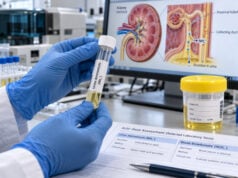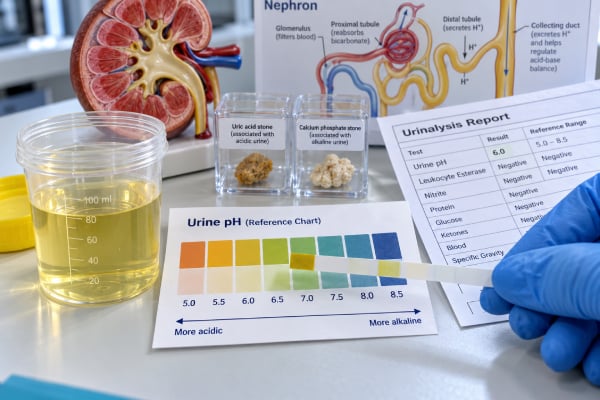
A urine pH test shows how acidic or alkaline urine is. It is a simple measurement, but its meaning depends heavily on context because urine pH changes with diet, hydration, medications, kidney acid handling, time of day, and some urinary infections. Most clinical laboratories use a broad reference interval around pH 4.5–8.0. A low pH can be a normal response when the body needs to excrete acid, but persistently acidic urine can increase the risk of uric acid stones. A high pH may occur after alkali intake, with some kidney acidification disorders, or when urease-producing bacteria raise urine pH during a urinary tract infection. Urine pH by itself does not diagnose an acid-base disorder, kidney stone type, or UTI. It becomes much more useful when read with blood bicarbonate, urine ammonium, urine culture, stone composition, urine volume, and other 24-hour urine measurements. Sample freshness and the measurement method also matter because urine pH can change after collection.
- A common urine pH reference interval is about 4.5–8.0, but one value can vary normally with meals, diet, and time of day.
- Persistently low urine pH, especially below about 5.5 in stone evaluation, favors uric acid crystallization.
- Persistently alkaline urine can favor calcium phosphate stones; very alkaline urine may also occur with urease-producing urinary infections and struvite stones.
- Urine pH above 8 can suggest bacterial contamination or a urea-splitting infection, but pH alone cannot diagnose a UTI.
- In metabolic acidosis, kidneys should normally lower urine pH; failure to acidify urine appropriately can suggest distal renal tubular acidosis when the full clinical picture fits.
Table of Contents
- What urine pH measures
- Normal range, testing methods, and sample timing
- What low urine pH can mean
- What high urine pH can mean
- Urine pH and kidney stone risk
- Urine pH, UTI, and urease-producing bacteria
- Acid-base balance and what to do next
What urine pH measures
Urine pH measures the concentration of free hydrogen ions in urine on a scale in which lower numbers are more acidic and higher numbers are more alkaline. A pH of 7 is neutral. Because the pH scale is logarithmic, a one-unit change represents about a tenfold change in hydrogen-ion activity.
The kidneys continuously help control the body’s acid-base balance. They reclaim filtered bicarbonate, generate new bicarbonate, secrete hydrogen ions, and excrete acid in buffered forms. Much of the acid leaves as ammonium and titratable acids such as phosphate. Urine pH reflects the concentration of free hydrogen ions, but it does not tell you the total amount of acid the kidneys excreted.
That distinction is important. Two people can have the same urine pH while excreting very different amounts of ammonium. One may be handling a large acid load normally by excreting abundant ammonium; another may have impaired ammonium production. For detailed acid-base assessment, urine pH is therefore one clue rather than a complete kidney acid-excretion test.
Diet strongly affects urine pH. Diets with a greater acid load, often including large amounts of animal protein, tend to lower urine pH. Diets rich in fruits and vegetables often provide more alkali precursors and can raise it. Meals also cause short-term shifts, so a random sample may differ from a fasting morning sample or a 24-hour average.
Medications and supplements can change urine pH deliberately or as a side effect. Potassium citrate and sodium bicarbonate alkalinize urine. Some drugs can contribute to renal tubular acidification problems. The result should always be interpreted with the medication list.
Urine pH also differs from blood pH. Blood pH is tightly regulated, while urine can vary across a much broader range as the kidneys dispose of acid or base. A normal urine pH does not prove that blood acid-base balance is normal.
Normal range, testing methods, and sample timing
A common laboratory reference interval for urine pH is 4.5–8.0. Mayo Clinic Laboratories lists that range for both random and 24-hour urine pH tests. The wide interval reflects the fact that normal kidneys can make urine quite acidic or alkaline depending on physiologic needs.
A reference interval should not be confused with a treatment target. In kidney stone care, clinicians may aim for a narrower pH range based on stone type. In acid-base testing, the key question may be whether urine becomes acidic enough during systemic acidosis. The same pH value can therefore be appropriate in one setting and clinically important in another.
Urine pH can be measured with reagent strips or more precisely with a pH electrode or meter. Dipsticks are convenient for routine urinalysis and home monitoring, but they report pH in steps and can differ from electrode measurements. Older comparative studies found clinically meaningful differences of more than 0.5 pH unit in a substantial minority of measurements. When medication dosing depends closely on pH, a clinician may recommend a specific strip or meter and a defined measurement schedule.
Freshness matters. Urine left standing can become more alkaline as carbon dioxide is lost and bacteria multiply. A very high pH in an old or poorly stored sample may therefore reflect specimen handling rather than the patient’s physiology. For 24-hour collections, the laboratory may require refrigeration or a specific preservative to keep the sample stable.
Spot and 24-hour values answer different questions. A spot urine pH captures one moment and may be useful during symptoms or for repeated home checks during alkalinization therapy. A 24-hour urine pH summarizes the full collection and is commonly used in metabolic stone evaluation. Because pH can swing during the day, the 24-hour average may hide short periods of very acidic or alkaline urine.
When collecting a 24-hour specimen, follow start and stop times exactly and store the container as directed. Do not add household substances to alter pH. If the laboratory rejects a sample because pH is unexpectedly above its stability limit, repeat collection may be necessary.
What low urine pH can mean
Low urine pH means the urine is relatively acidic. A low value can be completely appropriate when the kidneys need to remove acid. It becomes more informative when it is persistent, occurs with an abnormal blood acid-base state, or is linked to kidney stones.
Common contributors to acidic urine include a higher dietary acid load, fasting, dehydration, diarrhea with bicarbonate loss, and metabolic conditions associated with impaired ammonium buffering. Insulin resistance and metabolic syndrome are strongly associated with persistently low urine pH in uric acid stone formers.
In metabolic acidosis, normal kidneys should increase net acid excretion. One part of that response is lowering urine pH, often below about 5–5.5. A low pH in this setting can therefore be an appropriate kidney response rather than a disease marker. Blood chemistry, especially serum bicarbonate, is needed to establish whether systemic acidosis is present.
Chronic diarrhea is a useful example. Losing bicarbonate in stool creates an acid burden. If the kidneys are functioning normally, they respond by increasing ammonium excretion and making urine more acidic. This can also reduce urine citrate, creating a stone-promoting pattern.
Low pH is especially important in uric acid stone disease. Uric acid becomes less soluble as pH falls because more urate is converted to protonated uric acid. Current urolithiasis guidance considers a 24-hour urine pH below about 5.5 hyperacidic and notes that it can promote uric acid crystallization.
A single acidic urine reading does not prove that a person has a uric acid stone. Stone risk also depends on urine volume, uric acid excretion, supersaturation, diet, and other factors. If stones are recurrent, a structured 24-hour urine stone risk profile is far more informative than pH alone.
What high urine pH can mean
High urine pH means the urine is relatively alkaline. Common benign explanations include a recent meal, a plant-rich diet, prescribed alkali such as potassium citrate, or other changes in acid-base intake. Persistent alkalinity, however, can provide important clues.
One possibility is a distal renal acidification defect. In distal renal tubular acidosis, or dRTA, the collecting duct cannot lower urine pH appropriately despite systemic acid retention. Contemporary reviews describe classic dRTA as a failure to acidify urine below roughly pH 5.5 in the appropriate clinical setting. Blood bicarbonate is typically low in complete dRTA, and potassium abnormalities may also be present.
Urine pH alone cannot diagnose dRTA. A person without metabolic acidosis may normally have urine above 5.5. In addition, urinary infection can raise pH and must be excluded when evaluating an unexpectedly alkaline specimen. Specialized acidification testing is sometimes needed for incomplete forms of dRTA.
Persistently high urine pH can also increase the risk of calcium phosphate stones because phosphate species become more available for calcium phosphate crystallization as pH rises. This is one reason clinicians avoid simply pushing urine pH as high as possible when treating other stone types.
Very alkaline urine, especially above pH 8, raises another concern: urease-producing bacteria or sample contamination. Urease breaks urea into ammonia and related products that make urine alkaline. However, not every UTI causes alkaline urine, and alkaline urine does not prove infection.
Medicines may also contribute. Carbonic anhydrase inhibitors can raise urine pH while lowering citrate, a combination that may promote calcium phosphate stones in susceptible patients. Prescribed alkalinizing treatment intentionally raises pH and should be monitored according to the condition being treated.
When a high value seems unexpected, consider whether the sample was tested promptly. Bacterial growth in an old specimen can make pH rise after collection and may produce a misleading result.
Urine pH and kidney stone risk
Urine pH is one of the most important chemical controls over which crystals are likely to form. It does not act alone, but it changes mineral solubility enough that the same urinary concentrations can have different consequences at different pH levels.
| Urine pH pattern | Stone implication |
|---|---|
| Persistently low, often <5.5 | Strongly favors uric acid crystallization |
| Higher or persistently alkaline | Can increase calcium phosphate supersaturation |
| Very alkaline with urease-positive infection | Can promote struvite and carbonate apatite stones |
| Raised deliberately during cystinuria treatment | Improves cystine solubility, but requires controlled monitoring |
Uric acid stones are the clearest example of a pH-driven stone. A patient can form them without extreme hyperuricosuria if urine remains concentrated and strongly acidic. Raising urine pH with prescribed alkali can increase uric acid solubility and is a mainstay of treatment. For active dissolution, guideline targets can be higher than prevention targets, so dosing should be individualized rather than guessed from a generic “normal range.”
Calcium phosphate stones create the opposite problem. A higher pH favors calcium phosphate phases such as brushite and hydroxyapatite. If a patient with calcium stones is taking citrate, the clinician may balance the benefit of higher citrate against the possibility that excessive alkalinization increases calcium phosphate supersaturation.
Struvite stones are different again because infection drives the alkalinity. Urease-producing organisms generate ammonia, raise pH, and create conditions favoring magnesium ammonium phosphate crystallization. Treating the infection and addressing the stone are central; simply trying to change pH with diet is not enough.
A single dipstick pH cannot identify stone composition. Stone analysis, imaging, 24-hour urine chemistry, and clinical history provide the complete picture. If a stone has been passed or removed, laboratory analysis of the actual stone is often more useful than guessing from pH alone.
Urine pH, UTI, and urease-producing bacteria
Urine pH can support suspicion for a UTI in a narrow situation, but it is not a stand-alone infection test. Many common urinary pathogens do not produce enough urease to make urine markedly alkaline. A person can have a significant UTI with a pH well within the ordinary range.
The classic organism associated with alkaline urine is Proteus mirabilis. Its urease enzyme breaks down urea and produces ammonia, which raises urine pH. Other urease-producing organisms can do the same. Persistent infection with these organisms can promote struvite and carbonate apatite stones.
Mayo Clinic Laboratories notes that urine pH above 8 can suggest infection with a urea-splitting organism. But a pH above 8 can also occur when a specimen has been contaminated or left standing too long. That is why pH must be matched with symptoms and more specific urine testing.
If UTI is suspected, clinicians look for urinary symptoms and use urinalysis markers such as leukocyte esterase, nitrites, white blood cells, and bacteria. A urine culture can identify the organism and help guide antibiotic selection when culture is indicated.
Symptoms that raise concern include burning with urination, urinary frequency, urgency, suprapubic discomfort, and visible blood. Fever, chills, flank pain, vomiting, or systemic illness can suggest an upper urinary infection or obstruction and deserve prompt evaluation.
Alkaline urine plus a history of recurrent infection stones deserves particular attention. Infection stones can grow rapidly and may harbor bacteria within the stone, making complete treatment more complex than treating an uncomplicated bladder infection.
The practical rule is straightforward: high pH can be a clue to urease activity, but infection is diagnosed with the clinical picture and appropriate urine testing, not with pH alone.
Acid-base balance and what to do next
When urine pH is being used to investigate acid-base balance, the most important question is whether the kidney response is appropriate for the blood chemistry. Urine pH cannot be interpreted meaningfully without knowing whether the person is acidemic, alkalemic, or normal systemically.
In metabolic acidosis, normal kidneys should conserve bicarbonate and increase acid excretion. If urine remains inappropriately alkaline despite confirmed non-anion-gap metabolic acidosis, distal renal tubular acidosis becomes one consideration. Clinicians may then review serum potassium, kidney function, urine ammonium estimates, urine anion gap or osmolal gap in selected cases, medications, autoimmune disease, and stone history.
In metabolic alkalosis, urine pH can vary and may be less helpful by itself. Urine chloride often provides more actionable information about volume-responsive versus other causes of alkalosis. Acid-base disorders are therefore interpreted as patterns, not from a single urinalysis field.
For an unexpected urine pH result, these steps are practical:
- Check the sample conditions. Was it fresh, properly stored, and collected as instructed?
- Look for symptoms. Urinary symptoms, fever, flank pain, vomiting, or low urine output change the urgency and the likely causes.
- Review diet and medications. Alkali supplements, citrate, bicarbonate, high animal-protein intake, and certain prescription drugs can shift pH.
- Match the test to the question. Stone evaluation needs the broader urine chemistry profile; suspected UTI needs urinalysis and sometimes culture; acid-base disease needs blood electrolytes and bicarbonate.
- Use repeated measurements when appropriate. One random pH may not represent the daily pattern, especially during kidney stone prevention or alkalinization treatment.
Do not try to acidify or alkalinize urine aggressively with supplements based on one home strip. The desired pH depends on the disease, and overshooting can trade one stone risk for another or create electrolyte problems.
Seek prompt care for fever with flank pain, inability to urinate, severe persistent vomiting, confusion, or signs of serious dehydration. For a stable abnormal pH without urgent symptoms, the next step is usually to identify the clinical context rather than to “correct” the number itself.
References
- pH, 24 Hour, Urine 2026
- Metabolic Evaluation and Recurrence Prevention for Urinary Stone Patients: An EAU Guidelines Update 2024 (Guideline)
- The pathophysiology of distal renal tubular acidosis 2023 (Review)
- State of knowledge on ammonia handling by the kidney 2024 (Review)
- Urinary pH and antibiotics, choose carefully. A systematic review 2023 (Systematic Review)
- Beyond Infection: How Antimicrobial Therapies Influence the Urinary Microbiome and Stone Disease. 2025 (Review)
Disclaimer
Urine pH is a context-dependent measurement and cannot diagnose a UTI, renal tubular acidosis, or a kidney stone type by itself. Interpretation may require blood chemistry, urine culture, stone analysis, or a full 24-hour urine profile. Seek prompt medical care for fever with flank pain, inability to urinate, severe vomiting, or rapidly worsening symptoms.