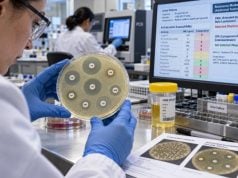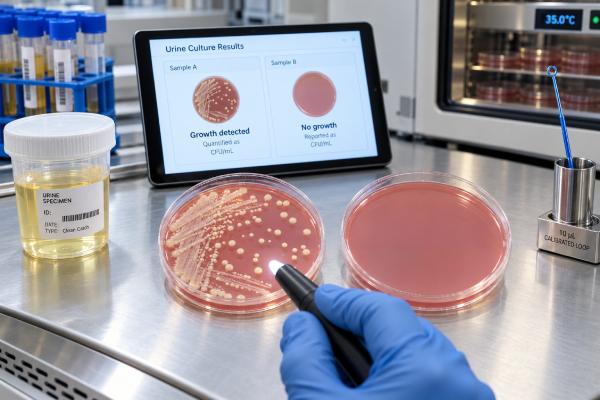
A urine culture checks whether bacteria or yeast grow from a urine sample and, when growth is significant, identifies the organism causing it. It is one of the most useful tests for confirming a urinary tract infection (UTI), especially when symptoms are severe, infections recur, pregnancy is involved, treatment has failed, or antibiotic resistance is a concern. A culture result is not interpreted by the word “positive” alone. The organism, colony count, sample type, symptoms, urinalysis findings, and whether more than one organism grew all matter. A high colony count of a typical urinary pathogen in a person with urinary symptoms strongly supports infection, while mixed growth or low-level growth may reflect contamination. Results commonly take 24–72 hours because organisms need time to grow and undergo identification and susceptibility testing. A clinician uses the result together with symptoms, not as a stand-alone diagnosis.
- A positive urine culture means an organism grew, but it does not always mean a symptomatic UTI is present.
- Colony counts are reported as CFU/mL; clinically meaningful thresholds vary with symptoms, sample method, and patient group.
- A negative culture lowers the likelihood of a typical bacterial UTI but does not exclude every urinary infection or noninfectious cause of symptoms.
- “Mixed flora” often points to sample contamination, especially in a midstream clean-catch specimen.
- Culture plus susceptibility testing can help choose an antibiotic when treatment is needed.
Table of Contents
- What a urine culture shows
- How the sample is collected
- Positive and negative results
- Colony count and significant growth
- Bacteria, yeast, and mixed flora
- Susceptibility and antibiotic choice
- When results need follow-up
- Questions about culture results
What a urine culture shows
A urine culture answers a different question from a routine urinalysis. Urinalysis looks for signs such as white blood cells, leukocyte esterase, nitrite, blood, and bacteria seen by microscopy. Culture attempts to grow living microorganisms from the specimen. If growth occurs, the laboratory can identify the organism and often determine which antibiotics inhibit it.
The most common bacterial cause of community UTIs is Escherichia coli. Other possible pathogens include Klebsiella, Proteus, Enterococcus, Staphylococcus saprophyticus, and several less common organisms. The meaning depends on the clinical setting. A person with burning urination, urgency, frequency, and suprapubic discomfort has a different pretest probability than someone whose urine was cultured despite having no urinary symptoms.
Culture is particularly valuable for complicated infection, pyelonephritis, recurrent UTI, pregnancy, infections in men, recent antibiotics, urinary catheters, known urinary tract abnormalities, or failure of initial treatment. For a broader look at how screening and confirmatory tests fit together, see the UTI test panel.
A culture does not directly show where an infection is located. Growth can occur with bladder infection, kidney infection, asymptomatic bacteriuria, or colonization around a urinary device. Symptoms, vital signs, exam findings, and sometimes blood tests or imaging establish the full picture. This is why a laboratory report may be microbiologically “positive” while a clinician decides that antibiotics are not indicated.
Asymptomatic bacteriuria is an important example. It means bacteria are present in urine without symptoms attributable to a UTI. In many nonpregnant adults, treating asymptomatic bacteriuria does not improve outcomes and can expose the person to adverse effects and antibiotic resistance. Important exceptions include certain pregnancy situations and selected urologic procedures, where screening and treatment can be appropriate.
How the sample is collected
The quality of the specimen strongly affects culture accuracy. A midstream clean-catch sample is common: the person begins urinating, then collects urine partway through the stream in a sterile container. The goal is to reduce contamination from skin and genital organisms. A dedicated clean-catch urine culture guide explains why technique matters.
For people who cannot provide a reliable voided sample, urine may be collected through a newly placed catheter or, less commonly, by suprapubic aspiration. These methods change how colony counts are interpreted because catheter-obtained urine generally has less contamination than a voided sample.
Whenever possible, collect the urine before starting an antibiotic. Even one or two doses can reduce bacterial growth and lead to a false-negative or lower-count culture. If treatment must start immediately because a person is very ill, clinicians often obtain the sample first and then give antibiotics without waiting for the result.
Fresh urine should reach the laboratory promptly. If transport is delayed, laboratories may refrigerate the specimen or use a preservative because bacteria can multiply at room temperature and distort the count. The exact handling process varies by laboratory.
Menstrual blood, vaginal discharge, poor collection technique, touching the inside of the cup, or collecting the first part of the urinary stream can increase contamination. A contaminated sample may still contain a true pathogen, but interpretation becomes harder. Repeating the test is often more useful than trying to make a treatment decision from an unclear result.
If a patient has an indwelling catheter, samples should generally be obtained from the sampling port using appropriate technique rather than from the drainage bag. Long-term catheters commonly become colonized with bacteria, so a positive culture is expected over time and should be interpreted in relation to symptoms and clinical signs.
Positive and negative results
A positive culture usually means the laboratory recovered a potentially significant organism. The report may name one species and provide a quantity, such as 50,000 or 100,000 CFU/mL. It may also report “greater than 100,000 CFU/mL,” “mixed flora,” or a qualitative description such as no growth.
A positive result is most convincing when three elements align: urinary symptoms are compatible with infection, the urinalysis shows inflammation or bacteriuria, and the culture grows a plausible urinary pathogen. A positive culture without symptoms may be asymptomatic bacteriuria rather than a UTI. Conversely, symptoms with a low colony count can still represent infection, particularly when a single typical pathogen is found in a properly collected specimen.
A negative culture means no clinically significant organism grew under the laboratory’s conditions. It makes a typical bacterial UTI less likely, but it is not absolute proof that infection is absent. Reasons for a negative culture despite symptoms include prior antibiotic exposure, very low bacterial numbers, fastidious organisms that do not grow well on routine media, unusually dilute urine, a specimen obtained early in infection, or an alternative diagnosis.
Common non-UTI explanations for urinary burning or urgency include vaginal infections, urethritis from sexually transmitted infections, kidney stones, bladder pain syndrome, irritation from products, pelvic floor problems, and genitourinary syndrome of menopause. If symptoms persist despite a negative culture, repeating the same test indefinitely is usually less useful than reassessing the diagnosis.
A result of “no growth” should also be considered alongside how the sample was obtained. A culture collected after antibiotics is less informative than one obtained before treatment. In recurrent or complicated cases, clinicians may consider specialized methods or molecular testing, but these tests can detect organisms that are not actually causing disease. The urine PCR test therefore needs the same symptom-based context.
Colony count and significant growth
Colony count estimates the concentration of viable organisms and is usually expressed as colony-forming units per milliliter, or CFU/mL. A traditional threshold of 100,000 CFU/mL (10^5 CFU/mL) has long been associated with significant bacteriuria in clean-catch urine, but modern practice does not treat that value as a universal cutoff.
In symptomatic patients, lower counts of a single typical uropathogen can be clinically meaningful. Research definitions and laboratory reporting practices vary, with thresholds ranging from 10^3 to 10^5 CFU/mL in different settings. Catheter specimens and samples from men or children may also use different criteria. The point is that colony count is a probability signal, not a switch that turns infection “on” at exactly 100,000.
| Culture pattern | Typical interpretation | What may happen next |
|---|---|---|
| No growth | Typical bacterial UTI less likely | Reassess symptoms, timing, antibiotics, and alternatives |
| Single uropathogen at a substantial count | Supports UTI when symptoms fit | Use susceptibility data if treatment is needed |
| Single organism at a lower count | Can still be meaningful in a symptomatic patient | Interpret with sample type and urinalysis |
| Multiple organisms or mixed flora | Often contamination in clean-catch urine | Repeat collection if the result will change care |
| Yeast | May represent colonization or fungal UTI | Assess risk factors, symptoms, and instrumentation |
The laboratory may suppress exact counts below a reporting threshold or may group results into categories. A clinician therefore should not assume that two laboratories use identical criteria. For a focused explanation of quantity, see urine colony count and CFU.
Repeated cultures can also differ because bacterial concentration changes with hydration, bladder dwell time, collection quality, and recent antibiotics. A single number should not be interpreted with false precision.
Bacteria, yeast, and mixed flora
When one recognized urinary pathogen grows in a compatible clinical setting, interpretation is usually straightforward. When two or more organisms grow, the report may describe “mixed flora,” “mixed urogenital flora,” or several colony types. In a voided specimen, that pattern often reflects contamination from organisms near the urethra, vagina, or skin.
Contamination becomes more likely when epithelial cells are abundant on urinalysis, the collection was difficult, or several organisms grow without one clear predominant pathogen. If symptoms are significant and the result is unclear, a repeat carefully collected specimen can be more informative. The distinction is discussed in more detail in urine culture contamination.
Some organisms need special context. Staphylococcus saprophyticus is a recognized cause of uncomplicated cystitis, especially in younger women. Enterococcus can be clinically important but may not produce nitrite on a dipstick. Proteus species can raise urine pH and are associated with certain infection stones. Hospitalized or catheterized patients may grow more resistant gram-negative organisms or multiple species.
Yeast, most often Candida, is different from common bacterial UTI. Candiduria is frequent in people with urinary catheters, diabetes, recent antibiotics, or hospitalization. It often represents colonization rather than tissue infection. If yeast is reported, the urine fungal culture context can help distinguish a finding that needs attention from one that may not require antifungal therapy.
A positive culture also cannot determine whether bacteria originated in the bladder or kidney. Fever, flank pain, chills, nausea, vomiting, low blood pressure, or systemic illness raise concern for upper-tract infection or sepsis and require clinical assessment rather than relying on the culture report alone.
Susceptibility and antibiotic choice
When a clinically significant bacterial isolate is identified, the laboratory may perform antimicrobial susceptibility testing. This is the “sensitivity” portion of a culture and sensitivity test. The report may categorize each tested antibiotic as susceptible, intermediate or susceptible with increased exposure, or resistant, depending on the standard used by the laboratory.
“Susceptible” does not automatically mean an antibiotic is the best choice. The drug also needs to reach the infected site, be appropriate for the type of UTI, fit the person’s allergies and kidney function, and have an acceptable safety profile. For example, an antibiotic appropriate for bladder infection may not be suitable for suspected kidney infection because tissue penetration differs.
“Resistant” means the organism is unlikely to respond reliably at standard exposure. If a person has already started treatment and the final culture shows resistance, the clinician may change therapy. If symptoms have already resolved, management can be more nuanced and depends on infection type and patient risk.
Some laboratories test only selected antibiotics based on the organism, local protocols, or antimicrobial stewardship rules. They may also infer resistance mechanisms from the susceptibility pattern. Molecular resistance genes, by contrast, indicate genetic markers and do not perfectly substitute for phenotypic susceptibility. That distinction is important when interpreting newer rapid tests.
The linked urine culture and sensitivity test explains how organism identification and susceptibility categories are combined. Final treatment should target a symptomatic infection rather than simply “sterilizing” a urine culture when no treatment indication exists.
When results need follow-up
Follow-up depends on symptoms, risk factors, and what the report shows. A routine uncomplicated bladder infection that improves promptly may need no repeat culture. A repeat or “test-of-cure” culture is more likely to be considered when symptoms persist or recur, during pregnancy in selected circumstances, or when a clinician is managing a complicated infection.
Seek prompt medical care for fever with urinary symptoms, flank or back pain, repeated vomiting, shaking chills, confusion, rapidly worsening illness, inability to keep fluids down, or signs of low blood pressure. These can signal kidney infection or systemic infection. Pregnant people, young children, older adults with acute systemic symptoms, immunocompromised patients, and people with urinary obstruction or recent procedures may also need faster assessment.
If a report says “mixed flora,” do not assume it proves infection or that a broad antibiotic is required. Ask whether the specimen should be repeated. If the report is positive but there are no urinary symptoms, ask whether asymptomatic bacteriuria is being considered and whether the person belongs to a group in which treatment is recommended.
If symptoms continue but culture is negative, the next step should be guided by the symptom pattern. Testing for sexually transmitted infections, evaluation for vaginal causes, imaging for a stone, or assessment for bladder pain may be more useful than repeated empiric antibiotics. Recurrent episodes should also prompt attention to whether each prior episode was culture-confirmed and whether the same organism keeps returning.
A urine culture is most useful when it answers a specific clinical question: Is there convincing growth? Which organism is present? Does the quantity fit the sample and symptoms? What antibiotics are active if treatment is necessary? Reading the result in that order prevents both missed infections and unnecessary treatment.
Questions about culture results
A culture can change after treatment begins, so timing matters. If the specimen was collected after an antibiotic dose, tell the clinician; a low colony count or no growth may be harder to interpret. Also ask whether a preliminary result is final. Laboratories may first report growth, then update the organism identification and susceptibility a day later.
If symptoms improve before the final report arrives, the culture still has value. It can confirm that the chosen drug is active, reveal resistance that may require a change, or show that the original diagnosis should be reconsidered. If symptoms worsen despite a “susceptible” organism, clinicians may reassess adherence, drug absorption, kidney involvement, obstruction, or an alternative diagnosis rather than relying only on the laboratory category.
References
- Novel technologies for the diagnosis of urinary tract infections 2025 (Review)
- Urinary Tract Infections: Core Curriculum 2024 2024 (Review)
- Diagnostic stewardship for urinary tract infection: A snapshot of the expert guidance 2022 (Review)
- The EFLM European Urinalysis Guideline 2023 2024 (Guideline)
- Performance of Urinalysis Parameters in Predicting Urinary Tract Infection: Does One Size Fit All? 2024 (Review)
Disclaimer
This article provides general information about urine culture testing and is not a diagnosis or treatment plan. Culture results should be interpreted with symptoms, sample type, medical history, and local laboratory standards. Seek urgent medical care for severe or rapidly worsening symptoms, especially fever, flank pain, vomiting, confusion, or signs of sepsis.