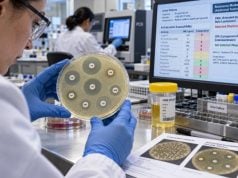
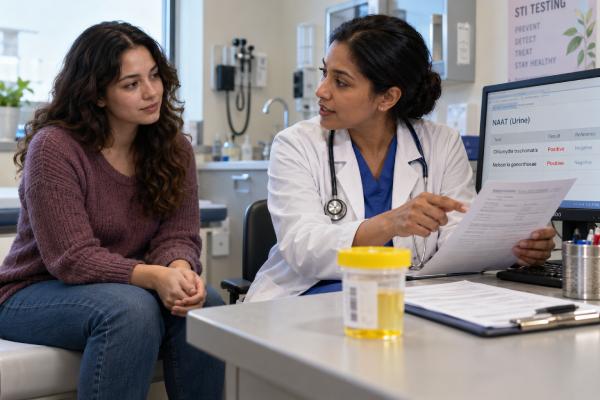
A chlamydia and gonorrhea urine NAAT checks urine for genetic material from Chlamydia trachomatis and Neisseria gonorrhoeae, two common bacterial sexually transmitted infections (STIs). NAAT stands for nucleic acid amplification test. These tests are highly sensitive and can detect infection even when there are no symptoms. For people with a penis, first-catch urine is often an excellent specimen for urethral infection. For people with a vagina, urine can be used, but a vaginal swab is usually more sensitive for genital chlamydia and gonorrhea. Urine also has an important limitation: it only samples the urogenital tract. A negative urine test does not rule out infection in the throat or rectum after oral or anal exposure. A positive result usually means the organism’s nucleic acid was detected and treatment is needed, but follow-up depends on the organism, pregnancy status, infection site, symptoms, and whether reinfection or treatment failure is a concern.
- A urine NAAT detects chlamydia and gonorrhea genetic material; it does not measure a bacterial colony count like a urine culture.
- First-catch urine, not a midstream clean-catch sample, is generally used for genital chlamydia and gonorrhea NAAT testing.
- A negative urine result does not exclude rectal or throat infection when those sites were exposed.
- Vaginal swabs are generally more sensitive than urine for genital chlamydia and gonorrhea testing in people with a vagina.
- After treatment, routine test-of-cure is not needed in every case, but retesting for reinfection is commonly recommended about 3 months later.
Table of Contents
- What the Urine NAAT Detects
- Who Should Be Tested and Which Sites Matter
- How to Collect a Urine NAAT Sample
- How to Read Positive, Negative, and Inconclusive Results
- What Happens After a Positive Result
- Test of Cure, Retesting, and Persistent Positive Results
- When Urinary Symptoms Need More Than an STI NAAT
What the Urine NAAT Detects
A nucleic acid amplification test detects small amounts of DNA or RNA from a target organism and amplifies that genetic signal so the laboratory can identify it. Modern NAATs are the preferred laboratory method for diagnosing most genital chlamydia and gonorrhea infections because they are more sensitive than older non-amplified tests and can work with noninvasive specimens such as urine.
A combined test usually reports Chlamydia trachomatis and Neisseria gonorrhoeae separately. A person can be positive for one, both, or neither. The result is generally qualitative—detected or not detected—rather than a measurement of how many organisms are present.
That is different from a bacterial urine culture. A routine urine culture grows common urinary bacteria, reports colony-forming units, and may include antibiotic susceptibility testing. It is designed mainly for urinary tract infections. Chlamydia does not grow on a standard urine culture, and routine culture methods are not the preferred screening test for gonorrhea.
NAATs are very accurate, but “detected” means nucleic acid was found; it does not directly prove that living organisms are still present at that moment. This distinction matters after treatment because residual nucleic acid can remain temporarily and make a repeat NAAT positive even after the infection has been cleared.
Gonorrhea also has a special resistance issue. A NAAT can diagnose N. gonorrhoeae, but standard NAATs generally do not provide the full antimicrobial susceptibility information that a live isolate can provide. If gonorrhea treatment failure is suspected, clinicians may collect a culture from the infected site so the organism can undergo susceptibility testing.
Who Should Be Tested and Which Sites Matter
Chlamydia and gonorrhea are often asymptomatic, so testing is not limited to people with burning, discharge, pelvic pain, or testicular pain. Screening recommendations vary by country, age, anatomy, pregnancy status, sexual practices, local prevalence, and individual risk.
In the United States, current CDC screening guidance includes annual chlamydia and gonorrhea screening for sexually active women younger than 25 and for women 25 or older who have increased risk. Pregnancy adds specific screening and follow-up recommendations. Men who have sex with men are generally screened at least annually at sites of sexual contact, with testing every 3–6 months in some higher-risk situations. Other people may be tested because of symptoms, a partner’s diagnosis, a new exposure, or local screening guidance.
The specimen site is as important as the test itself. A urine specimen mainly evaluates urethral or urogenital infection. It does not reliably represent the throat or rectum.
For example:
- receptive oral sex can expose the throat to gonorrhea or chlamydia;
- receptive anal sex can expose the rectum;
- genital exposure can lead to urogenital infection;
- infection can be present at one site while another site tests negative.
A 2025 rapid review found that extragenital infection can occur without a urogenital infection, which explains why a negative urine NAAT can miss clinically relevant infection when the wrong site is sampled. Testing should therefore match the person’s anatomy and sites of exposure rather than relying on urine as a universal STI screen.
For people with a vagina, vaginal swabs are generally the optimal urogenital specimen. A 2023 meta-analysis found pooled sensitivity for vaginal swabs versus urine of 94.1% versus 86.9% for chlamydia and 96.5% versus 90.7% for gonorrhea. Patient-collected vaginal swabs can perform well and are often acceptable to patients.
For people with a penis, first-catch urine is a standard specimen for urethral chlamydia and gonorrhea NAAT testing. If symptoms or exposure suggest another STI, testing may also include syphilis and HIV blood tests or a Trichomonas test depending on the clinical setting.
How to Collect a Urine NAAT Sample
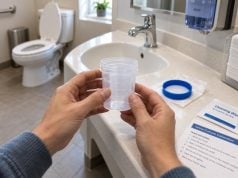
Urine STI testing uses a different collection method from the familiar midstream sample used for many UTI evaluations. Most chlamydia and gonorrhea urine NAATs use first-catch or first-void urine because the first portion of the urine stream is most likely to collect cells and secretions from the urethra.
The exact instructions depend on the laboratory and NAAT platform, so the kit directions take priority. Common steps include:
- Follow any instruction about how long not to urinate before collection. Some laboratories ask for at least 1 hour, while requirements vary by assay.
- Begin urinating directly into the specimen cup rather than urinating into the toilet first.
- Collect only the amount requested, often the first roughly 20–30 mL rather than filling a large cup.
- Close the container without touching its inner surface.
- Return the sample promptly or place it in the transport system specified by the laboratory.
Do not substitute “clean-catch midstream” technique unless the laboratory specifically instructs you to do so. For a clean-catch urine culture, the goal is to reduce urethral and skin contamination by discarding the first part of the stream. For an STI urine NAAT, that first portion is the part most useful for detecting urethral chlamydia and gonorrhea.
Over-diluting the sample can also reduce the concentration of target material. Drinking an unusually large amount of water immediately before testing or filling the cup with a large volume of urine may not follow the assay’s validated collection method. The laboratory’s volume and timing instructions matter more than a generic urine-test rule.
Recent antibiotic use is another useful detail to tell the clinician. Antibiotics can alter infection and test interpretation. Testing very soon after treatment is especially important because NAAT may still detect nonviable organisms even when viable bacteria are no longer present.
Menstruation usually does not automatically prevent NAAT testing, and many assays can process specimens despite small amounts of blood. However, visible blood, collection difficulties, or assay-specific restrictions should be discussed with the testing site.
How to Read Positive, Negative, and Inconclusive Results
A typical laboratory report lists each organism separately. Wording varies by platform: “positive,” “detected,” or “reactive” may indicate that target nucleic acid was found, while “negative” or “not detected” means it was not found above the assay’s detection threshold in that specimen.
| Result | Usual meaning | Important limitation |
|---|---|---|
| Chlamydia detected | C. trachomatis nucleic acid was found | The result does not show how long infection has been present |
| Gonorrhea detected | N. gonorrhoeae nucleic acid was found | A routine NAAT does not provide full culture-based drug susceptibility |
| Not detected | No target was detected in the collected specimen | Does not exclude infection at an untested throat or rectal site |
| Invalid or inconclusive | The assay could not provide a reliable answer | A new specimen may be required |
A true positive usually warrants treatment even if there are no symptoms because untreated chlamydia or gonorrhea can be transmitted and can cause complications. Chlamydia can contribute to pelvic inflammatory disease, infertility, and epididymitis. Gonorrhea can cause similar local complications and, less commonly, disseminate to joints, skin, or other sites.
A negative result is only as informative as the specimen and timing. Testing too early after a very recent exposure may occur before enough organism is present to detect reliably. There is no single universally reliable “window period” for every NAAT platform and exposure, so a clinician may recommend repeat testing when the exposure was very recent or symptoms develop despite an initial negative result.
An invalid result is not the same as a negative result. It can occur because of an insufficient specimen, an inhibitory substance, a processing problem, or another assay-specific issue. The usual response is recollection rather than assuming there is no infection.
False positives are uncommon with validated NAATs, but no diagnostic test is perfect. In a situation with a very low pretest probability or a result that conflicts strongly with the clinical context, a laboratory or clinician may consider repeat or confirmatory testing according to the assay and local guidance. A repeat test should not be used casually to dismiss a plausible positive result.
What Happens After a Positive Result
A positive chlamydia or gonorrhea result should lead to timely clinical management. The exact antibiotic regimen depends on the organism, infection site, pregnancy status, drug allergies, local resistance guidance, and national recommendations. Gonorrhea treatment is particularly sensitive to antimicrobial-resistance trends, so current local guidance matters.
The clinician will usually also consider testing for other STIs. A person with chlamydia should commonly be offered gonorrhea, HIV, and syphilis testing if not already performed. The same broader STI assessment often follows a gonorrhea diagnosis.
Sex partners also matter. Reinfection commonly occurs when partners are not evaluated or treated. Partner-management rules vary by jurisdiction and clinical setting, but recent sexual partners are generally advised to obtain evaluation and treatment. Some regions allow expedited partner therapy in appropriate situations.
People treated for chlamydia or gonorrhea are generally advised to avoid sexual activity until treatment has had time to work and partners have been treated. CDC guidance advises abstaining for 7 days after single-dose therapy or until completion of a 7-day regimen, and until sex partners have been treated. A clinician may give more specific advice based on the regimen and infection site.
Symptoms that persist after treatment deserve reassessment. Persistent burning or discharge does not automatically mean the same infection survived. Reinfection, another STI, nongonococcal urethritis, prostatitis, vaginitis, pelvic inflammatory disease, or a urinary infection can cause overlapping symptoms. In persistent urethritis, clinicians may consider a Mycoplasma genitalium evaluation when appropriate.
Gonorrhea has an additional reason for culture after suspected treatment failure: antimicrobial susceptibility. Because NAAT detects genetic material but generally does not produce a live isolate, a culture is needed when clinicians must determine whether viable N. gonorrhoeae remains and how it responds to antibiotics.
Test of Cure, Retesting, and Persistent Positive Results
“Test of cure” and “retesting for reinfection” are different. A test of cure asks whether treatment eradicated the original infection. Retesting later looks for a new or repeat infection, which is common after either chlamydia or gonorrhea.
For uncomplicated chlamydia in nonpregnant people who received recommended treatment, routine test of cure is generally not advised unless adherence is uncertain, symptoms persist, or reinfection is suspected. Testing with a chlamydia NAAT less than 4 weeks after treatment is discouraged because residual nucleic acid from nonviable organisms can produce a positive result.
Pregnancy is different. CDC guidance recommends a chlamydia test of cure by NAAT at about 4 weeks after treatment because persistent infection can affect both the pregnant patient and newborn. Retesting at about 3 months is also recommended.
For uncomplicated urogenital or rectal gonorrhea treated with a recommended or alternative regimen, routine test of cure is generally unnecessary. Pharyngeal gonorrhea is the important exception in CDC guidance: a test of cure is recommended 7–14 days after treatment. Testing at the earlier end of that window can increase the chance of a positive NAAT from residual nucleic acid, and a positive NAAT should prompt confirmatory culture when feasible before retreatment.
Regardless of routine test-of-cure rules, both chlamydia and gonorrhea carry a substantial reinfection risk. CDC recommends retesting about 3 months after treatment. This is not because the first treatment is expected to fail; repeat infections often come from an untreated partner or a new infected partner.
A persistently positive result therefore has several possible explanations:
- the repeat NAAT was performed too soon after treatment;
- treatment was not completed or absorbed as intended;
- the person was reinfected;
- the infection was at an additional untreated site;
- gonorrhea treatment failure or antimicrobial resistance is possible;
- the original or follow-up specimen needs confirmation.
The right response depends on timing and context. Repeatedly testing at short intervals without clinical interpretation can create confusion, especially because molecular tests can detect genetic material after organisms are no longer viable.
When Urinary Symptoms Need More Than an STI NAAT
Chlamydia and gonorrhea can cause burning with urination, urethral discharge, pelvic pain, spotting, testicular pain, or no symptoms at all. These symptoms overlap with urinary tract infections and other genital conditions, so an STI NAAT is sometimes only one part of the evaluation.
A standard UTI test panel may include urinalysis and urine culture when cystitis or kidney infection is possible. A person can also have an STI and a UTI at the same time. Finding leukocyte esterase or white blood cells on urinalysis does not identify which condition is responsible because urethritis and other genital inflammation can produce pyuria.
Site-specific symptoms also guide testing. Rectal pain, discharge, bleeding, or tenesmus may require a rectal swab. Throat exposure may justify a pharyngeal swab for gonorrhea. Pelvic pain with fever, pain during sex, or abnormal bleeding can raise concern for pelvic inflammatory disease, which requires prompt clinical assessment rather than waiting for a urine test alone.
Seek urgent medical care for severe pelvic or abdominal pain, high fever, repeated vomiting, fainting, severe testicular pain or swelling, pregnancy with concerning symptoms, or signs of disseminated infection such as fever with a new rash or joint pain. These presentations need examination and sometimes imaging, blood tests, or hospital treatment.
For routine screening, the most useful question is not simply “Can I give urine?” but “Which specimen tests the sites that were actually exposed?” Urine NAAT is convenient and highly useful for urogenital chlamydia and gonorrhea, especially for urethral infection. Accurate screening comes from pairing the right NAAT with the right anatomical site, following collection instructions, and interpreting follow-up tests according to treatment timing.
References
– Review of the Performance of Laboratory-Based Molecular Diagnostics for Chlamydia trachomatis and Neisseria gonorrhoeae 2026 (Systematic Review) – Guidelines for the management of asymptomatic sexually transmitted infections 2025 (Guideline) – 2025 European guideline on the management of Chlamydia trachomatis infections 2025 (Guideline) – Updated recommendations for the treatment of Neisseria gonorrhoeae, Chlamydia trachomatis, and Treponema pallidum (syphilis) and new recommendations on syphilis testing and partner services 2024 (Guideline) – Vaginal Swab vs Urine for Detection of Chlamydia trachomatis, Neisseria gonorrhoeae, and Trichomonas vaginalis: A Meta-Analysis. 2023 (Meta-Analysis) – Chlamydial Infections – STI Treatment Guidelines 2021 (Guideline)
Disclaimer
This article provides general information about chlamydia and gonorrhea NAAT testing and is not a diagnosis or treatment plan. STI screening, specimen sites, treatment, partner management, and follow-up vary by individual circumstances and local guidance. Seek prompt medical care for severe pelvic or testicular pain, high fever, pregnancy-related concerns, or symptoms of disseminated infection.