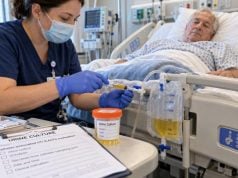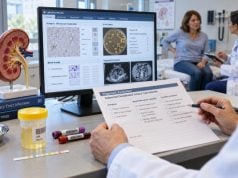
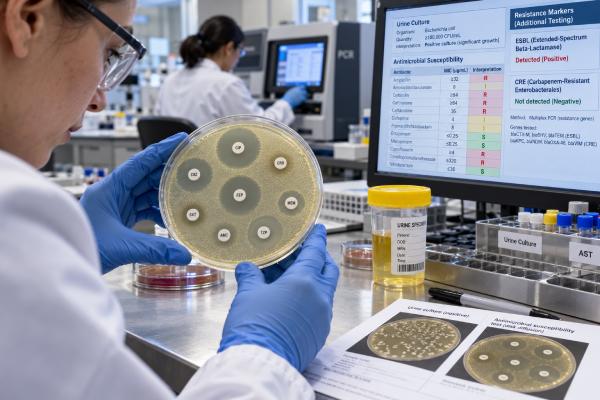
An antibiotic-resistant UTI test is not one single test. It usually starts with a urine culture that identifies the bacterium and then adds antimicrobial susceptibility testing to show which antibiotics are likely to work. Some laboratories also use molecular tests to detect resistance genes, especially when a serious infection or a highly resistant organism is suspected. Terms such as ESBL and CRE describe important resistance patterns in Enterobacterales such as Escherichia coli and Klebsiella pneumoniae. A resistant result does not automatically mean the infection is untreatable, but it can narrow the antibiotic choices and make correct interpretation more urgent. The result also has to be matched with symptoms, sample quality, infection location, kidney function, allergies, prior cultures, and recent antibiotic exposure. In a person who is very ill, treatment may begin before the full culture is final and then be adjusted when organism identification and susceptibility results return.
- A resistant UTI culture means the isolated bacterium is not reliably inhibited by one or more antibiotics at standard exposure levels.
- ESBL usually signals resistance to many penicillins and cephalosporins, while CRE means an Enterobacterales organism has carbapenem resistance or a carbapenemase mechanism.
- Culture plus susceptibility testing is the key test for choosing targeted treatment; a resistance-gene result does not replace the full clinical picture.
- Preliminary culture information may appear within about 24 hours, while final identification and susceptibility commonly take about 48–72 hours, depending on the laboratory and organism.
- Fever, flank pain, vomiting, confusion, low blood pressure, or worsening illness with a resistant organism can require urgent medical assessment.
Table of Contents
- What an Antibiotic-Resistant UTI Test Shows
- ESBL, CRE, and Resistance Markers
- How to Read Culture and Susceptibility Results
- Molecular Resistance Testing and PCR
- What Resistant Results Mean for Treatment
- Contamination, Colonization, and False Alarms
- Follow-Up and When to Get Help
What an Antibiotic-Resistant UTI Test Shows
The main purpose of testing is to answer two separate questions: what organism is present, and which antibiotics are active against it? A standard urine culture and sensitivity test does this by growing organisms from the urine, identifying clinically important growth, and testing the isolate against selected antimicrobial drugs.
A culture report may include the organism name, colony count, one or more antibiotics, and an interpretation such as susceptible, intermediate, susceptible-dose dependent, or resistant. Laboratories use standardized breakpoints that relate laboratory measurements such as the minimum inhibitory concentration, or MIC, to the drug exposure expected in patients. The MIC is the lowest tested concentration that inhibits visible bacterial growth. It is not a dose recommendation, and lower MIC numbers cannot be compared casually between unrelated antibiotics because each drug has different breakpoints and pharmacology.
Resistant UTI testing becomes especially important when there is a history of prior resistant cultures, recent hospitalization, a urinary catheter, repeated antibiotic use, recurrent infection, structural urinary problems, or a severe infection such as pyelonephritis or sepsis. These factors increase the chance that the usual first-choice antibiotic may not cover the organism.
Testing also helps avoid unnecessary broad-spectrum treatment. Once the organism and susceptibilities are known, clinicians can often move from a broad empiric antibiotic to a narrower agent that specifically covers the isolate. This is an important part of antimicrobial stewardship because unnecessary broad-spectrum exposure can cause adverse effects, disrupt the microbiome, and select for additional resistance.
A positive culture by itself does not prove that symptoms are caused by a UTI. The result must be interpreted alongside symptoms, urinalysis findings, collection method, and patient risk factors. A related urine culture result may be clinically meaningful in one person and represent colonization or contamination in another.
ESBL, CRE, and Resistance Markers
ESBL and CRE describe different but sometimes overlapping resistance problems. Both are most often discussed with Enterobacterales, a large group of gram-negative bacteria that includes common urinary pathogens such as E. coli and Klebsiella species.
What ESBL means
ESBL stands for extended-spectrum beta-lactamase. These are enzymes that can break down many beta-lactam antibiotics, including many penicillins, third-generation cephalosporins, and aztreonam. ESBL-producing organisms often carry additional resistance mechanisms as well, so resistance may extend beyond beta-lactam drugs.
Many laboratories do not issue a separate “ESBL positive” result for every isolate. Instead, the susceptibility pattern may suggest an ESBL mechanism, and the final report focuses on which drugs test susceptible or resistant. Current standards and guidance have evolved over time, so the exact reporting language can differ by laboratory.
ESBL production does not mean every antibiotic will fail. Some urinary isolates remain susceptible to non-beta-lactam drugs, and certain infections may be treatable with oral options if susceptibility is confirmed. For infections involving the kidneys, bloodstream, or systemic illness, drug penetration and illness severity become more important than a bladder-only infection.
What CRE means
CRE stands for carbapenem-resistant Enterobacterales. Carbapenems are powerful beta-lactam antibiotics often reserved for serious or resistant infections. A CRE isolate may be resistant because it produces a carbapenemase enzyme or because several other mechanisms combine to reduce carbapenem activity.
Carbapenemases are particularly important because the exact enzyme can affect which newer antibiotics work. Examples include KPC, NDM, VIM, IMP, and OXA-48-like enzymes. A laboratory may identify the resistance phenotype first and then perform additional molecular or biochemical testing to determine whether a carbapenemase is present.
The difference matters clinically. For example, a newer beta-lactam/beta-lactamase inhibitor may be active against one carbapenemase family but not another. This is why a report that identifies the specific mechanism can be more useful than a generic “resistant” label in a severe CRE infection.
| Term | What it generally means | Why it matters |
|---|---|---|
| ESBL | Enzyme that inactivates many penicillins and cephalosporins | May rule out several routine beta-lactam choices |
| CRE | Enterobacterales with clinically important carbapenem resistance | Can substantially narrow treatment options |
| KPC | A serine carbapenemase | Can guide selection among newer active agents |
| NDM/VIM/IMP | Metallo-beta-lactamase families | Many standard beta-lactamase inhibitors do not block them |
| OXA-48-like | Carbapenemase family with a distinct activity pattern | Mechanism-specific drug activity matters |
How to Read Culture and Susceptibility Results
Start with the organism, colony count, and whether the specimen appears clean enough to trust. Then read the susceptibility panel. If you need more background on growth quantity, the urine colony count test explains why colony-forming units, or CFU, are interpreted differently depending on symptoms and collection method.
The most common susceptibility categories are:
- Susceptible: The organism is expected to respond when the drug is used at the recommended exposure for the infection and patient.
- Intermediate: The meaning depends on the testing standard. It may indicate uncertain response, a need for higher exposure, or the possibility that a drug could still work at a body site where it concentrates well.
- Susceptible-dose dependent: Success depends on a dosing regimen that achieves higher drug exposure than a standard regimen.
- Resistant: The organism is not expected to be reliably inhibited at clinically achievable exposure.
Do not choose an antibiotic based only on the largest “susceptible” list. The drug still has to reach the infected site. An agent that concentrates in the bladder may be useful for lower UTI but inappropriate for suspected kidney infection or bacteremia. Kidney function, drug allergies, pregnancy, drug interactions, age, and adverse-effect risks can also change the safest option.
Prior cultures matter. A recent urine isolate that was resistant to a particular antibiotic makes that drug less attractive for empiric treatment before the new susceptibility report is available. The 2025 IDSA complicated UTI guidance also emphasizes recent antibiotic exposure and local antibiograms when choosing empiric therapy in higher-risk patients.
The culture result should also be matched to the clinical syndrome. A resistant E. coli at a significant count in a person with dysuria, frequency, and pyuria is different from the same organism found in a person without urinary symptoms. Likewise, mixed organisms in a poorly collected specimen may reflect contamination rather than a resistant polymicrobial infection.
Susceptibility panels are selective rather than exhaustive. A laboratory may suppress certain drugs when another result makes them clinically redundant, when the organism is intrinsically resistant, or when stewardship rules discourage reporting a broader agent that is not needed. Conversely, a report may add confirmatory testing when an unusual pattern suggests a carbapenemase or another important mechanism. If a familiar antibiotic is missing from the report, that does not necessarily mean the laboratory forgot to test it. Clinicians can often ask the microbiology laboratory whether additional testing is appropriate, especially when allergies, renal impairment, pregnancy, or resistance leave few practical options.
Molecular Resistance Testing and PCR
Molecular tests look for microbial DNA or RNA rather than waiting for organisms to grow. Some panels identify common urinary pathogens and resistance genes in hours. A urine PCR test for UTI can therefore provide faster clues when a rapid decision is important.
The advantage is speed. A molecular test may detect a gene associated with an ESBL or carbapenemase before a conventional culture has completed susceptibility testing. In a critically ill patient, that information can help clinicians avoid an antibiotic that is very unlikely to work.
The limitation is that a resistance gene is not the same as a complete susceptibility profile. Several issues can complicate interpretation:
- The panel can detect only the genes it was designed to find.
- A detected gene may not predict resistance to every drug in a class with perfect accuracy.
- Resistance may occur through mechanisms not included on the panel.
- DNA detection can sometimes identify organisms or genes even when the clinical significance is uncertain.
- Molecular testing usually does not provide the broad phenotypic susceptibility information that culture-based testing can provide.
For these reasons, molecular results are often best used as an early supplement rather than an automatic replacement for culture. The UTI test panel approach is useful because urinalysis, culture, susceptibility, and clinical assessment answer different parts of the diagnostic question.
Some hospitals also perform carbapenemase testing for infection-control reasons. A confirmed carbapenemase-producing organism may trigger additional precautions because these resistance genes can spread between bacteria and can contribute to healthcare-associated transmission.
What Resistant Results Mean for Treatment
The safest antibiotic is chosen from the intersection of three things: the organism’s susceptibility pattern, the infection site, and the patient’s clinical condition. A resistant result narrows options, but it does not mean there are no effective treatments.
For a lower UTI confined to the bladder, some resistant Enterobacterales may remain susceptible to oral agents. For pyelonephritis or complicated UTI, clinicians need drugs that reach kidney tissue and, when relevant, the bloodstream. A person with sepsis may need immediate intravenous therapy before final results are available.
Current IDSA guidance for antimicrobial-resistant gram-negative infections distinguishes treatment by organism and resistance mechanism. For ESBL-producing Enterobacterales, confirmed susceptibility can allow selected non-beta-lactam agents in some urinary infections, while carbapenems and other agents may be needed when suitable oral drugs are inactive, unsafe, or inappropriate. For CRE, mechanism-specific newer beta-lactam agents may be preferred in serious infections, especially when common oral options are not active.
The culture can also support de-escalation. Suppose a patient begins a broad intravenous antibiotic because resistant infection is possible. Two days later, culture shows an organism susceptible to a narrower oral drug, the patient is improving, and there is no reason to suspect poor absorption. The clinician may switch to the narrower drug rather than finish the entire course with the broadest agent.
Antibiotic duration is a separate decision. A “resistant” organism does not automatically require a longer course. Duration depends on the infection syndrome, clinical response, source control, and the drug used. In 2025 guidance, many improving complicated UTIs can be treated with shorter courses than the traditional 10–14 days, although important exclusions and patient-specific factors remain.
Never interpret a susceptibility report as a self-treatment menu. Doses differ with kidney function and infection severity, and some drugs that appear active in the laboratory are unsuitable for certain body sites. If the report shows a highly resistant organism, treatment decisions are often best made with the clinician managing the infection and, for difficult cases, an infectious diseases specialist.
Contamination, Colonization, and False Alarms
Not every resistant organism found in urine needs antibiotics. This is one of the most important safeguards against unnecessary treatment.
Contamination occurs when bacteria from skin, the genital area, or the collection container enter the sample. Mixed flora, several organisms without a dominant pathogen, or a poor clean-catch technique can make the result difficult to interpret. The urine culture contamination article covers why a repeat specimen is sometimes more useful than treating a questionable result.
Colonization or asymptomatic bacteriuria means bacteria are present in the urine without symptoms attributable to a UTI. In many nonpregnant adults, treating asymptomatic bacteriuria does not improve outcomes and can increase adverse effects and resistance. Important exceptions include pregnancy and certain invasive urologic procedures, where screening or treatment may be recommended.
People with long-term urinary catheters frequently develop bacteriuria because biofilm forms on the catheter. A positive culture from a catheterized patient therefore does not automatically establish catheter-associated UTI. Symptoms and proper specimen collection matter. When catheter-associated infection is suspected, a catheter urine culture needs to be interpreted in that context.
A false alarm can also occur when a molecular panel detects resistance DNA without enough clinical context to show that the gene belongs to the organism causing symptoms. Conversely, culture can miss an organism if antibiotics were started before collection or if the organism is difficult to grow. No single result should be interpreted in isolation.
Follow-Up and When to Get Help
Follow-up depends on symptoms and the resistance pattern. For an uncomplicated lower UTI, improvement often begins within the first few days of effective therapy. If symptoms are not improving, worsen, or return soon after treatment, a repeat assessment may be needed to check adherence, susceptibility, obstruction, stones, an abscess, an alternative diagnosis, or recurrent infection with the same or a new organism.
A routine “test of cure” is not necessary after every UTI. Repeat culture is more useful when symptoms persist or recur, in pregnancy when recommended, or in selected complicated situations. The post-treatment urine culture test can help explain when repeat testing adds value.
Seek urgent medical care for possible upper-tract infection or sepsis, especially with:
- Fever with shaking chills or rapidly worsening illness
- Flank or back pain with urinary symptoms
- Repeated vomiting or inability to keep fluids or medicines down
- Confusion, faintness, severe weakness, or very low blood pressure
- Pregnancy with fever or suspected kidney infection
- A urinary obstruction, kidney transplant, severe immune suppression, or recent urologic procedure with systemic symptoms
If the culture reports ESBL, CRE, a carbapenemase, or extensive multidrug resistance, keep a copy of the result. Prior susceptibility information can help guide future empiric treatment, especially if a new infection occurs before the next culture is final. It is also worth telling clinicians about recent antibiotics and prior resistant isolates because those details can materially change the first treatment choice.
References
- IDSA 2026 Guidance on the Treatment of Antimicrobial Resistant Gram-Negative Infections 2026 (Guideline)
- Infectious Diseases Society of America 2026 Guidance on the Treatment of Antimicrobial-Resistant Gram-Negative Infections 2026 (Guideline)
- IDSA 2025 Guideline Update on Complicated Urinary Tract Infections 2025 (Guideline)
- Clinical Practice Guidelines by Infectious Diseases Society of America: 2025 Guideline on Management and Treatment of Complicated Urinary Tract Infections–Selection of Antibiotic Therapy for Complicated Urinary Tract Infections 2025 (Guideline)
- Infectious Diseases Society of America 2024 Guidance on the Treatment of Antimicrobial-Resistant Gram-Negative Infections 2024 (Guideline)
Disclaimer
This article is for general education and does not replace medical diagnosis or treatment. Antibiotic selection for resistant UTIs depends on the organism, susceptibility results, infection site, kidney function, allergies, pregnancy status, and illness severity. Seek urgent medical care for severe or rapidly worsening symptoms, especially fever with flank pain, vomiting, confusion, or signs of sepsis.