A clean-catch urine culture is designed to collect bladder urine while limiting bacteria and cells picked up from the skin, urethral opening, or genital area. The usual method is a midstream sample: begin urinating, collect urine partway through the stream in a sterile cup, then finish in the toilet. The culture can identify a urinary pathogen, estimate bacterial growth, and often provide antibiotic susceptibility results. Collection quality matters because contamination can produce “mixed flora,” confusing colony counts, unnecessary repeat testing, or antibiotics that are not needed. Yet clean-catch instructions are not identical everywhere. Evidence suggests that elaborate cleansing does not always lower contamination in adults, while correct midstream collection and proper handling remain important. The sample also needs timely transport because bacteria can multiply if urine sits too long at room temperature. A useful result therefore depends on three stages: ordering the test for a valid reason, collecting the specimen correctly, and interpreting the culture alongside symptoms and urinalysis findings.
- A clean-catch culture usually uses midstream urine collected in a sterile container without touching the inside of the cup or lid.
- Do not use antiseptic cleansers unless specifically instructed; they can inhibit bacterial growth and are not routinely required for adults.
- Mixed flora often suggests contamination, but the meaning depends on the organisms, quantities, specimen type, and clinical setting.
- If processing will be delayed, laboratories may require prompt refrigeration or a validated preservative to prevent bacterial overgrowth.
- A contaminated culture may need to be repeated, and a straight-catheter specimen can sometimes provide a clearer result when repeated clean-catch samples are unreliable.
Table of Contents
- What a Clean-Catch Urine Culture Is For
- How to Collect a Midstream Clean-Catch Sample
- Cleansing, Menstruation, and Common Collection Questions
- Transport, Storage, and Why Timing Matters
- How Contamination Appears on a Culture Report
- When to Repeat the Culture or Use Another Method
- How to Get the Most Accurate Result
What a Clean-Catch Urine Culture Is For
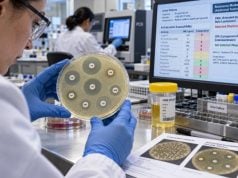
A urine culture is used when a clinician needs to know whether clinically important microorganisms are growing in urine. The laboratory inoculates a measured amount of urine onto culture media, identifies organisms that grow, estimates their concentration in colony-forming units per milliliter (CFU/mL), and may test antibiotic susceptibility when a likely pathogen is present.
The clean-catch method tries to make a voided specimen better represent urine from the bladder. Urine passes through the urethra and near skin and genital surfaces during collection. These areas normally carry microorganisms that are not causing a urinary infection. If too many of those organisms enter the cup, the laboratory may not be able to tell whether a true urinary pathogen is present.
A clean-catch culture is commonly used for suspected cystitis, recurrent urinary symptoms, pregnancy screening in settings where asymptomatic bacteriuria testing is recommended, and situations in which treatment should be guided by susceptibility results. It may also be used when a simple dipstick or urinalysis is not enough to answer the clinical question.
The culture should not be ordered automatically for every cloudy urine sample or every abnormal urinalysis. A urinalysis for UTI can show leukocyte esterase, nitrites, white blood cells, and bacteria, but those findings do not always mean a symptomatic infection. Unnecessary cultures can detect colonization and lead to unnecessary antibiotics.
The final report may include one predominant organism, no significant growth, mixed growth, or several organisms. It may also include a urine culture sensitivity result for antibiotics. The laboratory result becomes most useful when the specimen was collected well and the clinician knows the patient’s symptoms, pregnancy status, recent antibiotics, and relevant urinary history.
How to Collect a Midstream Clean-Catch Sample
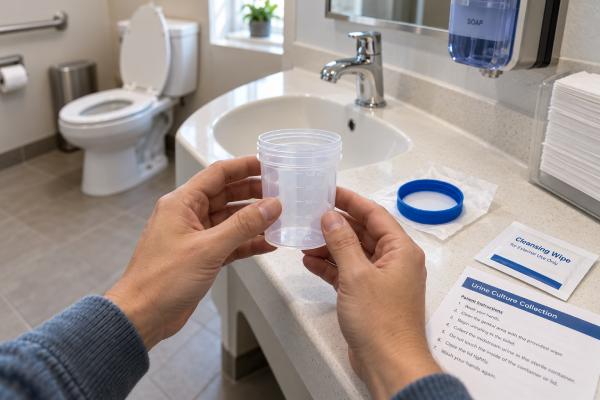
Always follow the collection kit or laboratory instructions first because details can vary. For a typical adult midstream sample, the goal is to avoid collecting the first urine that washes over the urethral opening and to keep fingers or surrounding skin away from the sterile interior of the cup.
A practical sequence is:
- Wash and dry your hands.
- Open the sterile container without touching the inside of the cup or lid.
- If instructed, position the genital area so urine can pass into the cup without touching nearby skin. People with a vulva may be asked to hold the labia apart; people with a penis may be asked to retract the foreskin if present and comfortable.
- Begin urinating into the toilet.
- Without stopping the stream, move the cup into position and collect the requested amount of midstream urine.
- Finish urinating into the toilet.
- Close the lid tightly and label the specimen as instructed.
- Return the sample promptly using the laboratory’s transport directions.
The cup does not need to be filled to the top unless the collection system specifically says so. A small to moderate amount is usually sufficient for culture, but preservative tubes or containers may need a particular volume to maintain the correct urine-to-preservative ratio.
Try not to let the rim of the cup touch the skin. Do not set the lid with its inner surface facing down on a counter. Do not transfer urine from a household container unless the laboratory has explicitly provided or approved that method.
The midstream approach differs from the first-catch method used for some sexually transmitted infection NAATs. A chlamydia and gonorrhea urine NAAT often needs the first portion of urine because it samples urethral material. For a routine bacterial culture, midstream collection is usually preferred to reduce contamination.
Cleansing, Menstruation, and Common Collection Questions
Many people have been told that a “clean-catch” sample requires aggressive cleansing. In adults, evidence is more nuanced. Studies and modern guidance have found that routine perineal cleansing does not consistently reduce contamination compared with careful midstream collection. The UK primary-care guidance specifically advises against antiseptic cleansing because antiseptics can inhibit bacterial growth.
If the collection kit includes a wipe, follow the kit’s directions. If it does not, do not improvise with disinfectants, alcohol, iodine, or household antibacterial products. Plain hygiene and correct positioning are usually more important than sterilizing the skin, which is not realistically possible.
For people with a vulva, holding the labia apart during collection may help keep the urine stream away from nearby skin and vaginal secretions. For people with a penis, collecting midstream urine rather than the first void can reduce contamination. These are practical measures rather than guarantees; even a carefully collected specimen can be contaminated.
Menstruation does not always make urine culture impossible, but blood and vaginal material can complicate interpretation. If the test is routine and can safely wait, the laboratory or clinician may suggest collecting after heavy bleeding has stopped. If symptoms are significant, pregnancy is involved, or the result is urgently needed, do not delay care without asking. The testing site can advise on the best collection method.
Vaginal discharge, incontinence, limited mobility, and difficulty controlling the urine stream can also make clean-catch collection harder. In these situations, tell the clinician or laboratory rather than trying repeatedly without guidance. A more controlled method may be useful if an accurate culture is important.
Recent antibiotics are another key issue. If possible and clinically safe, a culture for suspected UTI is usually collected before starting a new antibiotic because treatment can suppress growth and produce a lower colony count or false-negative result. Never postpone urgent treatment for severe illness solely to obtain an ideal sample.
Transport, Storage, and Why Timing Matters
Collection does not end when the lid is closed. Urine is a biological specimen, and microorganisms can multiply after collection if the sample is left warm for too long. That can raise colony counts and turn a small amount of contaminating bacteria into what appears to be clinically important growth.
Current UK guidance recommends culturing urine within about 4 hours of collection or using refrigeration or an approved boric acid preservative when processing is delayed. Laboratory protocols vary, so the collection site’s instructions should control. Some laboratories use transport tubes with preservatives that maintain the specimen during transit.
Preservative containers need the correct fill volume. Too little urine in a boric acid container can make the preservative concentration too high and may inhibit organisms, creating a misleadingly low count or false-negative culture. That is why the fill line matters if one is marked.
Refrigeration slows bacterial multiplication, but do not freeze the sample unless a laboratory specifically tells you to. A specimen should also be protected from leaking, mislabeled containers, and long periods in a hot car or bag.
Timing can also affect the relationship between culture and symptoms. A specimen collected after several doses of antibiotics may no longer reflect the organism that triggered the illness. Conversely, a sample collected long after symptoms have resolved may detect asymptomatic bacteriuria rather than an infection that needs treatment.
Good transport is part of diagnostic accuracy. A perfectly collected specimen can still become unreliable if it is stored incorrectly, and a well-preserved specimen cannot fully compensate for heavy contamination during collection. If a sample cannot reach the laboratory within the stated window, ask whether a refrigerated specimen or a new collection is preferable rather than guessing.
How Contamination Appears on a Culture Report
Contamination occurs when organisms from outside the bladder enter the specimen during collection. Laboratories may report this as “mixed flora,” “mixed urogenital flora,” “multiple organisms,” or a similar phrase. The exact laboratory criteria differ.
A mixed result often means that several organisms grew without a clear dominant urinary pathogen. In a 2025 study of adult women in urogynecology clinics, mixed flora occurred in 33.1% of midstream urine cultures compared with 4.7% of straight-catheter cultures. This does not mean every mixed culture is meaningless, but it shows how strongly collection method can affect the result.
A dedicated urine culture contamination result should be interpreted with the symptoms and specimen type. In an uncomplicated clean-catch specimen, several low-level organisms often point toward contamination. In contrast, true polymicrobial infection is more plausible in some patients with long-term catheters, urinary reconstruction, or complicated urinary anatomy.
Squamous epithelial cells on urinalysis are sometimes used as a clue that a specimen contacted skin or genital surfaces, but they are not a perfect contamination marker. A 2025 study evaluating quality indicators found that laboratory markers need context rather than being treated as an absolute pass/fail rule.
The colony count adds information but is not a universal truth threshold. A urine colony count may be reported as 10³, 10⁴, 10⁵ CFU/mL, or in descriptive categories. Historically, 10⁵ CFU/mL became a common benchmark, but symptomatic infection can occur at lower counts, especially when a typical uropathogen grows in a well-collected specimen.
A single organism at a substantial count plus compatible symptoms is generally more convincing than several low-level organisms in an asymptomatic person. However, laboratories use their own reporting rules, and pregnancy, catheter status, sex, urinary anatomy, and recent treatment can change interpretation.
| Culture pattern | Possible interpretation | Common next step |
|---|---|---|
| One typical uropathogen with compatible symptoms | Supports UTI when count and context fit | Use susceptibility results to guide therapy when needed |
| Mixed flora in a voided specimen | Often contamination | Repeat if the result is needed for management |
| No growth after antibiotics | Could be true negative or treatment-suppressed growth | Interpret timing and reconsider diagnosis |
| Positive culture without symptoms | May be asymptomatic bacteriuria | Treat only when a guideline-supported indication exists |
When to Repeat the Culture or Use Another Method
A repeat specimen is useful when the first culture cannot answer the clinical question. Common reasons include mixed flora, a specimen that leaked or was stored incorrectly, a colony count that conflicts with strong symptoms, or persistent symptoms despite a result reported as negative or contaminated.
When repeating a clean-catch sample, correct the likely source of error rather than simply doing the same thing again. Review the collection steps, use a new sterile container, collect midstream urine, and make sure transport is prompt. If the first sample was collected during heavy vaginal bleeding or from a container that touched skin, those details may be avoidable on the second attempt.
Some patients repeatedly produce contaminated voided specimens despite careful technique. If an accurate culture is important, a clinician may use a straight catheter urine specimen. A temporary catheter passes into the bladder and allows urine to be collected with less contamination from the external genital area. It is more invasive and therefore is not necessary for every routine culture.
The 2025 collection-method study illustrates the tradeoff: straight-catheter samples had much less mixed flora than midstream samples in that clinical population. Yet catheterization can cause discomfort, minor urethral trauma, and a small infection risk, so the decision depends on how important a definitive specimen is.
Persistent urinary symptoms with repeated negative cultures also call for a broader diagnostic review rather than endless reculturing. Conditions such as sexually transmitted infections, stones, vaginitis, prostatitis, interstitial cystitis/bladder pain syndrome, medication irritation, or upper-tract disease can resemble a lower UTI.
A repeat culture is especially important when symptoms recur soon after treatment and the clinician needs to distinguish relapse, reinfection, or resistance. In that setting, a clean specimen collected before the next antibiotic dose can be much more informative than treating empirically without microbiology.
How to Get the Most Accurate Result
Accuracy starts before collection. A culture is most informative when there is a clear reason to order it. Diagnostic-stewardship research shows that cultures obtained without urinary symptoms or another specific indication often detect bacteriuria that should not be treated.
For the patient, the most useful checklist is straightforward:
- use the sterile container provided;
- follow the laboratory’s exact instructions rather than a generic internet method;
- collect midstream urine unless told otherwise;
- avoid touching the inside of the cup or lid;
- do not add antiseptics or other substances;
- provide the requested volume, especially when a preservative container is used;
- label the specimen correctly;
- transport or refrigerate it as directed;
- tell the clinician about recent antibiotics, pregnancy, catheters, and prior resistant urine cultures.
For the clinician, the result should be read together with symptoms and the urinalysis. A bacteria-in-urine result is not automatically a UTI, and a high colony count is not automatically an indication for antibiotics if the patient is asymptomatic.
Seek prompt medical care rather than focusing on collection technique if urinary symptoms occur with fever, shaking chills, flank pain, repeated vomiting, pregnancy with systemic symptoms, inability to urinate, severe weakness, or signs of sepsis. Those features can indicate kidney infection, obstruction, or another complication that needs timely assessment.
The clean-catch method is simple but not trivial. Its value comes from reducing avoidable contamination without making collection so complicated that patients cannot perform it. Good instructions, a sterile container, true midstream collection, and correct transport usually provide the best balance between practicality and laboratory accuracy.
References
– The EFLM European Urinalysis Guideline 2023 2024 (Guideline) – Rate of Urine Culture Contamination with Different Methods of Urine Specimen Collection 2025 – Quality indicators for urine sample contamination: can squamous epithelial cells and bacteria count be used to identify properly collected samples? 2025 – Diagnostic Stewardship for Urine Cultures 2024 (Review) – Polymicrobial urine cultures: reconciling contamination with the urobiome while recognizing the pathogens 2025 (Review) – Prevalence and predictors of urine culture contamination in primary care: A cross-sectional study 2022
Disclaimer
This article provides general information about clean-catch urine collection and culture interpretation. Collection instructions and transport requirements vary by laboratory, so follow the directions provided with your test. Seek medical advice for persistent urinary symptoms and urgent care for fever with flank pain, severe illness, pregnancy-related concerns, urinary obstruction, or signs of sepsis.