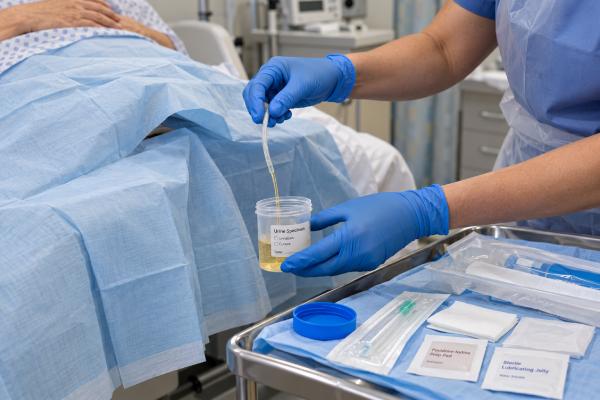
A straight catheter urine test collects urine directly from the bladder through a thin sterile tube that is inserted through the urethra and removed as soon as the sample is obtained. It is often used when a clean-catch specimen cannot be collected reliably, when repeated voided samples are contaminated, or when clinicians need a lower-contamination specimen to evaluate a possible urinary tract infection. The catheter itself does not diagnose UTI. The sample is usually sent for urinalysis and, when indicated, urine culture with antibiotic susceptibility testing. Because the catheter bypasses much of the skin and genital contamination that can affect voided urine, the result may be easier to interpret. However, catheterization is invasive, can cause brief discomfort or minor urethral irritation, and has a small risk of introducing bacteria. The decision to use it should therefore balance diagnostic value against invasiveness.
- A straight catheter specimen comes directly from the bladder, which usually lowers contamination compared with a voided sample.
- It is most useful when a clean-catch sample is unreliable, impossible to obtain, or repeatedly reports mixed flora.
- The sample can be used for urinalysis and urine culture, including bacterial identification, colony count, and antibiotic susceptibility.
- Any bacterial growth needs clinical context: symptoms, pyuria, collection method, and colony count all affect interpretation.
- Straight catheterization is brief but invasive: temporary burning, urethral irritation, and a small risk of iatrogenic infection or trauma are possible.
Table of Contents
- What a Straight Catheter Urine Test Is
- When Catheterized Urine Is Used
- How the Sample Is Collected
- How Results Are Interpreted
- Contamination Risk and Accuracy
- Risks, Discomfort, and Aftercare
- Straight Catheter vs Other Urine Samples
What a Straight Catheter Urine Test Is
A straight catheter urine test, also called an in-and-out catheter specimen, is a method of obtaining urine rather than a separate laboratory test. A sterile catheter is passed through the urethra into the bladder, urine is allowed to drain into a sterile container, and the catheter is then removed. Unlike an indwelling Foley catheter, a straight catheter does not remain in place.
The collected urine may undergo several tests. A rapid urinalysis can check leukocyte esterase, nitrite, white blood cells, red blood cells, bacteria, protein, and other markers. A culture can identify bacteria or yeast and measure growth, while susceptibility testing can show which antibiotics are likely to work. The laboratory result should indicate that the specimen was catheterized because colony-count interpretation depends partly on collection method.
The main advantage is specimen quality. A voided urine stream passes through the urethral opening and can pick up organisms from nearby skin or genital tissue. Straight catheterization reduces that exposure by collecting from inside the bladder. It does not make contamination impossible, but it can make a confusing culture easier to interpret.
This test is particularly relevant when a previous clean-catch urine culture showed mixed organisms or when the patient cannot produce a controlled midstream sample. It may also be used in young children, people with limited mobility, severe illness, urinary retention, pelvic organ prolapse, or neurologic bladder conditions.
Straight catheterization should not be confused with obtaining urine from an existing indwelling catheter. With a Foley catheter, urine for culture is generally collected aseptically from the sampling port according to protocol, not from the drainage bag. The biofilm that forms on long-term catheters creates a different interpretation problem from a one-time straight catheter specimen.
When Catheterized Urine Is Used
Clinicians usually choose the least invasive collection method that can provide a reliable answer. For many adults, a midstream voided specimen is adequate. Straight catheterization becomes more useful when the chance of contamination is high or when the person cannot provide a usable sample.
Common reasons include:
- repeated “mixed flora” cultures that do not clearly identify a pathogen;
- inability to void on request despite needing timely testing;
- urinary retention or very limited bladder emptying;
- severe illness or disability that makes clean-catch collection impractical;
- incontinence that prevents a controlled midstream sample;
- pelvic organ prolapse, obesity, limited mobility, or other circumstances that make clean-catch technique difficult;
- infants or young children when a sterile specimen is needed for culture;
- a need to clarify whether bacteria seen in a voided specimen represent bladder infection or contamination.
A straight catheter sample can be especially helpful when treatment decisions depend on a reliable culture. For example, a symptomatic patient may have a voided culture reported as “mixed urogenital flora.” Repeating the test by catheter can reduce contamination and may reveal a single urinary pathogen that can undergo susceptibility testing.
The test should not be ordered merely because urine looks cloudy, smells strong, or shows bacteria in a person without symptoms. Urine culture stewardship matters because asymptomatic bacteriuria is common in some populations and unnecessary testing can lead to unnecessary antibiotics. A positive culture should be connected to a clinical reason for testing.
In recurrent UTI, a catheterized sample may help when previous cultures are repeatedly contaminated. The broader recurrent UTI test panel still relies on symptoms and culture over time; catheterization simply improves sample quality when voided specimens are unreliable.
How the Sample Is Collected
Straight catheter urine collection is usually performed by a trained clinician using sterile or aseptic technique. Exact steps vary by setting, age, anatomy, and local policy, but the process is typically brief.
The person is positioned so the urethral opening can be accessed. The clinician performs hand hygiene, uses appropriate gloves and sterile supplies, cleans the urethral area according to protocol, lubricates the catheter, and gently advances it into the bladder. Once urine flows, enough is collected for the ordered tests. The catheter is then removed.
The specimen is labeled with the collection method and sent promptly to the laboratory. Timing matters because bacteria can multiply in urine left at room temperature, artificially increasing colony counts. If immediate transport is not possible, laboratories use refrigeration or validated preservative systems according to their procedures.
The sample itself may be split for:
- dipstick urinalysis;
- microscopic urinalysis;
- urine culture;
- antibiotic susceptibility testing if significant bacterial growth occurs;
- less commonly, specialized tests ordered for a specific diagnostic question.
For culture, only a small amount of urine is actually plated in the microbiology laboratory. The lab uses a calibrated method to estimate how many colony-forming units are present per milliliter. That quantitative result is then interpreted with the organism identity and the fact that the specimen came from a catheter rather than a voided stream.
Antibiotics should ideally be given after the specimen is obtained when the patient’s condition allows. Prior antibiotic exposure can suppress growth and make a culture falsely negative or reduce the colony count. In a seriously ill patient, however, urgent treatment should not be dangerously delayed just to obtain a perfect sample.
Patients generally do not need to fast or change fluid intake specifically for catheterized urine collection unless another test requires it. Excessive fluid loading immediately beforehand is usually unnecessary and can dilute urine. The clinic may ask about latex allergy, urethral injury, recent urologic surgery, or other factors that affect catheter choice or safety.
How Results Are Interpreted
A catheterized specimen is cleaner than many voided samples, but the diagnosis of UTI still requires clinical interpretation. The strongest pattern is compatible urinary symptoms plus pyuria and growth of a plausible uropathogen.
Urinalysis findings may include positive leukocyte esterase, increased white blood cells, nitrite, microscopic bacteria, and sometimes blood. None of these findings is completely specific. Pyuria can occur with inflammation from causes other than bacterial UTI, while a negative nitrite does not rule out infection.
The urine colony count is reported as CFU/mL or in a semiquantitative category. Historically, 100,000 CFU/mL has been widely used as a threshold for significant bacteriuria in voided urine, but lower counts may be clinically meaningful in symptomatic patients, especially when the specimen is catheterized and grows a single typical pathogen. Laboratories and clinical guidelines may use different reporting thresholds, so the number should not be interpreted in isolation.
A culture report may show:
| Result | Possible interpretation |
|---|---|
| Single uropathogen + pyuria + symptoms | Supports UTI when the clinical picture fits |
| No growth | UTI becomes less likely, but prior antibiotics or unusual organisms can reduce culture yield |
| Low-count single organism | May still be important in a symptomatic catheterized specimen |
| Several organisms or mixed flora | May indicate contamination, although true polymicrobial infection is possible in selected complicated cases |
| Positive culture without symptoms | May represent asymptomatic bacteriuria rather than infection requiring treatment |
If a pathogen grows, a culture and sensitivity report may classify antibiotics according to expected activity. Treatment still depends on infection site, kidney function, allergies, pregnancy, prior resistance, drug interactions, and local guidance.
Contamination Risk and Accuracy
Straight catheterization generally reduces contamination because urine is collected directly from the bladder and has less contact with surrounding skin and genital flora. A 2025 study in a urogynecology population found substantially higher odds of contamination with midstream urine than with straight-catheter specimens. That does not mean every patient needs catheterization; it means catheterization can be valuable when contamination is already a significant diagnostic problem.
Contamination can still occur if sterile technique is broken, the catheter touches nonsterile surfaces, collection equipment is mishandled, or the specimen is stored improperly. Interpretation errors can also occur even with a technically clean sample. For example, detecting bacteria in an asymptomatic person is not the same as diagnosing UTI.
Squamous epithelial cells are often used as a clue that a voided specimen may contain genital contamination. A catheterized sample typically has fewer such cells, but no single urinalysis marker definitively proves or excludes contamination. The culture pattern, collection method, symptoms, and organism identity matter more.
A confusing urine culture contamination result is one of the strongest reasons to consider a repeat specimen by a more controlled method. If a catheterized repeat culture is negative while the voided sample showed mixed flora, contamination becomes more likely. If the catheterized sample grows one predominant uropathogen that fits the symptoms, the result is more persuasive.
Accuracy also depends on preanalytic handling. Culture specimens should be delivered to the laboratory promptly or preserved according to laboratory instructions. Warm urine sitting for prolonged periods can allow bacterial overgrowth and falsely increase colony counts. Delays can therefore turn a good collection into a misleading result.
Risks, Discomfort, and Aftercare
Straight catheterization is usually quick, but it is not risk-free. Most people experience pressure or brief burning during insertion. Mild urethral soreness or a small amount of blood can occur afterward, especially if the urethra is irritated or the procedure is technically difficult.
Potential complications include:
- temporary urethral discomfort or burning with the next few voids;
- minor urethral bleeding;
- urethral trauma or creation of a false passage, which is uncommon with gentle technique but more concerning when resistance is encountered;
- introduction of bacteria into the urinary tract;
- rarely, a subsequent symptomatic UTI.
The risk of infection is one reason straight catheterization is used selectively rather than as the default for every urine test. Aseptic technique, appropriate catheter size, adequate lubrication, and avoiding unnecessary repeated catheterization help reduce complications.
After the procedure, most people can resume normal activity immediately. Drinking normally and voiding when needed is generally sufficient. Seek medical advice if there is persistent heavy bleeding, inability to urinate, severe urethral or pelvic pain, fever, or new urinary symptoms that worsen rather than improve.
People with known urethral strictures, recent urethral reconstruction, major pelvic trauma, or suspected urethral injury may need a different collection plan. Forcing a catheter against resistance can cause harm, so difficult catheterization should be managed by appropriately trained clinicians.
Straight Catheter vs Other Urine Samples
The “best” urine sample depends on the clinical problem. Straight catheterization offers a useful middle ground between a convenient voided sample and the more invasive suprapubic aspiration.
| Collection method | Main advantage | Main limitation |
|---|---|---|
| Midstream clean catch | Noninvasive, easy, usually adequate for cooperative adults | More vulnerable to genital and skin contamination |
| Straight catheter | Lower contamination and direct bladder sample | Invasive; causes discomfort and small infection/trauma risk |
| Suprapubic aspiration | Very low contamination because urine is obtained directly through the abdominal wall into the bladder | More invasive and used only in selected situations |
| Indwelling catheter port | Allows sampling in a person who already has a Foley catheter | Biofilm and colonization complicate interpretation; never use drainage-bag urine for culture |
In adults who can give a good voided specimen, clean catch is often reasonable. In patients with repeated contamination, inability to void reliably, or a high-stakes need for a clearer culture, straight catheterization can improve confidence in the result. In very young children, local pediatric guidance may favor catheterization or suprapubic aspiration when a definitive culture is required because bag specimens have high contamination rates.
The key point is that collection method is part of the laboratory result, not a minor detail. A culture cannot be interpreted properly without knowing how the urine reached the container. Straight catheterization reduces one major source of uncertainty, but symptoms and clinical judgment remain essential for deciding whether a positive culture represents a UTI that needs treatment.
One practical issue is how to compare a new catheterized result with an older voided result. The numbers are not always directly interchangeable because collection methods have different contamination risks and laboratories may use different reporting conventions. A lower colony count from a catheterized specimen can still be meaningful when there are clear urinary symptoms and pyuria, while a much higher count from a voided specimen may be less persuasive if it contains several organisms. This is why clinicians should avoid treating the CFU/mL number as a stand-alone severity score. Colony count estimates bacterial quantity in the specimen; it does not measure how sick the person is.
Another important distinction is between diagnostic catheterization and catheter treatment. A one-time straight catheter is used only long enough to obtain urine or empty the bladder, whereas intermittent catheterization may be performed repeatedly for chronic bladder-emptying problems. Repeated catheter use creates a different risk profile for bacteriuria and UTI. Someone who self-catheterizes regularly may have bacteriuria without infection, so new symptoms and changes from baseline become especially important. The same culture result can therefore mean something different in a healthy person who was catheterized once than in a patient who catheterizes several times each day. For this reason, the laboratory report should be interpreted alongside the patient’s baseline urinary symptoms, catheter history, recent antibiotics, and the exact reason the specimen was collected. When those details are missing, even a technically excellent specimen can be clinically misleading, particularly in people who commonly have bacteriuria without symptoms.
A catheterized specimen is most valuable when it answers a question that a voided sample cannot answer reliably. It should not be used automatically for every suspected UTI because catheter insertion is invasive and can cause discomfort, minor urethral trauma, and, rarely, introduce infection. The decision is a tradeoff: a cleaner sample may prevent an unnecessary antibiotic or clarify a confusing culture, but the procedure itself has costs and risks. Repeatedly contaminated voided cultures, inability to void on request, or a high-stakes need for an interpretable culture are common reasons that tradeoff may favor catheter collection.
References
- Urine Culture Stewardship in Patients without Indwelling Urinary Catheters 2024 (Guideline)
- Indwelling Urinary Catheter Culture Stewardship: Overview 2026 (Guideline)
- Rate of Urine Culture Contamination with Different Methods of Urine Specimen Collection 2025
- Best methods for urine sample collection for diagnostic accuracy in women with urinary tract infection symptoms: a systematic review 2023 (Systematic Review)
- Urine Culture: Clinical Use and Interpretation 2026 (Review)
Disclaimer
This article is for general education and does not replace medical evaluation or a facility’s sterile collection protocol. Straight catheterization should be performed by appropriately trained personnel, and urine culture results must be interpreted with symptoms, urinalysis, collection method, prior antibiotics, and individual risk factors. A clinician should decide when the benefit of a catheterized specimen outweighs the discomfort and procedural risks.