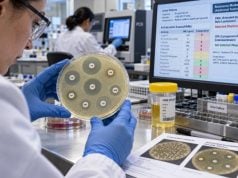
A urine culture and sensitivity test looks for bacteria or other microorganisms that grow from a urine sample and, when appropriate, tests which antibiotics are likely to work against the isolate. The culture identifies the organism and estimates how much grew, while the sensitivity portion—more formally called antimicrobial susceptibility testing—compares that organism with selected antibiotics. Results may be reported as susceptible, intermediate or susceptible with increased exposure, and resistant, depending on the laboratory standard. A positive culture does not automatically mean a UTI: symptoms, urinalysis findings, colony count, specimen quality, catheter status, and recent antibiotics all affect interpretation. The test is especially useful when infection is complicated, recurrent, severe, unusual, or not improving as expected. Culture results usually take longer than a dipstick or urinalysis because organisms must grow before identification and susceptibility testing can be completed.
- Culture identifies the organism: the report may name Escherichia coli, Klebsiella, Proteus, Enterococcus, or another organism and give a colony count or growth category.
- Sensitivity predicts antibiotic activity: “susceptible” generally means the drug is expected to work at an appropriate exposure; “resistant” means treatment failure is more likely.
- Results commonly take 24–48 hours, with full susceptibility testing sometimes taking longer: timing varies by organism, laboratory workflow, and whether additional resistance testing is needed.
- A positive culture must match the clinical picture: bacteria can reflect true UTI, asymptomatic bacteriuria, colonization, or contamination.
- The best antibiotic is not chosen from the S/R column alone: infection site, allergies, kidney function, pregnancy, drug interactions, and achievable drug levels also matter.
Table of Contents
- What Culture and Sensitivity Measures
- How the Test Is Performed and How Long It Takes
- How to Read Bacteria Type and Colony Count
- How Antibiotic Susceptibility Testing Works
- What Susceptible, Intermediate, and Resistant Mean
- When a Urine Culture and Sensitivity Test Is Most Useful
- How to Interpret Common Result Patterns
- What to Do After the Result
What Culture and Sensitivity Measures
A urine culture and sensitivity test answers two related questions: what grew in the urine, and which antibiotics are active against it? These are different from the questions answered by a routine urinalysis. Urinalysis can show white blood cells, leukocyte esterase, nitrite, blood, and bacteria under a microscope, but it usually does not identify a bacterial species or show which antibiotic is most likely to work.
The culture portion starts with a measured amount of urine placed on nutrient media. If microorganisms grow, the laboratory evaluates the number and appearance of colonies and identifies clinically important isolates. Common bacterial causes of UTI include E. coli, Klebsiella species, Proteus mirabilis, Enterococcus species, Staphylococcus saprophyticus, and, in some healthcare-associated or complicated infections, Pseudomonas aeruginosa and other resistant gram-negative organisms.
A related urinalysis for UTI helps show whether the urinary tract is inflamed. Pyuria, meaning increased white blood cells in urine, supports infection when compatible symptoms are present, but pyuria alone does not identify the pathogen and can occur for reasons other than bacterial UTI.
If an isolate is significant and susceptibility testing is indicated, the laboratory exposes it to selected antimicrobial drugs or measures the concentration needed to inhibit growth. The resulting report helps a clinician move from empiric treatment—an initial antibiotic chosen before final culture data—to targeted treatment based on the actual organism.
The word sensitivity is common in patient-facing language, but laboratories generally use susceptibility. The test does not measure whether a patient is personally “sensitive” or allergic to an antibiotic. It measures how the cultured organism behaves against that drug under standardized laboratory conditions.
How the Test Is Performed and How Long It Takes
For a routine voided culture, the goal is to collect urine from the bladder while minimizing organisms from skin and the genital area. A midstream specimen is commonly used. The person begins urinating, collects the middle portion into a sterile container, and avoids touching the inside of the cup or lid. When a clean voided sample cannot be obtained or repeated contamination is a problem, a catheterized specimen may be more informative.
A clean-catch urine culture is most useful when the sample reaches the laboratory promptly or is stored and transported according to the laboratory’s preservation rules. Delays at room temperature can allow contaminating organisms to multiply and can distort colony counts.
In the laboratory, a calibrated loop transfers a known volume of urine to culture media. Plates are incubated, commonly around 35–37°C, and checked for growth. Many routine bacterial cultures produce preliminary or final information within 24–48 hours. Some organisms grow more slowly, mixed cultures require clarification, and additional susceptibility or resistance-mechanism testing can extend the turnaround time to 48–72 hours or longer.
A report may appear in stages:
- Preliminary growth: the laboratory may report that a gram-negative rod, gram-positive organism, or other growth is present before full identification.
- Organism identification: the species is named when enough growth is available for reliable identification.
- Colony quantity: the report gives CFU/mL, a range, or terms such as light, moderate, or heavy growth depending on laboratory practice.
- Susceptibility results: selected antibiotics are reported after standardized testing and interpretation.
- Additional resistance findings: certain isolates may trigger confirmatory work for mechanisms such as extended-spectrum beta-lactamase production or carbapenem resistance.
Collecting the sample before starting antibiotics is ideal when the clinical situation allows. Even one or more doses can suppress bacterial growth and produce a low-count or negative culture despite a true infection. In a seriously ill patient, however, treatment should not be dangerously delayed just to obtain a perfect specimen; clinicians often collect cultures promptly and start empiric therapy while results are pending.
How to Read Bacteria Type and Colony Count
The organism name and the amount of growth are interpreted together. A typical report might read “E. coli, >100,000 CFU/mL,” followed by a susceptibility panel. Another might say “10,000–50,000 CFU/mL mixed urogenital flora,” which has a very different meaning.
CFU/mL means colony-forming units per milliliter. A traditional threshold of 10⁵ CFU/mL, or 100,000 CFU/mL, is still important, especially in definitions of asymptomatic bacteriuria. It is not a universal cutoff for symptomatic UTI. Lower counts of a single typical pathogen can represent real bladder infection in a person with classic symptoms and supportive urinalysis findings.
The urine colony count should therefore be read with five questions in mind:
- Is the patient having new urinary symptoms such as dysuria, urgency, frequency, suprapubic pain, flank pain, or fever?
- Did one likely uropathogen grow, or were several organisms mixed together?
- Was the specimen voided, catheterized, or collected by another method?
- Does the urinalysis show pyuria or other findings that support infection?
- Were antibiotics taken before the specimen was obtained?
Organism identity also matters. E. coli is the most common cause of uncomplicated cystitis, and predominant E. coli growth in a symptomatic patient is often clinically persuasive even when the count is below 10⁵ CFU/mL. By contrast, several low-level organisms typical of skin or genital flora more often indicate contamination in a voided sample.
The same organism can mean different things in different people. Enterococcus may be important in a hospitalized, catheterized, or recently instrumented patient but can be difficult to interpret as low-level growth in a poorly collected specimen. Pseudomonas is uncommon in routine uncomplicated cystitis and may raise concern for healthcare exposure, urinary instrumentation, structural urinary disease, or prior antibiotics. Repeated Proteus infection can be associated with urease activity and infection stones.
A culture is not a severity meter. A very high colony count does not by itself mean kidney infection or sepsis, and a lower count does not guarantee mild disease. Fever, flank pain, vomiting, low blood pressure, confusion, organ dysfunction, pregnancy, obstruction, and immune status matter far more for severity.
How Antibiotic Susceptibility Testing Works
Antimicrobial susceptibility testing, or AST, determines whether the cultured organism is inhibited by clinically relevant antibiotic concentrations. Laboratories use standardized methods so that the result can be compared with established breakpoints—cutoffs that translate a measured laboratory response into an interpretation used for treatment.
One common method is broth dilution, which exposes bacteria to increasing antibiotic concentrations. It can determine the minimum inhibitory concentration (MIC): the lowest concentration that prevents visible bacterial growth under the test conditions. Another method is disk diffusion, in which antibiotic-containing disks are placed on an agar plate seeded with the organism. The laboratory measures the zone where bacterial growth is inhibited around each disk. Automated systems can perform identification and susceptibility testing with standardized cards or panels.
An MIC is not interpreted in isolation. For example, an MIC of 1 mg/L may be susceptible for one organism-drug combination but resistant for another. Breakpoints account for the organism, antibiotic, dosing and pharmacology, clinical evidence, and sometimes infection site. For certain drugs, urine-specific breakpoints or the high concentrations achieved in urine may influence how a result is interpreted.
Laboratories generally follow a recognized standard such as CLSI or EUCAST. These organizations periodically update breakpoints as resistance patterns, dosing knowledge, and clinical evidence change. That means an older report and a newer report can occasionally classify the same MIC differently after breakpoint revisions.
Not every antibiotic is tested against every isolate. Laboratories often use a selective or cascade reporting strategy. They may test a broad panel internally but report narrower, preferred agents first and reveal broader drugs only when resistance requires it. This helps antibiotic stewardship and prevents a long list of “susceptible” drugs from being mistaken for equally appropriate choices.
Susceptibility testing also has biological limits. The laboratory tests a cultured isolate under controlled conditions; it cannot reproduce every feature of the human body. Drug absorption, kidney function, tissue penetration, urinary concentration, biofilm, obstruction, abscesses, immune response, and adherence all affect whether treatment succeeds.
What Susceptible, Intermediate, and Resistant Mean
The letters beside each antibiotic summarize how the isolate compares with the relevant breakpoint. The exact terminology depends on the standard used by the laboratory, so the report legend matters.
| Result | General meaning | Important nuance |
|---|---|---|
| Susceptible (S) | The organism is expected to respond when the drug is used at an appropriate approved exposure for the infection. | Clinical suitability still depends on infection site, patient factors, dose, route, and safety. |
| Intermediate (I), in some systems | The result falls between susceptible and resistant categories. | It may indicate uncertain efficacy or possible success when drug exposure is increased, depending on the standard and drug. |
| Susceptible, increased exposure (I), in EUCAST | A high likelihood of success is expected when drug exposure is increased appropriately. | “I” does not simply mean halfway resistant in this system. |
| Resistant (R) | There is a high risk of treatment failure even with the exposure represented by the breakpoint. | A resistant drug should generally not be relied on for definitive therapy when effective alternatives exist. |
The most important point is that “susceptible” does not mean “best for this patient.” Several drugs can test susceptible, but one may be preferred because it has a narrower spectrum, better urinary or kidney tissue penetration, fewer adverse effects, safer use in pregnancy, fewer drug interactions, or better dosing for the person’s kidney function.
Likewise, a resistance pattern can carry broader meaning. Resistance to third-generation cephalosporins in certain Enterobacterales can suggest an extended-spectrum beta-lactamase phenotype, while resistance to carbapenems can trigger evaluation for carbapenem-resistant organisms. An antibiotic-resistant UTI test interpretation may involve phenotypic susceptibility results, confirmatory laboratory methods, and sometimes molecular resistance-gene testing.
Prior cultures are also useful. A person with recurrent UTI who previously grew a resistant organism is more likely to grow a similar resistance pattern again than someone without that history, especially when the prior culture is recent. Still, a past antibiogram does not replace a new culture when current testing is clinically indicated.
When a Urine Culture and Sensitivity Test Is Most Useful
Not every episode of classic uncomplicated cystitis requires a culture before treatment. Culture becomes more valuable when the answer is likely to change management, when treatment failure would be more consequential, or when resistant or unusual organisms are more likely.
Common reasons include:
- suspected pyelonephritis or another systemic UTI;
- recurrent UTI;
- persistent symptoms or symptoms that return soon after treatment;
- pregnancy;
- male UTI or suspected prostatitis, depending on the clinical situation;
- urinary catheter, recent instrumentation, obstruction, stones, or structural urinary disease;
- recent hospitalization, healthcare exposure, or recent antibiotics;
- previous multidrug-resistant urinary isolates;
- severe illness or sepsis;
- atypical symptoms or an uncertain diagnosis.
A recurrent UTI test panel often relies on culture results from separate symptomatic episodes to show whether infections are caused by the same organism, a new organism, or increasingly resistant isolates. This longitudinal information can be more useful than any single test result.
Culture is also important in complicated infection because definitive therapy should be narrowed or adjusted once organism identification and susceptibility are available. In serious illness, clinicians commonly begin empiric antibiotics based on severity, local resistance patterns, prior cultures, and patient-specific risks, then revise therapy as soon as the culture provides better evidence.
Testing should still be tied to symptoms and a clinical indication. Routine cultures in people without urinary symptoms can detect asymptomatic bacteriuria and lead to unnecessary antibiotics. Important exceptions include pregnancy and selected patients before invasive urologic procedures that are expected to cause mucosal trauma.
How to Interpret Common Result Patterns
A culture report becomes clearer when the organism, colony count, urinalysis, symptoms, and susceptibility panel are considered as one pattern.
| Result pattern | Likely interpretation |
|---|---|
| Single typical uropathogen, high count, pyuria, classic symptoms | Strong support for bacterial UTI; susceptibility can guide targeted therapy. |
| Single typical uropathogen, lower count, classic symptoms and pyuria | Can still represent true UTI; the 10⁵ CFU/mL threshold should not be applied rigidly. |
| Mixed flora in a voided specimen | Often contamination, especially when no single pathogen predominates. |
| Positive culture without urinary symptoms | May represent asymptomatic bacteriuria or colonization rather than symptomatic UTI. |
| No growth after antibiotics were started | Does not fully exclude infection because treatment may suppress growth. |
| Pathogen resistant to the empiric antibiotic | Treatment may need adjustment, particularly if symptoms persist or infection is complicated. |
| Pathogen susceptible to the empiric antibiotic but symptoms persist | Reassess diagnosis, infection site, dose, adherence, obstruction, abscess, stone, or another cause. |
A mixed-flora or contaminated urine culture often provides too little information for reliable susceptibility-guided treatment. Repeating the specimen with careful collection, and sometimes using straight catheterization, may be more useful than choosing an antibiotic from partial mixed growth.
A “no growth” result can occur despite urinary symptoms for several reasons. Antibiotics may have suppressed bacteria, the organism may be present below the laboratory reporting threshold, collection may have occurred after frequent urination or heavy fluid intake, or the symptoms may come from a nonbacterial condition such as vaginitis, urethritis, sexually transmitted infection, interstitial cystitis/bladder pain syndrome, stones, or pelvic floor dysfunction.
Conversely, a positive result can be misleading when symptoms do not fit. Long-term catheter users commonly become bacteriuric. Older adults and people with certain urinary abnormalities can also have asymptomatic bacteriuria. Treating the culture instead of the patient can expose people to antibiotic adverse effects and select for resistance without improving outcomes.
What to Do After the Result
When culture and susceptibility are final, the next step is to compare the report with the patient’s clinical response. If the patient is improving on an empiric antibiotic and the organism is susceptible, the clinician may continue the planned course. If a narrower effective option is appropriate, therapy may be de-escalated. If the organism is resistant to the current antibiotic, the treatment plan often needs review, especially in pyelonephritis, complicated UTI, pregnancy, or persistent symptoms.
The report should never be used as a do-it-yourself antibiotic menu. Drug selection depends on factors the susceptibility table cannot show, including allergy history, kidney function, pregnancy, age, other medicines, infection location, previous adverse reactions, and whether the drug reaches adequate levels at the infected site. Nitrofurantoin, for example, can be useful for lower UTI when susceptible but is not appropriate treatment for kidney infection because it does not achieve adequate renal tissue levels.
Routine “test-of-cure” cultures are generally unnecessary after uncomplicated cystitis when symptoms completely resolve. A post-treatment urine culture becomes more relevant when symptoms persist, recur quickly, or a clinician needs documentation in a special clinical situation.
Seek prompt medical assessment for fever with flank pain, persistent vomiting, severe weakness, new confusion, fainting, low blood pressure, pregnancy with UTI symptoms, or worsening symptoms despite treatment. These features can signal kidney infection, obstruction, sepsis, or another condition that needs more than routine outpatient interpretation.
The most useful way to read a urine culture and sensitivity report is therefore not “Which antibiotic has an S?” but “Does this result represent a true infection, which organism is causing it, and which effective treatment fits this person and infection site?” That approach turns a laboratory table into a clinically meaningful result.
References
- Urine Culture: Clinical Use and Interpretation 2026 (Review)
- IDSA 2025 Guideline Update on Complicated Urinary Tract Infections 2025 (Guideline)
- EAU Guidelines on Urological Infections – THE GUIDELINE 2026 (Guideline)
- Predicting Antibiotic Susceptibility Among Patients With Recurrent Urinary Tract Infection Using a Prior Culture 2024
- M100 | Performance Standards for Antimicrobial Susceptibility Testing 2026
Disclaimer
This article is for general education and does not replace medical diagnosis or individualized antibiotic selection. Urine culture and susceptibility results must be interpreted with symptoms, specimen quality, infection site, medical history, pregnancy status, kidney function, allergies, and other medicines; seek prompt care for severe or worsening symptoms. Do not start, stop, or switch antibiotics solely from an S/I/R table without appropriate clinical guidance.