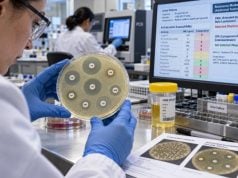
A UTI test panel is not one universal laboratory package. It usually means a combination of tests used to decide whether a urinary tract infection is likely, identify the organism when needed, and guide treatment. The fastest components are urinalysis markers such as leukocyte esterase, nitrite, white blood cells, bacteria, and sometimes blood. A urine culture takes longer but can show which organism grows and at what colony count. If a significant bacterial isolate is found, susceptibility testing can indicate which antibiotics are likely to work. The right combination depends on symptoms, age, pregnancy, recurrence, catheter use, suspected kidney infection, recent antibiotics, and other risk factors. No single marker proves UTI in every patient. Accurate diagnosis comes from matching symptoms and clinical findings with evidence of urinary inflammation and, when appropriate, microbiologic confirmation.
- Urinalysis gives rapid clues within minutes, while urine culture and susceptibility usually take longer but provide organism-level information.
- Leukocyte esterase and urine WBCs show inflammation; nitrite and bacteria provide evidence that microorganisms may be present.
- Culture reports organism growth and CFU/mL, while susceptibility testing helps choose an antibiotic when treatment is indicated.
- A positive test without urinary symptoms may represent asymptomatic bacteriuria or colonization rather than a UTI that needs treatment.
- Fever, flank pain, vomiting, pregnancy, recurrent infection, catheters, or treatment failure increase the value of culture and broader evaluation.
Table of Contents
- What is in a UTI test panel
- Urinalysis markers and what they mean
- Urine culture and colony count
- Antibiotic susceptibility testing
- How to interpret common result patterns
- When extra tests are needed
- Getting an accurate sample and follow-up
- Common UTI panel questions
What is in a UTI test panel
The phrase “UTI test panel” can refer to different combinations depending on the clinic or laboratory. The core approach usually begins with urinalysis and, when indicated, adds culture. Some settings automatically reflex a urine sample to microscopy or culture when predefined urinalysis criteria are met.
A typical diagnostic workup can include dipstick leukocyte esterase and nitrite, microscopic or automated white blood cell and red blood cell counts, bacteria, epithelial cells, urine pH, specific gravity, and culture. When culture finds a meaningful bacterial isolate, the laboratory may perform antimicrobial susceptibility testing.
These tests answer different questions. Symptoms describe the syndrome. Urinalysis estimates inflammation and provides bacterial clues. Culture confirms viable organism growth. Susceptibility testing predicts which antibiotics are active against that cultured organism.
Not every patient needs every component. A healthy nonpregnant woman with classic uncomplicated cystitis symptoms may sometimes be treated without culture. A person with suspected pyelonephritis, recurrent UTI, pregnancy, complicated anatomy, catheter use, recent resistant organisms, or failed treatment is more likely to benefit from culture.
Newer molecular tests can add rapid pathogen DNA and resistance-gene information. They are not yet a universal replacement for culture because increased sensitivity can detect organisms that are not causing symptoms. The urine PCR test is best understood as a complementary option in selected cases.
Urinalysis markers and what they mean
Urinalysis can be available in minutes and is often the first objective evidence used to support or challenge a UTI diagnosis. The most relevant markers are leukocyte esterase, nitrite, white blood cells, and bacteria.
Leukocyte esterase reflects enzyme activity from white blood cells. A positive result suggests pyuria, or urinary inflammation. Microscopy can quantify WBCs more directly, often as cells per high-power field, while automated instruments may report cells per microliter. Pyuria supports inflammation but is not specific for infection.
Nitrite is produced when certain bacteria convert urinary nitrate to nitrite. A positive result is a useful clue for bacteriuria, especially from common gram-negative organisms. A negative result does not exclude UTI because some pathogens do not make nitrite and urine may not have remained in the bladder long enough.
Bacteria seen on microscopy can support infection, but contamination can also introduce bacteria. Squamous epithelial cells may suggest a less clean sample, although they are not a perfect contamination marker by themselves. Blood can occur with cystitis but also with stones, menstruation, tumors, or other urinary conditions.
A detailed urinalysis for UTI interpretation should combine these markers rather than declaring infection from one abnormality. Positive urinalysis has lower specificity in older adults and catheterized patients because pyuria and bacteriuria can be present without symptomatic UTI.
Urine culture and colony count
Urine culture attempts to grow viable microorganisms from the specimen. If one or more organisms grow, the laboratory identifies them and may report a quantitative colony count in CFU/mL. This is the microbiologic core of UTI confirmation in complicated or uncertain cases.
A traditional threshold of 100,000 CFU/mL is widely recognized, but it is not a universal definition of infection. Symptomatic patients can have clinically meaningful lower counts, particularly when one typical uropathogen grows from a well-collected specimen. Research definitions often use thresholds from 10^3 to 10^5 CFU/mL depending on population and syndrome.
The pattern matters as much as the number. Heavy growth of one plausible pathogen in a symptomatic patient is persuasive. Mixed growth of several organisms from a clean-catch specimen often suggests contamination. “No growth” makes typical bacterial UTI less likely but can occur after antibiotics or with organisms that standard culture detects poorly.
Culture is especially valuable before changing antibiotics in recurrent or treatment-resistant cases. It also helps distinguish a true bacterial infection from pyuria caused by stones, sexually transmitted infection, kidney inflammation, or other nonbacterial conditions.
For focused interpretation of positive and negative reports, see urine culture results. The main principle is to interpret the culture with symptoms and sample type, not as an isolated pass/fail result.
Antibiotic susceptibility testing
Susceptibility testing is usually performed after culture identifies a clinically significant bacterial isolate. The laboratory exposes the organism to antibiotics or measures growth inhibition and classifies the result according to standardized breakpoints.
Reports may use categories such as susceptible, resistant, and intermediate or “susceptible, increased exposure,” depending on the laboratory standard. A susceptible result means the organism is expected to respond when the drug is used appropriately. Resistant means reliable treatment is unlikely at usual exposure.
The result is not a complete prescription. The clinician still considers infection site, allergies, pregnancy, kidney function, drug interactions, prior resistant organisms, and whether the antibiotic reaches adequate concentrations in the bladder or kidney tissue. Nitrofurantoin, for example, can be useful for lower UTI in appropriate patients but is not suitable for all upper-tract infections.
Some laboratories selectively report antibiotics to encourage narrower therapy and reduce unnecessary broad-spectrum use. Others use rapid phenotypic or molecular technologies to shorten susceptibility turnaround.
The culture and sensitivity report becomes most valuable when it changes treatment. If symptoms are resolving on an active, appropriate drug, no change may be needed. If resistance is found and symptoms persist, the clinician can choose a better-targeted option.
How to interpret common result patterns
A UTI panel becomes useful when the pieces are interpreted together. No pattern is perfect, but certain combinations are more persuasive than isolated abnormalities.
| Pattern | What it may mean | Common next step |
|---|---|---|
| Symptoms + pyuria + nitrite positive | Bacterial UTI is likely | Treat or culture based on risk and setting |
| Symptoms + pyuria + nitrite negative | UTI still possible | Consider culture, especially if complicated |
| No symptoms + pyuria/bacteriuria | Possible asymptomatic bacteriuria or colonization | Avoid automatic treatment; assess indication |
| Symptoms + negative urinalysis | UTI less likely but not impossible | Reassess, culture selectively, consider alternatives |
| Positive culture + one uropathogen | Supports UTI if symptoms fit | Use susceptibility if treatment is needed |
| Mixed flora | Often contamination | Repeat collection if clinically important |
Discordant results deserve thought rather than reflex treatment. Positive leukocyte esterase with a negative culture can reflect prior antibiotics, urethritis, stones, or sterile inflammation. Positive culture without pyuria or symptoms can reflect colonization or asymptomatic bacteriuria. Nitrite-positive urine with little leukocyte response may represent early infection, bacteriuria without symptoms, or a technical mismatch.
In older adults, nonspecific symptoms such as fatigue or confusion should not automatically be attributed to UTI simply because urinalysis is abnormal. Baseline bacteriuria and pyuria are common, and alternative causes should be evaluated.
When extra tests are needed
Additional testing depends on the clinical syndrome. Suspected pyelonephritis may prompt blood counts, kidney function tests, inflammatory markers, blood cultures in selected severe cases, and imaging when obstruction, stones, or abscess is a concern. The pyelonephritis test panel addresses that broader workup.
Recurrent infections may require careful review of prior cultures to determine whether episodes involve the same organism, new organisms, resistant bacteria, or repeated contaminated specimens. Structural imaging or urology evaluation can be considered when stones, obstruction, retention, or anatomical abnormalities are suspected.
Sexually transmitted infections can mimic UTI. Dysuria with urethral discharge, genital symptoms, new sexual exposure, or sterile pyuria may lead to nucleic-acid testing for chlamydia, gonorrhea, or other infections.
Pregnancy changes testing because asymptomatic bacteriuria can have different consequences and screening recommendations. Pediatric testing also uses age-specific collection and interpretation rules. Catheterized patients need particular caution because bacteriuria becomes common over time and the presence of a catheter can itself cause pyuria.
Molecular tests or expanded culture methods may be considered in selected persistent or complex cases, but they should not replace a broader diagnostic reassessment when repeated standard testing does not fit the symptoms.
Getting an accurate sample and follow-up
A good sample prevents many false leads. For a midstream clean-catch specimen, begin urinating first, then collect the middle portion in a sterile cup. Avoid touching the inside of the container. If a catheter is present, collection should come from the designated sampling port using proper technique rather than the drainage bag.
Collect urine before antibiotics when practical. Even a small number of doses can lower culture yield. If a patient is acutely ill, treatment should not be dangerously delayed, but obtaining the specimen first can preserve diagnostic value.
Most urinalysis results are available quickly. Culture commonly requires at least a day, and final susceptibility may take longer. Ask whether a preliminary result is expected and how you will be contacted if the antibiotic needs to change.
Routine repeat culture is not always necessary after an uncomplicated infection resolves. Follow-up is more likely when symptoms persist, recur quickly, pregnancy is involved, or a complicated infection is being managed. A post-treatment urine culture is therefore a targeted tool rather than a universal step.
Seek prompt medical care for fever with flank pain, repeated vomiting, shaking chills, confusion, low blood pressure, severe weakness, or inability to keep fluids down. These findings can indicate kidney infection or sepsis. The purpose of a UTI panel is to guide care quickly and accurately, not to delay treatment of a seriously ill patient while waiting for every laboratory component.
Common UTI panel questions
Do I need a culture every time I have UTI symptoms?
Not always. Some otherwise healthy nonpregnant adults with a classic uncomplicated cystitis pattern can be managed clinically. Culture becomes more valuable when infection is recurrent, complicated, associated with fever or flank pain, occurs during pregnancy, affects a man, follows recent antibiotics, or fails to improve as expected.
What if leukocyte esterase is positive but culture is negative?
That pattern means inflammation was detected but routine culture did not confirm a typical bacterial cause. Prior antibiotics, low bacterial counts, sexually transmitted infection, stones, interstitial nephritis, or contamination are possibilities. The next step should follow the symptom pattern rather than assuming the culture “missed” a UTI.
What if culture is positive but there are no symptoms?
This may be asymptomatic bacteriuria or colonization. In many nonpregnant adults, antibiotics are not recommended solely to clear bacteria from urine. Important exceptions exist, so the clinician considers pregnancy, planned urologic procedures, and other specific circumstances.
How quickly should symptoms improve after treatment?
Many uncomplicated bladder infections begin improving within roughly 24–48 hours of effective therapy, though discomfort can take longer to fully settle. Persistent fever, worsening flank pain, vomiting, or no improvement should prompt reassessment. Culture results may show resistance or an alternative diagnosis may need consideration.
Can a UTI panel show a kidney infection?
It can support the diagnosis by showing pyuria and bacteriuria, but it cannot locate infection with certainty. Kidney infection is primarily a clinical diagnosis based on systemic symptoms such as fever and flank pain, with culture and sometimes blood tests or imaging used to define severity and complications.
What does “reflex to culture” mean?
A reflex protocol means the laboratory starts with urinalysis and automatically sends the same specimen for culture only if predefined criteria are met, such as pyuria, leukocyte esterase, nitrite, or bacteria. This can reduce unnecessary cultures and false-positive results in low-risk populations. The criteria are not universal, and clinicians may still order culture directly when a patient is high risk or when a negative screening urinalysis would not safely exclude infection.
Why can different laboratories report different ranges?
Urine microscopy and automated analyzers use different methods, units, and thresholds. One laboratory may report WBCs per high-power field, another per microliter, and another as a semiquantitative category. Culture reporting thresholds and susceptibility terminology can also differ. Always use the reference range and interpretive notes on the actual report rather than applying a cutoff copied from another laboratory.
When reviewing a panel, compare the collection time with treatment. A urinalysis obtained before antibiotics and a culture obtained after several doses can appear discordant because the inflammatory response may remain while viable bacterial growth falls. Recording exactly when antibiotics began helps a clinician explain mismatched results and decide whether repeat testing is worthwhile.
References
- Novel technologies for the diagnosis of urinary tract infections 2025 (Review)
- Urinary Tract Infections: Core Curriculum 2024 2024 (Review)
- Diagnostic stewardship for urinary tract infection: A snapshot of the expert guidance 2022 (Review)
- The EFLM European Urinalysis Guideline 2023 2024 (Guideline)
- Performance of Urinalysis Parameters in Predicting Urinary Tract Infection: Does One Size Fit All? 2024 (Review)
Disclaimer
This article provides general information about UTI testing and does not replace individual medical advice. Urinalysis, culture, and susceptibility results should be interpreted with symptoms, specimen quality, risk factors, and local laboratory standards. Seek urgent care for severe symptoms, especially fever with flank pain, vomiting, confusion, or signs of sepsis.