A urine PCR test for UTI uses molecular methods to detect bacterial DNA, and some panels also look for selected antibiotic resistance genes. Compared with standard urine culture, PCR can return results faster and may detect organisms that are present in low numbers, grow poorly in routine culture, or were partially suppressed by prior antibiotics. That higher analytical sensitivity is useful in selected cases, but it also creates an important limitation: detecting DNA does not always prove that a living organism is causing a symptomatic urinary tract infection. PCR can identify colonizing bacteria, multiple organisms of uncertain importance, or DNA that remains after bacterial viability has changed. Resistance-gene detection is also not identical to conventional susceptibility testing. The best interpretation combines the molecular result with urinary symptoms, urinalysis, specimen quality, recent antibiotics, and—when needed—culture or phenotypic susceptibility testing.
- Urine PCR detects microbial DNA rather than waiting for bacteria to grow, so results can be much faster than standard culture.
- A positive PCR result shows that target DNA was detected; it does not automatically prove active UTI.
- PCR may detect more organisms than culture, including low-abundance or hard-to-grow bacteria, which can improve sensitivity but reduce clinical specificity.
- Resistance genes suggest potential resistance mechanisms but do not perfectly predict whether an antibiotic will work in the patient.
- PCR is most useful when it answers a specific clinical problem, such as persistent symptoms, prior antibiotics, recurrent UTI, or the need for rapid organism information.
Table of Contents
- How urine PCR testing works
- What a positive or negative result means
- PCR versus standard urine culture
- Resistance genes and antibiotic susceptibility
- Multiple organisms and clinical significance
- When PCR may be helpful
- Limitations and next steps
- Common urine PCR questions
How urine PCR testing works
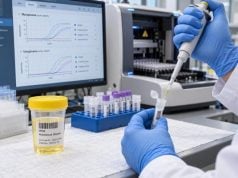
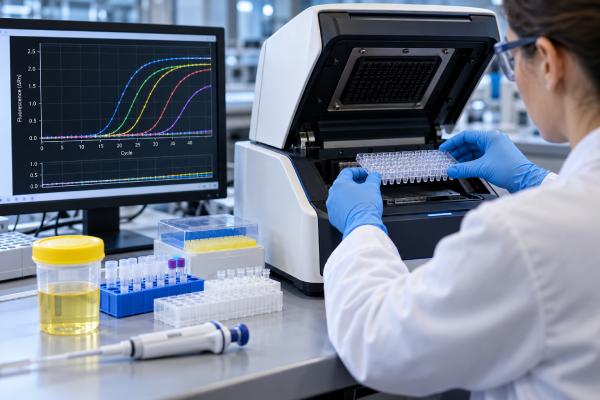
PCR stands for polymerase chain reaction. The method amplifies selected DNA sequences so that very small amounts of microbial genetic material become detectable. In a UTI panel, primers and probes are designed to recognize specific bacteria or groups of organisms. Some commercial tests include dozens of targets; others focus on a smaller set of common urinary pathogens.
A PCR assay does not require the organism to reproduce on a culture plate. That is the source of its speed. Depending on the platform, a laboratory may generate results in hours rather than waiting one or more days for growth and identification.
Panels vary substantially. One test may detect E. coli, Klebsiella, Proteus, Enterococcus, Pseudomonas, and selected staphylococci, while another includes additional bacteria, yeast, or resistance genes. A negative result means only that the test did not detect the organisms included in its target list above the assay’s threshold. It does not mean every possible infectious cause has been excluded.
Some assays are quantitative or semiquantitative, reporting a DNA concentration or abundance category. These numbers should not be treated as direct equivalents of culture CFU/mL because PCR counts genetic targets, while culture estimates viable organisms capable of growth.
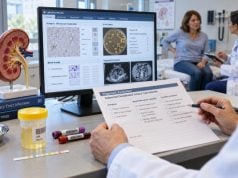
Molecular testing fits within a broader diagnostic framework. The UTI test panel still relies on symptoms and inflammatory markers to determine whether detected organisms are clinically meaningful.
What a positive or negative result means
A positive PCR result means DNA from a listed microbial target was detected. It can be highly informative when the organism matches the symptom pattern and urinalysis supports inflammation. It is less definitive when the patient has no symptoms, when several organisms appear at low abundance, or when the detected species commonly colonizes the urinary tract or surrounding skin.
PCR can remain positive when culture is negative. This may happen because the organism is present at a low level, grows poorly in standard conditions, or has been damaged by prior antibiotics but still leaves detectable DNA. It may also happen because PCR is finding colonization rather than the cause of symptoms.
A negative result lowers the likelihood of infection from the panel’s included targets. It does not rule out organisms that are absent from the panel, a noninfectious urinary condition, or technical issues related to collection and inhibition. In a very symptomatic patient, a clinician may still use culture or additional testing.
The clinical meaning depends heavily on pretest probability. In someone with classic dysuria, urgency, pyuria, and a PCR result showing a common uropathogen, the result fits a coherent infection story. In an asymptomatic person tested broadly, the same organism may be incidental.
This distinction parallels standard culture. More sensitive detection does not remove the need to distinguish symptomatic UTI from asymptomatic bacteriuria. The goal is to diagnose disease, not simply to catalogue microorganisms in urine.
PCR versus standard urine culture
PCR and culture measure different biological properties. PCR looks for nucleic acid. Culture looks for viable organisms that can grow under laboratory conditions. Each approach has strengths and weaknesses.
| Feature | Urine PCR | Standard urine culture |
|---|---|---|
| Turnaround | Often hours | Usually 24–72 hours for full workup |
| Detection principle | Microbial DNA | Viable organism growth |
| Low-level or fastidious organisms | May detect more | May miss some |
| Species scope | Limited to assay targets | Can recover unexpected cultivable organisms |
| Antibiotic information | Selected resistance genes on some panels | Phenotypic susceptibility from an isolate |
| Main interpretive risk | Over-detection and uncertain significance | Contamination, slow growth, false negatives after antibiotics |
Meta-analyses have found that molecular methods often identify more urinary bacteria than conventional culture. That does not automatically mean every additional detection is a missed infection. The urinary tract has a microbial community, and the clinical significance of low-level DNA can be difficult to establish.
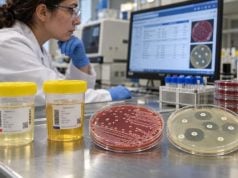
Culture also provides a living isolate that can undergo broad susceptibility testing. A standard urine culture and sensitivity test remains important when clinicians need phenotypic evidence about which antibiotics inhibit the organism.
PCR may be especially attractive after prior antibiotics because culture sensitivity can drop. Yet prior treatment can also leave detectable DNA from nonviable bacteria, so discordant results need careful interpretation rather than an automatic assumption that PCR is “right” and culture is “wrong.”
Resistance genes and antibiotic susceptibility
Some urine PCR panels detect genes associated with antibiotic resistance, such as selected beta-lactamase or carbapenemase genes. If a resistance gene is found, it suggests that at least one detected organism may carry a genetic mechanism capable of reducing susceptibility to certain antibiotics.
The key word is “suggests.” Genotypic resistance does not always match phenotypic resistance perfectly. A gene can be present but not expressed strongly enough to cause clinical resistance, or the assay may detect a gene without proving which organism carries it when multiple species are present. Conversely, an organism may be resistant through a mechanism that the panel does not test.
Phenotypic susceptibility testing exposes a cultured isolate to antibiotics and observes whether growth is inhibited. That approach captures the net effect of many resistance mechanisms. Molecular testing is faster but necessarily selective because it can detect only the genes included in the assay.
Research comparing molecular resistomes with conventional susceptibility has shown substantial but incomplete agreement. This is why a resistance-gene report should not be read as a complete antibiogram. It may help clinicians avoid a clearly compromised drug or make an early choice while awaiting culture, but local guidance and the full clinical picture still matter.
Drug selection also depends on infection site. An antibiotic can test active in the laboratory yet be unsuitable for kidney infection, pregnancy, impaired kidney function, allergies, or important drug interactions. The molecular result is one decision input rather than a prescription by itself.
Multiple organisms and clinical significance
PCR frequently detects more than one organism because of its analytical sensitivity. In a patient with recurrent symptoms, that may reveal a polymicrobial infection that routine culture underrepresented. It can also reveal background organisms that are not driving symptoms.
The interpretation challenge is greatest when several organisms appear at different abundance levels. A panel may list three or four bacteria, but not all necessarily deserve treatment. If urinalysis shows little or no inflammation and symptoms are atypical, broad antibiotic coverage based solely on the PCR list can cause more harm than benefit.
Specimen collection still matters. PCR cannot tell whether DNA came from the bladder or was introduced from skin, genital, or periurethral flora during collection. A poor-quality clean-catch sample can therefore produce a complex molecular profile just as it can produce mixed-flora culture.
Clinicians may look for concordance: Does one organism dominate? Is it a plausible uropathogen? Are inflammatory markers present? Does culture grow the same organism? Is the patient symptomatic? Did prior antibiotics alter culture? These questions help transform a long molecular list into a clinically meaningful interpretation.
The problem is not unique to PCR. The mixed-flora culture has similar uncertainty, although molecular tests can expose it at an even finer level of detail.
When PCR may be helpful
Urine PCR may be considered when rapid organism information could change care or when conventional culture repeatedly fails to explain a convincing clinical syndrome. Examples include selected recurrent or complicated UTIs, prior antibiotic exposure, suspected fastidious organisms, or situations where early resistance information has practical value.
It can also be useful in specialized populations under clinician guidance, including some patients with urinary tract reconstruction, chronic devices, or difficult-to-culture infections. The test is not uniformly recommended as a replacement for standard culture in all uncomplicated UTIs, and coverage, availability, and panel design vary.
Research has shown impressive analytical sensitivity for PCR, but studies have also highlighted a tradeoff: greater detection can reduce specificity in control populations and make overtreatment more likely. Clinical outcome evidence—showing that PCR-guided therapy consistently improves symptoms or reduces harm compared with culture-guided care—is still less mature than the analytical-performance literature.
For these reasons, the highest-value use is targeted rather than indiscriminate. Before ordering a panel, the question should be clear: What uncertainty will the result resolve, and what action will change based on a positive or negative finding?
PCR is especially unlikely to help when the main problem is that symptoms do not fit UTI at all. In that setting, a broader evaluation for stones, sexually transmitted infection, vaginal causes, bladder pain, pelvic floor dysfunction, or other conditions may be more useful than increasingly sensitive bacterial detection.
Limitations and next steps
The first limitation is over-detection. Finding bacterial DNA is not the same as proving tissue infection. The second is target limitation: a panel can only identify what it was designed to detect. The third is resistance interpretation, because gene presence does not equal a full phenotypic susceptibility profile.
Cost and access are additional issues. Molecular panels may be more expensive than standard urine culture, and insurance coverage varies. Laboratories also use different organisms, thresholds, abundance scales, and resistance markers, so results from two commercial tests may not be directly comparable.
If your PCR result is positive, review whether symptoms and urinalysis support UTI and whether one organism is more plausible than the others. Ask whether a culture was also performed and whether phenotypic susceptibility is available. If the result is negative but symptoms persist, ask whether the panel covered the suspected organism and whether a noninfectious diagnosis needs attention.
Seek urgent care for fever with flank pain, repeated vomiting, confusion, low blood pressure, severe weakness, or rapidly worsening illness. Rapid molecular results are useful only when they support timely clinical care; they should not delay evaluation of possible pyelonephritis, obstruction, or sepsis.
The most accurate interpretation treats PCR as a powerful detection tool, not a stand-alone definition of UTI. The test can shorten the time to organism information, but symptoms, inflammation, culture context, and responsible antibiotic use remain essential.
Common urine PCR questions
Can PCR stay positive after antibiotics?
Yes. PCR detects DNA, so it can remain positive when bacteria have been damaged or killed and culture is already negative. The duration varies with organism burden, assay design, and timing. A persistent positive result is therefore not automatically proof that viable bacteria remain.
Is PCR more accurate than culture?
It depends on what “accurate” means. PCR is often more analytically sensitive for detecting bacterial DNA, but clinical diagnosis requires knowing whether detected organisms are causing symptoms. Culture is less sensitive in some situations but provides viable isolates and phenotypic susceptibility. Neither test should be interpreted without clinical context.
What if PCR shows several bacteria?
Multiple detections can reflect a true polymicrobial infection, colonization, or contamination. The most useful clues are relative abundance, sample quality, pyuria, symptoms, and whether culture supports one dominant pathogen. Treating every organism on a broad panel can lead to unnecessary antibiotic exposure.
Do resistance genes guarantee resistance?
No. They raise concern for specific mechanisms but do not capture every gene-expression issue, every resistance pathway, or the effect of drug concentration at the infection site. When available, phenotypic susceptibility remains valuable for confirming the practical antibiotic response.
Should PCR replace culture for recurrent UTI?
Not routinely for every patient. Recurrent symptoms are heterogeneous: some episodes are true bacterial UTIs, while others may involve contamination, bladder pain, stones, pelvic floor disorders, or genital conditions. PCR can add information when standard culture is repeatedly unrevealing, but culture remains useful for viable isolates and conventional susceptibility. A targeted strategy usually provides more value than automatically ordering the broadest molecular panel for every episode.
References
- Comparison of polymerase chain reaction and next-generation sequencing with conventional urine culture for the diagnosis of urinary tract infections: A meta-analysis 2024 (Systematic Review)
- Molecular Diagnostic Methods Versus Conventional Urine Culture for Diagnosis and Treatment of Urinary Tract Infection: A Systematic Review and Meta-analysis 2022 (Systematic Review)
- Novel technologies for the diagnosis of urinary tract infections 2025 (Review)
- Diagnostic tests for urinary tract infections and antimicrobial resistance-a reality check between diagnostic innovation and implementation: a critical narrative review. 2026 (Review)
- Bacteriuria and phenotypic antimicrobial susceptibility testing in 45 min by point-of-care Sysmex PA-100 System: first clinical evaluation 2024
Disclaimer
This article provides general information about urine PCR testing for UTI and is not a diagnosis or treatment recommendation. Molecular results, including resistance genes, should be interpreted by a clinician with symptoms, urinalysis, specimen quality, culture data when available, and individual risk factors. Seek urgent care for signs of severe kidney infection or sepsis.