A “Mycoplasma and Ureaplasma urine test” can mean very different things depending on which organism the laboratory is looking for. Mycoplasma genitalium is an established sexually transmitted pathogen that can cause urethritis and cervicitis and is usually diagnosed with a nucleic acid amplification test (NAAT). By contrast, Mycoplasma hominis, Ureaplasma urealyticum, and Ureaplasma parvum commonly live in the genital tract without causing disease. A positive multiplex PCR for one of these organisms may therefore represent colonization rather than the cause of burning, discharge, pelvic discomfort, or urinary symptoms. Major sexual-health guidance does not support routine screening or automatic treatment for M. hominis or Ureaplasma in most asymptomatic people, and some guidelines discourage routine testing even in many symptomatic cases. Accurate interpretation starts with the exact species, the reason testing was ordered, the specimen type, and whether more established causes such as chlamydia, gonorrhea, trichomoniasis, bacterial vaginosis, or a urinary tract infection have been evaluated.
- Mycoplasma genitalium is an established STI; M. hominis and Ureaplasma species are often colonizers and are interpreted differently.
- NAAT is the main diagnostic method for M. genitalium because routine culture is impractical and the organism grows extremely slowly.
- A positive Ureaplasma or M. hominis PCR does not automatically prove that the detected organism caused urinary or genital symptoms.
- Persistent or recurrent urethritis or cervicitis is a common reason clinicians consider M. genitalium testing.
- Resistance-guided management is important for M. genitalium because macrolide resistance is common and treatment failure can occur.
Table of Contents
- Mycoplasma and Ureaplasma Are Not One Diagnosis
- When Mycoplasma genitalium Testing Is Useful
- How Urine NAAT and Other Specimens Work
- What a Positive Result Means by Organism
- Why Resistance Testing Matters for M. genitalium
- What to Do With Persistent Symptoms or Repeat Results
- When Other Tests Are More Important
Mycoplasma and Ureaplasma Are Not One Diagnosis
The names sound similar because these bacteria belong to a group of very small organisms called Mollicutes, but their clinical meaning is not the same. This is the most important point when reading a urine PCR panel.
Mycoplasma genitalium, often shortened to M. genitalium or Mgen, is a recognized sexually transmitted infection. It can cause nongonococcal urethritis in men and has been linked to cervicitis and pelvic inflammatory disease in women. It is particularly important in persistent or recurrent urethritis after more common causes have been treated or excluded.
Mycoplasma hominis is different. It can be part of the normal genital microbiota and is associated with certain infections in special circumstances, but routine detection from a genital or urine multiplex panel does not establish that it is causing symptoms.
Ureaplasma urealyticum and Ureaplasma parvum are also commonly carried in the urogenital tract. Colonization can occur without inflammation or illness. Research has explored whether high organism loads or selected clinical settings make U. urealyticum more likely to contribute to urethritis, but the evidence is much less straightforward than for M. genitalium.
The European STI Guidelines Editorial Board has specifically warned that routine testing and treatment for M. hominis, U. urealyticum, and U. parvum can cause more harm than benefit through overdiagnosis, antibiotic exposure, cost, and selection of resistance. A 2023 review reached a similar practical conclusion: detection of these organisms needs careful selection and interpretation because their pathogenic role is controversial.
This is why a laboratory report that simply says “Mycoplasma/Ureaplasma positive” is incomplete from a clinical perspective. The species matters. A result for M. genitalium belongs in STI management; a result for Ureaplasma or M. hominis often needs a much more cautious interpretation.
When Mycoplasma genitalium Testing Is Useful
M. genitalium testing is most useful when the clinical syndrome makes the organism plausible. Current CDC guidance recommends testing men with recurrent nongonococcal urethritis and women with recurrent cervicitis using an FDA-cleared NAAT. Testing can also be considered in women with pelvic inflammatory disease. Routine screening of asymptomatic people is not recommended in the CDC guideline.
Symptoms that may lead to evaluation include burning with urination, urethral discharge, penile irritation, bleeding after sex, abnormal cervical discharge, pelvic discomfort, or persistent symptoms after treatment for another diagnosed infection. None of these symptoms is specific to M. genitalium.
Before jumping to Mgen, clinicians commonly assess more established causes. A chlamydia and gonorrhea NAAT is often part of the first-line evaluation for urethritis or cervicitis. Depending on anatomy, symptoms, and exposure, testing may also include HIV, syphilis, bacterial vaginosis, candidiasis, herpes, or a Trichomonas test.
The phrase “persistent urinary symptoms” can also be misleading. Dysuria may come from urethritis, cystitis, vaginitis, irritation, stones, prostatitis, or pelvic-floor conditions. If urgency, frequency, suprapubic pain, fever, or flank pain suggest a bacterial UTI, urinalysis and urine culture may be more relevant than an Mgen test.
M. genitalium is especially important after persistent or recurrent nongonococcal urethritis because CDC cites it as a major cause of recurrent cases. However, symptoms alone are not enough to justify repeated antibiotic courses. Objective evidence of urethral or cervical inflammation and targeted testing help prevent unnecessary treatment.
Routine Ureaplasma or M. hominis testing is a different question. Some commercial multiplex panels automatically include them, but inclusion on a panel does not mean every positive result is clinically actionable. A clinician should ask whether the organism has a well-supported link to the patient’s syndrome before attributing symptoms to it.
How Urine NAAT and Other Specimens Work
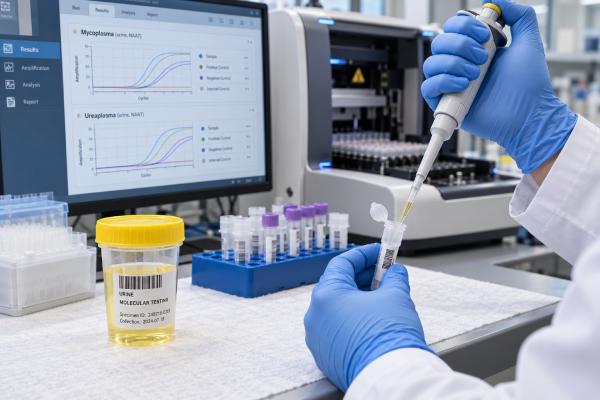
NAATs detect specific bacterial DNA or RNA and amplify the signal so small amounts can be found. For M. genitalium, NAAT is the practical diagnostic method because traditional culture is exceptionally slow and technically difficult. CDC notes that culture can take months and is generally limited to research settings.
FDA-cleared M. genitalium NAATs in the United States can use several specimen types, including urine and certain urethral, penile-meatal, endocervical, and vaginal swabs. The best specimen depends on anatomy, symptoms, and the validated instructions for the assay.
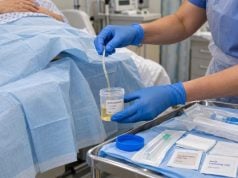
For a urine NAAT, laboratories often request first-catch urine rather than a midstream clean-catch specimen. First-catch urine collects urethral cells and secretions that may contain the organism. Exact volume and precollection instructions vary, so the laboratory kit should be followed rather than assuming all urine tests use the same technique.
This differs from a bacterial clean-catch urine culture, which usually uses midstream urine to reduce contamination from the urethral opening and skin. Giving the wrong type of urine sample can reduce the usefulness of a test.
Commercial multiplex PCR panels may report M. genitalium, M. hominis, U. urealyticum, U. parvum, and other organisms from the same specimen. These panels are analytically convenient, but clinical interpretation is not equally strong for every target. Detecting genetic material does not tell the clinician whether an organism is simply present, causing active inflammation, or present at a load that is clinically meaningful.
Standard urine culture is also a poor way to look for these organisms. M. genitalium does not grow in routine urine culture, and Ureaplasma and M. hominis have special growth requirements that differ from common UTI bacteria such as E. coli. A negative routine urine culture therefore does not rule out M. genitalium, but it also does not automatically make Ureaplasma the cause of symptoms.
Collection details can affect molecular-test performance. A first-catch specimen and a midstream specimen are not interchangeable for every assay, and urinating shortly before collection can reduce material in a first-void sample. Follow the laboratory’s timing and collection instructions; an invalid or insufficient sample should be repeated rather than treated as a negative result.
What a Positive Result Means by Organism
A positive molecular result should first be translated into the exact species name. The clinical meaning changes substantially from one result to another.
| Organism | What a positive NAAT usually means | Main interpretation issue |
|---|---|---|
| Mycoplasma genitalium | An established sexually transmitted pathogen was detected | Resistance and treatment history affect management |
| Mycoplasma hominis | The organism is present in the sampled site | Colonization is common; routine treatment is usually not justified by detection alone |
| Ureaplasma urealyticum | The organism is present | May represent colonization; causal significance is uncertain in many patients |
| Ureaplasma parvum | The organism is present | Frequently carried without disease; positive PCR alone does not prove infection |
For M. genitalium, a positive NAAT in an appropriately tested patient generally represents infection that warrants clinician-directed management. The result does not show how long the infection has been present, who transmitted it, or exactly when transmission occurred. Because asymptomatic infection can occur, timing cannot be inferred from symptoms alone.
For Ureaplasma and M. hominis, a positive test may be an incidental finding. The 2018 European position statement explicitly recommends against routine testing of asymptomatic or symptomatic men and women for these organisms. It notes that asymptomatic carriage is common and warns that multiplex testing can drive unnecessary antimicrobial use.
A Korean STI guideline published in 2024 likewise describes U. urealyticum, U. parvum, and M. hominis as symbiotic bacteria in many settings rather than routine STI targets. A 2023 review calls their pathogenicity controversial and stresses avoiding overdiagnosis.
There are exceptions. These organisms can be clinically important in unusual invasive infections, pregnancy-related settings, neonatal disease, severe immunocompromise, or transplant medicine. Those situations require specialist interpretation and are different from a routine outpatient urine panel for dysuria.
A positive result should therefore never be read without the symptom pattern, inflammation findings, exposure history, and results of more established tests. If a broad urine PCR panel detects several organisms at once, greater sensitivity can create more—not less—interpretive uncertainty.
Why Resistance Testing Matters for M. genitalium
M. genitalium has become difficult to manage because antimicrobial resistance is common, especially resistance to macrolides such as azithromycin. WHO’s 2024 guidance emphasizes choosing therapy according to an individual resistance profile, surveillance data, or the likelihood of resistance in the local setting.
CDC similarly recommends resistance-guided therapy whenever resistance testing is available. Molecular resistance assays look for mutations associated with failure of particular antibiotic classes. Access varies by country and laboratory; in some places, M. genitalium NAAT is widely available while resistance testing is limited.
This matters because M. genitalium lacks a cell wall. Penicillins and cephalosporins, which work by disrupting bacterial cell-wall synthesis, are ineffective against it. It also means that casually prescribing antibiotics used for ordinary cystitis may not treat Mgen at all.
The resistance problem is one reason clinicians should avoid treating an undifferentiated “Mycoplasma/Ureaplasma” panel result without knowing the species. Unnecessary macrolide or fluoroquinolone exposure can select resistance in M. genitalium and other bacteria.
Modern guidance generally uses staged treatment strategies rather than a single empiric dose, and the exact regimen depends on resistance results, previous antibiotics, pregnancy, contraindications, local guidance, and treatment history. WHO updated its M. genitalium treatment recommendations in 2024, while BASHH issued updated M. genitalium guidance in 2025.
Because recommendations change as resistance patterns evolve, a laboratory result should be paired with current local clinical guidance rather than an old medication regimen found online. Persistent infection after recommended therapy is a reason for specialist advice, especially when resistance testing was not available initially.
What to Do With Persistent Symptoms or Repeat Results
Persistent symptoms after treatment do not automatically mean the same organism is still present. The first step is to review what was actually diagnosed, which antibiotic was taken, whether all doses were completed, whether there was new sexual exposure, and whether another condition could explain the symptoms.
For confirmed M. genitalium, follow-up strategy depends on the regimen and guideline used. CDC does not recommend routine test of cure for asymptomatic people who received a recommended regimen, but persistent urethritis, cervicitis, or pelvic inflammatory disease with M. genitalium detection needs reassessment. Some alternative regimens specifically require a test of cure because failure risk is higher.
Testing too soon after treatment can also complicate molecular results because NAAT detects nucleic acid rather than proving that live organisms remain. The clinician should follow the recommended timing for the specific regimen and local guideline rather than repeating a NAAT immediately after the last dose.
Partners may also need evaluation. M. genitalium can be shared between sexual partners, and reinfection can make an apparently successful treatment look like failure. Partner testing and management recommendations vary, but a positive result should trigger a conversation about recent partners and reducing reinfection risk.
For Ureaplasma or M. hominis, repeated positive PCRs are even harder to interpret. Persistent detection may simply reflect stable colonization. “Eradicating” every positive molecular signal is not a reasonable goal when the organism can be part of the usual genital microbiota and when evidence that treatment improves symptoms is weak.
If symptoms continue while standard STI testing and urine cultures are negative, reassessment is more useful than cycling through antibiotics. Depending on anatomy and symptoms, clinicians may evaluate vaginitis, bacterial vaginosis, prostatitis, pelvic inflammatory disease, stones, bladder pain syndrome, dermatologic irritation, or pelvic-floor dysfunction.
When Other Tests Are More Important
Dysuria is a symptom, not a diagnosis. The right test depends on what else is happening.
When burning is accompanied by urinary frequency, urgency, suprapubic discomfort, positive nitrite, or typical bacterial risk factors, a standard UTI test panel may be more useful than a broad Mycoplasma/Ureaplasma PCR. Fever, flank pain, vomiting, or systemic illness raises concern for kidney infection and requires prompt evaluation.
When urethral discharge or sexual exposure is prominent, chlamydia and gonorrhea testing usually comes first. If those tests are negative and urethritis persists, M. genitalium becomes more relevant. In men who have sex with women, Trichomonas may also be considered depending on local prevalence and the clinical picture.
For vaginal discharge, odor, or irritation, bacterial vaginosis and candidiasis may be more likely explanations than Ureaplasma colonization. In women with pelvic pain, bleeding, fever, or cervical motion tenderness, clinicians consider pelvic inflammatory disease and test for established STIs rather than relying on a urine multiplex panel alone.
A negative routine urine culture plus a positive Ureaplasma PCR can feel like a clear explanation, but that inference is often too simple. Routine cultures and Ureaplasma NAAT measure different things, and the positive molecular test may be incidental. The strongest interpretation comes from matching the organism to a well-supported syndrome.
Seek urgent medical care for severe pelvic or abdominal pain, high fever, repeated vomiting, fainting, severe testicular pain or swelling, pregnancy with concerning symptoms, inability to urinate, or signs of sepsis. These situations require examination and broader testing rather than waiting for a specialized urine PCR result.
The practical rule is to read the species name before acting. M. genitalium is a recognized STI with defined NAAT-based diagnosis and resistance concerns. M. hominis and Ureaplasma species are frequently colonizers whose detection often does not explain symptoms. Treating those categories as interchangeable can turn a sensitive molecular test into an inaccurate clinical conclusion.
References
– Mycoplasma genitalium 2025 2025 (Guideline) – Recommendations for the treatment of Trichomonas vaginalis, Mycoplasma genitalium, Candida albicans, bacterial vaginosis and human papillomavirus (anogenital warts) 2024 (Guideline) – 2023 Korean sexually transmitted infections guidelines for non-gonococcal bacterial infection (chlamydia, syphilis, etc.) by the Korean Association of Urogenital Tract Infection and Inflammation 2024 (Guideline) – [Ureaplasma urealyticum, Ureaplasma parvum, and Mycoplasma hominis: commensals or pathogens?] 2023 (Review) – Should we be testing for urogenital Mycoplasma hominis, Ureaplasma parvum and Ureaplasma urealyticum in men and women? – a position statement from the European STI Guidelines Editorial Board 2018 (Position Statement) – Mycoplasma genitalium 2021 (Guideline)
Disclaimer
This article provides general information about Mycoplasma and Ureaplasma testing and does not determine whether a positive result requires treatment. Species, symptoms, pregnancy status, resistance testing, other STI results, and local guidelines all affect interpretation. Seek prompt medical care for severe pelvic or testicular pain, high fever, pregnancy-related concerns, urinary obstruction, or rapidly worsening symptoms.