The urine osmolal gap is a calculated estimate of unmeasured particles in urine. In clinical nephrology, its main use is to roughly estimate urinary ammonium excretion when direct urine ammonium measurement is unavailable. That question matters most in normal-anion-gap metabolic acidosis, where the clinician needs to know whether the kidneys are responding appropriately by increasing acid excretion as ammonium. A large positive urine osmolal gap can suggest substantial ammonium excretion, which points toward an extrarenal bicarbonate loss such as diarrhea. A small or unexpectedly low gap can suggest impaired renal ammonium excretion, as may occur in renal tubular acidosis. The test is only an approximation, however. Glucose, ketones, alcohols, mannitol, medications, unusual anions, and errors in the calculated osmolality can make the gap misleading. Direct urinary ammonium measurement is more specific and is increasingly favored when available. The urine osmolal gap should therefore be viewed as a bedside physiologic clue, not a stand-alone diagnosis.
- The urine osmolal gap estimates unmeasured urinary osmoles and can serve as a rough surrogate for ammonium excretion.
- In normal-anion-gap metabolic acidosis, a larger positive gap suggests the kidneys are increasing ammonium excretion appropriately.
- A low or unexpectedly small gap can suggest impaired renal acid excretion and may support renal tubular acidosis.
- The calculation becomes unreliable when unmeasured osmoles such as glucose, ketones, mannitol, or toxic alcohol metabolites are present.
- Direct urine ammonium measurement is preferable when available because both the urine osmolal gap and urine anion gap are imperfect surrogates.
Table of Contents
- What the Urine Osmolal Gap Is
- How the Gap Is Calculated
- Why Ammonium Matters in Metabolic Acidosis
- How to Interpret a High or Low Gap
- Urine Osmolal Gap Versus Urine Anion Gap
- Limitations and Common Mistakes
- Follow-Up Testing and Clinical Use
- Worked Urine Osmolal Gap Examples
What the Urine Osmolal Gap Is
Osmolality measures the number of dissolved particles in a kilogram of water. A laboratory can measure urine osmolality directly, usually by freezing-point depression. Clinicians can also calculate an estimated urine osmolality from the major measured solutes, typically sodium, potassium, urea nitrogen, and glucose.
The difference between the measured and calculated values is called the urine osmolal gap.
The logic is simple: if measured osmolality is substantially higher than the amount explained by the usual measured solutes, additional particles must be present. During metabolic acidosis, one important unmeasured urinary particle is ammonium, usually excreted with chloride or another anion. Ammonium and its accompanying anion both contribute to osmolality, which is why the gap can rise when ammonium excretion rises.
The urine osmolal gap is not the same as the serum osmolal gap, which is commonly used when evaluating toxic alcohols and other unmeasured blood osmoles. The urine version is mainly a renal acid-base tool.
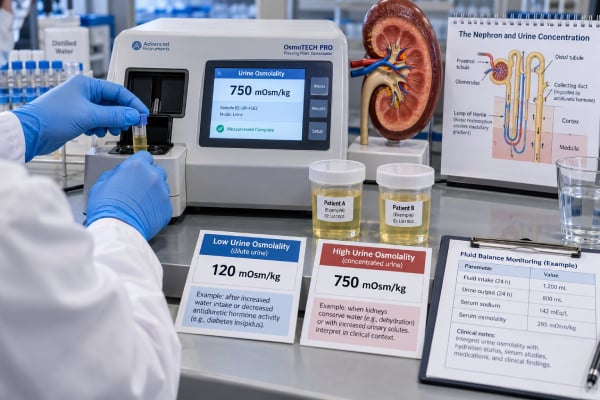
It is also not the same as urine osmolality itself. An urine osmolality test answers how concentrated the urine is overall. The osmolal gap asks how much of that measured concentration is not explained by the solutes included in the calculation.
How the Gap Is Calculated
A commonly used calculation is:
Calculated urine osmolality ≈ 2 × (urine sodium + urine potassium) + urine urea nitrogen contribution + urine glucose contribution
When conventional U.S. units are used, the urea nitrogen and glucose terms require conversion factors. A commonly used form is:
Calculated urine osmolality = 2 × (UNa + UK) + UUN/2.8 + Uglucose/18
where sodium and potassium are in mmol/L, urine urea nitrogen is in mg/dL, and urine glucose is in mg/dL.
Then:
Urine osmolal gap = measured urine osmolality − calculated urine osmolality
Some laboratories report urine urea rather than urea nitrogen, or glucose in mmol/L rather than mg/dL. In those cases, the formula must be adjusted. Using the wrong units can produce a completely meaningless result.
Because each ammonium salt contributes more than one osmotic particle, the gap is sometimes divided by about two to generate a rough estimate of urine ammonium concentration. That conversion is approximate, not exact. The relationship depends on which counterions accompany ammonium and what other unmeasured osmoles are present.
For practical interpretation, the clinician often focuses less on an exact ammonium number and more on whether the gap is large enough to indicate a robust renal acid-excretion response.
Why Ammonium Matters in Metabolic Acidosis
The kidneys maintain acid-base balance by reclaiming filtered bicarbonate and excreting daily acid. A large part of net acid excretion occurs as ammonium. During systemic metabolic acidosis, healthy kidneys can markedly increase ammonium production and excretion.
This response is clinically useful. Imagine two patients with the same low serum bicarbonate and the same normal serum anion gap:
- One has chronic diarrhea and is losing bicarbonate from the gastrointestinal tract. The kidneys are healthy, so they should respond by excreting more ammonium.
- The other has distal renal tubular acidosis. The kidneys themselves cannot excrete acid appropriately, so ammonium excretion is inadequate for the degree of acidosis.
Blood chemistry alone may not distinguish these two mechanisms. Urinary ammonium can.
Direct urine ammonium is therefore a valuable marker of kidney acid handling. During extrarenal bicarbonate loss, ammonium should rise substantially. During renal acidification defects, the response is blunted.
A direct urine ammonium test is preferable when a reliable assay is available. The urine osmolal gap is mainly useful because ammonium historically has not been routinely measured by many clinical laboratories.
Ammonium also matters in chronic kidney disease. As functioning nephron mass declines, total ammonium excretion often falls before overt metabolic acidosis becomes severe. Low ammonium excretion can therefore reflect reduced renal acid-excretion capacity even when serum bicarbonate is not dramatically abnormal.
How to Interpret a High or Low Gap
There is no single universal reference interval because formulas, units, assays, diet, and unmeasured solutes vary. Interpretation is most useful in a patient who already has normal-anion-gap metabolic acidosis and whose urine does not contain major interfering osmoles.
| Urine osmolal gap pattern | What it may indicate | Common clinical direction |
|---|---|---|
| Large positive gap | Substantial unmeasured osmoles; in the right setting, robust ammonium excretion | Supports appropriate kidney response, often extrarenal bicarbonate loss such as diarrhea |
| Small or unexpectedly low gap | Less unmeasured osmole burden; in acidosis, may reflect low ammonium excretion | Raises concern for renal tubular acidosis or impaired kidney acid excretion |
| Very high gap with glucosuria, ketonuria, or administered osmoles | Gap may be driven by non-ammonium particles | Do not infer ammonium without further testing |
A classic teaching approach considers a urine osmolal gap above roughly 150 mOsm/kg compatible with high ammonium excretion in metabolic acidosis, while a much smaller gap may suggest impaired ammonium generation or excretion. These values are approximate and should not be applied as hard laboratory cutoffs.
Example: diarrhea
A patient has low serum bicarbonate, a normal serum anion gap, and ongoing diarrhea. If the kidneys are working normally, ammonium excretion should rise to replace lost base with newly generated bicarbonate. A substantially positive urine osmolal gap supports that compensatory response.
Example: distal renal tubular acidosis
A patient has normal-anion-gap metabolic acidosis, inappropriately alkaline urine, and low potassium. If urinary ammonium is not increasing as expected, the urine osmolal gap may remain relatively small. That pattern supports impaired distal acid secretion, especially when other causes are excluded.
A urine pH test adds useful context but cannot replace ammonium assessment. Urine pH reflects free hydrogen ion activity, while most urinary acid is buffered. A patient can have an acidic urine pH yet still excrete too little total acid if ammonium production is low.
Urine Osmolal Gap Versus Urine Anion Gap
The urine anion gap is another indirect method for estimating ammonium. It is usually calculated as:
Urine anion gap = urine sodium + urine potassium − urine chloride
The concept assumes that ammonium is excreted primarily with chloride. When ammonium chloride excretion rises, urine chloride rises relative to sodium plus potassium, making the urine anion gap more negative. A negative urine anion gap therefore traditionally suggests high ammonium excretion, while a positive gap suggests low ammonium excretion.
The urine anion gap is simple because it needs only three urine electrolytes, but it has important limitations. If ammonium is excreted with anions other than chloride, such as ketoanions or certain drug-related anions, the relationship breaks down. Low urine sodium, unusual dietary states, and other electrolyte patterns can also make the result unreliable.
The urine osmolal gap is less dependent on chloride as the ammonium counterion because ammonium salts contribute to total osmolality regardless of which anion accompanies them. However, it is vulnerable to any other unmeasured osmole. In practice:
- urine anion gap is easy but depends on chloride relationships;
- urine osmolal gap is broader but can be contaminated by non-ammonium osmoles;
- direct ammonium measurement is the most specific of the three.
Modern nephrology reviews increasingly argue that direct urinary ammonium should be made more routinely available rather than relying heavily on imperfect surrogate calculations.
Limitations and Common Mistakes
The urine osmolal gap can become misleading whenever measured osmolality includes particles that are absent from the calculation.
Important interferers include:
- glucose when not properly included in the calculation;
- ketone bodies and ketoanion salts;
- mannitol;
- radiographic contrast;
- glycine or sorbitol irrigation fluids;
- toxic alcohols or their metabolites;
- unusually high concentrations of drug metabolites;
- large amounts of other organic anions.
Urea and glucose unit errors are another major problem. A formula copied from one source may assume mg/dL, while the laboratory reports mmol/L. Before interpreting the gap, clinicians should confirm both the equation and units.
The timing of the urine sample matters as well. Acid excretion is dynamic. A spot sample obtained before the kidney has had time to respond to a new acid load may underestimate the eventual ammonium response. Conversely, treatment with bicarbonate, IV fluids, potassium, or medications can rapidly alter urine chemistry.
Another common error is using the urine osmolal gap when the patient does not actually have metabolic acidosis. The gap can be calculated in anyone, but its diagnostic value for ammonium is strongest when the body has a clear reason to increase acid excretion and the clinician is testing whether the kidneys are doing so.
A serum bicarbonate result, serum anion gap, potassium, creatinine/eGFR, and clinical history should therefore be established before the urine calculation is used to classify a renal acidification problem.
Follow-Up Testing and Clinical Use
If the urine osmolal gap suggests low ammonium excretion, the next step is not to diagnose renal tubular acidosis automatically. The clinician first confirms the blood acid-base disturbance, reviews kidney function and potassium, checks urine pH, and looks for medication or disease causes.
Distal RTA may be associated with low potassium, urine pH that remains inappropriately high during systemic acidosis, kidney stones, or nephrocalcinosis. Type 4 RTA more often occurs with hyperkalemia and reduced ammonium generation, commonly in diabetes, chronic kidney disease, or states of impaired aldosterone action. Proximal RTA involves bicarbonate wasting and has a different physiologic pattern.
If direct urine ammonium is available, it can clarify an uncertain surrogate result. Repeat testing may also help when the first sample was obtained during active treatment or when glucose, ketones, or another unmeasured osmole was present.
Urgent management is driven by the severity and cause of the metabolic acidosis. Deep rapid breathing, confusion, severe weakness, shock, marked hyperkalemia, or rapidly worsening kidney function requires prompt medical assessment. The urine osmolal gap itself is not an emergency value; it is a calculation that helps explain why acid is accumulating.
Used carefully, the test provides a useful physiologic bridge between blood chemistry and kidney function: it asks whether the kidneys are generating and excreting enough ammonium to meet the body’s acid load.
Worked Urine Osmolal Gap Examples
A worked example shows how the calculation can support—not replace—clinical reasoning.
Suppose a patient with normal-anion-gap metabolic acidosis has a measured urine osmolality of 500 mOsm/kg. Urine sodium is 25 mmol/L, urine potassium is 20 mmol/L, urine urea nitrogen is 700 mg/dL, and urine glucose is negligible. Using the common formula, the calculated osmolality is approximately 2 × (25 + 20) + 700/2.8, or about 340 mOsm/kg. The urine osmolal gap is therefore about 160 mOsm/kg. In the absence of another large unmeasured osmole, that sizeable positive gap is compatible with substantial ammonium salt excretion. If the patient has diarrhea, this finding supports an appropriate renal response to gastrointestinal bicarbonate loss.
Now consider a second patient with the same type of metabolic acidosis whose measured urine osmolality is 320 mOsm/kg and calculated osmolality is 290 mOsm/kg. The gap is only about 30 mOsm/kg. If glucose, ketones, and unusual drug exposures are absent, ammonium excretion appears inappropriately low for systemic acidosis. Distal or type 4 renal tubular acidosis becomes more plausible, depending on urine pH and potassium.
The apparent simplicity can be deceptive. If the first patient also has heavy ketonuria, the 160-point gap may be driven in part by sodium or ammonium ketoanion salts. If mannitol was given, it can dominate the gap. If urine urea nitrogen was mistakenly entered as if it were urea, or mg/dL was confused with mmol/L, the calculated osmolality can be wrong by hundreds of units.
A second practical issue is concentration versus excretion rate. Spot ammonium concentration can be high in a concentrated, low-volume urine but total daily ammonium excretion may still be modest. The urine osmolal gap mainly estimates concentration in that specimen. When precise acid excretion matters, a timed direct ammonium measurement provides more complete information.
The gap is therefore most useful when four conditions are met: systemic metabolic acidosis is confirmed, the serum anion gap has been classified correctly, major unmeasured urine osmoles are absent, and the calculation uses the correct units. If any of those conditions fail, direct ammonium testing or a broader acid-base evaluation is safer than forcing a diagnosis from the gap.
The serum anion gap also deserves careful attention before using the urine calculation. Albumin is a major unmeasured serum anion, so a low albumin level can make a high-anion-gap acidosis look deceptively normal unless the serum gap is corrected or interpreted with albumin in mind. A patient can also have mixed disorders, such as diarrhea plus lactic acidosis or ketoacidosis. In those situations, a urine osmolal gap may describe renal ammonium handling but cannot by itself explain the entire acid-base picture.
Potassium is another useful branch point. Hyperkalemic normal-anion-gap acidosis raises concern for type 4 RTA or advanced CKD, whereas hypokalemia is more typical of diarrhea, distal RTA, or proximal bicarbonate loss. These patterns are not absolute, but they help determine which follow-up tests are most useful and reduce the risk of treating the calculation as a diagnosis.
When uncertainty remains, repeating the blood and urine studies together after stabilization can show whether the kidney response is reproducible and physiologically appropriate.
References
- Urinary Ammonium in Clinical Medicine: Direct Measurement and the Urine Anion Gap as a Surrogate Marker During Metabolic Acidosis 2023 (Review)
- State of knowledge on ammonia handling by the kidney 2024 (Review)
- Metabolic Acidosis 2025 (Review)
- Acid-Base Interpretation: A Practical Approach 2025 (Review)
- Beyond the Urine Anion Gap: In Support of the Direct Measurement of Urinary Ammonium 2022 (Review)
- The pathophysiology of distal renal tubular acidosis 2023 (Review)
Disclaimer
This article is for general education and is not a substitute for individual acid-base evaluation. The urine osmolal gap is an indirect estimate that can be inaccurate when unmeasured urinary osmoles are present and should be interpreted with blood tests, urine pH, kidney function, and clinical history. Significant metabolic acidosis or severe symptoms require prompt medical care.