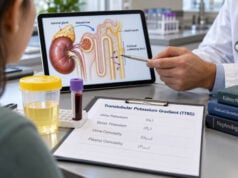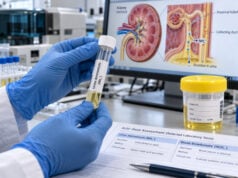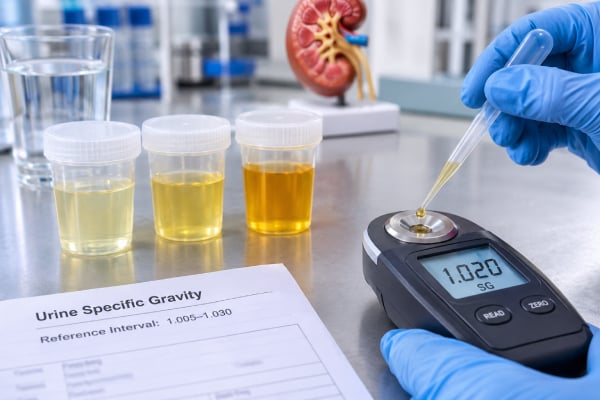
Urine specific gravity estimates how concentrated or dilute a urine sample is compared with pure water. It is a quick way to assess how much dissolved material is present and can provide clues about hydration, kidney concentrating ability, and disorders that alter water balance. A higher number usually means more concentrated urine, while a lower number usually means more dilute urine. However, specific gravity is not a direct measurement of body water and should not be interpreted from one sample without context. Recent fluid intake, sweating, vomiting, diuretics, kidney function, glucose, protein, and radiographic contrast can all change the result. Urine osmolality is often more precise when clinicians need to measure concentration because specific gravity is influenced by both the number and the weight of dissolved particles. The result is most useful when combined with symptoms, blood sodium, serum osmolality, urine output, and the reason the test was ordered.
- A common laboratory reference range for urine specific gravity is about 1.002–1.030, although ranges vary by method and laboratory.
- High specific gravity usually reflects concentrated urine, but glucose, protein, or contrast material can raise it disproportionately.
- Low specific gravity usually reflects dilute urine from high fluid intake or impaired concentrating ability.
- A single urine specific gravity value cannot reliably diagnose dehydration, diabetes insipidus, or kidney disease on its own.
- Urine osmolality is often preferred when precise assessment of kidney concentration or water-balance disorders is needed.
Table of Contents
- What urine specific gravity measures
- Why the test is used
- How the test is done and what affects it
- What high urine specific gravity can mean
- What low urine specific gravity can mean
- Hydration, osmolality, and kidney concentrating ability
- When follow-up testing is useful
What urine specific gravity measures
Specific gravity is a ratio that compares the density of urine with the density of water. Pure water has a specific gravity of 1.000. Urine contains urea, electrolytes, creatinine, and many other dissolved substances, so its specific gravity is normally above 1.000.
A value such as 1.010 means the urine is denser than water, while a value such as 1.025 indicates a more concentrated sample with more dissolved mass per unit of volume. Unlike urine osmolality, which depends mainly on the number of dissolved particles, specific gravity is affected by both particle number and particle size or mass.
That difference matters. Small ions such as sodium and chloride contribute to both osmolality and specific gravity in a fairly predictable way. Large molecules can distort the relationship. Glucose, albumin, mannitol, and iodinated radiographic contrast may increase specific gravity more than they increase osmolality. In those settings, a urine sample can look “concentrated” by specific gravity even when its water concentration is not as high as the number suggests.
The kidneys change urine concentration from moment to moment. When the body needs to conserve water, antidiuretic hormone—also called vasopressin—promotes water reabsorption in the collecting ducts, producing a smaller volume of more concentrated urine. When water is abundant and vasopressin is suppressed, the kidneys excrete a larger volume of dilute urine.
Specific gravity is therefore a convenient proxy for kidney concentration. It can be part of a routine urinalysis, a hydration assessment, or a focused evaluation of excessive urination, abnormal blood sodium, or suspected concentrating defects. It is not the same as a glomerular filtration rate test; filtration and concentrating ability are different kidney functions and can be impaired to different degrees.
Why the test is used
Urine specific gravity is useful because it is fast, inexpensive, and available from a small sample. It can help answer whether the urine is relatively concentrated or dilute at that moment.
Common uses include:
- evaluating possible dehydration or high fluid intake;
- interpreting a routine urinalysis;
- assessing polyuria, meaning unusually large urine volumes;
- investigating abnormal blood sodium or water balance;
- screening kidney concentrating ability;
- monitoring hydration in selected sports, occupational, or treatment settings;
- checking whether a urine sample is extremely dilute when interpreting other urine tests.
In dehydration from inadequate fluid intake, fever, sweating, vomiting, or diarrhea, the kidneys often conserve water and produce more concentrated urine. Specific gravity may rise. But this response depends on kidney function, hormone signaling, solute excretion, and the timing of the sample.
In conditions that cause excessive water excretion, specific gravity may be persistently low. Diabetes insipidus is an important example. In central diabetes insipidus, the body does not produce or release enough vasopressin. In nephrogenic diabetes insipidus, the kidneys do not respond normally to vasopressin. Both can produce large volumes of very dilute urine, thirst, and sometimes high blood sodium if water intake cannot keep up.
The opposite pattern can occur in syndrome of inappropriate antidiuresis, in which vasopressin activity remains elevated despite low blood osmolality. Urine may stay inappropriately concentrated in a person with hyponatremia. In that situation, clinicians usually rely on measured urine osmolality rather than specific gravity alone.
Specific gravity is also useful for interpreting urine dipstick results. For example, a small amount of protein may be more significant in very dilute urine than the same dipstick reading in concentrated urine. Conversely, concentration can exaggerate the apparent amount of some analytes on semiquantitative testing.
How the test is done and what affects it
A random urine sample is usually sufficient. No fasting is required unless other tests ordered at the same time have their own instructions. The sample should be collected in a clean container and tested according to laboratory procedures.
A widely used laboratory reference interval is about 1.002 to 1.030. Results close to 1.000 are very dilute, while values toward the upper end are more concentrated. These numbers are not universal diagnostic cutoffs. The method, sample timing, diet, fluid intake, and clinical setting all matter.
Laboratories may measure specific gravity by refractometry, which measures how urine bends light, or by reagent strip methods that estimate ionic concentration. Refractometry generally provides a direct and useful estimate of urine density, but it is strongly affected by large molecules such as glucose, protein, and contrast agents. Dipstick specific gravity is based on ionic effects and has its own sources of error. If a result does not fit the clinical picture, measured urine osmolality is often the better confirmation test.
Several factors can shift the result:
| Factor | Typical effect on specific gravity |
|---|---|
| Drinking a large amount of water | Lowers it |
| Sweating or limited fluid intake | Often raises it |
| Glucose in urine | Can raise it markedly |
| Heavy proteinuria | Can raise it |
| Recent iodinated contrast | Can raise refractometer readings substantially |
| Diuretics | Can make urine more dilute or alter timing-dependent concentration |
| Kidney concentrating defects | Can keep it low despite dehydration |
First-morning urine is usually more concentrated than many daytime samples because fluid intake stops during sleep and vasopressin activity often promotes overnight water conservation. That makes first-morning urine useful for some hydration comparisons, but it can overstate how concentrated the urine remains during the rest of the day.
If the test is being used to investigate thirst, high urine volume, or abnormal blood sodium, do not intentionally change fluid intake unless a clinician specifically instructs you. Formal water-deprivation testing can be dangerous and should only be performed under medical supervision when indicated.
What high urine specific gravity can mean
A high specific gravity usually means there is a high amount of dissolved material relative to water. The most common explanation is concentrated urine.
Dehydration or reduced water intake can raise specific gravity. The kidneys conserve water, urine volume falls, and solutes become more concentrated. Fever, sweating, vomiting, diarrhea, and strenuous exercise can produce this pattern. A high reading after an overnight fast from fluids can also be normal.
Glucose in the urine can increase specific gravity. When blood glucose rises above the kidney’s reabsorptive capacity, glucose spills into urine and adds substantial solute mass. Because glucose can also pull water into the urine, a person with uncontrolled diabetes may have both a high specific gravity and a large urine volume. That combination is different from the small volume of concentrated urine often seen with ordinary dehydration.
Proteinuria can also elevate specific gravity, especially when protein loss is substantial. This is one reason measured urine osmolality may be more informative when a patient has heavy proteinuria or nephrotic syndrome.
Radiographic contrast and other large solutes can cause unusually high refractometer values. If a urine sample is collected soon after a contrast-enhanced imaging study, the specific gravity may not accurately represent hydration or kidney concentrating ability.
SIADH and other states of persistent vasopressin activity can produce relatively concentrated urine, but specific gravity by itself is not enough to make that diagnosis. The correct evaluation includes blood sodium, serum osmolality, urine osmolality, urine sodium, thyroid and adrenal considerations, and medication review.
A high number should therefore be read as “this sample is dense,” not automatically as “this person is dehydrated.” The reason for the density must be considered.
What low urine specific gravity can mean
Low specific gravity means the urine is relatively dilute. This is often a normal response to high water intake, but persistent low values can signal a concentrating problem.
High fluid intake is the simplest cause. After drinking a large amount of water, vasopressin falls and the kidneys excrete excess water. A spot sample can become very dilute even in a healthy person.
Diuretics may increase urine flow and lower concentration, depending on the drug, timing, and clinical state. IV fluids can do the same. A low value obtained soon after aggressive fluid administration should not be interpreted as a chronic concentrating defect.
Diabetes insipidus is a more important cause when low specific gravity occurs with marked polyuria and intense thirst. Urine osmolality is usually low because the kidneys are excreting water that is insufficiently concentrated. Blood sodium can be normal if thirst and access to water are intact, but it can rise if fluid replacement is inadequate.
Primary polydipsia, in which fluid intake is excessive, can also produce persistently dilute urine. The distinction from diabetes insipidus requires assessment of serum and urine osmolality and sometimes supervised dynamic testing.
Kidney tubular or medullary disease can impair the ability to concentrate urine. Chronic kidney disease may progressively narrow the range over which the kidneys can dilute and concentrate. In more advanced disease, urine specific gravity may hover around values near the specific gravity of protein-free plasma ultrafiltrate, often around 1.010, a pattern historically called isosthenuria. This is not diagnostic by itself, but persistent near-fixed values can be a clue to reduced concentrating flexibility.
Acute tubular injury, certain electrolyte disorders, sickle cell disease or trait in some patients, lithium exposure, and inherited tubule disorders can also impair concentration. These conditions require more specific testing than a routine urinalysis.
Hydration, osmolality, and kidney concentrating ability
Specific gravity is useful for hydration assessment, but it has important limits. Urine is a delayed signal: it reflects what the kidneys have been doing over a period of time rather than giving a direct real-time measurement of total body water. Exercise, meals, morning timing, recent drinking, and solute intake can all shift the result.
In sports research, thresholds such as 1.020 are often used to flag probable underhydration, while lower values suggest more dilute urine. Those cutoffs are practical screening tools for populations, not universal medical definitions. A healthy person can have a first-morning value above 1.020 without clinically important dehydration, and a patient with a concentrating defect can be dehydrated despite a low specific gravity.
Urine osmolality is more physiologically precise because it counts dissolved particles rather than weighting them by mass. It is especially useful when glucose, protein, mannitol, or contrast could distort specific gravity. Serum osmolality and blood sodium add information about the body’s extracellular water balance.
A useful way to think about the tests is:
- Specific gravity: quick estimate of urine density and concentration.
- Urine osmolality: more precise measure of the number of dissolved particles.
- Serum osmolality: measure of blood water concentration.
- Blood sodium: major determinant and indicator of extracellular tonicity in most settings.
- Urine volume: tells how much water is actually being excreted.
When clinicians are evaluating kidney concentration, the pattern across these values matters more than any one result. A person with high blood sodium should normally generate concentrated urine if vasopressin and the kidneys are functioning. Inappropriately dilute urine in that setting raises concern for impaired antidiuretic signaling or response.
The reverse pattern can be useful too. When blood sodium is low because the body has retained too much water, the kidneys should normally produce very dilute urine if vasopressin is fully suppressed. If urine remains concentrated, persistent antidiuretic activity may be part of the problem. Specific gravity can hint at that pattern, but urine osmolality is preferred when precise water-balance decisions are being made.
Specific gravity also cannot show whether a concentrated sample is concentrated because of ordinary electrolytes or because it contains unusually heavy molecules. Glucose and protein can raise the density disproportionately, which is why a high specific gravity in diabetes or heavy proteinuria may overstate the kidney’s true water-concentrating response. In those situations, comparing specific gravity with osmolality and the rest of the urinalysis prevents a common interpretation error.
When follow-up testing is useful
No follow-up may be needed for a mildly high or low specific gravity found incidentally in an otherwise normal urinalysis. A repeat sample under usual conditions is often enough if the value appears inconsistent with fluid intake or symptoms.
A first-morning specimen can be useful because it samples the kidney after several hours without routine daytime drinking, but it is not automatically “better” for every purpose. Exercise hydration screening, evaluation of excessive urination, and suspected water-balance disorders may require samples collected at specific times or paired with blood tests. The clinical question determines the best specimen.
Further testing becomes more useful when specific gravity is persistently abnormal, urine output is unusually high or low, blood sodium is abnormal, or there are symptoms such as extreme thirst, frequent urination, swelling, dizziness, vomiting, or weakness.
Common follow-up tests include urine osmolality, serum osmolality, blood sodium, glucose, creatinine, eGFR, and urinalysis for glucose and protein. A comprehensive metabolic panel can provide sodium, glucose, creatinine, and other useful blood measurements. When chronic kidney disease is a concern, a creatinine blood test and eGFR assess filtration, while urine concentration testing assesses a different kidney function.
If diabetes insipidus is suspected, clinicians may use paired serum and urine osmolality, copeptin-based testing in some centers, or carefully supervised stimulation or deprivation protocols. These tests should not be attempted at home because withholding water can cause dangerous hypernatremia in susceptible people.
Seek prompt medical care for confusion, severe weakness, fainting, inability to keep fluids down, very low urine output, rapidly increasing thirst with massive urination, or known major blood sodium abnormalities. In routine cases, the best question is not simply “Is my specific gravity high or low?” but “Is this urine concentration appropriate for my fluid intake, blood sodium, and current health?”
References
- Reference Values for Hydration Biomarkers: Optimizing Athletic Performance and Recovery 2025 (Review)
- Characterizing Hydration Practices in Healthy Young Recreationally Active Adults-Is There Utility in First Morning Urine Sampling? 2023
- Acute kidney injury biomarkers and hydration assessments following prolonged mild hypohydration in healthy young adults 2023
- Validation of urine colour Lab* for assessing hydration amongst athletes 2022
- Specific Gravity, Random, Urine 2026
- The relationship between urine osmolality and specific gravity 2002
Disclaimer
Urine specific gravity is a screening measure of urine concentration and cannot diagnose dehydration, kidney disease, or a water-balance disorder by itself. This article is for general education and does not replace medical evaluation. Severe thirst with very high urine output, confusion, fainting, or major blood sodium abnormalities require prompt medical care.