A blood uric acid test measures the amount of urate circulating in the bloodstream and can help identify gout, high uric acid production, reduced kidney urate clearance, and metabolic conditions linked with kidney stones. It is useful in a stone workup, but it does not tell you directly whether a stone is made of uric acid. Uric acid stones are driven most strongly by persistently acidic urine, often together with low urine volume; some people form them even when their blood uric acid is normal. Conversely, a high serum uric acid level does not prove that a kidney stone is a uric acid stone. Clinicians therefore interpret the blood result alongside urine pH, 24-hour urine uric acid, urine volume, stone analysis, kidney function, diet, medications, and conditions such as gout, diabetes, obesity, or metabolic syndrome.
- Blood uric acid is a supporting stone-risk test, not a stone-composition test; urine pH and stone analysis are usually more direct for identifying uric acid stone risk.
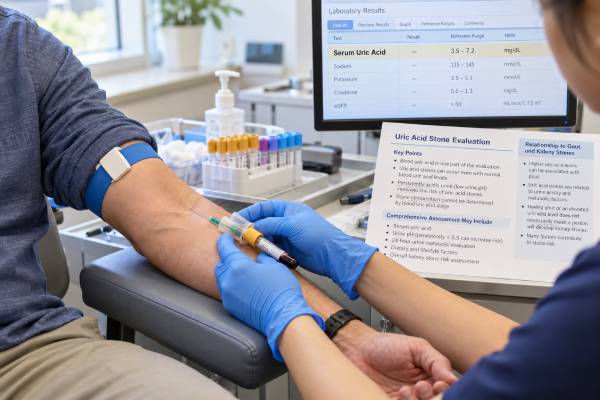
- Serum uric acid reference ranges vary by laboratory, commonly around 3.5–7.2 mg/dL in men and 2.6–6.0 mg/dL in women.
- Uric acid stones can form with normal blood uric acid when urine stays too acidic, especially if urine volume is low.
- High blood uric acid is common in gout and reduced kidney urate clearance, but urinary uric acid excretion may be high, normal, or low depending on the cause.
- For confirmed uric acid stones, raising urine pH is usually the key preventive treatment, while urate-lowering medicine is added only when clinically indicated.
Table of Contents
- What the Blood Uric Acid Test Measures
- How Serum Uric Acid Relates to Kidney Stone Risk
- Gout, Hyperuricemia, and Kidney Stones
- What High or Low Blood Uric Acid Can Mean
- Why Urine pH, Urine Uric Acid, and Stone Analysis Matter More
- How Results Can Change Treatment and Prevention
- Preparation, Repeat Testing, and Follow-Up
What the Blood Uric Acid Test Measures
Uric acid is the final breakdown product of purines, compounds found naturally in human cells and in many foods. Most circulating uric acid exists as urate at normal blood pH. The kidneys remove much of it, while the intestine also contributes to urate elimination.
A serum uric acid test measures the concentration in blood at one point in time. Typical adult laboratory ranges are roughly 3.5–7.2 mg/dL for men and 2.6–6.0 mg/dL for women, although cutoffs differ by laboratory, sex, age, method, and clinical purpose. A value above the lab’s upper limit is called hyperuricemia.
The test is commonly used in gout evaluation and monitoring, but it can also be part of a kidney stone metabolic panel. In a stone former, the result helps answer questions such as whether there may be excess urate production, impaired kidney excretion, metabolic syndrome, a medication effect, or another condition that changes uric acid handling.
Uric acid may also be reported in micromoles per liter. A rough conversion is 1 mg/dL = 59.5 µmol/L. That means 6 mg/dL is about 357 µmol/L and 7 mg/dL is about 416 µmol/L. These conversions are useful when comparing records from different countries, but the laboratory’s reference interval still takes priority.
The “normal range” and the “treatment target” are also different concepts. A person receiving urate-lowering therapy for gout may have a goal below the upper end of the population reference range because long-term crystal dissolution requires lower serum urate. Kidney stone prevention, however, cannot be judged from that serum target alone. Urine pH, urine volume, and urinary uric acid still need separate attention.
It does not measure how much uric acid entered the urine during the day. That requires a urine uric acid test for kidney stones, usually performed as part of a 24-hour urine collection. Blood and urine uric acid can move in different directions because serum concentration depends on both production and excretion.
For example, a person may have high serum urate because the kidneys reabsorb too much urate or excrete too little. Another person may produce a large uric acid load and excrete a substantial amount into urine. These two situations can yield different stone risks even when the blood numbers look similar.
How Serum Uric Acid Relates to Kidney Stone Risk
High serum uric acid is associated with stone disease, but the relationship is indirect. The most important chemical driver of uric acid stone formation is usually low urine pH, not the serum uric acid level itself.
Uric acid becomes much less soluble as urine becomes acidic. When urine pH stays below about 5.5, more uric acid is present in its poorly soluble non-ionized form, making crystals easier to form. Low urine volume further increases concentration and supersaturation. That is why a person with normal serum urate can still form uric acid stones if urine is consistently acidic and concentrated.
The reverse is also possible. Someone with high blood uric acid may never form a uric acid stone if urine pH and volume remain favorable. Hyperuricemia still matters for gout and other clinical questions, but it should not be used as a shortcut to diagnose stone type.
Serum uric acid can also matter in calcium stone disease. High urinary uric acid, called hyperuricosuria, can occur in some calcium oxalate stone formers. The mechanism is not simply “uric acid turns into a calcium stone”; urate may promote calcium oxalate crystallization under certain conditions. Selected hyperuricosuric calcium oxalate stone formers may benefit from targeted treatment after a full metabolic evaluation.
This is why a uric acid stone risk test emphasizes urine pH, uric acid excretion, and urine volume rather than blood uric acid alone.
Gout, Hyperuricemia, and Kidney Stones
Gout and uric acid stones share urate biology, but they are not the same disease. Gout occurs when monosodium urate crystals deposit in joints or other tissues, usually after years of serum urate above its saturation threshold. Uric acid kidney stones form within urine, where pH and concentration strongly determine whether uric acid remains dissolved.
People with gout have a higher prevalence of kidney stones than the general population, and uric acid stones are more common in gout. However, a stone in someone with gout is not automatically a uric acid stone. Calcium oxalate stones can also occur, and laboratory analysis remains valuable.
Conditions that often cluster with gout—obesity, insulin resistance, metabolic syndrome, hypertension, and type 2 diabetes—also favor acidic urine. One important mechanism is impaired renal ammonium production and buffering, which lowers urine pH even when total acid production is not dramatically increased. This metabolic link helps explain why uric acid stone disease is common in people with insulin resistance.
The serum urate level can vary during an acute gout flare, so one result should be interpreted in context. A normal level during a painful joint attack does not completely exclude gout. Likewise, the target used for long-term gout treatment is different from the reference range used to label a lab value “normal.” Many gout guidelines use a treatment target below 6 mg/dL, with a lower target considered in severe tophaceous disease. Those gout targets do not replace urine targets for stone prevention.
If gout and kidney stones coexist, clinicians often evaluate both blood and urine. Serum testing helps assess systemic urate burden, while urine testing shows whether the stone environment is acidic, concentrated, or hyperuricosuric.
What High or Low Blood Uric Acid Can Mean
Hyperuricemia usually reflects increased uric acid production, decreased excretion, or both. Reduced kidney excretion is common and may occur with chronic kidney disease, insulin resistance, certain medications, dehydration, and inherited differences in urate transport.
Common contributors to a high serum uric acid result include:
- gout or a strong genetic tendency toward hyperuricemia;
- chronic kidney disease or reduced kidney filtration;
- obesity, insulin resistance, metabolic syndrome, and type 2 diabetes;
- high alcohol intake, especially beer and spirits;
- high intake of purine-rich foods in susceptible people;
- high fructose intake;
- diuretics such as thiazides or loop diuretics;
- rapid cell turnover, including some blood cancers or cancer treatments;
- psoriasis and other high-cell-turnover states;
- dehydration or major fluid losses.
A mildly high serum urate does not by itself establish the cause. Medication lists, kidney function, diet, alcohol use, blood counts, and symptoms can narrow the possibilities.
The magnitude and persistence of elevation matter. A single value just over the laboratory cutoff may reflect dehydration or recent dietary factors, whereas repeated hyperuricemia over months is more likely to represent an ongoing metabolic or excretory tendency. Very high values, especially during chemotherapy or rapid cell breakdown, can signal a much larger urate load and may require urgent prevention of crystal-related kidney injury.
Low blood uric acid is less commonly relevant to routine stone evaluation. It can result from urate-lowering treatment, increased kidney urate loss, certain genetic transporter disorders, severe liver disease, low purine production, or conditions that increase uric acid excretion. Importantly, renal urate wasting can produce low serum urate while increasing urinary uric acid, so a low blood value does not always mean no uric acid stone risk.
Rare hereditary renal hypouricemia illustrates this point. Defects in urate reabsorption can lower serum urate yet raise urine uric acid and, in some people, contribute to exercise-associated kidney injury or stones. These disorders are uncommon, but they show why blood and urine testing answer different questions.
Why Urine pH, Urine Uric Acid, and Stone Analysis Matter More
To understand uric acid stone risk, clinicians usually need three pieces of information: urine pH, urine volume, and uric acid excretion. A full 24-hour urine kidney stone risk test can measure all three along with calcium, oxalate, citrate, sodium, and creatinine.
Urine pH can vary through the day, so a single dipstick value is only a snapshot. Persistently acidic values are more informative than one low reading after a meal or overnight fast. In established uric acid stone disease, home pH checks may be used during alkalinization therapy to help keep urine within the clinician’s target range.
Twenty-four-hour urine uric acid measures the total amount excreted. Common definitions of hyperuricosuria are above about 800 mg/day in men and 750 mg/day in women, although laboratories and guidelines may use different thresholds. High excretion can reflect purine-rich diet, excess production, some blood disorders, genetic conditions, or medication effects.
Urine volume matters because even a moderate uric acid load can become highly concentrated in a small amount of urine. Stone-prevention guidance commonly aims for more than about 2.5 L of urine per day in adults, with the fluid intake adjusted upward for heat, exercise, sweating, or gastrointestinal losses.
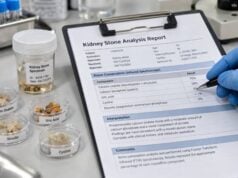
Stone composition is the most direct evidence of what actually crystallized. A kidney stone analysis test can distinguish uric acid from calcium oxalate, calcium phosphate, cystine, struvite, and other materials. Pure uric acid stones are often radiolucent on plain X-ray but are visible on noncontrast CT; imaging characteristics alone are suggestive rather than definitive.
| Test | Main question it answers |
|---|---|
| Blood uric acid | Is systemic urate concentration high, low, or within range? |
| Urine pH | Is the urine acidic enough to favor uric acid crystallization? |
| 24-hour urine uric acid | How much uric acid is excreted in a day? |
| 24-hour urine volume | Is the urine too concentrated? |
| Stone analysis | What minerals actually formed the stone? |
How Results Can Change Treatment and Prevention
For confirmed uric acid stones, urine alkalinization is usually the central treatment because raising pH converts uric acid into more soluble urate. Potassium citrate is commonly used when appropriate. Sodium bicarbonate can also alkalinize urine, but sodium load may be undesirable in some patients and can affect calcium excretion, blood pressure, or fluid balance.
Alkalinization is one of the few kidney stone treatments that can sometimes dissolve an existing stone rather than only prevent a future one. That benefit depends on the stone truly being uric acid, the urinary tract not being dangerously obstructed or infected, and pH being monitored. A mixed stone with a substantial calcium component may not dissolve completely, which is another reason composition and imaging context matter.
The target pH depends on whether the goal is prevention or active dissolution and must avoid excessive alkalinization. Many clinicians aim roughly for urine pH 6.0–6.5 for prevention and somewhat higher during supervised dissolution, often around 6.5–7.0. Sustained pH well above that range can increase calcium phosphate stone risk, so more is not always better.
Fluid intake is adjusted to achieve adequate urine volume. Dietary measures may include reducing excessive purine intake, moderating animal protein, limiting high-fructose beverages, improving weight and metabolic health, and avoiding dehydration. These steps can help serum urate, urinary uric acid, urine pH, or several of these at once.
Allopurinol or another urate-lowering drug is not automatically required for every uric acid stone. It is more useful when hyperuricosuria, gout, marked hyperuricemia, urate overproduction, or another specific indication is present. For many uric acid stone formers, correcting acidic urine is more important than lowering serum urate alone.
A recent series of patients treated medically with potassium citrate reported high rates of uric acid stone dissolution, reinforcing that these stones can often be treated chemically when correctly identified and monitored. Dissolution should still occur under clinical supervision because obstruction, infection, kidney function, stone size, and uncertainty about composition can change the plan.
For calcium oxalate stone formers with hyperuricosuria, treatment may focus on purine moderation and, in selected cases, allopurinol. The decision is based on the complete urine pattern rather than the blood uric acid result in isolation.
Preparation, Repeat Testing, and Follow-Up
A blood uric acid test usually requires a standard blood draw. Fasting is not always necessary, but the laboratory may include uric acid in a panel that has its own preparation instructions. Follow those instructions rather than fasting automatically.
Tell the clinician about diuretics, aspirin, urate-lowering medicines, chemotherapy, supplements, and major recent diet changes because they can affect urate. Do not stop prescription medicine before testing unless specifically instructed.
Because serum urate varies with hydration, diet, illness, kidney function, and medications, repeat testing may be useful when the result is unexpected. Long-term trends are often more meaningful than one borderline value.
For a stone former, the most useful follow-up is usually not another blood uric acid test alone. If the stone type is unknown or stones recur, consider stone analysis and a 24-hour urine profile. When uric acid stones are confirmed and urine alkalinization is started, home urine pH checks and repeat 24-hour urine testing can show whether the treatment is reaching its goal without pushing pH too high.
Seek prompt medical care for kidney stone symptoms accompanied by fever, chills, inability to urinate, persistent vomiting, severe uncontrolled pain, a single functioning kidney, pregnancy, or signs of serious illness. Metabolic testing is for prevention and follow-up; it does not replace urgent evaluation of an obstructing or infected stone.
The key interpretation is simple: serum uric acid describes systemic urate, while urine pH and urine chemistry describe the environment where a stone forms. Using those tests together gives a much clearer picture than any single number.
References
- Metabolic Evaluation and Recurrence Prevention – EAU Guidelines on Urolithiasis – Uroweb 2026 (Guideline)
- Metabolic Evaluation and Recurrence Prevention for Urinary Stone Patients: An EAU Guidelines Update 2024 (Review)
- Medical treatment of uric acid kidney stones 2024
- Update on Uric Acid and the Kidney 2022 (Review)
- Kidney Stone Pathophysiology, Evaluation and Management: Core Curriculum 2023 2023 (Review)
- UPDATE – Canadian Urological Association guideline: Evaluation and medical management of kidney stones 2022 (Guideline)
Disclaimer
This article is for general education and does not replace medical care. Serum uric acid and urine targets vary with laboratory methods, kidney function, stone type, medications, and individual health conditions. Do not start, stop, or change urate-lowering or urine-alkalinizing medication without guidance from a qualified clinician.