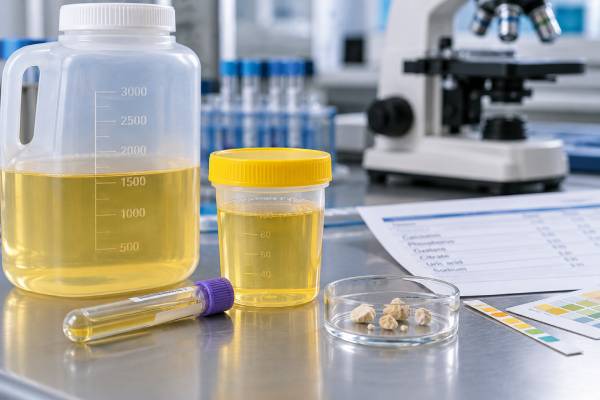
A urine phosphorus test measures how much phosphorus, mainly as phosphate, is excreted in urine over a set period. In kidney stone evaluation, a 24-hour result helps describe mineral balance and can add context when calcium phosphate stones are suspected. High urine phosphorus can increase the amount of phosphate available to combine with calcium, but phosphorus is only one part of the problem. Calcium phosphate crystallization depends strongly on urine pH, calcium concentration, citrate, and urine volume. A person can have high urinary phosphorus without forming calcium phosphate stones, and a person can form these stones with phosphorus that falls inside a laboratory reference range if urine is persistently alkaline and calcium supersaturation is high. The result is therefore most useful when interpreted as part of a complete metabolic stone profile. Diet, parathyroid hormone activity, kidney phosphate handling, medications, and collection accuracy can all affect the number, so an isolated high or low value should not be overinterpreted.
- A common stone-risk reference point is below about 1,100 mg of phosphorus per 24 hours, while some guidelines flag inorganic phosphate around 35 mmol/day.
- High urine phosphorus can contribute to calcium phosphate supersaturation, but high urine pH and high urine calcium are usually more important drivers.
- A 24-hour urine collection is preferred because phosphorus excretion varies with meals, protein intake, hormones, and time of day.
- High phosphorus may reflect diet, increased parathyroid hormone activity, or reduced kidney reabsorption of phosphate.
- Low phosphorus can occur with low intake, reduced intestinal absorption, or other metabolic conditions and is not usually a direct kidney stone target.
Table of Contents
- What urine phosphorus measures
- Ranges and 24-hour collection
- What high urine phosphorus can mean
- How phosphorus relates to calcium phosphate stones
- What low urine phosphorus can mean
- Diet, hormones, and medications that change the result
- Next steps after an abnormal result
What urine phosphorus measures
Phosphorus is an essential mineral used in bone, cell membranes, energy metabolism, and acid-base chemistry. In blood and urine, it is present mainly as phosphate. The kidneys continuously filter phosphate and then reabsorb much of it in the proximal tubules. The amount that ends up in urine reflects a balance among dietary intake, intestinal absorption, hormones, kidney function, and tubular reabsorption.
For kidney stone formers, urine phosphorus is most relevant to calcium phosphate chemistry. Calcium phosphate stones contain minerals such as hydroxyapatite or brushite. They form when enough calcium and phosphate are present in a urinary environment that favors crystallization.
The test is usually part of a broader 24-hour urine stone risk profile. That profile may include urine volume, calcium, citrate, oxalate, uric acid, sodium, potassium, magnesium, pH, creatinine, and supersaturation calculations. Phosphorus becomes much more informative when those values are visible at the same time.
This is important because the amount of phosphate in urine does not directly equal calcium phosphate stone risk. The charge of phosphate changes with pH. As urine becomes more alkaline, more phosphate exists as HPO4²⁻, the form that readily complexes with calcium. Thus, the same amount of urinary phosphorus can be more lithogenic at a higher pH.
A urine phosphorus test should also be distinguished from a serum phosphorus test. Blood phosphorus helps evaluate systemic phosphate balance, kidney disease, parathyroid disorders, and bone-mineral disease. Urine phosphorus focuses on how much phosphate the kidneys are excreting. Sometimes both are needed to understand whether the kidneys are appropriately conserving or wasting phosphate.
Ranges and 24-hour collection
For adult stone evaluation, a 24-hour urine collection is generally preferred. Phosphorus excretion rises and falls after meals, so a single random sample can be difficult to interpret. A full-day collection smooths out those short-term changes and allows direct comparison with urine calcium, sodium, citrate, and volume.
Common clinical references use a stone-risk value of roughly less than 1,100 mg/day. Current European guidance lists an inorganic phosphate level of about 35 mmol/day as a limit for medical attention, which is close to 1,080 mg of elemental phosphorus. Some laboratories use much wider general reference intervals because urinary phosphorus is strongly influenced by diet. For example, general laboratory ranges may extend well above 1,100 mg/day in healthy adults.
That difference illustrates an important point: a laboratory reference interval is not always the same as a kidney stone prevention target. A value can be statistically common in the general population yet still contribute to supersaturation in a person with calcium phosphate stones.
A typical 24-hour collection starts after you discard the first morning urine. From that time onward, every void is collected for 24 hours, including the first morning urine the next day at the finish time. The container may need refrigeration or preservative. Follow the laboratory instructions exactly.
Missing urine tends to make phosphorus and other solutes appear falsely low. Collecting longer than 24 hours can make them appear falsely high. Creatinine helps clinicians judge whether the collection is plausible, but it is not perfect. If the reported phosphorus, sodium, calcium, and creatinine are all unexpectedly low, an incomplete collection should be considered before concluding that mineral excretion is truly low.
The initial test should usually reflect your ordinary diet and fluid intake. Changing to a very low-protein or unusually low-phosphorus diet just for the collection can hide the pattern that occurs in everyday life.
What high urine phosphorus can mean
High urine phosphorus is sometimes called hyperphosphaturia. It means more phosphorus than expected was excreted during the collection, but it does not identify the cause by itself.
Diet can have a large effect. Foods naturally rich in protein—meat, poultry, dairy, legumes, nuts, and seeds—contain phosphorus. Processed foods may also contain highly absorbable phosphate additives. A high-protein day can therefore raise urinary phosphorus, and it may simultaneously increase urinary calcium, sulfate, acid load, and uric acid depending on the foods consumed.
Parathyroid hormone, or PTH, is another major regulator. PTH reduces phosphate reabsorption in the proximal tubule, increasing phosphate excretion. If a stone former has high blood calcium, high or inappropriately normal PTH, and increased urine calcium, primary hyperparathyroidism becomes an important consideration. A PTH test for kidney stones can help evaluate that pattern.
Renal phosphate wasting can also raise urine phosphorus relative to the blood phosphorus level. Causes include certain inherited tubular disorders and acquired proximal tubule dysfunction. In these situations, clinicians may calculate fractional phosphate excretion or tubular phosphate reabsorption rather than relying on the 24-hour value alone.
A high result should therefore trigger questions such as:
- Is urine pH elevated?
- Is urine calcium high?
- Is citrate low?
- Was sodium or animal-protein intake high?
- Is serum phosphorus low, normal, or high?
- Is serum calcium elevated?
- Is PTH abnormal?
- Was the collection complete?
The answers help distinguish ordinary dietary variation from a more specific metabolic disorder.
How phosphorus relates to calcium phosphate stones
Calcium phosphate stones are not simply “too much phosphorus” stones. Their formation depends on a combination of high urine pH, calcium availability, phosphate concentration, low citrate, and urine concentration.
Urine pH is especially important. At higher pH, phosphate shifts toward HPO4²⁻, which combines readily with calcium. Modern reviews note that calcium phosphate supersaturation rises rapidly above about pH 6.0. Brushite formation is particularly favored in the mid-to-high 6 range when urinary calcium and phosphate are also elevated.
This explains why the urine pH result often carries more practical weight than urine phosphorus alone. A phosphorus value near the upper end of normal may be important at pH 6.8 but much less important at pH 5.8.
Urine calcium is another major driver. High sodium intake can raise urinary calcium, and primary hyperparathyroidism can raise both serum and urine calcium. Low urine citrate removes a natural inhibitor that normally binds calcium and interferes with crystal growth. Low urine volume concentrates all of these solutes.
A useful integrated measure is calcium phosphate supersaturation. Some 24-hour urine panels calculate it from the measured chemistry. Supersaturation does not tell you exactly where a future stone will form, but it summarizes the chemical pressure for calcium phosphate crystallization more directly than phosphorus alone. The urine supersaturation test is therefore useful when individual values seem only mildly abnormal.
Stone composition matters too. If the person has passed or removed a stone, a kidney stone analysis can distinguish brushite, hydroxyapatite, calcium oxalate, uric acid, cystine, and infection-related material. Calcium phosphate stones are more likely than calcium oxalate stones to prompt a focused search for distal renal tubular acidosis, hyperparathyroidism, and medications that raise urine pH.
One practical mistake is to assume that a calcium phosphate stone requires a “low-phosphorus diet.” That is not a standard recommendation for otherwise healthy stone formers. Dietary phosphorus is widespread in protein-rich foods that also provide calcium, magnesium, and other nutrients. Aggressive restriction can be difficult to sustain and may not meaningfully lower stone risk if high pH and hypercalciuria remain untreated. The more useful approach is to identify which urine variables are actually driving supersaturation.
For example, consider two people who both excrete 1,150 mg of phosphorus per day. One has urine pH 5.9, normal calcium, high citrate, and 2.8 L of urine. The other has pH 6.9, marked hypercalciuria, low citrate, and 1.4 L of urine. Their phosphorus values look similar, but the second urine environment is much more favorable for calcium phosphate crystallization. This is why clinicians prioritize the integrated chemistry rather than treating a phosphorus threshold as an all-or-none cutoff.
What low urine phosphorus can mean
Low urine phosphorus is usually less important as a direct stone risk marker. It may reflect low dietary phosphorus intake, reduced intestinal absorption, vitamin D deficiency, use of phosphate-binding products, or appropriate kidney conservation when blood phosphorus is low.
Because phosphorus participates in bone mineralization, a low value becomes more clinically important when it accompanies low serum phosphorus, fractures, bone pain, muscle weakness, or unexplained vitamin D problems. In that setting, the question shifts from stone prevention to systemic phosphate balance. A nephrologist or endocrinologist may use paired blood and urine testing to determine whether phosphorus is being lost through the kidneys or simply not being absorbed or consumed in sufficient amounts.
The serum phosphorus level changes the interpretation. If blood phosphorus is low and urine phosphorus is also low, the kidneys may be appropriately conserving phosphate. If blood phosphorus is low but the kidneys continue to excrete an inappropriately large amount, renal phosphate wasting becomes more likely.
Low urine phosphorus can also occur during a day with low food intake or an incomplete collection. That is why clinicians rarely diagnose a phosphate disorder from a single 24-hour number without reviewing serum values collection quality, and stone composition.
In kidney stone care, there is usually no reason to intentionally drive urine phosphorus as low as possible. Excessive restriction can reduce intake of nutritious foods and may create other problems. The goal is to lower overall calcium phosphate supersaturation through the most important modifiable factors, not to eliminate phosphorus from the diet.
A low result may even be a clue to nutritional issues if it occurs with low urine urea nitrogen, low sodium, low potassium, and low creatinine. In that setting, a clinician may ask whether the person ate normally during the collection or whether the sample was incomplete.
Diet, hormones, and medications that change the result
Urine phosphorus responds quickly to diet. Higher protein intake often raises phosphorus excretion, while lower intake reduces it. Phosphate additives in processed meats, cola beverages, baking mixes, processed cheese, and packaged foods can be absorbed efficiently, although the effect on stones depends on the whole diet and urine profile.
Current kidney stone nutrition guidance emphasizes an overall healthy eating pattern rather than aggressive phosphorus restriction. For most calcium stone formers, better-supported priorities include adequate fluid, moderate sodium, normal dietary calcium, and avoiding excessive animal protein.
Food source also matters when interpreting a high value. Phosphorus from highly absorbable additives can contribute a different dietary load than naturally occurring phosphorus bound within many plant foods. A diet history can therefore be more informative than simply labeling every phosphorus-containing food as a problem, especially when the main stone drivers are high urine calcium, alkaline pH, or low volume.
Hormonal control is central. PTH promotes phosphate loss in urine. Fibroblast growth factor 23 (FGF23) also reduces kidney phosphate reabsorption, while vitamin D increases intestinal phosphate absorption. Disorders involving these pathways can produce unusual combinations of blood and urine phosphorus.
Medications can affect the result either through phosphate handling or by changing the stone environment. Carbonic anhydrase inhibitors such as topiramate can raise urine pH and lower citrate, increasing calcium phosphate stone risk even if phosphorus is not dramatically elevated. Diuretics, vitamin D products, phosphate supplements, and some antacids can also change mineral balance.
This is why a medication and supplement list belongs in every metabolic stone evaluation. The clinician needs to know not only prescription drugs but also protein powders, electrolyte products, vitamin D, calcium, phosphate-containing bowel preparations, and antacids.
Next steps after an abnormal result
If urine phosphorus is high, the first step is to confirm context rather than treat the number in isolation. Review the laboratory range, collection completeness, diet that day, urine pH, calcium, citrate, sodium, volume, and calcium phosphate supersaturation.
If the result occurs with high pH and a known calcium phosphate stone, the clinician may look for causes of alkaline urine, including distal renal tubular acidosis and medications. If urine calcium is high, sodium reduction and evaluation for hypercalciuria may be more important than cutting dietary phosphorus. If blood calcium is high, PTH testing is important.
Practical prevention usually includes:
- enough fluid to produce at least about 2.0–2.5 L of urine daily, with many current guidelines targeting 2.5 L or more;
- moderate sodium intake, often around or below 2,300 mg sodium per day for calcium stone formers;
- normal dietary calcium rather than a low-calcium diet;
- reasonable animal-protein intake; and
- targeted treatment of high urine calcium, low citrate, or persistently high pH when indicated.
After meaningful changes, repeat 24-hour urine testing can show whether phosphorus, calcium, citrate, pH, and supersaturation moved in the desired direction. A trend is often more useful than a one-time result because phosphorus excretion is strongly diet dependent.
If the repeat result changes substantially, review whether the two collections were comparable. A workday with takeout meals, a weekend with lower protein intake, travel, heavy exercise, or missed urine can all shift phosphorus and sodium together. Consistency in collection conditions makes trends more meaningful.
Seek medical evaluation sooner if an abnormal phosphorus result is accompanied by high blood calcium, low blood phosphorus, muscle weakness, bone pain, recurrent calcium phosphate stones, nephrocalcinosis, or declining kidney function. These features can point to a systemic mineral disorder that deserves more than routine dietary advice.
References
- Metabolic evaluation for prevention of kidney stones – CARI Guidelines 2025 (Guideline)
- Nutrition therapy for the prevention of kidney stones – CARI Guidelines 2025 (Guideline)
- Metabolic Evaluation and Recurrence Prevention for Urinary Stone Patients: An EAU Guidelines Update 2024 (Review)
- 24-Hour Urinary Chemistries and Kidney Stone Risk 2024
- Calcium Phosphate Nephrolithiasis: A Comprehensive Review 2026 (Review)
Disclaimer
This article provides general information about urine phosphorus testing in kidney stone evaluation and does not diagnose a phosphate disorder or prescribe treatment. Reference ranges and treatment priorities depend on the laboratory, stone composition, blood phosphorus and calcium, kidney function, hormones, and the rest of the 24-hour urine profile. Discuss persistent or marked abnormalities with a qualified clinician. A single urine phosphorus value should never be used alone to diagnose hyperparathyroidism, renal phosphate wasting, or a calcium phosphate stone disorder.